The Heritage of Philippine Piña Cloth: The Art of Pineapple Fiber Weaving
The Heritage of Philippine Piña Cloth: The Art of Pineapple Fiber Weaving
Imagine a textile so ethereal and translucent that it mimics the delicate wings of a moth or the morning dew resting on a spiderweb. This is piña cloth, a legendary fabric born from the leaves of the pineapple plant and elevated by the unparalleled patience and artistry of Filipino weavers. Among the vast tapestry of global textile traditions, Philippine piña cloth stands as a testament to human ingenuity, transforming an agricultural byproduct into one of the most luxurious and sought-after natural fabrics in the world.
The story of piña is deeply intertwined with the history of the Philippines. While the pineapple plant itself is not native to the archipelago—having been introduced by Spanish colonizers via the Manila Galleon Trade from the Americas—the indigenous population possessed a profound understanding of natural fibers. Long before the arrival of foreign powers, Filipinos were weaving textiles from abaca, cotton, and tree bark. When the Red Spanish pineapple variety took root in the local soil, it was the native artisans who recognized the hidden potential within its long, spiky leaves. They developed a painstaking extraction and weaving process that resulted in a fabric of such exquisite fineness that it soon rivaled, and in some cases surpassed, the finest European linens and laces.
During the height of the Manila Galleon Trade, piña cloth became a highly prized export. It was shipped across the Pacific to Acapulco and eventually made its way to the royal courts of Europe. Monarchs and aristocrats marveled at the fabric's gossamer-like quality, its natural sheen, and its ability to hold intricate embroidery. Today, piña remains a powerful symbol of Philippine heritage, representing a perfect synthesis of indigenous craftsmanship, colonial history, and enduring national pride. To understand piña is to understand the soul of Filipino sartorial elegance.
The Meticulous Craftsmanship of Piña Weaving
The creation of piña cloth is an exercise in extreme patience and precision. It is widely considered one of the most labor-intensive textile production processes in existence. Unlike cotton or silk, which can be harvested and processed in relatively large quantities, piña fibers must be coaxed from the plant and prepared entirely by hand. The entire process, from leaf to loom, requires a deep understanding of the material and an unwavering commitment to traditional methods.
The journey begins in the fields with the harvesting of the Red Spanish pineapple leaves. This specific variety is favored because its leaves are exceptionally long and yield strong, fine fibers. Once harvested, the leaves undergo a process called pagkigue or scraping. Artisans use a broken porcelain plate, a clam shell, or a specialized scraping tool to carefully remove the green epidermis of the leaf. This reveals the inner fibers, which are divided into two distinct layers: the coarse outer fibers used for heavy strings, and the incredibly fine, silky inner fibers reserved for premium piña cloth.
Following extraction, the fibers are washed in running water—a step known as paglinot—to remove any remaining plant sap and impurities. They are then left to dry in the shade. However, the most daunting challenge lies in the preparation of the yarn. Because the individual fibers are relatively short, they must be knotted together end-to-end to create a continuous thread. This process, called pag-ugid, is done entirely by hand. A weaver will sit for hours, tying microscopic knots with their fingers, sometimes aided by a needle, to create a single, unbroken spool of thread. It is said that a master knotter can only produce a few spools of thread in a single day, highlighting the immense time and effort required before weaving even begins.
Finally, the thread is mounted on traditional upright looms. Weaving piña requires a highly controlled environment; the air must be sufficiently humid to prevent the brittle fibers from snapping under the tension of the warp and weft. The weaver operates the pedals and shuttle with a gentle, rhythmic precision, knowing that a single heavy-handed movement could break the delicate threads. The resulting fabric is a masterclass in textile engineering, boasting a natural stiffness, a beautiful lustrous sheen, and a translucent quality that makes it the ultimate canvas for embroidery.
Cultural Significance and Sartorial Elegance
In the Philippines, piña cloth is much more than a mere fabric; it is a cultural artifact that carries the weight of national identity and social milestones. The most iconic application of piña is the Barong Tagalog, the traditional formal garment for Filipino men. As detailed in our comprehensive Barong Tagalog style guide, the Barong is characterized by its sheer, lightweight nature, intricate embroidery, and the tradition of wearing it untucked over an undershirt. When crafted from pure piña, the Barong Tagalog elevates the wearer, offering a regal silhouette that is perfectly suited to the tropical climate while maintaining the utmost formality.
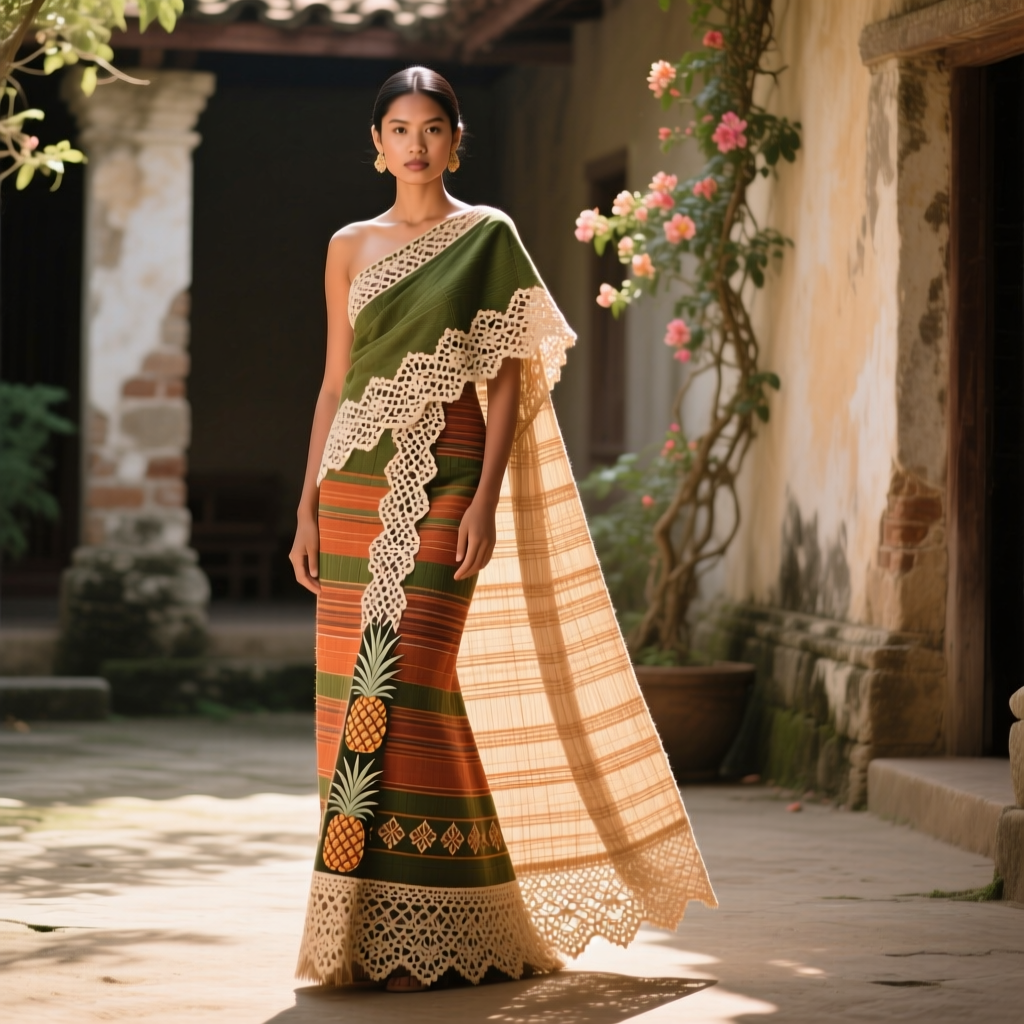
For women, piña cloth has historically been the foundation of the Baro't Saya and, more specifically, the Terno. The Terno is famous for its architectural butterfly sleeves, which require a fabric that is stiff enough to hold its dramatic, upright shape without the need for heavy internal boning. Pure piña provides exactly this structural integrity while remaining breathable and elegant. The interplay of light through the translucent piña sleeves, combined with the opaque underskirts, creates a visual poetry that has defined Filipina elegance for generations.
Beyond everyday fashion, piña is the fabric of choice for life's most significant moments. It is the preferred material for wedding gowns, christening robes, and state-sponsored diplomatic gifts. When a Philippine president hosts a state dinner, or when a Filipino diplomat presents a gift to a foreign dignitary, piña cloth is frequently the medium of exchange. It communicates a message of profound respect, showcasing the pinnacle of local artistry. In the realm of tropical formalwear, few textiles can match the prestige, breathability, and visual impact of hand-woven piña.
The cultural significance of piña also extends to its role as a marker of heritage preservation. In a world increasingly dominated by mass-produced, synthetic garments, choosing to wear piña is a deliberate act of cultural patronage. It supports rural livelihoods, keeps ancestral techniques alive, and asserts a distinct aesthetic identity on the global fashion stage. Much like the enduring legacy of Philippine Inabel weaving, piña serves as a tangible link between the ancestors who first scraped the pineapple leaves and the modern generation that wears the finished cloth with pride.
Regional Variations and Artistic Expressions
While the pineapple plant grows in various parts of the Philippines, the epicenter of piña weaving is the province of Aklan, particularly the municipality of Kalibo. The weavers of Aklan have guarded their techniques for centuries, passing down the secrets of the loom from mother to daughter. The piña cloth produced in this region is renowned for its uniformity, fineness, and exceptional tensile strength. The local government and various cooperatives have worked tirelessly to maintain the high standards of Aklan piña, ensuring that the geographical indication remains a mark of true quality.
However, the journey of piña cloth does not end at the loom. Once the raw fabric is woven, it is often sent to other regions renowned for their needlework, most notably the town of Lumban in Laguna and the municipality of Taal in Batangas. These areas are the undisputed capitals of Philippine hand-embroidery. Here, master artisans transform the sheer piña canvas into breathtaking works of art using techniques like Calado and Sombreado.
Calado is a drawn-thread openwork technique that resembles European lace but is executed with a distinct Filipino sensibility. Artisans painstakingly pull out individual warp and weft threads from the piña cloth and then wrap and stitch the remaining threads to create intricate, geometric, or floral cut-work patterns. Sombreado, on the other hand, involves shading embroidery, where threads of varying thicknesses and colors are layered to create a three-dimensional, almost sculptural effect on the fabric. The collaboration between the weavers of Aklan and the embroiderers of Lumban represents a beautiful synergy of regional specialties, resulting in a finished garment that is a masterpiece of collective Filipino artistry.
In response to the high cost and extreme rarity of pure piña, regional weavers have also developed exquisite blended fabrics. Piña-Seda (piña and silk) combines the crispness and sheen of pineapple fiber with the soft drape and strength of silk, resulting in a more durable and slightly more affordable luxury textile. Piña-Cotton blends offer a more matte finish and a softer hand-feel, making them suitable for a wider range of contemporary garments. These variations ensure that the legacy of piña remains accessible and adaptable to the evolving needs of modern fashion while still honoring the core traditions of the craft.
Modern Preservation and the Future of Piña
Despite its illustrious history, the survival of pure piña weaving has faced severe threats in the modern era. The sheer physical toll of the work, combined with the diminishing financial returns compared to faster, more industrialized trades, led to a steep decline in the number of active weavers and knotters. For a time, it seemed that the ancestral knowledge of pag-ugid (knotting) and the specific tension required for the piña loom might fade into obscurity, replaced by cheap, synthetic organza masquerading as traditional fabric.
Fortunately, a robust movement of cultural preservationists, sustainable fashion advocates, and government agencies has sparked a renaissance in the piña industry. Organizations dedicated to agricultural and textile development have initiated programs to replant the Red Spanish pineapple, ensuring a steady supply of raw materials. More importantly, there has been a concerted effort to elevate the economic status of the weavers. By connecting rural cooperatives directly with haute couture designers and international luxury markets, artisans are now receiving fair compensation that reflects the true value of their time and skill.
Contemporary Filipino designers have played a pivotal role in reimagining piña for the global stage. No longer confined strictly to traditional formalwear, piña is now being utilized in avant-garde silhouettes, modern streetwear accents, and high-end accessories. This innovation proves that heritage textiles need not be frozen in time; they can evolve and remain relevant in contemporary wardrobes. Furthermore, as the global fashion industry grapples with its environmental impact, piña stands out as a beacon of sustainability. It is a natural, biodegradable fiber that requires no synthetic pesticides and utilizes a byproduct of the agricultural food industry.
For consumers and collectors, investing in piña is an investment in slow fashion and cultural continuity. Proper maintenance is essential to preserve these heirloom pieces for future generations. Those who own these delicate garments should consult specialized resources, such as our guide on fabric care for delicate textiles, to ensure that the fibers remain intact and the intricate embroidery is protected from environmental damage. Through conscious consumption and continued appreciation, the art of pineapple fiber weaving will continue to thrive, weaving the rich history of the Philippines into the fabric of the future.
Frequently Asked Questions
What exactly is piña cloth made from?
Piña cloth is made exclusively from the fibers extracted from the leaves of the Red Spanish pineapple plant (Ananas comosus). Unlike the fruit, which is consumed, the long, fibrous leaves are harvested specifically for textile production. The leaves undergo a rigorous process of scraping, washing, and hand-knotting to produce the ultra-fine threads that are eventually woven into the translucent fabric known as piña. It is important to distinguish true piña from synthetic imitations or other plant-based fabrics like abaca or linen.
How long does it take to weave a single yard of piña fabric?
The production timeline for piña is staggeringly long, which is a primary reason for its high value. The extraction and hand-knotting of the fibers alone can take weeks for a single spool of thread. Once the thread is prepared, a master weaver working on a traditional upright loom can only produce a few inches of pure piña cloth per day. Therefore, weaving a single yard of high-quality, unblemished piña fabric can take several weeks to a few months of continuous, meticulous labor, not including the time required for subsequent embroidery.
Is piña cloth sustainable and eco-friendly?
Yes, piña cloth is highly sustainable. It is a natural, 100% biodegradable fiber. Furthermore, it represents an excellent example of agricultural upcycling, as the leaves used for fiber extraction are often a byproduct of pineapple farming for fruit consumption. The processing of the fiber relies on manual labor and natural washing methods rather than harsh chemical treatments or heavy, energy-consuming machinery. When dyed, traditional artisans often use natural, plant-based dyes, further minimizing the environmental footprint of the textile.
How should piña garments be cared for and washed?
Pure piña garments require exceptionally gentle care due to the delicate nature of the fibers and the intricacy of the hand-embroidery. They should never be machine washed or wrung out. Instead, they should be hand-washed in cool water using a very mild, pH-neutral detergent. After washing, the garment should be rolled in a clean, dry towel to absorb excess moisture and then laid flat or hung on a padded hanger to dry in the shade, away from direct sunlight which can yellow or weaken the fibers. Ironing should be done on a low heat setting with a protective cloth placed between the iron and the piña fabric.
What is the difference between pure piña and piña-silk blends?
Pure piña is woven entirely from pineapple fibers, resulting in a fabric that is exceptionally crisp, highly translucent, and possesses a distinct, natural stiffness that holds architectural shapes beautifully. Piña-silk (or Piña-Seda) blends the pineapple fiber warp with a silk weft. This combination softens the drape of the fabric, adds a richer, more luminous sheen, and increases the tensile strength and durability of the textile. While pure piña is the most prestigious and expensive option, piña-silk offers a luxurious, slightly more resilient alternative that is highly favored for modern formalwear and gowns.