Norwegian Bunad: A Complete Guide to Regional Folk Costumes
Norwegian Bunad: A Complete Guide to Regional Folk Costumes
Few garments in the world carry as much cultural weight, regional identity, and artisanal mastery as the Norwegian bunad. More than a costume, the bunad is a living archive of Norway's rural heritage — a meticulously crafted ensemble that connects modern Norwegians to the landscapes, communities, and traditions of their ancestors. With over 400 documented regional variations spanning fjords, valleys, and coastal communities, the bunad represents one of Europe's most vibrant and enduring folk costume traditions.
Unlike many national dress traditions that faded into museum displays, the bunad remains a thriving part of Norwegian life. Families invest thousands of kroner in hand-embroidered garments that are worn at weddings, confirmations, Constitution Day celebrations, and other milestone occasions. Each stitch tells a story of place, lineage, and belonging. To understand the bunad is to understand something fundamental about Norwegian identity — its deep roots in the land, its reverence for craft, and its quiet insistence that tradition need not be static to endure.
In this comprehensive guide, we explore the origins, craftsmanship, regional diversity, and contemporary relevance of Norwegian bunad folk costumes. Whether you are a textile enthusiast, a cultural historian, or simply curious about heritage garments that have survived centuries of change, the bunad offers a remarkable study in how clothing can carry the soul of a nation.
The Origins and Evolution of the Norwegian Bunad
The word bunad itself is a relatively modern term, coined in the early twentieth century to distinguish reconstructed folk costumes from the everyday rural clothing that inspired them. However, the roots of the bunad stretch back centuries into Norway's agrarian past, when rural communities developed distinctive styles of dress shaped by local materials, climate, trade routes, and social customs.
From Rural Dress to National Symbol
Before industrialization, Norwegian farming communities in isolated valleys and along remote coastlines developed clothing traditions that were unmistakably local. A woman's skirt color, the cut of a man's vest, the pattern of embroidery on a bodice — these details could reveal not just which valley a person came from, but sometimes even which farm. These garments were not costumes in the theatrical sense; they were simply the clothing people made and wore, shaped by the wool, linen, and dyes available in their immediate environment.
The nineteenth century brought profound change. As Norway experienced urbanization, emigration, and growing national consciousness — particularly during the period of union with Sweden and the push toward independence — there emerged a romantic fascination with rural folk culture. Artists, writers, and cultural activists began to document and celebrate the distinctive dress traditions of Norway's countryside. This movement paralleled similar folk revivals across Scandinavia and broader Europe, but in Norway it took on particular urgency as the young nation sought symbols of cultural distinctiveness.
The Bunad Movement of the Early Twentieth Century
The formal bunad movement crystallized around the work of Hulda Garborg, a writer and cultural activist who championed the idea that reconstructed folk costumes could serve as a national dress for all Norwegians. Garborg did not advocate for exact historical replicas; instead, she encouraged the creation of garments inspired by historical rural dress but adapted for modern wear. This philosophy — balancing historical authenticity with practical relevance — remains central to bunad culture today and reflects broader conversations about folk costume traditions across Europe.
Throughout the twentieth century, local bunad committees formed across Norway, researching historical garments preserved in museums, private collections, and family attics. These committees made decisions about which historical elements to incorporate, which colors to standardize, and how to adapt patterns for contemporary production. The result was not a single national costume but a rich tapestry of regional bunader, each claiming authenticity through documented historical sources while acknowledging the creative choices involved in reconstruction.
The establishment of Bunad- og Folkedraktrådet (the Norwegian Bunad and Folk Costume Council) brought a degree of national coordination to this decentralized movement. The council advises on historical accuracy, approves new bunad designs, and serves as a guardian against commercialization that might dilute the cultural integrity of the garments. Its existence reflects a distinctly Norwegian approach to cultural heritage: community-driven, research-based, and resistant to top-down standardization.
Craftsmanship and Materials: The Art of Making a Bunad
A genuine bunad is a masterwork of traditional textile arts. The creation of a single bunad can require hundreds of hours of skilled handwork, and the materials used are subject to exacting standards that prioritize natural fibers, traditional techniques, and regional authenticity. Understanding the craftsmanship behind the bunad is essential to appreciating why these garments command such respect — and such prices — in Norwegian culture.
Textiles and Embroidery
The foundation of most bunader is wool — specifically, high-quality Norwegian wool woven in traditional patterns. Many bunads use fabric woven at historic Norwegian mills, including Husfliden workshops that have maintained traditional weaving techniques for generations. The wool is typically fulled (shrunk and thickened through a controlled washing process) to create a dense, weather-resistant fabric that drapes beautifully and wears for decades.
Embroidery is the most visually distinctive element of many bunader, and it is here that regional identity is most clearly expressed. The embroidery patterns on a bunad from Hardanger differ fundamentally from those on a bunad from Telemark or Trøndelag. Hardanger embroidery, known as hvitsøm (whitework), features intricate cutwork and drawn-thread techniques in white thread on white fabric — a technique with roots in Renaissance-era European textile arts that found its most enduring expression in Norwegian folk tradition.
Other regions favor colorful wool embroidery on dark fabric, with motifs drawn from local flora, historical rose painting (rosemaling), or geometric patterns found on historical garments. The rosesøm (rose embroidery) tradition, particularly associated with the bunader of the Gudbrandsdalen and surrounding valleys, features lush floral motifs in reds, greens, and golds that echo the decorative painting found on furniture, walls, and household objects throughout rural Norway.
For those interested in the broader world of embroidered traditional garments, our guide to embroidered folk textiles explores similar traditions from other cultures.
Silver and Metalwork
No bunad is complete without its silver. The silver jewelry associated with Norwegian bunader — including brooches (søljer), cufflinks, buttons, buckles, and crowns — represents a metalworking tradition that dates to the Viking Age and earlier. Each region has its own distinctive silver traditions, and the pieces worn with a bunad are expected to match the regional style of the garment itself.
The sølje, a decorative brooch worn at the neckline, is perhaps the most iconic piece of bunad silver. Designs range from simple ring brooches to elaborate filigree pieces featuring dangling spoon-shaped pendants, known as skjeier, which were historically believed to ward off evil spirits. In some regions, the number and complexity of silver pieces worn indicated social status or marital standing, adding another layer of meaning to the ensemble.
Norwegian bunad silver is traditionally made of sterling silver, often with oxidized details that give the metalwork a distinctive dark-and-light contrast. Many families pass silver pieces down through generations, and it is not uncommon for a woman to wear her grandmother's sølje on her wedding day — a practice that connects personal family history to the broader cultural tradition. The craftsmanship involved in creating bunad silver is explored further in our article on traditional accessories and jewelry.
Construction and Tailoring
A bunad is not a mass-produced garment. Even bunader made by professional workshops involve substantial handwork, and many are sewn entirely by hand or by the wearer herself as part of a course or study circle. The Norwegian study circle tradition (studiering) plays a vital role in bunad culture: groups of women gather regularly to learn embroidery stitches, sewing techniques, and the historical context of their local bunad under the guidance of experienced instructors.
The construction of a bunad follows principles that prioritize durability and repairability over speed and economy. Seams are finished by hand, linings are made of natural fibers, and every element is designed to be replaceable if damaged. A well-made bunad is expected to last a lifetime and beyond — it is not unusual for a bunad to be altered and passed down through two or three generations. This philosophy of permanence stands in stark contrast to modern fast fashion and aligns with growing interest in sustainable wardrobe practices.
Regional Variations: A Journey Through Norway's Bunad Landscape
The extraordinary diversity of Norwegian bunader reflects the country's dramatic geography. Deep fjords, high mountain plateaus, and dense forests historically isolated communities from one another, allowing distinct textile traditions to develop in relative independence. Today, this geographic diversity is preserved in the hundreds of registered bunad designs, each tied to a specific region, valley, or district. Exploring these regional variations reveals not just differences in color and pattern, but the deep relationship between landscape, material culture, and community identity.
Hardanger: The Cradle of Bunad Culture
The Hardanger region in western Norway holds a special place in bunad history. The Hardanger bunad, with its striking black wool skirt, white linen apron with cutwork embroidery, and richly embroidered bodice, was among the first rural dress traditions to be recognized and celebrated as a national symbol. The Hardanger bunad's distinctive whitework embroidery has become almost synonymous with Norwegian folk art internationally.
The Hardanger tradition includes several variations, including the Hardangerbunad proper and related designs from neighboring communities. The color palette tends toward the dramatic: deep black wool contrasted with brilliant white embroidery, accented by silver jewelry and, in some variations, touches of red or green ribbon trim. The overall effect is one of refined elegance that belies the rural origins of the garment.
Telemark: Rose Painting in Thread
If Hardanger represents the refined elegance of western Norway, the bunader of Telemark in the south embody the exuberant decorative spirit of the inland valleys. Telemark is the heartland of rosemaling, the distinctive Norwegian folk painting tradition characterized by flowing floral motifs, C-curves, and rich colors. This decorative vocabulary translates directly into the embroidery of Telemark bunader, which feature bold, colorful floral patterns on dark wool fabric.
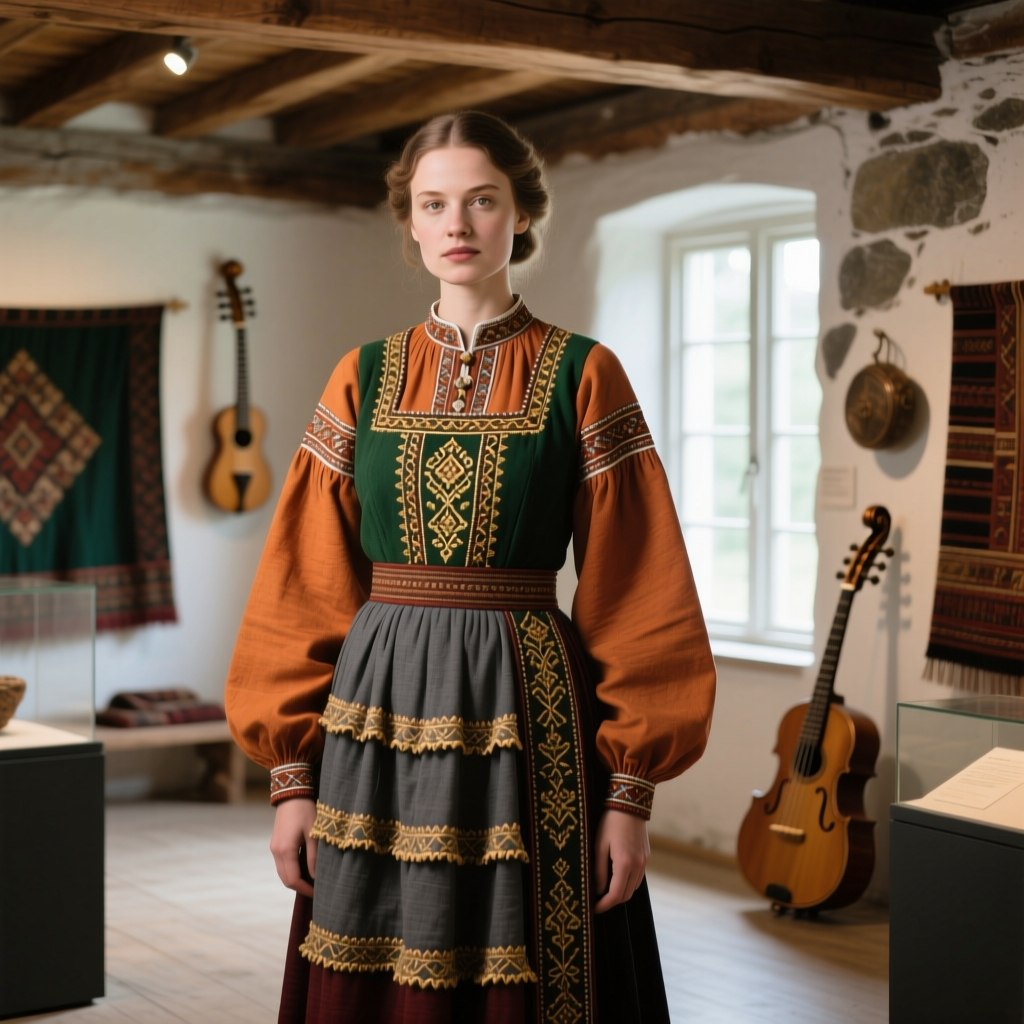
The Telemark bunad is among the most visually striking of all Norwegian folk costumes. The embroidery often covers substantial areas of the bodice, skirt, and accessories, creating a garment that is almost painterly in its effect. The colors — deep reds, vivid greens, warm golds, and occasional blues — are drawn from the same palette used in traditional rose painting, creating a visual harmony between the garment and the decorated interiors of historic Telemark farmhouses and stave churches.
Trøndelag: Northern Simplicity
Moving north to the Trøndelag region surrounding Trondheim, the bunad tradition takes on a different character. The Trønderbunad and related designs from this region tend toward simpler, more structured forms with less elaborate embroidery than their southern counterparts. This reflects both the practical demands of a harsher northern climate and the influence of Trondheim's urban mercantile culture, which historically favored more restrained styles than the isolated farming valleys to the south.
The Trønderbunad typically features dark blue or black wool with restrained embroidery in white or colored threads, complemented by silver jewelry of a more geometric, less ornate style than southern traditions. The overall impression is one of quiet dignity and practical elegance — qualities that resonate with the broader Scandinavian design tradition of functional beauty.
Setesdal and Agder: Southern Distinctiveness
The Setesdal valley in southern Norway preserves one of the most distinctive and well-documented bunad traditions in the country. The Setesdalsbunad draws on an unusually continuous tradition of folk dress: unlike many regions where historical clothing traditions had been largely abandoned before the bunad revival, Setesdal maintained its distinctive dress customs well into the modern era, providing bunad designers with living models rather than only museum pieces.
The Setesdal bunad is characterized by its dark, heavy wool fabric, intricate cross-stitch embroidery in geometric patterns, and distinctive silver jewelry including the famous solje brooches with their characteristic spoon-shaped pendants. The geometric precision of Setesdal embroidery stands in contrast to the flowing floral patterns of Telemark or the delicate whitework of Hardanger, demonstrating the remarkable range of Norwegian folk textile arts within a relatively small geographic area.
Sami-Inspired and Northern Norwegian Bunader
Norway's northernmost regions present a complex intersection of Norwegian and Sami cultural traditions. While the Sami people maintain their own distinct national dress tradition — the gákti — which is separate from and should not be conflated with the bunad, some northern Norwegian bunader reflect the cultural exchange that has occurred between Norwegian and Sami communities over centuries. The Finnmark bunad, one of the newer designs, incorporates elements inspired by the region's multicultural heritage, though its development has been the subject of thoughtful discussion about cultural boundaries and respectful representation.
Cultural Significance: The Bunad in Norwegian Life
To wear a bunad in Norway is to make a statement about identity, belonging, and values. Unlike national costumes in many other countries, which are primarily worn by performers or for tourist displays, the bunad is a garment of genuine personal significance. Understanding the cultural rules and meanings surrounding the bunad is essential to appreciating its role in contemporary Norwegian society.
The Rules of Belonging
One of the most distinctive aspects of bunad culture is the convention that a person should wear the bunad of a region to which they have a genuine connection. This connection is typically established through birth, family origin, or long-term residence. A woman whose grandmother was born in Hardanger might wear the Hardanger bunad; a man who grew up in Telemark might wear the Telemark bunad. This convention is not legally enforced but is widely observed and reflects the bunad's fundamental purpose: to express a specific, personal connection to a specific place.
This rule creates interesting dilemmas for modern Norwegians who may have roots in multiple regions or who have moved far from their ancestral communities. The bunad thus becomes a vehicle for exploring and negotiating personal identity — a process that can be deeply meaningful. Many Norwegians describe the experience of choosing their bunad as a journey of self-discovery, involving research into family history, conversations with older relatives, and visits to ancestral regions.
Constitution Day and National Celebrations
The most visible occasion for bunad wearing is Syttende Mai (May 17th), Norway's Constitution Day. On this day, hundreds of thousands of Norwegians don their bunader for parades, church services, family gatherings, and community celebrations. The sight of entire families — from infants in bunad-inspired christening gowns to elderly grandparents in bunader they have worn for decades — processing through streets decorated with Norwegian flags is one of the most powerful expressions of national identity in modern Europe.
What makes this tradition remarkable is its voluntary, grassroots character. There is no official requirement to wear a bunad on Constitution Day; Norwegians do so because the garment has become inseparable from their conception of what it means to celebrate their nation. The bunad on Syttende Mai is not a costume adopted for performance but an authentic expression of cultural belonging — a garment that says, as clearly as words, "I am part of this place and this community."
Life Transitions and Ceremonial Wear
Beyond national celebrations, the bunad plays a central role in Norwegian life transitions. Many young Norwegians receive or begin creating their first bunad in connection with their confirmation, typically around age fourteen or fifteen. This rite of passage marks the transition from childhood to young adulthood and connects the individual to generations of ancestors who underwent the same ceremony in similar garments.
Weddings are another major occasion for bunad wearing. A bride who chooses to wear a bunad rather than a conventional white wedding dress is making a powerful statement about the importance of heritage and continuity. In some regions, special bridal bunader or bridal crowns (brudekrone) preserve wedding traditions that predate the modern bunad movement by centuries. The integration of bunad traditions into wedding celebrations is explored further in our guide to ceremonial and wedding garments from around the world.
Modern Preservation and the Future of the Bunad
The Norwegian bunad tradition faces the same challenges as many living heritage practices in the modern world: how to maintain authenticity and quality while adapting to changing social conditions, economic pressures, and cultural contexts. The Norwegian approach to these challenges offers valuable lessons for cultural preservation efforts worldwide.
Institutional Support and Quality Standards
Norway has developed a robust institutional framework for bunad preservation. The Bunad- og Folkedraktrådet provides expert guidance on historical accuracy and design standards. Local husflidslag (handicraft associations) offer courses, workshops, and study circles where traditional techniques are taught to new generations. Museums across Norway maintain extensive collections of historical garments that serve as reference points for bunad makers and researchers.
The Norwegian government has also recognized the bunad tradition as an important element of national cultural heritage, providing funding for research, documentation, and education. This institutional support has helped ensure that the knowledge required to create authentic bunader — from embroidery techniques to silver-smithing to wool preparation — is systematically preserved and transmitted.
The Challenge of Commercialization
One of the most contentious issues in contemporary bunad culture is the tension between accessibility and authenticity. A hand-made bunad from a reputable Norwegian workshop can cost between 30,000 and 80,000 Norwegian kroner or more, placing it beyond the reach of some families. This has led to the emergence of commercial producers — some based outside Norway — offering lower-cost bunader made with machine embroidery, imported fabrics, and simplified construction techniques.
The bunad community is deeply divided on how to respond to this pressure. Purists argue that machine-made bunader undermine the very qualities that give the garment its cultural value: the handwork, the local materials, the connection to specific craft traditions. Others contend that making bunader more affordable is essential to ensuring that the tradition remains inclusive and vital rather than becoming the exclusive domain of the wealthy. This debate mirrors broader conversations about artisanal versus mass-produced garments across many cultural traditions.
Intangible Cultural Heritage and UNESCO Recognition
The Norwegian bunad tradition has been discussed in the context of UNESCO's Convention for the Safeguarding of Intangible Cultural Heritage, which recognizes living cultural practices — rather than physical monuments — as worthy of protection and support. The bunad exemplifies the kind of living heritage that the convention seeks to promote: a tradition that is simultaneously rooted in historical practice and actively evolving, maintained not by institutions alone but by communities of practitioners who find genuine meaning and joy in its continuation.
Efforts to document and preserve bunad knowledge have taken many forms, from academic research projects to community-based oral history initiatives to digital archives of historical patterns and techniques. The goal is not to freeze the tradition in a single historical moment but to ensure that future generations have the knowledge and skills to continue practicing it in ways that are both authentic and meaningful.
New Generations, New Meanings
Perhaps the most encouraging sign for the future of the bunad is the enthusiasm of younger Norwegians. Far from viewing the bunad as a relic of their grandparents' generation, many young Norwegians embrace it as a vital part of their identity. Social media has created new spaces for bunad enthusiasts to share their work, discuss historical details, and celebrate the beauty of traditional craftsmanship. The hashtag communities around bunad making and wearing connect practitioners across Norway's vast geography, creating a digital complement to the physical communities that have sustained the tradition for generations.
At the same time, contemporary discussions about the bunad increasingly address questions of inclusion and belonging in a multicultural Norway. As Norwegian society becomes more diverse, conversations about who can wear the bunad, what it means to claim connection to a Norwegian region, and how the tradition can welcome newcomers without losing its integrity have become more prominent. These conversations reflect the broader challenge faced by all living heritage traditions: how to honor the past while remaining relevant and inclusive in the present.
For those interested in exploring how traditional garments are being preserved and reinterpreted in contemporary fashion, our heritage-inspired fashion guide examines the intersection of historical dress traditions and modern style.
Frequently Asked Questions
What is the difference between a bunad and a folkedrakt?
The terms are related but distinct. A folkedrakt (folk dress) refers to the historical, everyday clothing worn by rural Norwegians in previous centuries — garments that evolved organically over time within specific communities. A bunad, by contrast, is a reconstructed or designed garment inspired by historical folkedrakt but created deliberately, often in the twentieth century, as a regional or national dress. While folkedrakter were the natural clothing of their time and place, bunader are conscious revivals that draw on historical sources while making deliberate choices about design, materials, and construction. Some bunader are very close to their folkedrakt predecessors; others involve more creative interpretation. The Bunad- og Folkedraktrådet maintains standards to ensure that bunader remain grounded in documented historical sources.
Can non-Norwegians wear a bunad?
This question generates considerable discussion within Norwegian bunad communities. The general consensus is nuanced: wearing a bunad is not considered offensive when done respectfully, but it is important to understand the cultural significance of the garment. Non-Norwegians who have married into Norwegian families, who have lived in Norway for extended periods, or who have a genuine personal connection to a specific region may be welcomed into bunad culture. However, wearing a bunad as a costume for a party or without understanding its cultural meaning is generally frowned upon. The key principle is respect: the bunad is not a generic "Norwegian costume" but a garment expressing specific personal and regional identity. Those interested in Norwegian textile traditions without claiming a bunad identity might explore Norwegian-inspired knitwear or accessories as a respectful alternative.
How much does an authentic Norwegian bunad cost?
An authentic, hand-made Norwegian bunad represents a significant investment. Prices typically range from 30,000 to 80,000 Norwegian kroner for a complete women's bunad ensemble, with men's bunader generally somewhat less expensive. The cost reflects the hundreds of hours of skilled handwork involved, the high-quality natural materials used, and the specialized expertise required. Silver jewelry adds substantially to the total cost, with a complete set of bunad silver ranging from 10,000 to 40,000 kroner or more depending on complexity. Many Norwegians save for years to purchase their bunad, and it is common for families to contribute to the cost as a gift for confirmations, graduations, or weddings. Some communities offer courses where participants make their own bunad under expert guidance, which reduces the monetary cost while requiring a substantial investment of time and effort.
How do I choose which regional bunad is right for me?
The traditional convention is that you should choose the bunad of a region to which you have a genuine personal connection — typically through birth, family origin, or long-term residence. Many Norwegians research their family history to identify the region or regions most meaningful to their heritage. If you have connections to multiple regions, it is generally acceptable to choose the one that feels most personally significant. When in doubt, consulting with a local husflidslag (handicraft association) or the Bunad- og Folkedraktrådet can provide guidance. These organizations can help you understand the historical basis of different bunader, connect you with local makers, and ensure that your choice respects the cultural conventions surrounding the tradition. The process of choosing and acquiring a bunad is itself considered a meaningful journey of connection to Norwegian heritage.
How should a bunad be cared for and stored?
Proper care is essential to preserving a bunad for future generations. Wool bunad garments should be aired regularly and spot-cleaned when necessary, but full washing should be avoided unless absolutely essential and should only be undertaken by professionals experienced with traditional textiles. Embroidered elements require particular care, as aggressive cleaning can damage delicate stitchwork. Silver jewelry should be polished gently and stored in anti-tarnish cloth to prevent oxidation. The complete bunad ensemble should be stored in a cool, dry place, ideally in a breathable garment bag rather than plastic, which can trap moisture and promote deterioration. Many bunad owners place acid-free tissue paper between folded elements to prevent creasing and fabric stress. Given the investment represented by a bunad, professional conservation advice from a textile specialist is recommended for valuable or antique pieces. This approach to garment care reflects the broader principle of garment care and longevity that applies to all quality clothing.