The Heritage of the Nigerian Hausa Babban Riga: Tailoring, Embroidery, and Cultural Identity
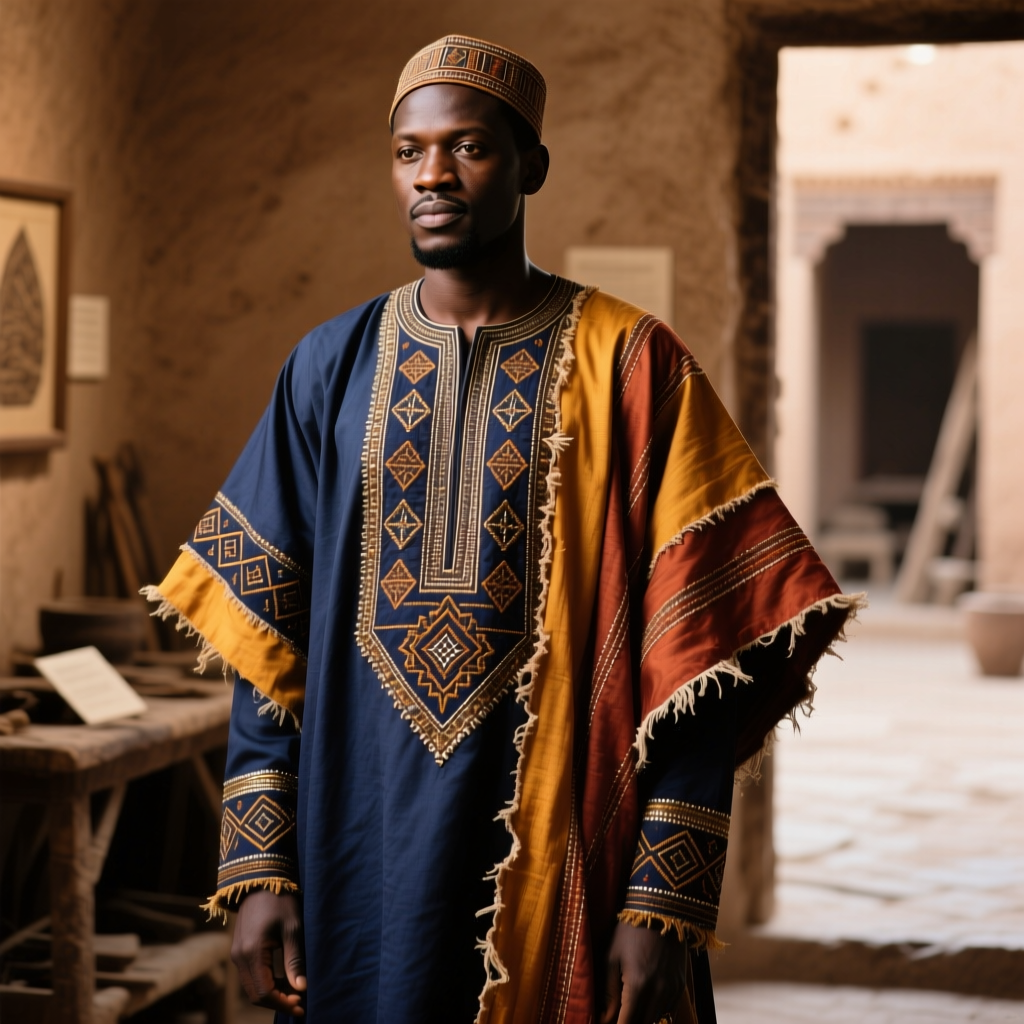
The sweeping silhouette of the Babban Riga is one of the most commanding and recognizable garments in West Africa. Far more than a mere article of clothing, this voluminous, heavily embroidered robe is an architectural marvel of cloth that encapsulates the history, spirituality, and social hierarchy of the Hausa and Fulani peoples of Northern Nigeria. When a man dons the Babban Riga, he does not simply wear a garment; he steps into a legacy of trans-Saharan trade, Islamic scholarship, and indigenous artistry that has evolved over centuries. The sheer physical presence of the robe—with its wide, draping sleeves and intricate chest panels—demands a dignified posture and a deliberate gait, physically manifesting the cultural ideals of respect and authority.
As a cornerstone of Sahelian sartorial heritage, the Babban Riga represents a masterclass in traditional tailoring and textile manipulation. From the historic indigo dye pits of Kano to the meticulous hand-embroidery workshops of Sokoto, the creation of this robe involves a complex ecosystem of artisans. In this comprehensive guide, we explore the profound heritage of the Nigerian Hausa Babban Riga, examining its historical roots, cultural significance, unparalleled craftsmanship, and the ongoing efforts to preserve this majestic tailoring tradition in the modern era.
The Historical Roots of the Babban Riga
The origins of the Babban Riga are deeply intertwined with the history of the Hausa city-states and the broader trans-Saharan trade routes that connected West Africa to North Africa and the Middle East. Beginning around the 11th century, caravans crossing the Sahara brought not only salt, spices, and gold but also new textiles, Islamic scholarship, and distinct sartorial codes. The synthesis of indigenous Hausa weaving traditions with Islamic concepts of modesty and aristocratic dress birthed the early iterations of the flowing robes seen across the Sahel today.
Historically, the climate of the Sahel and the Sahara dictated the need for garments that offered protection from the harsh sun and swirling desert sands while allowing for air circulation. The voluminous nature of the Babban Riga served a highly practical purpose: the wide sleeves and expansive body created a microclimate of cool air around the wearer. However, as the Kanem-Bornu Empire and later the Sokoto Caliphate rose to prominence, the garment transcended its utilitarian roots. It became a canvas for displaying wealth, political allegiance, and religious piety.
The establishment of the Sokoto Caliphate in the early 19th century profoundly standardized and elevated the Babban Riga. The Caliphate’s aristocracy adopted heavily embroidered robes as official court dress, cementing the garment's status as a symbol of Islamic authority and political power. The intricate embroidery, often featuring geometric and arabesque motifs, reflected the Islamic prohibition against figurative art, channeling artistic expression into complex, mathematical textile designs. For a broader look at the continent's sartorial history and the fabrics that made this trade possible, explore our guide to African textiles.
Cultural Significance and Social Hierarchy
In Hausa culture, clothing is a primary indicator of social status, age, and occasion. The Babban Riga is the undisputed pinnacle of martaba (prestige and honor). It is not an everyday garment for the common laborer; rather, it is reserved for moments of profound cultural and religious significance. Weddings, naming ceremonies, political coronations, and the joyous celebrations of Sallah (Eid) are the primary arenas where the Babban Riga makes its grand appearance.
The psychology of the garment is as important as its aesthetics. The sheer weight and volume of the fabric, particularly when layered over a matching kaftan and loose-fitting trousers known as wando or sokoto, restrict hasty or erratic movement. A man wearing a fully tailored Babban Riga must move with a slow, measured, and graceful stride. This physical restriction enforces a behavioral code of kunya (modesty, reserve, and dignity), ensuring that the wearer projects an aura of calm authority and deep respect for the occasion.
Furthermore, the Babban Riga is a vital component of the traditional Hausa wedding trousseau. A groom is often presented with multiple, highly expensive robes by his family and his bride’s family, serving as a public display of the family's wealth and their commitment to the union. The garment is also deeply tied to the concept of aging and elderhood; while younger men may wear lighter, less embroidered robes, the most opulent, heavily stitched Babban Riga is typically the domain of elders, chiefs, and religious clerics. To understand how these majestic pieces fit into a global wardrobe and formal event dressing, visit our men's traditional formalwear style page.
The Art of Craftsmanship: Weaving, Tailoring, and Embroidery
The creation of an authentic Babban Riga is a collaborative masterpiece that involves several distinct artisanal disciplines. The journey from raw fiber to finished robe is a testament to the specialized guilds that have operated in Northern Nigerian cities for generations.
The Foundation: Textiles and Dyeing
Traditionally, the base fabric for the Babban Riga was Akyaso or Tsaka, a hand-woven cotton cloth produced on narrow-strip looms. These strips were meticulously sewn together to create the wide expanse of fabric required for the robe. The most prized indigenous cotton was dyed using the ancient indigo pits of Kano, such as the famous Kofar Mata dye pits. The deep, rich blues and blacks achieved through months of fermentation and repeated dipping were highly sought after across the Sahel. The history and chemistry behind these stunning fabrics are detailed in our indigo dyeing traditions article.
As global trade expanded, imported textiles became integrated into the tradition. Today, luxury Babban Riga robes are frequently crafted from Shadda (a rich, heavy silk brocade), Atamfa (pure, lightweight silk), and high-grade damasks. The choice of fabric dictates the drape, the weight, and the ultimate cost of the garment.
The Tailor (Mai Dinki) and the Embroiderer (Mai Zane)
The construction of the robe falls to the Mai Dinki (tailor), who must possess an expert understanding of geometry and drape. The Babban Riga is constructed from large, rectangular panels with minimal cutting, preserving the integrity of the expensive fabric. The tailoring focuses on the neckline, the structural integrity of the shoulder seams, and the precise calibration of the sleeve length, which is designed to pool elegantly at the wrists or be draped over the shoulders.
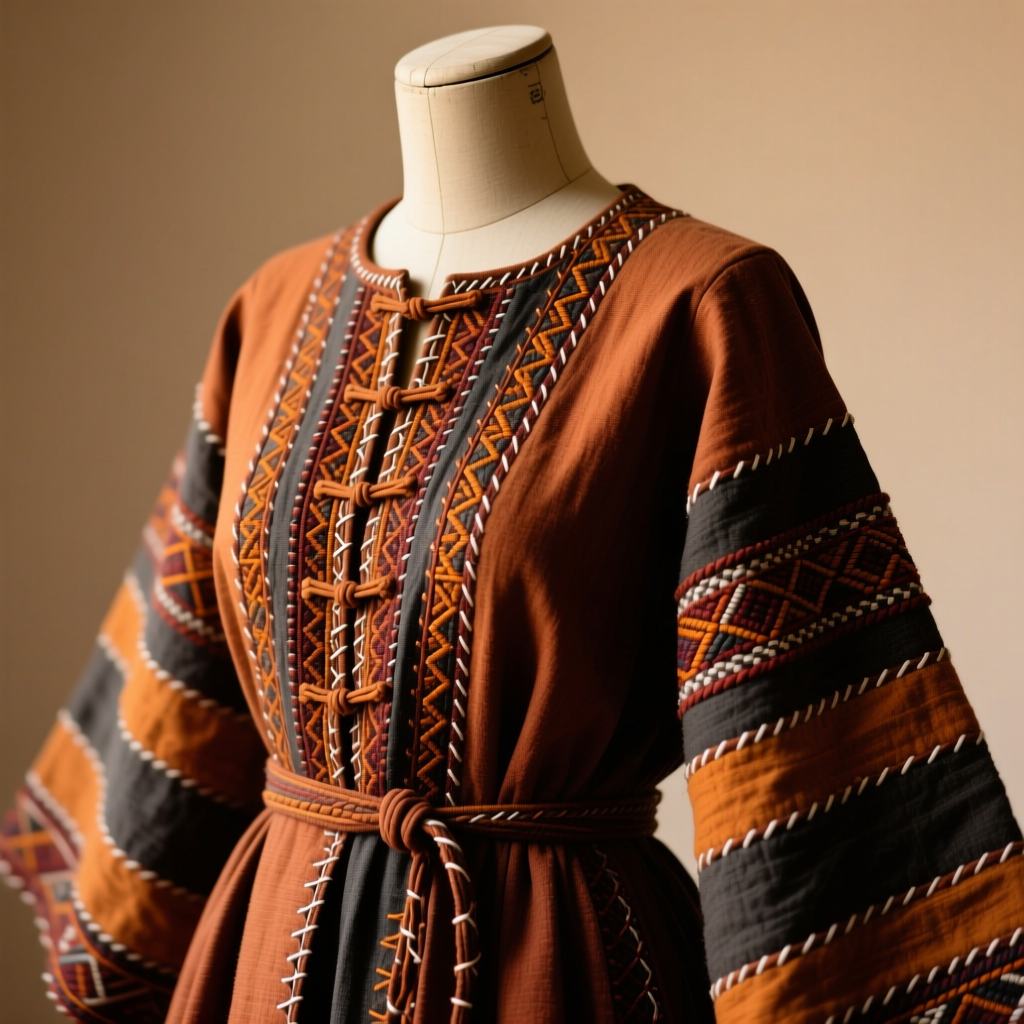
However, the true soul of the Babban Riga lies in the Zane (embroidery). The Mai Zane is a master artisan who spends years, often decades, perfecting the intricate hand-stitching that adorns the chest, neckline, and back of the robe. The embroidery is not merely decorative; it serves to reinforce the structural stress points of the garment while displaying a lexicon of cultural motifs. The meticulous stitching is part of a global tradition detailed in our hand embroidery techniques guide.
Common motifs include the Hannun Guda (single hand), the calabash, and various interlocking geometric knots that symbolize unity, protection, and the infinite nature of the divine. The embroidery thread, traditionally spun silk or cotton, is now often supplemented with high-sheen synthetic threads or even metallic yarns for a more luminous finish. The density of the embroidery on the chest panel is a direct indicator of the garment's value; a fully