The Inuit Amauti: Heritage & Craftsmanship of the Caribou Skin Parka
The Inuit Amauti: Heritage & Craftsmanship of the Caribou Skin Parka
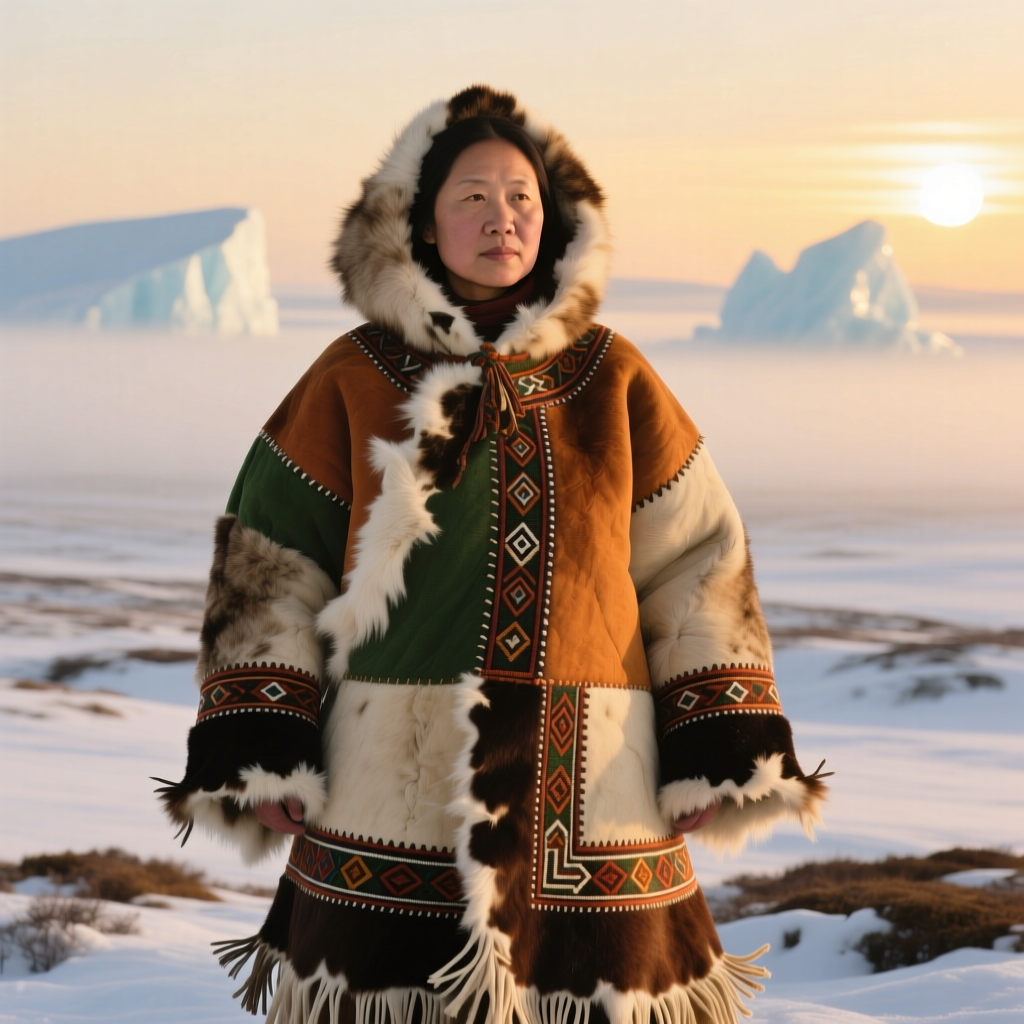
The Arctic landscape is an environment of extreme beauty & unforgiving conditions, where survival depends on a profound understanding of the natural world. For millennia, the Inuit have thrived in this icy expanse, relying on an intricate knowledge of local wildlife, weather patterns, & material science. At the very heart of this survival strategy is the amauti, a masterfully tailored caribou skin parka designed specifically for women. Far more than a simple piece of winter outerwear, the amauti is a marvel of ergonomic engineering, a deeply spiritual garment, & a vibrant canvas of cultural identity. To understand the genius of indigenous winter survival garments, one must look closely at the amauti & the generations of Inuit women who have perfected its creation.
The caribou skin parka represents the pinnacle of Arctic tailoring. It is a garment born from necessity but elevated to high art through meticulous craftsmanship & an intimate relationship with the environment. Every stitch, seam, & decorative element serves a distinct purpose, blending utilitarian function with profound cultural meaning. As we explore the heritage of the amauti, we uncover a narrative of resilience, maternal devotion, & an enduring legacy that continues to inspire contemporary Arctic outerwear silhouettes & global fashion alike.
The Cultural Significance of the Amauti
The amauti is intrinsically linked to Inuit womanhood, motherhood, & the continuation of life in one of the harshest climates on Earth. Unlike standard parkas, the amauti features a specialized, built-in pouch known as the amaut, located just below the hood & above the mother's waist. This pouch is designed to carry an infant, allowing the child to rest skin-to-skin against the mother's back. This proximity provides essential warmth, facilitates discreet nursing, & allows the mother to keep her hands completely free for daily tasks, from foraging & sewing to navigating the tundra.
Beyond its practical utility, the amauti holds deep spiritual & social significance. In traditional Inuit cosmology, the caribou is a sacred animal, providing not only sustenance but also the vital materials needed for shelter & clothing. The transformation of a caribou hide into an amauti is viewed as a respectful continuation of the animal's life force. The woman who wears the parka is enveloped in the spirit of the caribou, while the child nestled within the amaut is protected by both the mother & the natural world. This symbiotic relationship underscores a worldview where humans, animals, & garments are inextricably linked.
Furthermore, the amauti serves as a visual marker of identity & status. The specific cut, the arrangement of the fur, & the decorative elements communicate a woman's regional affiliation, her marital status, & her family's lineage. When a young girl transitions into womanhood, the gifting or creation of her first amauti is a major rite of passage, symbolizing her readiness to take on the responsibilities of adulthood & the potential for motherhood. The garment is a wearable archive of personal & communal history, encapsulating the values & aesthetics of its creator.
Anatomy of the Parka: Design & Functionality
The structural design of the caribou skin amauti is a testament to the Inuit understanding of anatomy, thermodynamics, & movement. The garment is typically composed of several distinct sections, each engineered to maximize warmth & mobility. The most prominent feature is the nasaq, or hood, which is generously sized to accommodate the mother's head along with the infant's when the child is moved to the front for nursing or interaction. The hood is often trimmed with a ruff of wolverine, wolf, or dog fur, which serves to break the wind & prevent frost from accumulating near the face.
The amaut (the baby pouch) is supported by a broad, reinforced belt or a series of toggles, ensuring that the weight of the child is distributed evenly across the mother's hips & shoulders rather than pulling uncomfortably on the neck. Beneath the pouch, the parka features the akuq, a elongated back flap or tail that provides extra insulation when the mother sits on the snow or ice, effectively acting as a built-in seating mat. The front of the parka is often cut slightly shorter to allow for unimpeded walking, while the sides may feature slits for ease of movement.
The interior of the parka is equally ingenious. Caribou hide possesses a unique cellular structure; the hairs are hollow, trapping air & creating an exceptional thermal barrier. In the deepest winter, an Inuit woman might wear two amauti layers: an inner parka with the fur facing inward against the skin for maximum heat retention, & an outer parka with the fur facing outward to shed wind & snow. This layered system is a precursor to modern technical layering, demonstrating an advanced grasp of traditional hide tanning techniques & thermal regulation long before the advent of synthetic textiles.
Masterful Craftsmanship & Tailoring Techniques
The creation of a traditional caribou skin amauti is a labor-intensive process that requires immense skill, patience, & physical endurance. The journey begins with the harvest of the caribou. Hides taken in the late summer or early autumn are preferred for outerwear, as the fur is thick, luxurious, & relatively free from the damage caused by winter molting or insect bites. Once the hide is removed, it undergoes a rigorous preparation process. It must be scraped clean of fat & flesh using an ulu (a traditional crescent-shaped woman's knife), stretched on a frame, & repeatedly worked with specialized tools to break down the fibers.
Softening the hide is perhaps the most physically demanding step. Women traditionally use their hands, feet, & even their teeth to chew & massage the skin, working in natural oils & ensuring the leather remains supple even when exposed to freezing temperatures. If the hide is not properly softened, it will stiffen like armor in the cold, restricting movement & compromising the seams. The mastery of this preparation phase is a closely guarded skill, passed down from mother to daughter, ensuring that the final textile is as soft as it is resilient.
The tailoring & assembly of the amauti rely on a sophisticated system of geometric patterning. Inuit seamstresses do not use paper patterns; instead, they measure directly on the hide using their hands, arms, & fingers as proportional guides. This bespoke approach ensures a perfect, custom fit for the wearer while adhering to a strict zero-waste philosophy. Every scrap of hide is utilized, whether for patching, creating decorative inlays, or fashioning small accessories. The pieces are sewn together using sinew thread—derived from the long back tendons of the caribou—which is incredibly strong, water-resistant, & swells when wet to seal the needle holes. The needles, historically crafted from bone or antler, & later from traded steel, are wielded with a microscopic precision that modern tailoring machines struggle to replicate.
Regional Variations Across the Arctic
While the fundamental purpose of the amauti remains consistent across the Arctic, its aesthetic & structural details vary significantly from region to region. These variations are a source of immense local pride & serve as a visual language that identifies a woman' geographic origins. In the Kivalliq region of Nunavut, historically home to the Caribou Inuit, the amauti is renowned for its expansive use of thick, dark winter caribou fur, often accented with striking geometric patterns of white caribou belly fur. The hoods in this region tend to be sharply pointed, & the decorative hems are relatively understated, prioritizing the natural beauty of the pelts.
Conversely, in the Kitikmeot region & among the Copper Inuit, the amauti often features elaborate fringing, intricate fur inlays, & a distinctively rounded hood. The introduction of trade goods, such as glass beads, cotton calico, & wool braids, led to the development of highly ornate decorative panels along the hood, chest, & hem. These beaded motifs are not merely decorative; they often represent local topography, animal tracks, or celestial bodies, embedding the landscape into the very fabric of the garment.
In Greenland, the traditional women's parka, known as the amaut or timaaq, showcases a different evolution of the silhouette. Greenlandic amauti are frequently crafted from sealskin as well as caribou, & they are famous for their vibrant, intricate beadwork collars that drape over the shoulders like a yoke. The color palettes & beadwork patterns in Greenland are distinct from those in North America, reflecting a unique cultural trajectory shaped by different historical trade networks. Exploring these diverse regional Arctic outerwear styles reveals the incredible adaptability & creativity of Inuit seamstresses across the circumpolar north.
Modern Preservation & Contemporary Revival
The transmission of amauti-making knowledge faced severe threats during the eras of forced assimilation, residential schooling, & the rapid modernization of Arctic communities. As manufactured southern clothing became more accessible, the daily use of heavy caribou skin parkas declined, & the risk of losing centuries of tailoring wisdom became imminent. However, the amauti has never been relegated to the status of a mere museum artifact. It remains a vital, living garment, & its preservation is driven by the fierce dedication of Inuit women, elders, & cultural educators.
Today, there is a vibrant revival of traditional skin-sewing, supported by community sewing circles, elder-youth mentorship programs, & cultural institutes dedicated to indigenous textile preservation. While many modern women may opt for lightweight, commercially manufactured outerwear for daily chores, the traditional caribou skin amauti is still highly prized for land trips, hunting expeditions, & extreme cold weather, where synthetic materials simply cannot compete with the breathability & warmth of natural hide.
Furthermore, contemporary Inuit fashion designers are reimagining the amauti for the modern world. By blending traditional silhouettes & fur trims with modern textiles like wool duffel, denim, & technical synthetics, they are creating hybrid garments that honor the past while suiting the realities of contemporary urban & northern life. These designers are bringing the amauti to global runways & international exhibitions, asserting Indigenous intellectual property rights & ensuring that the legacy of the caribou skin parka continues to evolve. The amauti stands today not just as a relic of survival, but as a powerful symbol of Inuit sovereignty, artistic brilliance, & enduring maternal love.
Frequently Asked Questions
What makes caribou skin ideal for Arctic parkas?
Caribou skin is uniquely suited for extreme cold due to the structure of its hair. Each caribou hair is hollow, which traps air & creates an exceptional thermal barrier that provides superior insulation without excessive weight. Additionally, when properly tanned & softened, caribou leather remains incredibly supple even in sub-zero temperatures, unlike many other hides that become stiff & brittle. The skin is also highly wind-resistant & durable, making it the ultimate natural textile for Arctic survival.
How does the amauti's baby pouch function?
The amaut (pouch) is integrated into the back of the parka, just below the hood. It allows the infant to sit securely against the mother's bare back, facilitating skin-to-skin contact, which regulates the baby's temperature & allows for easy nursing. The mother can easily shift the child from the back pouch to the front of her body through the spacious hood without ever exposing the baby to the freezing outside air. The weight of the child is supported by a specialized belt or tie system, relieving strain on the mother's shoulders.
Are traditional amauti still worn today?
Yes, traditional caribou skin amauti are still worn today, particularly when families travel on the land, go hunting, or participate in cultural celebrations. While modern synthetic parkas are common for everyday town wear due to their lighter weight & ease of cleaning, nothing matches the warmth & breathability of caribou skin in extreme conditions. Additionally, many modern Inuit seamstresses create contemporary versions of the amauti using wool duffel & modern fabrics, keeping the iconic silhouette & functional design alive in daily life.
How long does it take to craft a traditional caribou skin amauti?
Crafting a traditional caribou skin amauti from scratch is a monumental task that can take hundreds of hours, often spread over several weeks or months. The process includes harvesting the hide, fleshing, stretching, drying, & the physically demanding work of chewing & softening the leather. Once the hides are prepared, the cutting & intricate hand-sewing using sinew thread require immense precision. Because it is such a labor-intensive process, an amauti is deeply cherished, meticulously maintained, & often passed down through generations or repurposed when it finally wears out.
What is the difference between an amauti and a standard parka?
While the word 'parka' is often used as a catch-all term for Arctic hooded coats (derived from the Nenets word for 'animal skin'), the amauti is specifically a woman's garment defined by its structural accommodations for child-rearing. A standard men's or child's parka lacks the enlarged hood, the specialized amaut baby pouch, the supportive belting system, & the elongated back flap (akuq) that characterize the amauti. The amauti is uniquely engineered around the physical & social realities of Inuit motherhood.