Indonesian Songket: The Living Heritage of Gold Thread Weaving
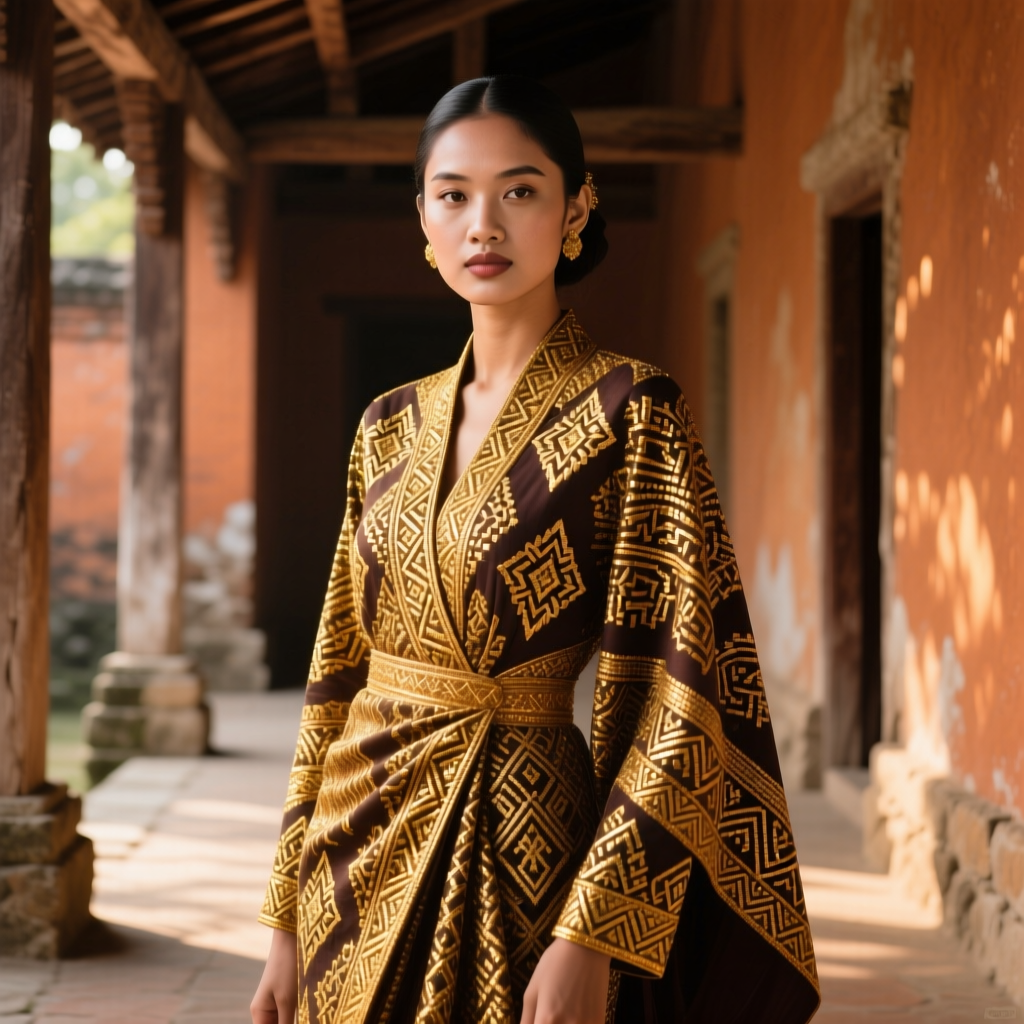
Long before the rise of global fashion houses & mass-produced textiles, the weavers of the Indonesian archipelago were creating fabrics so exquisite that they were reserved exclusively for royalty, sacred ceremonies, & rites of passage. Among these extraordinary textiles, songket stands apart — a handwoven cloth in which gold & silver threads are meticulously inserted into silk or cotton to produce shimmering, brocade-like patterns that seem to float above the fabric's surface. More than mere decoration, songket represents centuries of cultural identity, spiritual belief, & technical mastery passed down through generations of artisans across Sumatra, Bali, Lombok, & beyond.
The word "songket" itself is believed to derive from the Malay word sungkit, meaning "to hook" or "to pick up," a direct reference to the technique of lifting individual warp threads to insert supplementary weft threads of precious metal. This painstaking process transforms simple cloth into a canvas of geometric precision & symbolic meaning, where every motif carries a story & every thread reflects the status of its wearer. As we explore the heritage of Indonesian songket, we uncover not just a textile tradition, but a living art form that continues to evolve while remaining deeply rooted in the cultural consciousness of the Indonesian people.
The Historical Origins & Royal Legacy of Songket
The origins of songket weaving in Indonesia stretch back several centuries, deeply intertwined with the rise & fall of the great maritime kingdoms that once dominated Southeast Asian trade routes. Scholars trace the earliest forms of songket production to the Srivijaya Empire, a powerful Buddhist thalassocracy centered in Palembang, South Sumatra, which flourished between the seventh & thirteenth centuries. As a major hub of international commerce connecting China, India, the Middle East, & the broader Malay world, Palembang became a crucible of cultural exchange where weaving techniques, design motifs, & materials from distant civilizations converged & were reimagined by local artisans.
The introduction of gold thread to the archipelago is closely linked to these trade networks. Indian merchants brought not only textiles but also the knowledge of supplementary weft weaving techniques, while Chinese traders supplied silk & metallic yarns. Indonesian weavers absorbed these influences & transformed them into something distinctly their own — a textile language that spoke of local cosmology, social hierarchy, & spiritual devotion. Under the patronage of royal courts, songket became the ultimate symbol of power & prestige. Sultans & their families wore songket garments during coronations, royal weddings, & diplomatic receptions, using the fabric to project authority & divine right.
In the Minangkabau highlands of West Sumatra, the Pandai Sikek village emerged as one of the most celebrated centers of songket production, a reputation it maintains to this day. Here, the craft was elevated to an art form governed by strict adat (customary law), which dictated which motifs could be worn by which members of society. A bride from a noble family might wear a songket selendang (shawl) featuring the kaluak paku (fern tendril) motif, symbolizing the graceful adaptability expected of a young woman entering married life. Meanwhile, the saluak motif, resembling interlocking waves, was reserved for community leaders & elders, representing the flowing wisdom that guides communal decision-making.
The royal courts of Palembang developed their own distinctive songket traditions, producing fabrics of extraordinary density & opulence. The legendary songket lepus — a cloth so heavily brocaded with gold thread that the base fabric is almost entirely concealed — was considered the pinnacle of the weaver's art. Only the sultan & his immediate family were permitted to wear songket lepus, & the creation of a single piece could take months or even years of dedicated labor. These garments were not merely clothing; they were heirlooms, passed from mother to daughter across generations, carrying within their threads the accumulated history & blessings of an entire lineage.
The Art of Craftsmanship: Techniques, Materials & the Weaver's Skill
Creating authentic songket is an act of extraordinary patience & precision, requiring skills that take years — often decades — to master. The process begins long before the loom is threaded. Traditional songket weavers must first conceptualize the pattern, a mental exercise that demands an intimate understanding of geometry, proportion, & cultural symbolism. Unlike printed or embroidered textiles, songket patterns are not applied to the surface of the fabric; they are structurally integrated into the cloth itself through the supplementary weft technique.
The loom used for songket weaving is typically a traditional backstrap loom or a frame loom, depending on the regional tradition. The weaver sets up the warp threads — the longitudinal threads that form the foundation of the fabric — & then works row by row, using a small stick or bamboo pick to lift specific warp threads according to the desired pattern. Into this opening, the supplementary weft thread — traditionally made of real gold or silver wrapped around a silk or cotton core — is carefully laid. The weaver then beats the thread into place with a wooden comb-like tool called a beater or reed, ensuring that each metallic thread sits flush & even against its neighbors.
The quality of the gold thread itself is a subject of immense importance in the songket tradition. Historically, the finest songket was woven with thread made from thin strips of real gold foil wrapped around a silk core. This genuine gold thread, known as benang emas, gives antique songket its characteristic warm luster & remarkable durability — pieces woven centuries ago can still gleam with their original brilliance when properly preserved. Over time, as real gold became prohibitively expensive, weavers began using alternatives: silver thread gilded with gold, copper-based metallic yarns, & eventually synthetic metallic threads. While modern materials have made songket more accessible, connoisseurs & collectors still prize pieces woven with genuine gold thread for their unmatched beauty & cultural authenticity.
A single songket cloth can require anywhere from one to six months of continuous work, depending on the complexity of the design & the density of the metallic patterning. The most elaborate pieces — those featuring multiple colors of supplementary weft, intricate borders, & fields filled with dense, interlocking motifs — represent thousands of individual thread manipulations, each one performed by hand. It is this human element, the subtle variations in tension & the slight imperfections that mark handwoven work, that distinguishes true songket from machine-made imitations. For those interested in understanding how handcrafted textiles compare to modern alternatives, our guide to handwoven versus machine-made textiles offers a detailed comparison.
The dyeing of the base threads is another crucial element of the craft. Traditional songket weavers used natural dyes derived from plants, minerals, & insects: indigo for deep blues, turmeric & jackfruit wood for yellows, & the roots of the mengkudu tree (Morinda citrifolia) for rich reds. These natural dyes produce colors of remarkable depth & subtlety, with a living quality that synthetic dyes cannot replicate. The combination of naturally dyed base threads with gleaming metallic supplementary weft creates the visual contrast that makes songket so visually arresting — a shimmering gold pattern dancing across a field of deep crimson or midnight blue.
Regional Variations: From Sumatra to Bali & Beyond
While songket is often associated primarily with Sumatra, the tradition extends across a wide swath of the Indonesian archipelago, with each region developing its own distinctive aesthetic vocabulary, technical approaches, & ceremonial applications. These regional variations reflect not only differences in local culture & available materials but also the diverse historical influences — Hindu-Buddhist, Islamic, Chinese, European — that shaped each area's artistic development.
Palembang & South Sumatra
Palembang remains the spiritual heartland of songket, & its weavers are renowned for producing some of the finest & most technically accomplished examples of the art form. Palembang songket is characterized by its dense, symmetrical patterns & its generous use of gold thread. The songket lepus, with its fully brocaded surface, represents the apex of the Palembang tradition. Motifs frequently draw from the natural world & Islamic geometric design: the bunga tanjung (cape jasmine flower), the bunga melati (jasmine), & various star & diamond configurations that echo the region's Islamic heritage. The color palette tends toward rich reds, deep maroons, & gold, creating fabrics of intense visual warmth & regal authority. Explore more about traditional Indonesian textiles & their regional distinctions across the archipelago.
Minangkabau & West Sumatra
The Minangkabau people of West Sumatra, famous for their matrilineal social structure, have developed a songket tradition that is deeply embedded in their adat ceremonies. Minangkabau songket, particularly from the village of Pandai Sikek, tends to feature more open, spacious designs compared to the densely patterned Palembang style. The motifs are heavily symbolic, encoding social values & philosophical teachings. The kaluak paku (fern tendril) motif, for instance, represents the importance of adaptability & graceful growth, while the balah kacang (split peanut) motif symbolizes fairness & equal division — a core principle of Minangkabau justice. Songket plays a central role in Minangkabau wedding ceremonies, where the bride & groom are adorned in elaborate songket ensembles that communicate their family's social standing & cultural refinement.
Bali
Balinese songket occupies a unique position within the island's Hindu-Buddhist ceremonial culture. Unlike the predominantly Islamic contexts of Sumatran songket, Balinese songket is intimately connected to temple ceremonies, cremation rites, & the elaborate rituals that structure daily life on the island. The village of Klungkung, particularly the community of Sidemen, is renowned for its songket weaving. Balinese songket often features motifs drawn from Hindu mythology: the garuda (mythical bird), lotus flowers, & various geometric patterns associated with spiritual protection. The color palette is broader than in Sumatra, incorporating vibrant greens, purples, & oranges alongside the traditional red & gold. Balinese songket is typically worn as a selendang (sash) or as part of the elaborate ceremonial dress worn during temple festivals, where the shimmering gold thread catches the tropical sunlight & adds a sense of divine radiance to the proceedings.
Lombok & Eastern Indonesia
The Sasak people of Lombok have their own songket traditions, which blend indigenous weaving practices with influences from neighboring Bali & the broader Islamic world. Lombok songket is often characterized by bolder, more geometric designs & a somewhat heavier hand than the delicate weavings of Palembang. In eastern Indonesia, particularly in parts of Sulawesi & the Lesser Sunda Islands, supplementary weft weaving traditions exist that share technical similarities with songket, though they may use different materials & serve different ceremonial purposes. These regional variations collectively illustrate the remarkable adaptability of the songket concept — the idea of enriching woven cloth with precious threads — across an extraordinarily diverse cultural landscape.
Cultural Significance: Songket in Ceremony, Identity & Social Life
To understand songket fully, one must look beyond its material beauty & recognize its role as a cultural text — a fabric that communicates identity, status, spiritual belief, & social relationships. In traditional Indonesian societies, the wearing of songket is never a casual act. It is governed by complex rules of adat that specify who may wear which patterns, on what occasions, & in what combinations. These rules transform songket from mere clothing into a sophisticated system of visual communication.
In wedding ceremonies across Sumatra & Bali, songket plays an indispensable role. The exchange of songket garments between the families of the bride & groom is often a formal part of the marriage negotiations, symbolizing the joining of two lineages & the mutual respect between families. The bride's songket ensemble — typically consisting of a sarong, a selendang, & sometimes a headcloth — is among the most important visual elements of the ceremony, signaling her family's heritage & her transition into a new social role. In Minangkabau tradition, the quality & quantity of songket presented at a wedding is a direct reflection of the family's standing within the community, making the selection of these garments a matter of serious deliberation.
Beyond weddings, songket features prominently in coming-of-age ceremonies, religious festivals, royal installations, & funeral rites. In Bali, songket cloths are used to wrap sacred objects & to dress temple statues during important ceremonies, extending the fabric's symbolic power beyond the human realm into the domain of the divine. The act of weaving songket is itself considered a spiritually charged activity in many communities. Traditional weavers may observe certain rituals before beginning a new piece — prayers, offerings, or periods of abstinence — to ensure that the cloth is imbued with positive energy & spiritual protection.
Songket also functions as a form of cultural memory. The motifs woven into each cloth carry meanings that have been transmitted across generations, encoding philosophical teachings, historical narratives, & communal values in a visual language that can be "read" by those who understand the tradition. When a young woman wraps herself in her grandmother's songket for her wedding day, she is not simply wearing a beautiful garment; she is literally wrapping herself in her family's history & the accumulated wisdom of her ancestors. For more on how traditional garments serve as vehicles of cultural identity, our guide to incorporating traditional garments into modern wardrobes explores the continuing relevance of heritage textiles in contemporary life.
Modern Preservation: Challenges, Revival & the Future of Songket
Like many traditional crafts worldwide, songket weaving faces significant challenges in the modern era. The rise of inexpensive, machine-printed imitations has flooded markets with fabrics that mimic the appearance of songket at a fraction of the cost, undermining the economic viability of genuine handwoven production. Young people in weaving communities often seek employment in cities or industries that offer more reliable income than the months-long labor required to produce a single songket cloth. The master weavers who possess the deepest knowledge of complex patterns & techniques are aging, & in some communities, their knowledge risks disappearing without adequate transmission to the next generation.
Yet the story of songket is not one of simple decline. Across Indonesia, a multifaceted revival movement is underway, driven by a combination of government initiatives, nonprofit organizations, entrepreneurial designers, & the weavers themselves. The Indonesian government has recognized songket as an important element of the nation's intangible cultural heritage, & various programs have been established to support weaving communities through training, marketing assistance, & intellectual property protection. Organizations working at the grassroots level have helped weavers access broader markets, connect with collectors & fashion designers, & secure fair prices for their work.
The Indonesian fashion industry has played a particularly important role in songket's contemporary revival. A growing number of designers are incorporating authentic handwoven songket into modern garments — tailored jackets, evening gowns, structured bags — creating a bridge between traditional craftsmanship & contemporary style. This fusion has generated new demand for songket & has introduced the textile to audiences who might never have encountered it in its traditional context. However, this commercial engagement raises important questions about cultural appropriation, the dilution of traditional meanings, & the pressure on weavers to modify their designs to suit market tastes. The most successful collaborations are those that respect the integrity of the tradition while finding innovative ways to ensure its economic sustainability.
Education & documentation are equally critical to preservation. Universities, museums, & cultural organizations are increasingly investing in the systematic recording of songket patterns, techniques, & oral histories before they are lost. Digital archives, weaving workshops, & cultural tourism programs offer additional avenues for keeping the tradition alive. In communities like Pandai Sikek & Sidemen, weaving cooperatives have been established that allow artisans to share resources, train apprentices, & collectively market their work, strengthening both the economic & social foundations of the craft.
Collectors & enthusiasts also play a vital role. By seeking out authentic, handwoven songket — & by learning to distinguish genuine artisanal work from mass-produced imitations — they create a market that rewards quality & tradition. Understanding the difference between real gold thread & synthetic alternatives, recognizing the hallmarks of handwoven construction, & appreciating the cultural significance of specific motifs all contribute to a more informed & respectful engagement with this extraordinary textile heritage. Our guide to identifying authentic handwoven textiles provides practical tips for evaluating the quality & authenticity of traditional fabrics.
Frequently Asked Questions About Indonesian Songket
What makes songket different from other brocade textiles?
Songket is distinguished by its supplementary weft technique, in which metallic threads — traditionally real gold or silver — are individually inserted by hand into the warp of the fabric during weaving. Unlike embroidery, where decoration is applied to the surface of an already-woven cloth, songket patterns are structurally integrated into the fabric itself. This creates a distinctive effect where the metallic motifs appear to float on or slightly above the surface of the base cloth. The use of genuine precious metal threads, the hand-operated loom techniques, & the deep cultural symbolism encoded in the motifs collectively set songket apart from other brocade traditions found in Europe, India, or East Asia. The result is a textile that is simultaneously a work of art, a cultural document, & a functional garment.
How can I tell if a piece of songket is authentically handwoven?
Authentic handwoven songket exhibits several telltale characteristics. First, examine the reverse side of the fabric: in genuine songket, the metallic supplementary weft threads will appear somewhat discontinuous on the back, floating across sections where they are not needed for the pattern. Machine-made imitations often show a more uniform, continuous thread pattern on the reverse. Second, look for slight irregularities in the weaving — minor variations in tension, small inconsistencies in thread spacing — that are the natural hallmarks of human craftsmanship. Perfectly uniform patterns are typically machine-produced. Third, authentic songket tends to be heavier & more substantial than machine-made alternatives, due to the density of the metallic threads. Finally, purchasing from reputable sources — weaving cooperatives, established galleries, or certified artisans — greatly increases the likelihood of acquiring genuine handwoven songket.
How should songket garments be cared for & preserved?
Proper care is essential to preserving the beauty & integrity of songket, particularly pieces made with real gold or silver thread. Songket should never be machine-washed or subjected to harsh chemical detergents, which can damage both the metallic threads & the base fabric. For minor cleaning, gentle hand washing in cool water with a mild, pH-neutral soap is recommended, followed by air drying away from direct sunlight. For valuable or antique pieces, professional textile conservation is the safest option. When storing songket, wrap it in acid-free tissue paper or clean white cotton cloth & keep it in a cool, dry environment. Avoid folding along the same lines repeatedly, as this can cause the metallic threads to break over time. Rolling the fabric around a padded tube is an excellent alternative to folding. With proper care, a quality songket can remain beautiful for generations, continuing to serve as both a wearable garment & a treasured family heirloom.
Is it culturally appropriate for non-Indonesians to wear songket?
Generally, Indonesian communities welcome respectful engagement with their textile traditions, including the wearing of songket by non-Indonesians, particularly when attending cultural events, ceremonies, or formal occasions in Indonesia. In fact, many Indonesians view the international appreciation of songket as a source of national pride. However, sensitivity is important: understanding the context in which songket is traditionally worn, avoiding the use of sacred or ceremonial patterns in inappropriate settings, & purchasing from ethical sources that fairly compensate the weavers are all essential aspects of respectful engagement. When in doubt, consulting with local hosts or cultural advisors can provide valuable guidance on appropriate usage.
Where can I purchase authentic Indonesian songket?
Authentic songket can be purchased directly from weaving communities, where buyers can observe the production process & speak with the artisans themselves. In Sumatra, the villages of Pandai Sikek near Bukittinggi & the songket workshops of Palembang are excellent sources. In Bali, the weaving centers of Sidemen & Klungkung offer direct access to skilled weavers. Major Indonesian cities also host reputable textile galleries & markets specializing in traditional fabrics. When purchasing online, seek out sellers who provide detailed information about the origin, materials, & weaving technique of each piece, & who can verify that the fabric is genuinely handwoven. For those building a collection of heritage garments, our heritage textile collection features additional resources on sourcing & appreciating traditional textiles from around the world.