Ethiopian Habesha Kemis & Tibeb Embroidery: A Living Heritage of the Horn of Africa
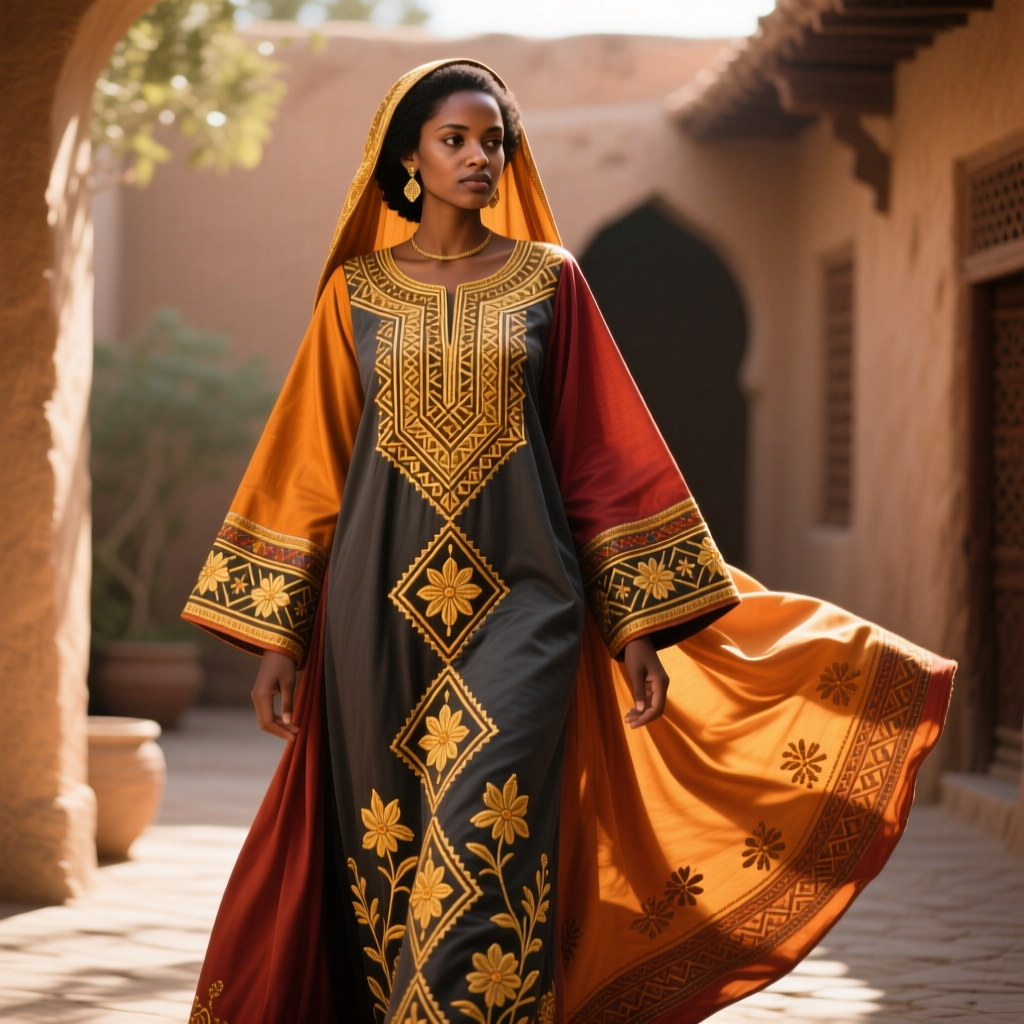
The Habesha Kemis is more than a garment. It is a woven chronicle of identity, faith, and artistry that has clothed the women of Ethiopia and Eritrea for centuries. Crafted from hand-spun cotton and finished with bands of vivid, geometric embroidery known as tibeb, this ankle-length dress carries the memory of ancient kingdoms, Orthodox liturgy, and the quiet labor of generations of weavers and needleworkers. To study the Habesha Kemis is to read a textile language — one where every stitch, color, and motif speaks of region, status, occasion, and belonging.
Unlike many traditional garments that have retreated into ceremonial use, the Habesha Kemis remains a living wardrobe. It is worn to church on Sundays, to weddings, to coffee ceremonies, and increasingly to offices and diaspora gatherings around the world. Its endurance is a testament to the resilience of Ethiopian textile culture — a culture shaped by the highlands of the Horn of Africa, insulated by mountains, and refined through millennia of trade along the Red Sea. In this article, we trace the heritage of the Habesha Kemis and its defining ornament, the tibeb, from its Axumite roots to its modern revival.
Ancient Roots: From Axum to the Highlands
The lineage of the Habesha Kemis reaches back to the Aksumite Empire, which flourished between the first and eighth centuries across what is now northern Ethiopia and Eritrea. Archaeological evidence and early iconography suggest that wrapped and draped cotton garments were already in use among the elite, often adorned with woven borders that signaled rank. The word habesha itself — a cultural identifier for the Semitic-speaking peoples of the highlands — became inseparable from a shared aesthetic of dress: lightweight, undyed cotton against richly embroidered bands.
With the adoption of Christianity in the fourth century under King Ezana, textile culture absorbed a new layer of meaning. The white, luminous quality of handwoven cotton came to symbolize purity and was adopted for liturgical use by priests and congregants alike. The netela — the shawl-like wrap that accompanies the Kemis — evolved as both a modesty garment and a marker of reverence, draped over the shoulders in specific ways depending on whether one was praying, mourning, or celebrating. This liturgical dimension ensured the survival of the garment through centuries of political upheaval; the church became its most faithful custodian.
Trade routes linking the highlands to the Red Sea ports also introduced silk threads, metallic yarns, and dyestuffs that would eventually transform the tibeb from modest woven borders into the elaborate embroidered panels recognized today. By the medieval period, the silhouette of the Habesha Kemis — a loose, flowing dress with a V-neckline, three-quarter sleeves, and ornamental bands at the hem, cuffs, and front placket — was firmly established.
Cultural Significance & the Language of Dress
In Ethiopian and Eritrean society, clothing has never been merely functional. The Habesha Kemis operates as a visual grammar. The width, density, and palette of the tibeb can indicate a woman's region, age, marital status, and the formality of the occasion. A narrow, restrained border might be worn for daily life or church; a wide, densely stitched panel in gold and crimson is reserved for weddings and major holidays such as Timkat (Epiphany) and Meskel (the Finding of the True Cross).
The accompanying netela carries its own vocabulary. The way it is folded and draped — over one shoulder, across both, or pulled up over the head — communicates respect, grief, prayer, or festivity. Elders in rural communities can still read these cues fluently, though the subtleties are fading in urban settings. For a deeper look at how draped garments encode meaning across cultures, our heritage archive surveys parallel traditions from West Africa to South Asia.
The Kemis also plays a central role in rites of passage. A young woman's first full Habesha Kemis is often gifted at confirmation or before marriage, and heirloom dresses — sometimes more than a century old — are passed from mother to daughter. In diaspora communities, wearing the Kemis has become an act of cultural affirmation, a way of making the homeland visible in cities from Washington, D.C. to Stockholm.
The Craftsmanship of Tibeb Embroidery
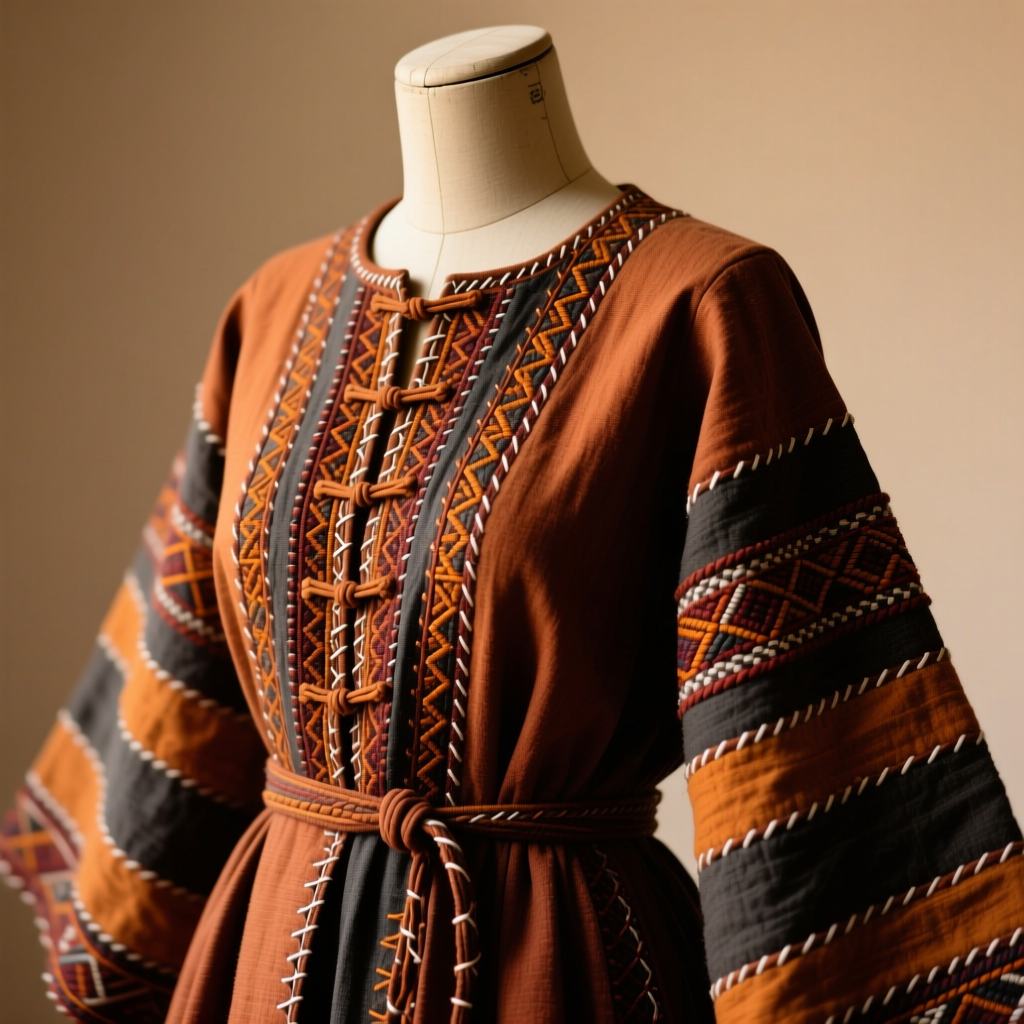
The soul of the Habesha Kemis is its tibeb — the ornamental bands that frame the dress. Historically, tibeb was woven directly into the fabric on narrow pit looms by male weavers known as shemanes, using supplementary weft threads of colored cotton or silk. Over time, especially from the nineteenth century onward, hand embroidery began to supplement and sometimes replace woven borders, allowing for greater complexity and personalization.
Traditional tibeb motifs are overwhelmingly geometric: crosses, diamonds, interlaced stars, stepped pyramids, and stylized floral forms. Many of these patterns echo the carved stonework of rock-hewn churches such as those at Lalibela, and several carry explicit Christian symbolism — the eight-pointed star, for instance, references resurrection, while repeated crosses anchor the garment in faith. In Muslim Harari and eastern communities, motifs shift toward arabesques and curvilinear vines, reflecting a different devotional aesthetic.
The execution of fine tibeb is painstaking. A single hem panel on a wedding Kemis can require hundreds of hours of hand stitching, typically performed by women working in cooperatives or family workshops. The base cloth — known as shemma — is woven from hand-spun cotton in narrow strips that are then sewn together, leaving faint seam lines that are considered part of the garment's authenticity. For readers interested in the global family of embroidered textiles, our guide to embroidered heritage garments places the tibeb alongside Palestinian tatreez and Mexican Otomi work.
Materials, Techniques & the Weaving Process
Authentic Habesha Kemis begins with cotton. Traditionally, this was locally grown, hand-ginned, and spun on a drop spindle called a inzirtib, producing a yarn with slight irregularities that give the finished shemma its characteristic soft luster. Today, while industrially spun cotton is common for everyday pieces, connoisseurs still prize hand-spun fabric for its drape and breathability in the highland climate.
The weaving itself is done on a horizontal pit loom, usually operated by men from weaving castes whose craft has been passed patrilineally for generations. The weaver produces long, narrow strips — typically between thirty and fifty centimeters wide — which are then cut and joined by a tailor. The tibeb may be woven as part of the strip, added afterward as a separate woven band, or embroidered directly onto the finished garment using silk, cotton, or metallic thread. The most luxurious contemporary pieces incorporate zari, a gold- or silver-wrapped thread imported historically from India via the port of Massawa.
Dyeing, when it occurs, traditionally relied on plant sources: indigo for deep blues, safflower and turmeric for yellows, madder for reds. Synthetic dyes have largely replaced these, but a small revival movement among artisan cooperatives in Addis Ababa and Mekelle is returning to botanical dyes for premium pieces, producing colors that age with a softness synthetics cannot replicate. Our garment guides include further reading on natural dyeing traditions worldwide.
Regional Variations Across the Horn
While the basic silhouette of the Habesha Kemis is consistent, regional variations are pronounced and closely guarded. In the Amhara highlands, the classic form prevails: a white shemma dress with a wide tibeb at the hem featuring crosses and geometric medallions in red, green, and gold. The accompanying netela often carries a matching border, creating a coordinated ensemble.
In Tigray, the embroidery tends to be denser and more linear, with strong vertical motifs running down the front placket and around a rounded neckline. Eritrean Kebessa communities share this northern aesthetic but often favor deeper jewel tones — emerald, burgundy, sapphire — and more extensive use of metallic thread. Among the Oromo, particularly in the Arsi and Bale zones, the Kemis may be cut fuller and paired with vivid beaded accessories, while Harari women in the east have developed a distinctive style featuring richly embroidered bodices and headwraps that draw on centuries of contact with Arabian and South Asian textile traditions.
The Gurage, in the south-central highlands, are known for exceptionally fine weaving and for incorporating subtle, tone-on-tone tibeb that rewards close inspection. Each of these regional idioms is a source of local pride, and women can often identify the origin of a Kemis at a glance — a form of sartorial literacy that persists even as internal migration and mass production blur older boundaries.
Modern Preservation & Contemporary Revival
The Habesha Kemis faces the same pressures as most heritage garments: industrial imports, shifting wardrobes, and the attrition of skilled artisans. Machine-made imitations produced overseas now flood urban markets at a fraction of the cost of handwoven pieces, and younger weavers are often drawn to more lucrative trades. Yet the picture is far from one of decline. A robust revival movement is underway, led by women's cooperatives, diaspora designers, and cultural institutions.
In Addis Ababa, ateliers such as Sabahar and Mafi Mafi have built international reputations by pairing traditional shemma weaving with contemporary silhouettes, proving that heritage techniques can sustain modern fashion houses. Ethiopian designers on global runways have reinterpreted the tibeb on jackets, trousers, and evening gowns, introducing the vocabulary of the Kemis to audiences unfamiliar with its origins. Within Ethiopia, government-supported craft fairs and the growing popularity of cultural festivals have renewed demand for authentic, hand-finished pieces.
Digital platforms have also played a role. Young Ethiopian and Eritrean creators document weaving processes, motif meanings, and styling traditions on social media, building archives that would once have been lost with their makers. Museums in Addis Ababa and Mekelle are increasingly cataloging historic pieces, and university programs in textile design now include modules on indigenous weaving. For readers interested in how other cultures are safeguarding their textile heritage, our style pages explore parallel efforts from West African kente to Andean backstrap weaving.
The future of the Habesha Kemis will likely be hybrid: rooted in hand-spun cotton and tibeb embroidery, but flexible enough to travel, to adapt, and to speak to new generations. Its survival so far — through empire, colonization, revolution, and diaspora — suggests a garment whose story is far from finished.
Frequently Asked Questions
What is the difference between a Habesha Kemis and a netela?
The Habesha Kemis is the ankle-length dress itself, while the netela is the shawl-like wrap worn over it. The netela is typically made from the same handwoven shemma cotton as the dress and often features a matching tibeb border along its edges. Together they form a coordinated ensemble, though the netela can also be worn with other garments and is removed or re-draped to signal respect, prayer, or mourning.
How long does it take to make an authentic Habesha Kemis?
A fully handwoven and hand-embroidered Habesha Kemis can require anywhere from several weeks to several months, depending on the complexity of the tibeb. The weaving of the shemma fabric alone may take two to four weeks, while an elaborate wedding tibeb with metallic thread can add another one to three months of embroidery work. Simpler everyday pieces are completed more quickly, but true artisan-grade garments remain labor-intensive by design.
Can non-Ethiopians wear the Habesha Kemis respectfully?
Generally, yes — the Habesha Kemis is widely regarded as a garment of hospitality, and Ethiopian hosts often gift or lend the dress to visitors for weddings, religious ceremonies, and cultural celebrations. The key is context: wearing one as a guest at an Ethiopian event is typically welcomed, while treating it as a costume or wearing it without understanding its significance can feel appropriative. Purchasing from Ethiopian-owned makers and cooperatives also ensures the tradition benefits its custodians.
How should a Habesha Kemis be cared for and stored?
Because the shemma fabric is handwoven cotton and the tibeb often includes delicate silk or metallic thread, gentle care is essential. Most artisans recommend hand washing in cool water with a mild detergent, avoiding agitation, and laying the garment flat to dry out of direct sunlight. Ironing should be done on a low setting with a pressing cloth over the embroidered areas. For long-term storage, fold the Kemis with acid-free tissue paper in a breathable cotton bag; plastic traps moisture and can tarnish metallic threads.
Where can I buy an authentic Habesha Kemis?
The most reliable sources are Ethiopian and Eritrean artisan cooperatives, established ateliers in Addis Ababa such as Sabahar, and diaspora-owned boutiques in cities with large Habesha communities. Look for sellers who can describe the weaving method, the origin of the cotton, and the artisans who made the piece. Mass-market online retailers often stock machine-made imitations; while affordable, these do not support the craft or carry the cultural weight of a hand-finished garment. Our garment guides include tips on identifying authentic handwoven textiles.