Zapotec Rug Weaving: The Living Heritage of Oaxaca's Textile Tradition
Zapotec Rug Weaving: The Living Heritage of Oaxaca's Textile Tradition
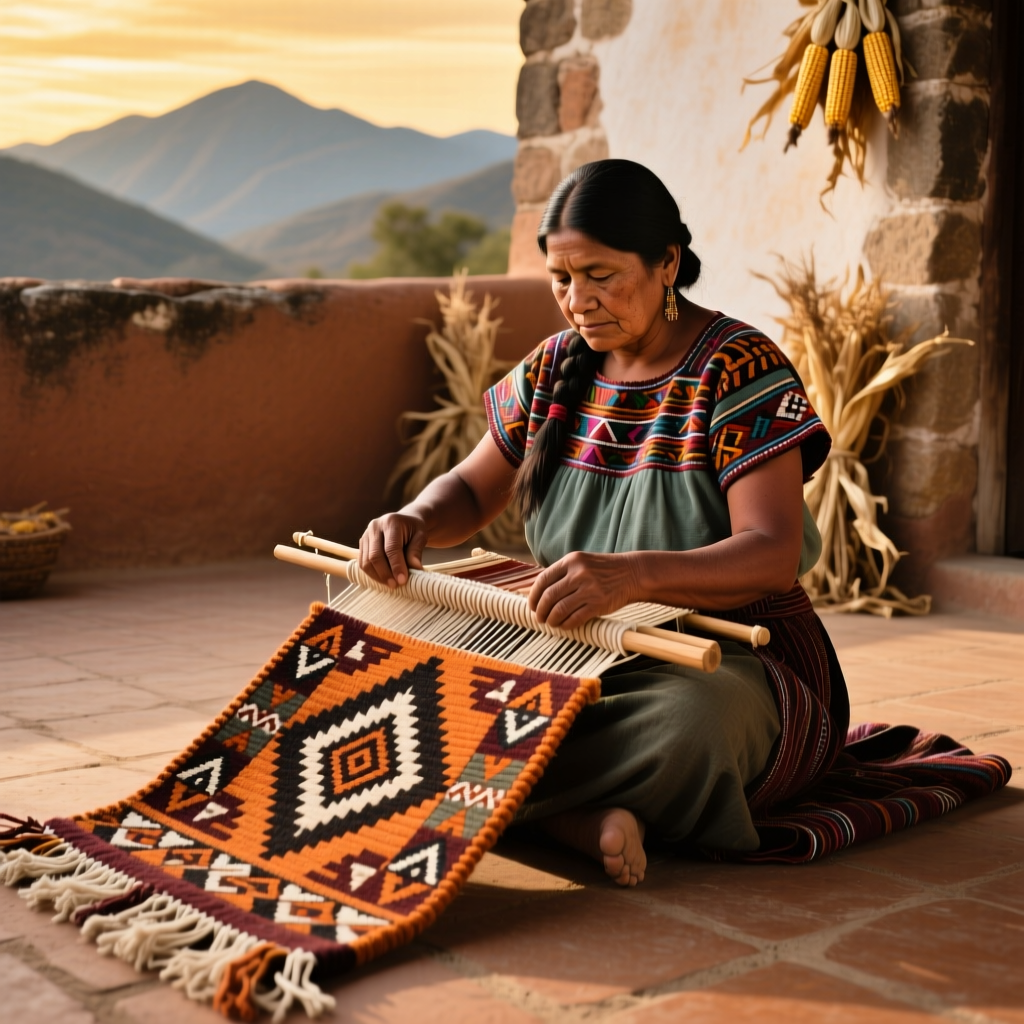
In the sun-drenched valleys of Oaxaca, Mexico, a rhythmic clatter echoes through adobe workshops as it has for centuries. Wooden looms, warped with cotton and wool, produce some of the most extraordinary textiles ever conceived by human hands. Zapotec rug weaving is not merely a craft — it is a living language of color, geometry, and ancestral memory that stretches back to the very foundations of Mesoamerican civilization. To understand these textiles is to understand a people who have woven their cosmology, their struggles, and their identity into every fiber.
The Zapotec civilization, one of the oldest in the Americas, flourished in the Valley of Oaxaca for millennia before European contact. While their monumental architecture at Monte Albán and their hieroglyphic writing system speak to a society of remarkable sophistication, it is arguably their textile tradition that most intimately carries the spirit of Zapotec culture into the modern era. Today, the village of Teotitlán del Valle stands as the beating heart of this heritage, where generations of weaving families continue to produce rugs and tapestries that honor ancient methods while adapting to contemporary aesthetics. For those who appreciate the intersection of cultural heritage and artisanal craftsmanship, the story of Zapotec weaving is both humbling and inspiring.
Ancient Roots: The Historical Origins of Zapotec Weaving
The origins of Zapotec textile production reach deep into pre-Columbian history. Archaeological evidence from sites throughout the Valley of Oaxaca reveals that weaving was already a well-established practice among the Zapotec people long before the arrival of the Spanish. Fragments of cloth, spindle whorls, and representations of weavers in Zapotec codices and stone carvings attest to the central role that textiles played in daily life, religious ceremony, and social hierarchy.
Before European contact, Zapotec weavers worked primarily with native cotton and fibers derived from agave and yucca plants. The backstrap loom — a deceptively simple device that uses the weaver's own body weight to maintain tension on the warp threads — was the primary tool of production. This technology, which appears throughout the ancient Americas, allowed weavers to produce intricate brocades and gauze weaves of extraordinary delicacy. Textiles served as tribute, as ceremonial garments, as markers of social rank, and as sacred offerings to the gods. The act of weaving itself carried profound spiritual significance, often associated with the feminine creative force and the cyclical nature of existence.
The Spanish conquest of the sixteenth century brought dramatic changes to Zapotec weaving practices. European colonizers introduced the pedal loom — a larger, foot-operated frame loom that enabled the production of wider, heavier textiles at a faster pace. They also brought sheep, whose wool would become the dominant fiber in Zapotec rug production. The combination of indigenous design sensibility with European technology created a hybrid tradition that defines Zapotec rug weaving to this day. Dominican missionaries further influenced the craft by introducing new motifs drawn from European decorative arts, including Greek key patterns, fleur-de-lis forms, and Christian iconography. Yet the underlying geometric logic and symbolic vocabulary of Zapotec design proved remarkably resilient, absorbing these foreign elements and transforming them into something distinctly Oaxacan.
The village of Teotitlán del Valle, located approximately thirty kilometers east of Oaxaca City, emerged as the principal center of rug production during the colonial period. The village's name itself — meaning "place of the gods" in Nahuatl — speaks to its deep spiritual heritage. Here, weaving knowledge passed from parent to child across countless generations, with each family developing its own signature patterns, dye recipes, and quality standards. This familial transmission of knowledge remains the backbone of the tradition, ensuring that techniques refined over centuries are not lost to the homogenizing forces of industrial production. For more on how traditional textile practices shape contemporary wardrobes, explore our guide to artisanal textiles in modern fashion.
The Alchemy of Color: Natural Dyes and Material Mastery
Perhaps no aspect of Zapotec rug weaving captures the imagination quite like the tradition of natural dyeing. In an era when synthetic dyes dominate global textile production, Zapotec artisans continue to extract a breathtaking palette of colors from the plants, insects, and minerals of the Oaxacan landscape. This knowledge — painstakingly accumulated over generations — represents a form of chemical expertise that modern science has only recently begun to fully appreciate.
The crown jewel of the Zapotec dye repertoire is cochineal (Dactylopius coccus), a tiny scale insect that lives on the pads of the nopal cactus. When dried and ground, cochineal yields carminic acid, one of the most powerful and lightfast natural colorants known to humanity. The range of hues achievable from cochineal is astonishing: by manipulating the pH of the dye bath with acidic agents like lime juice or alkaline substances like wood ash, skilled dyers can produce colors spanning from vivid scarlet and deep burgundy to soft rose, dusky mauve, and even warm lavender. The Spanish crown recognized the value of cochineal almost immediately after the conquest, and it quickly became one of the most lucrative exports from colonial Mexico — second only to silver in economic importance. Today, cochineal remains central to the identity of authentic Zapotec textiles, and its cultivation continues in the gardens of Teotitlán del Valle.
Beyond cochineal, the Zapotec dye palette draws from a remarkable diversity of botanical and mineral sources. Indigo, obtained from the leaves of Indigofera suffruticosa (known locally as añil), produces rich blues that range from pale sky to deep navy. The process of extracting indigo is itself a complex fermentation technique requiring considerable skill and patience. Marigold flowers (cempasúchil), the same blossoms used to honor the dead during Día de los Muertos celebrations, yield warm yellows and golden oranges. Pecan shells and oak bark contribute deep browns and tans. The wild sage known as muicle (Justicia tinctoria) produces dark greens and near-blacks when used in combination with iron mordants. Lichen scraped from rocks provides subtle earth tones, while pomegranate rinds offer warm ambers and rusts.
The dyeing process itself is an exercise in patience and precision. Wool must first be thoroughly cleaned and then treated with a mordant — typically alum — to ensure that the dyes bond permanently with the fiber. The wool is then immersed in dye baths that may simmer for hours or, in the case of indigo, undergo repeated dipping and oxidation cycles. Master dyers develop an intuitive understanding of how variables such as water temperature, mineral content, dye concentration, and immersion time interact to produce specific colors. This knowledge is often guarded as a family secret, passed down through oral tradition rather than written formula. The result is wool of extraordinary depth and luminosity — colors that seem to glow from within rather than sitting on the surface of the fiber. Learn more about the importance of natural fibers and dyes in heritage textile production.
Symbolism and Design: Reading the Visual Language of Zapotec Rugs
To the untrained eye, a Zapotec rug may appear as a beautiful but purely decorative arrangement of geometric forms. In reality, these textiles constitute a sophisticated visual language whose symbols carry layers of cultural meaning accumulated over thousands of years. Understanding this language transforms the experience of viewing a Zapotec rug from aesthetic appreciation to genuine cultural encounter.
The diamond or rhombus motif is among the most ubiquitous and significant elements in Zapotec design. Often positioned at the center of a rug's composition, the diamond represents the four cardinal directions and the cyclical movement of the sun across the sky. In Zapotec cosmology, the universe is organized around these cardinal points, each associated with specific colors, deities, and natural forces. The diamond thus serves as a kind of cosmological map, placing the viewer at the center of a sacred geography. Variations of this motif — nested diamonds, diamonds within borders, diamonds combined with stepped frets — create virtually infinite possibilities for artistic expression while maintaining their symbolic core.
The stepped fret pattern, known in Spanish as grecas, is another defining element of Zapotec textile design. This motif bears a striking resemblance to the carved stone fretwork found on the facades of pre-Columbian buildings at Mitla, the ancient Zapotec religious center. The continuous, angular line that doubles back upon itself is understood to represent the cyclical nature of life, death, and rebirth — a concept central to Zapotec spirituality. Some scholars have also interpreted the stepped fret as a representation of the winding path of the feathered serpent, a deity of immense importance throughout Mesoamerica. The precision with which weavers execute these patterns, maintaining perfect symmetry across large textiles without the aid of drawn templates, speaks to a mastery born of decades of practice.
Animal motifs appear frequently in Zapotec rugs, ranging from stylized representations of birds, serpents, and jaguars to more naturalistic depictions influenced by modern artistic trends. The serpent holds particular significance as a symbol of wisdom, fertility, and the life force that flows through the earth. Birds — especially eagles and quetzals — represent the celestial realm and the connection between the human and divine. The butterfly, with its metamorphic life cycle, symbolizes transformation and the soul's journey. Pre-Columbian motifs drawn directly from the archaeological record at Monte Albán and Mitla have experienced a revival in recent decades, as younger weavers seek to reconnect with their ancestral heritage and distinguish their work in an increasingly competitive market.
Color choices in Zapotec rugs are never arbitrary. Red, derived from cochineal, is associated with the sun, blood, and the life force. Blue, from indigo, evokes water, rain, and the celestial domain. Yellow and gold represent maize, abundance, and the earth's generosity. Black signifies the underworld and the mystery of death, while white symbolizes purity, light, and the bones of the ancestors. The interplay of these colors within a rug's composition creates a narrative that can be read by those literate in Zapotec visual culture — a story of cosmic balance, agricultural cycles, and the eternal dialogue between the living and the dead. For those interested in how cultural patterns influence global fashion, our article on textile patterns and their cultural meaning offers further insight.
The Weaver's Art: Craftsmanship and Technique on the Pedal Loom
The creation of a Zapotec rug is a multi-stage process that demands mastery of several distinct disciplines: fiber preparation, dyeing, loom warping, weaving, and finishing. Each stage requires specialized tools, materials, and knowledge, and the completion of a single rug can represent weeks or even months of concentrated labor.
The process begins with raw wool, traditionally sourced from local sheep herds raised in the highlands surrounding the Valley of Oaxaca. The wool is washed, carded, and spun into yarn — tasks that were historically performed by women of the household using hand spindles (malacates) or spinning wheels. While some workshops now use commercially prepared yarn for certain purposes, the finest Zapotec rugs continue to feature hand-spun wool, whose slight irregularities give the finished textile a warmth and character that machine-spun yarn cannot replicate. The spinning process itself requires considerable skill: the spinner must maintain consistent thickness and twist throughout hundreds of meters of yarn, adjusting for variations in the raw fiber.
Once the yarn is dyed and dried, the loom must be warped — a process of threading hundreds of vertical warp threads through the loom's frame in precise alignment. This task, which can take several hours even for an experienced weaver, determines the width and structural integrity of the finished rug. The warp threads are typically made of strong cotton or wool, and their tension must be perfectly uniform to ensure an even weave. Any error in warping will manifest as a flaw in the finished textile.
The weaving itself is where artistry and technical skill converge most dramatically. Working on a traditional wooden pedal loom, the weaver uses foot pedals to raise and lower alternating sets of warp threads, creating a shed through which the weft yarn is passed. The weft is beaten into place with a heavy comb or batten, and the process repeats, row after row, as the textile grows from bottom to top. For patterned rugs, the weaver must follow a precise mental or drawn template, changing weft colors at specific points to create the desired design. This requires an extraordinary capacity for spatial reasoning: the weaver must hold the entire pattern in mind while executing it one row at a time, counting threads to ensure that each geometric element is perfectly proportioned and symmetrically placed.
The finest Zapotec rugs achieve a density of approximately thirty to forty weft threads per inch, producing a textile that is both flexible and durable. Master weavers can execute complex patterns featuring multiple interlocking elements, gradient color transitions, and intricate border designs with remarkable speed and accuracy. Yet even for these experts, a large rug with elaborate patterning may require several hundred hours of weaving time. The physical demands of the work are considerable: weavers spend long hours seated at the loom, their feet working the pedals, their hands shuttling the weft, their backs and shoulders bearing the strain of repetitive motion. It is a discipline that demands not only skill but endurance, patience, and deep love for the craft. Discover more about the handwoven textiles buying guide to understand what to look for in quality artisanal pieces.
Preserving the Thread: Modern Challenges and the Future of Zapotec Weaving
Despite its deep roots and continuing vitality, Zapotec rug weaving faces a constellation of challenges that threaten its long-term survival. The pressures of globalization, shifting consumer preferences, economic hardship, and environmental change all bear upon the weavers of Teotitlán del Valle and neighboring communities, forcing difficult choices between tradition and adaptation.
One of the most pressing challenges is economic. The global market is flooded with machine-made imitations of Zapotec-style rugs, produced in factories far from Oaxaca and sold at prices that handmade textiles cannot match. These imitations dilute the brand value of authentic Zapotec weaving and create confusion among consumers who may not understand the difference between a handwoven, naturally dyed textile and a synthetic reproduction. For weaving families, the economic pressure can be devastating: young people, seeing the financial struggles of their parents and grandparents, may choose to pursue other careers, breaking the chain of intergenerational knowledge transfer that has sustained the craft for centuries.
Environmental pressures add another layer of complexity. The plants and insects used in natural dyeing depend on specific ecological conditions that are increasingly threatened by climate change, agricultural expansion, and urbanization. Cochineal cultivation, for example, requires healthy nopal cactus and specific temperature ranges; changes in rainfall patterns and rising temperatures can reduce yields and increase vulnerability to disease. Similarly, the wild plants gathered for dyeing — muicle, indigo, various lichens and barks — may become scarcer as their habitats are altered or destroyed. Some weaving families have responded by establishing their own dye gardens, cultivating key plants in controlled conditions to ensure a reliable supply.
Yet there are also powerful forces working in favor of preservation. A growing global movement valuing artisanal craftsmanship, sustainability, and cultural authenticity has created new markets for genuine Zapotec textiles among discerning consumers, interior designers, and collectors. Fair trade organizations and cultural nonprofits have helped connect weavers directly with international buyers, ensuring that a greater share of the final sale price returns to the artisans themselves. Educational initiatives within Teotitlán del Valle — including weaving cooperatives, youth apprenticeship programs, and community museums — work actively to transmit traditional knowledge to new generations while encouraging artistic innovation.
Perhaps most significantly, a new generation of Zapotec weavers is emerging that combines deep respect for tradition with entrepreneurial vision and technological savvy. These young artisans use social media and e-commerce platforms to reach global audiences, tell the stories behind their textiles, and educate consumers about the value of handmade, naturally dyed work. They experiment with contemporary color palettes and design formats while maintaining the structural integrity and symbolic depth of traditional Zapotec weaving. Some have traveled internationally to exhibit their work, participate in artist residencies, and build cross-cultural collaborations that bring fresh perspectives to the craft. Their energy and creativity suggest that Zapotec rug weaving, far from being a relic of the past, remains a living tradition capable of evolving and thriving in the modern world. Explore how heritage crafts are influencing sustainable and heritage fashion movements worldwide.
Regional Variations: Beyond Teotitlán del Valle
While Teotitlán del Valle is the most widely recognized center of Zapotec rug weaving, the broader tradition encompasses a rich tapestry of regional variations throughout the Valley of Oaxaca and beyond. Neighboring communities such as Santa Ana del Valle, San Miguel del Valle, and Díaz Ordaz each maintain their own weaving traditions, distinguished by subtle differences in design vocabulary, color preference, and technical approach.
In Santa Ana del Valle, weavers are known for their particularly fine execution of traditional Zapotec diamond and stepped fret motifs, often rendered in muted, earth-toned palettes that emphasize the natural colors of undyed wool. The community has also developed a strong tradition of producing tapetes (tapestries) featuring elaborate pictorial scenes — landscapes, village life, and pre-Columbian imagery — that showcase the weaver's ability to create curvilinear forms and shading effects within the constraints of the loom.
The Mixtec communities of the Oaxacan coast, while culturally distinct from the Zapotec, share many weaving techniques and have developed their own distinctive textile traditions that sometimes intersect with and influence Zapotec rug production. In the Mixteca Alta, weavers have preserved particularly ancient backstrap loom techniques alongside pedal loom weaving, producing textiles that bridge pre-Columbian and colonial technologies in a single piece. These regional cross-pollinations enrich the broader Oaxacan textile heritage and remind us that cultural traditions are rarely confined to neat geographic boundaries.
Within Teotitlán del Valle itself, distinct family styles have evolved over generations. Some families specialize in large-format rugs with bold, minimalist compositions; others are known for intricate all-over patterning that covers every inch of the textile surface. Certain workshops have become associated with particular innovations — the development of new dye colors, the revival of specific pre-Columbian motifs, or the creation of custom commissions for international clients. This diversity within unity is one of the great strengths of the Zapotec weaving tradition: it is a living ecosystem of artistic expression rather than a monolithic, static practice.
Frequently Asked Questions About Zapotec Rug Weaving
What makes an authentic Zapotec rug different from imitations?
An authentic Zapotec rug is handwoven on a traditional wooden pedal loom by artisans in the Valley of Oaxaca, typically using wool that has been dyed with natural colorants such as cochineal, indigo, and various plant materials. Key indicators of authenticity include slight irregularities in the weave (which reveal the human hand), the luminous depth of natural dyes (which synthetic colors cannot replicate), and the presence of traditional Zapotec design motifs executed with geometric precision. Authentic rugs often bear a tag or certificate identifying the weaver, their family workshop, and the community of origin. Machine-made imitations, by contrast, display perfectly uniform stitching, use synthetic dyes that appear flat and harsh under close inspection, and lack the structural weight and tactile warmth of handwoven wool. When purchasing, buying directly from weaving cooperatives, established artisans, or reputable fair trade dealers is the most reliable way to ensure authenticity and support the continuation of the craft.
How long does it take to weave a Zapotec rug?
The time required to produce a Zapotec rug varies enormously depending on its size, design complexity, and the fineness of the weave. A small rug with a simple geometric pattern might be completed in two to three weeks of full-time work. A large, elaborately patterned rug featuring multiple colors and intricate border designs can easily require three to six months of dedicated weaving — not counting the additional time needed for wool preparation, dyeing, and loom warping. Some master weavers working on exceptionally fine commissioned pieces may invest a year or more in a single textile. This substantial time investment is a key factor in the cost of authentic Zapotec rugs and underscores the importance of valuing handmade textiles as works of art rather than mass-produced commodities.
Are natural dyes truly more durable than synthetic alternatives?
Natural dyes, when properly prepared and applied with appropriate mordants, can be remarkably durable — as evidenced by textile fragments from pre-Columbian and colonial Oaxaca that retain vivid color centuries after their creation. Cochineal, in particular, is renowned for its exceptional lightfastness and resistance to fading. Indigo, which bonds with fiber through a unique chemical process rather than requiring a mordant, is equally long-lasting. However, the durability of natural dyes does depend on proper technique: insufficient mordanting, inadequate rinsing, or the use of inferior dye materials can result in colors that bleed or fade prematurely. Well-made naturally dyed Zapotec rugs, cared for properly (kept out of prolonged direct sunlight, cleaned gently, and stored in dry conditions), will maintain their beauty for generations. Many collectors and connoisseurs actually prefer the way natural dyes age, developing a rich patina that synthetic dyes cannot achieve.
How can I incorporate Zapotec rugs into modern interior design?
Zapotec rugs are remarkably versatile design elements that can anchor a wide range of interior styles, from bohemian and eclectic to minimalist and contemporary. Their geometric patterns and rich color palettes make them natural focal points in living rooms, studies, and bedrooms. In modern spaces, a single large Zapotec rug can provide warmth and visual interest against neutral walls and simple furnishings. Many interior designers use Zapotec textiles as wall hangings, where their artistry can be appreciated without the wear that floor use entails. Smaller pieces work beautifully as accent rugs in entryways or as decorative throws on furniture. When selecting a rug for your space, consider the room's existing color palette and choose a textile whose dominant hues complement or thoughtfully contrast with your décor. For more inspiration on integrating heritage textiles into contemporary spaces, browse our heritage textiles home styling resources.
What is the best way to care for and maintain a Zapotec rug?
Proper care will ensure that a Zapotec rug remains beautiful and structurally sound for decades. Regular vacuuming (without a beater bar, which can damage the fibers) keeps dust and grit from grinding into the wool. Rotate the rug periodically to ensure even wear if it is used on the floor. Avoid prolonged exposure to direct sunlight, which can gradually fade even the most lightfast natural dyes. If the rug becomes wet, allow it to dry completely in a well-ventilated area to prevent mildew. For deeper cleaning, professional textile cleaning is recommended rather than home washing, as immersion in water can cause colors to bleed and fibers to shrink. Minor repairs — such as re-securing loose fringe or reinforcing a worn edge — should be addressed promptly to prevent further damage. With thoughtful care, a Zapotec rug is not merely a purchase but an heirloom that can be passed down through generations, carrying with it the story of its makers and the enduring legacy of one of the world's great textile traditions.
The story of Zapotec rug weaving is, at its heart, a story of resilience. Through conquest, colonization, revolution, and the relentless pressures of globalization, the weavers of Oaxaca have maintained their craft, adapting its forms while preserving its essential spirit. Each rug that emerges from a Teotitlán workshop is more than a decorative object — it is an act of cultural continuity, a declaration that indigenous knowledge and artistic vision have enduring value in a rapidly changing world. For those who choose to bring a Zapotec textile into their homes, the reward is not only the beauty of the object itself but the privilege of participating in the preservation of one of humanity's most remarkable creative traditions. Explore more of our heritage textile guides to deepen your understanding of the world's artisanal craft traditions.