Aso Oke: The Handwoven Cloth of Yoruba Heritage
Aso Oke: The Handwoven Cloth of Yoruba Heritage
In the vibrant tapestry of West African textile traditions, few fabrics command the reverence and admiration that Aso Oke does among the Yoruba people of southwestern Nigeria. Translated literally from the Yoruba language, Aso Oke means "top cloth" or "high-status cloth" — a name that immediately signals its prestigious position within Yoruba society. For centuries, this handwoven fabric has served as far more than a mere garment; it is a living archive of cultural identity, social standing, artistic expression, and spiritual belief, woven thread by thread into the very fabric of Yoruba life.
The story of Aso Oke stretches back hundreds of years, rooted in the ancient weaving traditions of the Yoruba city-states. Historical accounts and oral traditions suggest that the craft of strip-weaving was well established among Yoruba communities long before European contact, with master weavers occupying respected positions within their societies. The towns of Iseyin, Oyo, and Ilorin emerged as major centers of Aso Oke production, each developing distinctive styles and techniques that persist to this day. From royal courts to wedding ceremonies, from chieftaincy coronations to religious festivals, Aso Oke has remained the definitive textile of Yoruba ceremonial life — a cloth that speaks before the wearer ever utters a word.
In this comprehensive exploration, we journey through the history, craftsmanship, cultural significance, regional variations, and modern preservation of Aso Oke, illuminating why this extraordinary handwoven cloth continues to captivate generations and inspire designers, scholars, and cultural custodians around the world. For a broader look at traditional African textiles and their global influence, explore our heritage collection of garment histories from across the continent.
The Cultural Significance of Aso Oke in Yoruba Society
To understand Aso Oke is to understand the Yoruba worldview — a perspective in which cloth is never simply cloth. In Yoruba philosophy, what a person wears communicates volumes about who they are, where they come from, and what they value. Aso Oke sits at the very apex of this sartorial language, reserved for moments of profound importance and worn by individuals whose roles carry deep communal significance.
Ceremonial and Rite-of-Passage Garments
Aso Oke is indispensable in virtually every major Yoruba ceremony. At traditional weddings, known as engagement ceremonies or traditional introductions, the bride and groom are adorned in matching Aso Oke ensembles that symbolize unity, prosperity, and the blessing of ancestral spirits. The bride typically wears a wrapper skirt (iro), a blouse (buba), a shawl (iborun), and a head tie (gele), all crafted from coordinated Aso Oke fabric. The groom dons a flowing agbada or dashiki paired with Aso Oke trousers (sokoto) and a cap (fila). These coordinated outfits are not merely aesthetic choices; they represent the merging of two families and the weaving together of two destinies.
At chieftaincy coronations, Aso Oke takes on an even more sacred dimension. A new chief is draped in specific patterns and colors that denote rank, lineage, and the particular office being assumed. The cloth becomes a form of investiture — without it, the ceremony is incomplete. Similarly, during funerary rites for elders and community leaders, Aso Oke is used to honor the deceased, with family members wearing specific weaves that signal their relationship to the departed and their commitment to preserving the family legacy.
Social Status and Identity Markers
Historically, the quality, complexity, and type of Aso Oke a person wore communicated their social rank with remarkable precision. Certain patterns were reserved exclusively for royalty — kings (Obas) and their immediate families — while other designs were appropriate for chiefs, priests, warriors, or wealthy merchants. The weight and thickness of the cloth, the fineness of the threads, and the inclusion of metallic or silk accents all contributed to a garment's prestige value.
This system of textile-based social coding meant that Aso Oke functioned as a visual language readable by anyone familiar with Yoruba cultural norms. A person arriving at a gathering in a particular Aso Oke pattern could be identified by their community of origin, their family lineage, and their social standing before any verbal introduction took place. In this way, the cloth served as both personal adornment and public biography. For more on how traditional garments communicate identity across cultures, visit our garment guides section.
Spiritual and Symbolic Dimensions
Beyond social signaling, Aso Oke carries deep spiritual resonance within Yoruba cosmology. Many traditional patterns incorporate motifs inspired by proverbs, natural phenomena, and spiritual concepts. The belief that cloth can carry ashe — the Yoruba concept of divine energy and life force — elevates Aso Oke from a material object to a vessel of spiritual power. Weavers historically observed rituals and taboos during the production process, and certain cloths were consecrated for use in religious ceremonies dedicated to Yoruba deities (Orishas).
White Aso Oke, for instance, is closely associated with Obatala, the Orisha of creation, purity, and wisdom. Devotees of Obatala wear white Aso Oke during festivals and sacred gatherings as an outward manifestation of their spiritual devotion. Dark indigo varieties may be linked to other deities or used in rituals requiring specific energetic properties. This interweaving of the material and the spiritual is one of the most remarkable aspects of Yoruba textile culture.
The Craftsmanship Behind Every Thread
The creation of Aso Oke is a meticulous, labor-intensive process that demands years of apprenticeship and a deep understanding of both materials and mechanics. Unlike industrially produced fabrics, every meter of authentic Aso Oke bears the unmistakable imprint of human hands — slight variations in tension, the rhythm of the weaver's movements, and the creative decisions made in real time at the loom.
Materials: From Cotton Fields to Silk Threads
Traditional Aso Oke is woven primarily from locally sourced cotton, which is spun into thread by hand or with simple spinning tools. The cotton used in premium Aso Oke is known for its durability and softness, qualities that improve with age and wear. In addition to cotton, weavers have historically incorporated silk threads — originally obtained by unraveling imported silk fabrics from trans-Saharan trade routes and later sourced directly as silk yarn. The introduction of silk, known in Yoruba as sanyan, revolutionized Aso Oke production, allowing weavers to create fabrics with a lustrous sheen that cotton alone could not achieve.
Metallic threads, particularly gold and silver-colored yarns, were introduced in more recent centuries and have become a hallmark of celebratory Aso Oke, especially for weddings and festivals. The combination of cotton, silk, and metallic threads allows weavers to achieve extraordinary textural and visual complexity within a single cloth. The selection and preparation of materials is itself a specialized skill, with some families guarding secret techniques for dyeing and treating threads that have been passed down through generations.
The Narrow-Strip Loom and Weaving Technique
Aso Oke is woven on a traditional narrow-strip loom, a device that produces long, narrow bands of fabric typically measuring between four and ten centimeters in width. This strip-weaving technique is common across West Africa, but the Yoruba have developed it to an exceptionally high level of sophistication. The loom is operated primarily by men in most Yoruba weaving communities, though women have historically played crucial roles in spinning thread, dyeing, and designing patterns.
The weaver sits at the loom, manipulating heddles and a shuttle to interlace warp and weft threads in complex patterns. The foot pedals control the raising and lowering of warp threads, while the hands guide the shuttle and beat the weft into place with a wooden sword or reed. The rhythmic clatter of the loom is a familiar sound in weaving towns like Iseyin, where generations of artisans have honed their craft. A single strip of Aso Oke may take several days to complete depending on the complexity of the pattern, and a full garment requires multiple strips sewn together edge to edge with remarkable precision.
Pattern Design and Color Mastery
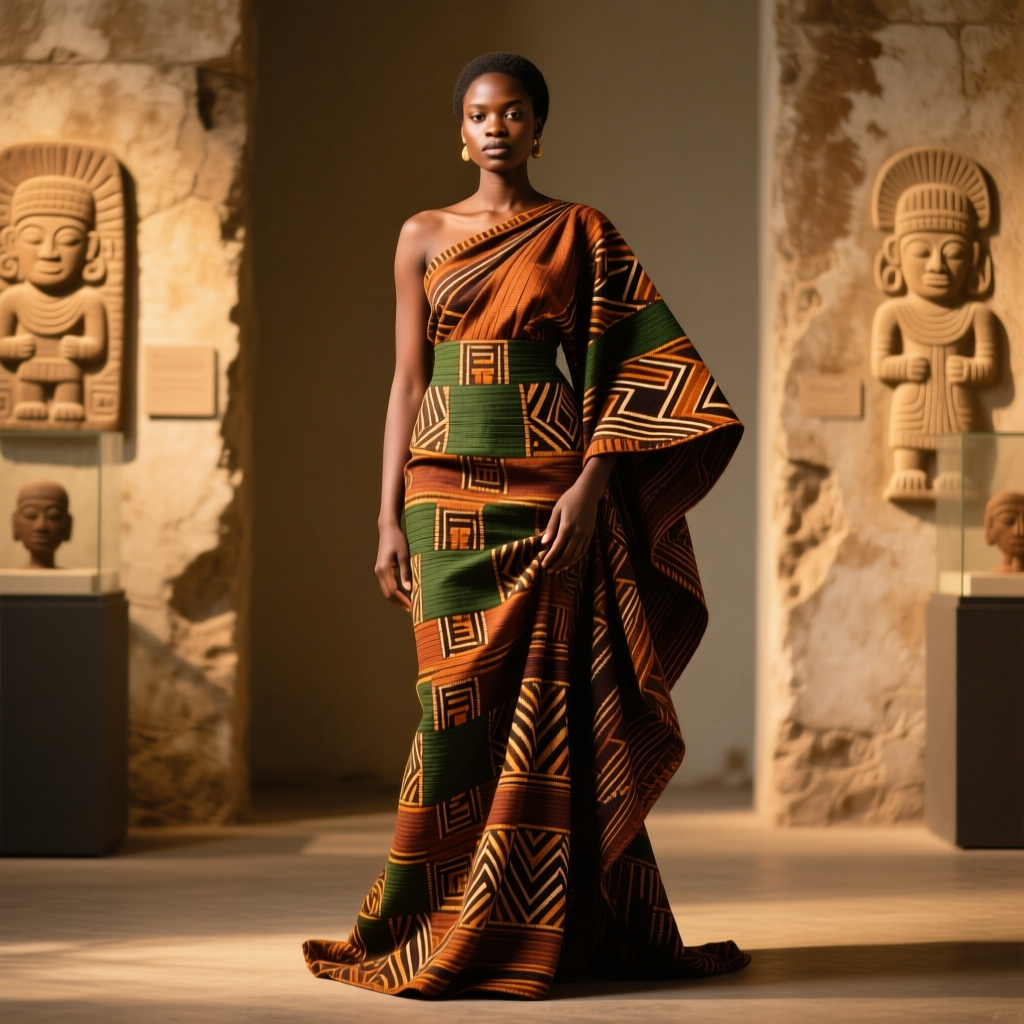
The patterns woven into Aso Oke are not random; they follow established design vocabularies that carry names, meanings, and histories. Some patterns are geometric — zigzags, diamonds, and parallel lines — while others depict stylized representations of animals, plants, or objects from daily life. Master weavers are expected to know dozens of traditional patterns and to understand the appropriate contexts for each one.
Color selection is equally deliberate. Indigo, achieved through natural dyeing with fermented indigo leaves, is one of the most prized colors in Yoruba textile culture, symbolizing depth, wisdom, and endurance. The process of achieving a rich, dark indigo can involve repeated dipping and oxidation over many days. Other traditional colors include white (purity and spirituality), red (vitality and power), green (fertility and growth), and gold (wealth and prestige). The interplay of these colors within a single cloth creates visual narratives that are both beautiful and meaningful. Learn more about natural dyeing traditions in our indigo dyeing heritage guide.
Regional Variations: Iseyin, Oyo, Ilorin, and Beyond
While Aso Oke is recognized as a distinctly Yoruba textile, its expression varies significantly across different towns and regions. These variations reflect local resources, historical trade relationships, aesthetic preferences, and the influence of individual master weavers whose innovations became community standards.
Iseyin: The Weaving Capital
The town of Iseyin, located in present-day Oyo State, is widely regarded as the heartland of Aso Oke production. Weaving has been the dominant occupation in Iseyin for centuries, and the town's identity is inseparable from the loom. Iseyin weavers are known for their technical precision and their mastery of complex multi-color patterns. The town produces a wide range of Aso Oke types, from everyday fabrics to the most elaborate ceremonial cloths commissioned by royalty and wealthy patrons.
Iseyin is particularly famous for its etu cloth — a dark indigo Aso Oke with fine white or light blue pinstripes that is considered one of the most prestigious traditional fabrics in Yorubaland. The production of etu requires exceptional skill in both dyeing and weaving, as the deep indigo background must be perfectly uniform and the thin stripes must be absolutely straight across the entire length of the narrow strip. Etu is traditionally worn by elders, chiefs, and individuals of high social standing.
Oyo: Royal Weaving Traditions
As the historical capital of the Oyo Empire, the city of Oyo developed Aso Oke traditions closely tied to royal patronage. The Aláàfin (king) of Oyo and his court were major consumers of fine textiles, and weavers in and around Oyo developed specialized patterns and techniques to meet the demands of the royal household. Oyo-style Aso Oke tends to feature bold, large-scale patterns with strong color contrasts, reflecting the imperial grandeur associated with the empire.
The alaari cloth, a richly colored Aso Oke often featuring deep reds, magentas, and purples, is particularly associated with the Oyo region. This cloth is frequently worn at festivals and celebrations where visual impact and exuberance are valued. The Oyo tradition also includes the production of heavily embroidered Aso Oke garments, where the woven cloth serves as a foundation for additional decorative needlework.
Ilorin: The Northern Crossroads
Ilorin occupies a unique position in Yoruba textile history due to its location at the cultural crossroads between the Yoruba south and the Hausa-Fulani north. This geographical position has resulted in Aso Oke styles that incorporate influences from both traditions. Ilorin weavers are known for their skill with silk and their use of intricate, small-scale geometric patterns that sometimes echo the aesthetics of Saharan and Sahelian textile traditions.
The sanyan cloth — woven from wild silk threads that produce a natural beige or tan fabric with a distinctive sheen — is strongly associated with Ilorin and the broader northern Yoruba region. Sanyan is prized for its natural beauty and its connection to trans-Saharan trade networks that historically brought silk, salt, and other luxury goods into Yorubaland. Wearing sanyan signals sophistication, historical awareness, and an appreciation for the finest natural materials.
Contemporary Regional Blending
In modern times, increased mobility and communication between weaving communities have led to a blending of regional styles. Weavers in Lagos, Abeokuta, and other urban centers draw on techniques and patterns from multiple traditions, creating hybrid Aso Oke fabrics that reflect the cosmopolitan nature of contemporary Yoruba society. While some traditionalists lament the dilution of distinct regional identities, others see this cross-pollination as a natural evolution that keeps the craft vital and relevant. Discover more about how regional textile traditions interact in our style exploration pages.
Aso Oke in Modern Fashion and Cultural Preservation
Far from being a relic of the past, Aso Oke has experienced a remarkable renaissance in contemporary fashion and cultural life. Designers, entrepreneurs, and cultural advocates have found innovative ways to honor the cloth's heritage while introducing it to new audiences and new applications.
Contemporary Fashion and Design Innovation
Modern Nigerian and diaspora fashion designers have embraced Aso Oke as a source of inspiration and a material for high-fashion creations. Runway shows in Lagos, London, Paris, and New York have featured Aso Oke reinterpreted as structured blazers, evening gowns, handbags, shoes, and accessories. The cloth's inherent texture, rich color palettes, and cultural depth make it an irresistible medium for designers seeking to create garments that are both visually stunning and culturally meaningful.
Some designers work directly with traditional weavers, commissioning custom Aso Oke fabrics that meet the specifications of modern garment construction while preserving authentic weaving techniques. This collaborative approach supports weaving communities economically while ensuring that traditional skills remain in active practice. Others incorporate Aso Oke panels or accents into garments made primarily from other fabrics, creating fusion pieces that bridge traditional and contemporary aesthetics. For more on how heritage textiles influence modern wardrobes, see our traditional-to-modern wardrobe guide.
Preservation Efforts and Educational Initiatives
The preservation of Aso Oke weaving traditions has become a priority for cultural organizations, educational institutions, and government agencies in Nigeria. Apprenticeship programs, weaving cooperatives, and cultural festivals dedicated to textile heritage help ensure that young people have opportunities to learn the craft. Organizations such as the Nike Art Gallery and various cultural foundations in Osogbo, Abeokuta, and Iseyin offer training programs that pair young aspiring weavers with master artisans.
Academic research has also played a crucial role in documenting Aso Oke traditions. Ethnographers, art historians, and textile scholars have recorded patterns, techniques, oral histories, and cultural contexts that might otherwise have been lost. Museums in Nigeria and abroad maintain collections of historical Aso Oke fabrics that serve as reference points for contemporary weavers and as educational resources for the public.
Economic Empowerment and Sustainable Production
The global interest in handmade, ethically produced textiles has created new economic opportunities for Aso Oke weavers. International buyers, interior designers, and fashion houses increasingly seek out authentic handwoven fabrics, and Aso Oke's reputation for quality and cultural authenticity positions it well in this market. Weaving cooperatives, particularly those led by women in communities where female weavers have become more common, have leveraged this demand to build sustainable livelihoods.
Sustainability is another area where traditional Aso Oke production holds important lessons for the broader textile industry. The use of natural fibers, hand-operated looms that require no electricity, and natural dyeing processes represent an environmentally responsible approach to textile production that stands in stark contrast to the resource-intensive practices of fast fashion. As consumers worldwide become more conscious of the environmental and social costs of their clothing choices, Aso Oke offers a compelling model of slow, meaningful, and culturally rich garment production. Explore more about sustainable heritage textiles in our heritage archives.
Challenges and the Path Forward
Despite its resilience, Aso Oke production faces significant challenges. The availability of cheap, machine-made imitations from overseas factories threatens to undercut the market for authentic handwoven cloth. Young people in weaving communities may be drawn to more lucrative or less physically demanding occupations, potentially disrupting the transmission of skills from one generation to the next. Additionally, the rising cost of raw materials — particularly high-quality cotton and silk — puts economic pressure on weavers who must balance quality with affordability.
Addressing these challenges requires a multi-faceted approach that includes intellectual property protection for traditional designs, investment in weaving infrastructure, marketing support for artisan cooperatives, and continued cultural education that reinforces the value of authentic Aso Oke within Yoruba communities and beyond. The future of Aso Oke depends not only on the skill of weavers but on the collective commitment of consumers, designers, policymakers, and cultural custodians to honor and sustain this extraordinary tradition.
Frequently Asked Questions About Aso Oke
What is the difference between Aso Oke and other African woven textiles like Kente?
While both Aso Oke and Kente are prestigious West African strip-woven textiles, they originate from different cultural traditions and exhibit distinct characteristics. Aso Oke is a Yoruba textile from southwestern Nigeria, typically woven in narrower strips and featuring patterns that reflect Yoruba cosmology, proverbs, and social structures. Kente originates from the Ashanti and Ewe peoples of Ghana and Togo, and is known for its bold, large-scale geometric patterns and vibrant color blocks. The looms, weaving techniques, pattern vocabularies, and cultural contexts differ significantly between the two traditions, though both serve as markers of prestige and cultural identity within their respective societies. Both textiles share the strip-weaving method, but the aesthetic and cultural languages they speak are uniquely their own.
How long does it take to weave a complete Aso Oke outfit?
The time required to produce a complete Aso Oke outfit varies enormously depending on the complexity of the design, the quality of materials used, and the skill level of the weaver. A simple, single-color Aso Oke wrapper might take a skilled weaver three to five days to complete. A full ceremonial outfit for a bride or groom — consisting of multiple garments with intricate multi-color patterns, silk threads, and metallic accents — can require two to four weeks of dedicated weaving. Additional time must be factored in for thread preparation, dyeing, and the sewing together of strips into finished garments. Commissioning a custom Aso Oke outfit from a master weaver is therefore a process that requires patience and planning, often beginning months before the intended occasion.
Can Aso Oke be worn by people who are not Yoruba?
Aso Oke is widely appreciated and worn by people from many cultural backgrounds, both within Nigeria and internationally. Within Nigeria, it is common for non-Yoruba individuals to wear Aso Oke at Yoruba ceremonies, weddings, and cultural events as a sign of respect and participation. Internationally, Aso Oke has been embraced by fashion enthusiasts, collectors, and designers who value its beauty and craftsmanship. As with any cultural garment, the key consideration is respectful engagement — understanding the significance of the cloth, purchasing from authentic sources that support Yoruba weaving communities, and wearing it in appropriate contexts. Many Yoruba people take pride in seeing their textile heritage appreciated globally and view the broader adoption of Aso Oke as a positive form of cultural exchange.
How should Aso Oke garments be cared for and maintained?
Proper care is essential to preserving the beauty and longevity of Aso Oke garments. Because the fabric is handwoven from natural fibers, it requires gentler handling than industrially produced textiles. Dry cleaning is generally recommended, particularly for Aso Oke containing silk or metallic threads, as machine washing can damage the delicate weave and cause colors to bleed. When storing Aso Oke, it should be kept in a cool, dry place away from direct sunlight, which can fade natural dyes over time. Some people wrap their Aso Oke garments in acid-free tissue paper or clean cotton cloth to protect them from dust and moisture. With proper care, a high-quality Aso Oke garment can last for decades and even be passed down as a family heirloom, gaining sentimental and cultural value with each generation.
Where can authentic Aso Oke fabric be purchased?
Authentic Aso Oke can be purchased directly from weaving communities in Nigeria, particularly in towns like Iseyin, Oyo, Ilorin, and Osogbo, where markets and weaving cooperatives offer a wide selection of fabrics. In major Nigerian cities such as Lagos, Ibadan, and Abuja, specialized textile markets and boutiques carry curated collections of Aso Oke. For buyers outside Nigeria, reputable African textile dealers, online marketplaces specializing in handmade crafts, and cultural festivals often feature authentic Aso Oke. When purchasing, it is important to distinguish between genuine handwoven Aso Oke and machine-made imitations, which are typically lighter, more uniform, and lack the subtle irregularities that characterize true handwoven cloth. Supporting authorized dealers and cooperatives helps ensure that weavers receive fair compensation for their extraordinary skill and labor.
Aso Oke is more than a textile — it is a testament to the Yoruba people's enduring commitment to beauty, meaning, and cultural continuity. Every thread carries the weight of history, the creativity of the artisan, and the aspirations of a civilization that has always understood the profound power of what we wear. Whether draped over the shoulders of a bride, displayed in a museum, or reimagined on a contemporary runway, Aso Oke continues to weave its story — one strip, one pattern, one generation at a time.