Adinkra Cloth: Akan Printing Heritage
Long before the advent of mass-produced textiles, the Akan people of Ghana and Côte d'Ivoire developed one of West Africa's most philosophically profound textile traditions. Adinkra cloth printing is not merely a method of decorating fabric — it is a visual language, a philosophical treatise rendered in dye and stamp, and a living testament to a civilization that chose to encode its deepest wisdom into the very garments its people wore. Each symbol pressed into the cloth carries centuries of accumulated knowledge about life, death, morality, resilience, and the human condition. To understand Adinkra is to understand a worldview that has survived colonialism, globalization, and the relentless march of industrialization, emerging not as a relic but as a vibrant, evolving tradition that continues to speak to new generations.
The tradition originates primarily from the Asante (Ashanti) and Gyaman kingdoms, where Adinkra cloth was historically reserved for royalty, spiritual leaders, and significant ceremonial occasions. Today, it stands as one of Africa's most recognizable and culturally significant textile arts, admired and studied worldwide. For those interested in the broader landscape of cultural heritage textiles, Adinkra offers a uniquely philosophical entry point — a tradition where every motif is a proverb, every pattern a lesson, and every cloth a story waiting to be read.
The Historical Origins and Evolution of Adinkra Cloth
The origins of Adinkra cloth printing trace back several centuries to the Gyaman kingdom, which spanned parts of present-day Ghana and Côte d'Ivoire. According to oral tradition, the practice is linked to a Gyaman king named Nana Kwadwo Agyemang Adinkra, who is said to have originally developed the symbols and their application to cloth. The Asante people, following their military conquest of the Gyaman in the early nineteenth century, adopted and expanded the tradition, elevating it to an art form of extraordinary sophistication and cultural depth.
Initially, Adinkra cloth was the exclusive domain of Asante royalty and aristocracy. The finest pieces were commissioned for funerals of paramount chiefs and kings, where the cloth served both as mourning attire and as a medium for communicating philosophical messages about the transition between life and death. The word "Adinkra" itself is often translated as "to part" or "to say goodbye," underscoring the tradition's deep association with funerary rites and the contemplation of mortality.
Over time, the use of Adinkra expanded beyond royal courts. By the mid-twentieth century, the cloth had become accessible to a broader segment of Ghanaian society, worn at funerals, festivals, naming ceremonies, and other significant communal gatherings. The town of Ntonso, located in the Ashanti Region of Ghana, emerged as the recognized center of Adinkra production and remains so to this day. Artisans in Ntonso have preserved and transmitted the knowledge of dye preparation, stamp carving, and symbol application across countless generations, maintaining techniques that have changed remarkably little over the centuries.
The evolution of Adinkra also reflects broader shifts in West African society. As trade routes expanded and new materials became available, artisans incorporated innovations while preserving core methods. The introduction of commercially produced cotton fabrics, for instance, supplemented but never replaced the hand-woven strip cloth traditionally used as a base. Similarly, while synthetic dyes have entered the market, the most revered Adinkra cloths continue to employ the traditional adinkra aduru — a dark, vegetable-based dye derived from the bark of the kuntunkuni tree and iron slag. This commitment to authentic materials is part of what makes Adinkra a cornerstone among natural dye textile traditions worldwide.
The Cultural Significance and Philosophy Behind Adinkra Symbols
What distinguishes Adinkra from many other textile printing traditions around the world is the extraordinary philosophical depth embedded in its visual vocabulary. There are well over eighty documented Adinkra symbols, each carrying a specific name, meaning, and associated proverb or philosophical concept. These symbols do not function as mere decoration; they constitute a sophisticated system of visual communication that encodes the ethical, spiritual, and social values of the Akan people.
Consider the symbol known as Gye Nyame, perhaps the most widely recognized of all Adinkra motifs. Its name translates to "except for God" or "I fear none but God," and it expresses the omnipotence and supremacy of the divine. The symbol's sweeping, asymmetric curves suggest both the vastness of creation and the humility of the human soul before a higher power. It appears on everything from cloth to architecture to jewelry, serving as a constant reminder of spiritual surrender and faith.
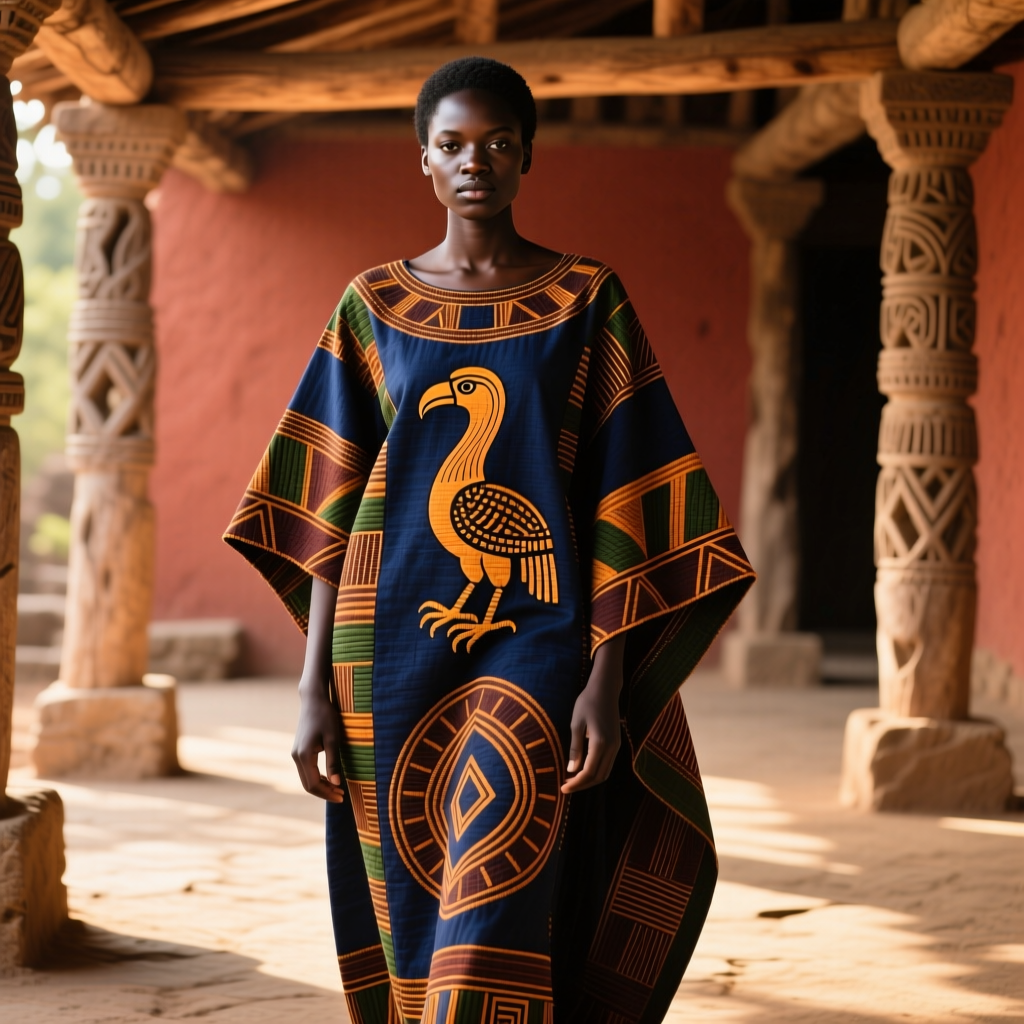
Another profoundly significant symbol is Sankofa, depicted as a bird turning its head backward to retrieve an egg from its tail, or sometimes as a stylized heart shape. Sankofa translates to "go back and get it," encapsulating the Akan belief that understanding the past is essential to building the future. This symbol has achieved global resonance, adopted by African diaspora communities and social justice movements as an emblem of historical reclamation and cultural memory. Its message — that there is no shame in returning to retrieve what has been lost or forgotten — speaks to a universal human experience.
The symbol Dwennimmen, representing ram's horns, conveys the concept of humility alongside strength. The ram, known for its power and tenacity in battle, is also an animal that bows its head when approaching an opponent — a metaphor for the idea that true strength requires humility and that even the powerful must exercise restraint. Similarly, Funtunfunefu Denkyemfunefu — the Siamese crocodiles — depicts two crocodiles sharing a single stomach, symbolizing unity in diversity and the futility of internal conflict. The associated proverb reminds communities that infighting harms all parties since they ultimately share the same destiny.
These symbols function within a broader Akan philosophical framework that emphasizes communal responsibility, moral integrity, respect for ancestors, and the interconnectedness of all living things. When an individual selects or commissions an Adinkra cloth, the choice of symbols is deeply intentional. A cloth worn to a funeral might feature Owuo Atwedee (the ladder of death), which reminds the living that death is a universal journey — every person must climb the same ladder. A cloth for a celebration or wedding might feature Osram Ne Nsoromma (the moon and the star), representing love, faithfulness, and harmony in partnership.
The philosophical richness of Adinkra has attracted scholarly attention from linguists, semioticians, and cultural anthropologists who recognize in these symbols a form of visual literacy that predates and operates independently of written language. For readers exploring the intersection of meaning and material culture, our guide to symbolic patterns in textiles provides further context on how cultures worldwide have woven meaning into fabric.
The Craftsmanship: Techniques, Tools, and Materials
The creation of an authentic Adinkra cloth is a labor-intensive, multi-step process that demands considerable skill, patience, and knowledge passed down through apprenticeship. Every stage — from the preparation of the dye to the carving of the stamps to the final pressing of symbols onto cloth — involves specialized techniques that have been refined over generations.
Preparing the Dye
The traditional Adinkra dye, known as adinkra aduru, is produced through a process that can take several days. Artisans harvest bark from the kuntunkuni tree (Ceiba pentandra) and soak it in water, then boil it for extended periods. Iron slag or rusted metal is added to the mixture, which reacts with tannins in the bark to produce a deep, dark brownish-black color. The resulting dye is thick, rich, and remarkably colorfast — cloths dyed with adinkra aduru can retain their deep tones for decades when properly cared for. The dye is strained and sometimes further reduced over low heat to achieve the desired consistency, which must be thick enough to hold the impression of a stamp without bleeding into the surrounding fabric.
Carving the Stamps
The stamps used to apply Adinkra symbols are traditionally carved from the bottom of calabash gourds. An artisan selects a mature calabash, cuts it to produce a flat surface, and then painstakingly carves the desired symbol in relief. The carving must be precise — too shallow, and the stamp will not hold enough dye to produce a clear impression; too deep, and the lines become muddied and indistinct. Master stamp carvers are highly respected within the artisan community, as their work directly determines the clarity and beauty of the finished cloth. Some carvers maintain collections of dozens or even hundreds of stamps, each representing a different Adinkra symbol.
In more recent decades, some artisans have experimented with rubber and other materials for stamp production, but calabash remains the preferred medium for traditionalists. The organic texture of calabash imparts a subtle quality to the printed impression that synthetic materials cannot replicate — a slight irregularity that is considered a hallmark of authenticity and handcraftsmanship.
Printing the Cloth
The printing process begins with the preparation of the base cloth. Traditionally, this is a hand-woven cotton strip cloth, though commercially woven cotton is also widely used today. The cloth is often dyed a base color before printing — traditionally deep red, russet brown, or dark blue, each carrying its own symbolic associations. Red cloths are most commonly associated with funerals and mourning, while lighter or brighter base colors may be used for celebratory occasions.
The printer lays the cloth flat on a padded surface and begins applying symbols in a carefully planned grid pattern. Using a comb-like tool made from bamboo or palm rib, the artisan first marks out guidelines to ensure even spacing and alignment. The calabash stamp is then pressed into the dye and applied to the cloth with firm, even pressure. Each impression must be consistent with those around it — the spacing, orientation, and depth of color must remain uniform across the entire surface of the cloth.
A single Adinkra cloth may contain hundreds of individual stamp impressions, and a large ceremonial cloth can take a skilled artisan an entire day or more to complete. The repetition of a single symbol across the cloth creates a powerful visual rhythm, while some cloths combine multiple symbols to convey layered messages. The borders and edges often feature different symbols or decorative patterns that frame the central field of the design.
The mastery required for this process places Adinkra printing firmly among the world's great handcraft traditions. Those interested in learning more about traditional garment construction and handcraft techniques may find our handcrafted garments guide a valuable companion resource.
Regional Variations and Stylistic Distinctions
While Ntonso in the Ashanti Region is widely recognized as the heartland of Adinkra production, the tradition exhibits meaningful regional variations that reflect local histories, aesthetic preferences, and cultural exchanges. These variations enrich the broader Adinkra tradition and demonstrate its adaptability across different communities and contexts.
In the Ashanti Region itself, cloths produced in and around Kumasi tend to feature dense, tightly packed symbol arrangements with a strong emphasis on traditional funerary motifs. The color palette leans heavily toward dark backgrounds — deep maroon, black, and dark brown — reflecting the region's historical association with royal Asante funeral customs. The symbols used are often the most classical and widely recognized, including Gye Nyame, Sankofa, and Dwennimmen, arranged in strict geometric grids that convey order, discipline, and reverence.
In contrast, Adinkra producers in the Brong-Ahafo Region and parts of the Western Region have developed somewhat looser compositional styles, sometimes incorporating larger-scale symbols or more experimental arrangements. These artisans may combine Adinkra stamping with other decorative techniques, such as resist dyeing or hand-painting, creating hybrid textiles that push the boundaries of the traditional form. The color palette in these regions may also include lighter tones — yellows, greens, and undyed whites — particularly for cloths intended for non-funerary occasions.
Across the border in Côte d'Ivoire, where the Gyaman people maintain their own Adinkra-related traditions, the cloths often display subtle differences in symbol interpretation and application. Some symbols found in Ivorian Gyaman cloth are not part of the standard Asante Adinkra repertoire, suggesting that the original Gyaman tradition contained unique elements that were partially lost or transformed during the Asante adoption. Scholars and cultural preservationists continue to document these variations, recognizing that each regional expression holds irreplaceable knowledge about the tradition's evolution.
Contemporary designers and fashion houses, both within Ghana and internationally, have introduced further stylistic variations. Adinkra symbols now appear on silk, linen, denim, and synthetic fabrics, applied through screen printing, digital printing, and other modern techniques alongside traditional hand-stamping. While purists may debate the authenticity of these adaptations, they have undeniably expanded the global visibility of Adinkra and introduced the tradition to audiences who might never have encountered it otherwise. The intersection of heritage and contemporary fashion is a theme explored further in our African textile fashion style guide.
Modern Preservation, Global Influence, and Cultural Stewardship
Like many traditional craft practices around the world, Adinkra cloth printing faces a complex set of challenges in the modern era. The availability of cheap, mass-produced imitations — fabrics printed with Adinkra symbols using industrial processes and sold at a fraction of the cost of hand-stamped cloth — threatens the economic viability of traditional artisans. Young people in producing communities may be drawn to more lucrative or less labor-intensive careers, raising concerns about the intergenerational transmission of knowledge. Additionally, the widespread commercial use of Adinkra symbols on products ranging from coffee mugs to mass-market T-shirts has sparked ongoing conversations about cultural appropriation, intellectual property, and the ethics of profiting from indigenous cultural heritage.
Despite these challenges, significant efforts are underway to preserve and promote authentic Adinkra traditions. In Ghana, organizations such as the National Cultural Centre in Kumasi and various artisan cooperatives in Ntonso have established training programs, workshops, and apprenticeship initiatives designed to attract young people to the craft. These programs emphasize not only the technical skills of dye preparation and stamp carving but also the philosophical and historical knowledge that gives the symbols their meaning. An Adinkra artisan who can stamp a symbol but cannot explain its meaning is, in the view of traditionalists, only half-trained.
International interest in Adinkra has also contributed to preservation efforts. Universities, museums, and cultural institutions around the world have organized exhibitions, research projects, and artist residencies centered on Adinkra traditions. The symbols have been adopted by architects, graphic designers, educators, and community organizers who recognize their power as visual tools for conveying complex ideas. In the United States, Sankofa in particular has become a widely recognized emblem within African American communities, appearing in murals, community centers, and educational materials that emphasize the importance of historical awareness and cultural continuity.
Ghana's intellectual property framework has also evolved to address concerns about the unauthorized commercial exploitation of Adinkra and other traditional cultural expressions. The Ghanaian Copyright Act includes provisions for the protection of folklore, and efforts continue to develop more robust mechanisms for ensuring that communities of origin benefit from the commercial use of their cultural heritage. These legal frameworks, while imperfect, represent important steps toward recognizing traditional knowledge as a form of intellectual property deserving of protection and respect.
Tourism has played a dual role in Adinkra preservation. Cultural tourism in the Ashanti Region brings visitors to Ntonso and other production centers, providing economic support for artisan communities and raising global awareness of the tradition. However, the demand for inexpensive souvenirs can also incentivize the production of lower-quality, simplified cloths that prioritize speed and volume over craftsmanship and meaning. Balancing accessibility with authenticity remains an ongoing challenge for the communities that steward this tradition.
For those who wish to support authentic Adinkra traditions, the most meaningful approach is to seek out cloths produced by recognized artisan cooperatives and to understand the symbols and their significance before making a purchase. An authentic, hand-stamped Adinkra cloth is not merely a textile — it is a work of cultural art, carrying within it the accumulated wisdom of generations. When displayed in a home or worn at a significant occasion, it serves as a bridge between the past and the present, between the Akan philosophical tradition and the wider world. Our guide to ethical textile sourcing offers additional perspective on how to engage with traditional textile arts responsibly.
Frequently Asked Questions
What is the difference between Adinkra cloth and Kente cloth?
While both Adinkra and Kente are iconic Ghanaian textile traditions associated with the Asante people, they are fundamentally different in technique, appearance, and cultural function. Kente is a woven cloth, created on narrow-strip looms using brightly colored silk and cotton threads arranged in complex geometric patterns. Adinkra, by contrast, is a printed cloth — symbols are stamped onto a base fabric using carved calabash stamps and vegetable-based dye. Historically, Kente was associated with royalty, wealth, and celebration, while Adinkra was more closely linked to funerals, mourning, and philosophical reflection. Both traditions carry deep cultural significance, but they occupy different ceremonial and aesthetic spaces within Akan culture.
How can you tell if an Adinkra cloth is authentically hand-stamped?
Authentic hand-stamped Adinkra cloth exhibits several characteristics that distinguish it from machine-printed imitations. First, examine the regularity of the impressions — hand-stamped symbols will show slight variations in alignment, pressure, and ink density that are natural results of the manual process. Machine-printed fabrics will display perfectly uniform, identical repetitions. Second, authentic cloths typically use the traditional dark, vegetable-based dye, which has a distinctive matte finish and a slightly textured surface. Third, the base cloth of authentic Adinkra is usually a substantial, woven cotton rather than a thin, synthetic blend. Finally, purchasing from recognized artisan cooperatives or reputable dealers who can verify the cloth's origin is the most reliable way to ensure authenticity.
Are Adinkra symbols still being created today, or is the set of symbols fixed?
The traditional corpus of Adinkra symbols — numbering roughly eighty to one hundred well-documented motifs — is considered largely established, but the tradition is not entirely static. Contemporary artisans and scholars have occasionally proposed new symbols to address modern concepts and experiences. However, these newer symbols must gain widespread community acceptance and demonstrate the same philosophical depth as traditional motifs before they are recognized as legitimate additions to the Adinkra vocabulary. The process of acceptance is organic and community-driven, reflecting the Akan understanding that cultural traditions are living systems that can grow while remaining rooted in their foundational values.
What occasions are appropriate for wearing Adinkra cloth?
Traditionally, Adinkra cloth was most closely associated with funerals and mourning ceremonies, particularly cloths in dark red, brown, or black. However, the tradition has broadened considerably, and Adinkra cloth is now worn at a wide range of occasions depending on the color and symbols chosen. Lighter-colored cloths with celebratory or philosophical symbols may be worn at festivals, naming ceremonies, weddings, graduations, and other joyful events. Dark-colored cloths with symbols related to mortality and ancestral reverence remain the standard for funerals and memorial services. The key principle is intentionality — the wearer selects symbols and colors that are appropriate to the occasion and that communicate a meaningful message.
Where can visitors experience authentic Adinkra cloth printing in Ghana?
The village of Ntonso, located approximately twenty kilometers from Kumasi in the Ashanti Region, is the most well-known destination for visitors seeking to observe and participate in authentic Adinkra cloth production. Several artisan workshops and cooperatives in Ntonso welcome visitors, offering demonstrations of the full production process — from dye preparation and stamp carving to the final printing of cloth. The National Cultural Centre in Kumasi also features Adinkra artisans and provides educational resources about the tradition. Visitors are encouraged to approach these experiences with respect and genuine curiosity, and to support the artisan community by purchasing cloths directly from the producers. Many workshops also offer hands-on printing experiences, allowing visitors to create their own Adinkra cloth under the guidance of master artisans — an unforgettable way to connect with one of Africa's most profound cultural traditions.