What Is Traditional Irish Dress? A Complete Cultural Guide
What Is Traditional Irish Dress? A Complete Cultural Guide
When most people picture traditional Irish dress, images of flowing green cloaks, intricately cable-knit sweaters, and vibrant tartan-like patterns spring to mind. Yet the true story of what Irish people have worn across the centuries is far richer and more nuanced than any single stereotype. Ireland's sartorial heritage is a tapestry woven from Celtic mythology, rural necessity, colonial resistance, and a fierce pride in local craftsmanship. From the woolen mantles of ancient Gaelic chieftains to the world-renowned Aran sweater, traditional Irish dress tells a story of identity, resilience, and artistry that continues to captivate people around the globe.
In this comprehensive guide, we explore the origins, defining characteristics, regional variations, and enduring cultural significance of traditional Irish clothing. Whether you are a fashion historian, a heritage enthusiast, or simply curious about Celtic clothing history, this article will give you a thorough understanding of what makes Irish dress so distinctive.
The Origins and Evolution of Traditional Irish Dress
The roots of Irish dress stretch back thousands of years to the early Celtic peoples who settled the island. Archaeological evidence and early medieval manuscripts reveal that the ancient Irish wore garments fundamentally shaped by their environment: a damp, windswept Atlantic climate that demanded warmth, durability, and water resistance. Wool was the cornerstone of Irish textile production from the earliest periods, and the skills of spinning, dyeing, and weaving were deeply embedded in rural community life.
The Léine and the Brat: Ireland's Earliest Garments
The two most iconic garments of early medieval Ireland were the léine (pronounced "lay-nuh") and the brat. The léine was a long, loose-fitting tunic, typically made of linen, that fell to the knees or below. It was often dyed with saffron, giving it a distinctive golden-yellow hue — a color that became so associated with the Irish that English Tudor-era laws specifically banned saffron-dyed clothing in an attempt to suppress Irish cultural identity.
The brat was a heavy woolen cloak or mantle worn over the léine. It served as both a practical outer layer against Ireland's relentless rain and a marker of social status. Wealthier individuals wore brats made of finer wool, sometimes adorned with elaborate borders or fringe. The cloak was typically fastened at the shoulder with a brooch or pin, many of which have been recovered as stunning examples of Celtic metalwork. If you are interested in how these early garments compare to other European traditions, our guide on medieval European clothing provides further context.
The Influence of English Colonization
Beginning in the 12th century and intensifying through the Tudor and Cromwellian periods, English rule profoundly impacted Irish dress. Sumptuary laws were enacted to force the Irish to abandon their native clothing in favor of English styles. The saffron léine was outlawed, and the wearing of the Irish mantle was repeatedly prohibited. These laws were not merely about fashion — they were instruments of cultural erasure, designed to dismantle visible markers of Irish identity.
Despite these efforts, many elements of traditional dress persisted in rural and Gaelic-speaking communities, particularly in the west of Ireland. The resilience of native textile traditions, especially wool working, ensured that Irish dress never fully conformed to English norms. Instead, a hybrid style emerged over centuries that blended practical English-influenced tailoring with distinctly Irish materials and decorative sensibilities.
The 19th and 20th Century Revival
The Gaelic Revival of the late 19th and early 20th centuries sparked renewed interest in traditional Irish culture, including dress. Organizations like the Gaelic League promoted the wearing of Irish-made textiles and garments as acts of cultural and political assertion. This period saw the popularization of what many now consider "traditional" Irish dress — including the kilt (a Scottish import adapted for Irish use), the iconic Aran sweater, and the use of Celtic motifs in jewelry and accessories. The cultural heritage textiles movement played a critical role in preserving these traditions for future generations.
Defining Characteristics of Traditional Irish Clothing
Traditional Irish dress is defined not by a single uniform but by a collection of garments, materials, and decorative techniques that reflect the island's geography, history, and cultural values. Several key characteristics unite these diverse elements into a recognizable tradition.
Wool as the Foundation
If there is one material that defines Irish dress, it is wool. Ireland's lush green pastures have supported sheep farming for millennia, and the island's wool workers developed extraordinary skill in transforming raw fleece into garments of remarkable beauty and utility. From the heavy, water-resistant wool of the Aran sweater to the fine, soft yarns used in traditional knitting and weaving, wool is the thread that runs through virtually every aspect of Irish textile heritage.
Irish wool was traditionally dyed using natural pigments derived from local plants, lichens, and minerals. Common colors included deep blues from woad, rich browns and russets from onion skins and bog oak, and the vibrant purples and reds obtained from certain lichens. This connection between the land and the clothing it produced is a hallmark of traditional Irish dress and a theme explored further in our article on natural dyeing traditions.
Cable Knitting and the Aran Sweater
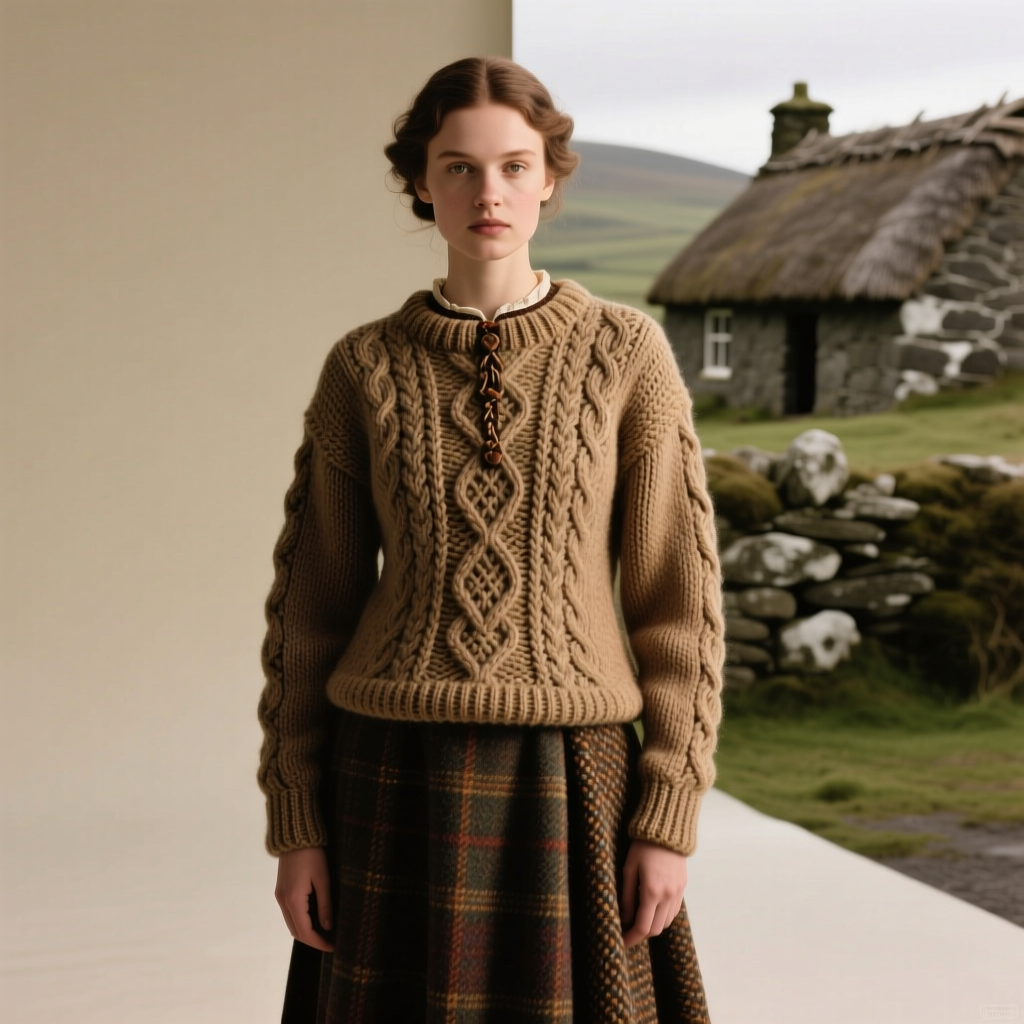
Perhaps no garment is more instantly associated with Ireland than the Aran sweater. Originating from the Aran Islands off the coast of County Galway, these heavy, cream-colored sweaters are distinguished by their intricate cable, diamond, honeycomb, and basket stitch patterns. Each pattern is said to carry symbolic meaning — the cable stitch representing fisherman's ropes, the diamond reflecting the small fields of the islands, and the honeycomb symbolizing the rewards of hard work.
While the romantic notion that specific patterns were used to identify drowned fishermen is largely a modern myth, the Aran sweater remains a masterpiece of functional artistry. The untreated wool retains its natural lanolin, making the garment remarkably water-resistant — an essential quality for the fishing communities who first wore them. For a deeper look at how knitting traditions vary worldwide, see our guide to traditional knitting techniques.
Linen and the Irish Linen Tradition
While wool dominated outerwear, linen held an equally important place in traditional Irish dress as the fabric of choice for undergarments, shirts, and household textiles. Ireland — and particularly the province of Ulster — became world-renowned for the quality of its linen production. The cool, damp climate proved ideal for growing flax, and Irish linen became a luxury export prized across Europe.
In traditional dress, linen was used for the léine in ancient times and later for shirts, blouses, and household linens. The craft of linen weaving was passed down through generations, and many of the techniques used in historic production are still practiced by artisan weavers today.
Celtic Knotwork, Claddagh, and Decorative Motifs
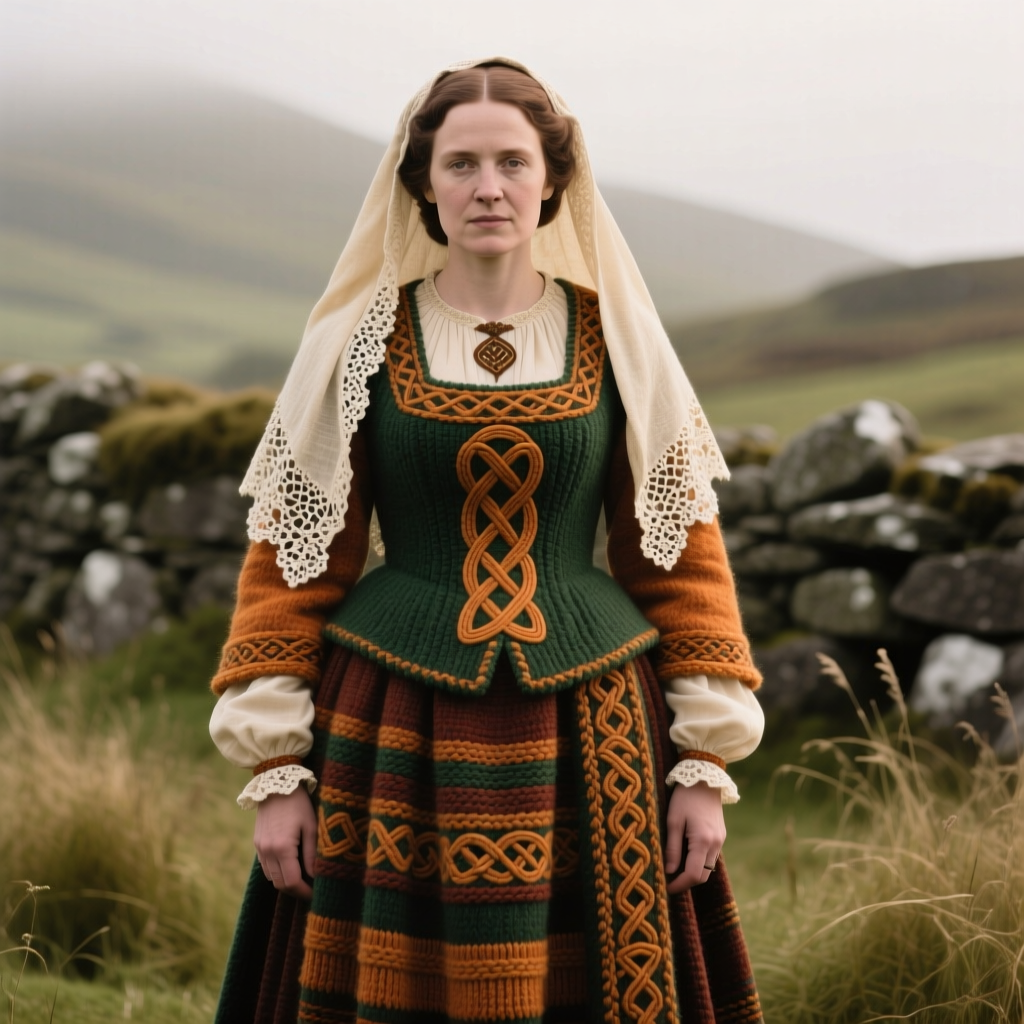
Traditional Irish dress is enriched by a vocabulary of decorative motifs drawn from Celtic art. Interlacing knotwork patterns, spirals, and zoomorphic designs appear in embroidered borders, woven bands, and metal fastenings. The Claddagh symbol — two hands holding a crowned heart — is perhaps the most recognizable Irish motif and appears frequently in jewelry, particularly rings, that complement traditional dress.
Tartan-like patterns, while more commonly associated with Scotland, also have a place in Irish textile tradition. Several Irish tartans have been registered, often associated with specific counties or families, and are used in kilts, sashes, and accessories worn at cultural events. Explore more about pattern symbolism in our piece on Celtic patterns and symbolism.
Traditional Irish Dress for Special Occasions
Traditional Irish garments take on heightened significance during cultural celebrations, religious ceremonies, and community gatherings. These occasions provide the primary contexts in which historic dress is still worn and celebrated today.
Irish Step Dancing Costumes
One of the most visible contexts for traditional Irish dress is the world of Irish step dancing, which gained global fame through productions like Riverdance. Solo dance costumes for women typically feature elaborately embroidered dresses with Celtic knotwork designs, often in rich jewel tones. These dresses are heavily structured, with stiff skirts that showcase the dancer's precise footwork. Men's dance attire tends to be simpler — typically a kilt or dark trousers paired with a jacket bearing embroidered Celtic motifs.
The embroidery on Irish dance dresses represents hundreds of hours of skilled handwork, and many designs are unique to specific dance schools or regions. The costumes are a living tradition, continually evolving while maintaining deep connections to historic Irish decorative arts.
Weddings and Formal Ceremonies
Irish weddings frequently incorporate elements of traditional dress, particularly in rural communities and among diaspora families reconnecting with their heritage. Brides may wear dresses featuring Irish lace — a tradition dating to the 19th century when lace-making provided crucial income during and after the Great Famine. Carrickmacross lace, Kenmare lace, and Irish crochet lace are all highly prized for bridal wear.
Grooms and male attendants sometimes opt for Irish-inspired formal wear, including tweed suits woven from Donegal or Connemara wool, kilts in Irish tartan, or jackets featuring subtle Celtic embroidery. The traditional wedding garments around the world guide offers a broader perspective on how cultures celebrate matrimony through dress.
St. Patrick's Day and National Celebrations
St. Patrick's Day, celebrated on March 17th, is the most prominent occasion for the display of traditional Irish dress worldwide. Parades and festivals see participants wearing everything from historically accurate reproductions of medieval Irish garments to modern interpretations featuring Aran sweaters, tweed caps, and Celtic jewelry. The wearing of green — while more of a modern convention than a historical one — has become an inseparable part of the celebration.
In Ireland itself, national celebrations and cultural festivals like the Galway International Arts Festival or local féiseanna (Irish cultural competitions) provide important platforms for the display and continuation of traditional dress practices.
Religious and Community Gatherings
In some rural Irish communities, particularly in Gaeltacht (Irish-speaking) regions, elements of traditional dress persist in everyday and Sunday-best contexts. Older residents may still wear hand-knitted Aran sweaters, woven tweed jackets, or shawls that have been passed down through families. These garments carry deep personal and communal significance, connecting wearers to ancestors and to the land itself.
Regional Variations in Irish Dress
Ireland's relatively small size belies the significant regional diversity in its traditional dress. Geography, local industry, and cultural history all shaped distinctive sartorial traditions across the island's four provinces.
The Aran Islands and the West Coast
The Aran Islands — Inis Mór, Inis Meáin, and Inis Oírr — are the undisputed heartland of Ireland's most iconic knitting tradition. The heavy, cream-colored Aran sweater was born here, developed by island women to protect their husbands and sons from the brutal Atlantic weather. The tradition remains vibrant, with several island families still producing hand-knitted sweaters using patterns and techniques passed through generations.
Beyond the sweater, the west coast of Ireland, including Connemara and the Clare coast, has a strong tradition of woven woolens. Báinín (pronounced "baw-neen"), a type of undyed woolen flannel, was historically used for work clothing throughout the region. The distinctive red and black check patterns of Connemara woven fabrics are still produced by a handful of artisan weavers.
Donegal and the Northwest
County Donegal in the northwest is renowned for its Donegal tweed, a fabric characterized by its distinctive flecks of colored yarn woven into a base of natural wool. The tweed's signature look — small nubs of dyed color scattered through undyed or lightly dyed wool — was originally achieved by using leftover dyed fibers from other projects, making it a triumph of resourcefulness as much as aesthetics.
Donegal tweed has been used for suits, jackets, caps, and coats for centuries and remains a premium fabric sought by tailors and designers worldwide. The flat cap, often called a "paddy cap" or "Irish cap," made from Donegal tweed, is an enduring symbol of Irish working-class dress. Learn more about regional textile traditions in our guide to handwoven textiles.
Ulster and the Linen Heartland
The province of Ulster, particularly counties Antrim, Down, and Armagh, developed a world-leading linen industry that shaped both the economy and the dress of the region. While the linen industry was largely industrialized by the 18th and 19th centuries, its roots lie in the domestic spinning and weaving traditions of rural Ulster households.
Traditional Ulster dress reflected the influence of Scottish settlers, particularly in counties with significant Presbyterian populations. This cross-cultural exchange introduced elements like the plaid shawl and certain tartan patterns into the local dress vocabulary, creating a distinctive regional style that differs markedly from the wool-dominated traditions of the west.
Munster and the Southern Counties
The southern province of Munster, encompassing counties like Cork, Kerry, and Limerick, has its own rich textile heritage. The city of Cork was historically a major center for wool exports, and the surrounding countryside maintained strong spinning and knitting traditions. In Kerry, the tradition of the Galway shawl (despite its name, widely worn in Munster as well) persisted well into the 20th century — a heavy, fringed woolen shawl worn over the shoulders as protection against the damp coastal climate.
Limerick lace, another Munster specialty, represents the finer end of Irish textile production and was used extensively for collars, cuffs, veils, and decorative dress elements, particularly in the 19th and early 20th centuries.
The Cultural Significance of Traditional Irish Dress
Traditional Irish dress is far more than a collection of garments — it is a living expression of cultural identity that has served as a site of resistance, pride, and community throughout Irish history. Understanding its significance requires looking beyond aesthetics to the social, political, and emotional roles that clothing has played in Irish life.
Dress as Cultural Resistance
From the Tudor sumptuary laws to the penal era, the suppression of Irish dress was a deliberate strategy of colonial control. By banning the saffron léine, the Irish mantle, and other native garments, English authorities sought to erase visible markers of Irishness and force assimilation. The persistence of these garments in rural communities — often worn in defiance of the law — represents a quiet but powerful form of cultural resistance.
This dynamic continued into the modern era. During the Irish independence movement of the early 20th century, wearing Irish-made clothing, particularly garments featuring Celtic designs or produced by Irish cooperatives, became a political statement. The Gaelic League actively promoted Irish dress as part of its broader project of cultural revival, arguing that a nation that wore the clothes of its colonizer could never be truly free.
Connection to Land and Livelihood
Every element of traditional Irish dress reflects a deep connection to the Irish landscape. The wool comes from sheep grazing on hillsides and islands. The linen is woven from flax grown in fertile river valleys. The dyes are extracted from lichens scraped from stone walls, from plants gathered in hedgerows, and from berries picked in autumn woods. To wear traditional Irish dress is, in a very real sense, to wear the land itself.
This connection is particularly poignant in the context of the Great Famine of the 1840s, when millions of Irish people died or emigrated. The textile traditions that survived the famine — knitting, weaving, lace-making — became lifelines for communities struggling to rebuild. Lace-making schools established by charitable organizations provided income for famine-affected families, and the skills learned in these schools became the foundation of lasting craft traditions.
The Irish Diaspora and Dress as Heritage
The massive emigration from Ireland, particularly during and after the famine, scattered Irish people across the globe. In countries like the United States, Canada, Australia, and Argentina, Irish communities maintained connections to their homeland through cultural practices, including dress. The wearing of Aran sweaters, Celtic jewelry, and Irish-made textiles became ways for diaspora communities to assert their identity and pass it to their children.
Today, the global appetite for traditional Irish garments — from hand-knitted Aran sweaters to Donegal tweed jackets — reflects not only appreciation for their quality and beauty but also the enduring power of clothing to connect people to their heritage. Our exploration of garments of the diaspora examines how displaced communities worldwide use dress to maintain cultural bonds.
Contemporary Revival and Modern Interpretations
In recent decades, there has been a significant revival of interest in traditional Irish textiles and garments, driven by both cultural pride and the global sustainable fashion movement. Irish designers are reinterpreting heritage techniques — Aran knitting, Donegal tweed weaving, Irish lace-making — within contemporary silhouettes, bringing traditional craftsmanship to new audiences.
Organizations like the Crafts Council of Ireland and individual artisan producers are working to preserve endangered textile skills while making them economically viable for new generations of makers. This revival ensures that traditional Irish dress remains not a museum artifact but a living, evolving tradition that continues to adapt while honoring its roots.
Frequently Asked Questions About Traditional Irish Dress
Do Irish people wear kilts?
The kilt is historically a Scottish garment, but it was adopted by some Irish cultural nationalists in the late 19th and early 20th centuries as part of the Gaelic Revival movement. Today, kilts in Irish tartans are commonly worn by pipe bands, step dancers, and at formal cultural events in Ireland and among the Irish diaspora. While not historically "native" to Ireland in the way the léine or brat are, the kilt has become an accepted part of modern Irish ceremonial dress. The saffron kilt, in particular, has become popular among Irish pipe bands and is recognized as a symbol of Irish cultural pride.
What is the difference between an Aran sweater and a regular cable-knit sweater?
A genuine Aran sweater is distinguished by several factors. First, it originates from the Aran Islands tradition and uses specific, symbolic stitch patterns — including cable, diamond, honeycomb, trellis, and blackberry stitches — arranged in panels across the body and sleeves. Second, traditional Aran sweaters are knitted from untreated, oil-rich wool (báinín) that retains its natural lanolin, making it water-resistant. Mass-produced cable-knit sweaters may mimic the visual appearance of Aran patterns but often use processed wool that lacks the functional properties of a true Aran. Hand-knitted Aran sweaters remain the gold standard and are still produced by skilled knitters in the west of Ireland.
Is there an official Irish national costume?
Ireland does not have a single, officially designated national costume in the way that some countries do. What is generally recognized as "traditional Irish dress" is a collection of garments and textile traditions that have evolved over centuries. For women, this often includes elements like the Galway shawl, Irish lace, and Celtic-inspired embroidery. For men, it may include an Aran sweater, Donegal tweed jacket, flat cap, or a saffron kilt for formal occasions. Irish step dancing costumes, while highly stylized, are perhaps the most internationally visible representation of Irish dress, though they represent a performance tradition rather than everyday historical clothing.
What fabrics are most associated with traditional Irish clothing?
The two fabrics most deeply associated with traditional Irish dress are wool and linen. Wool has been the dominant material for outerwear throughout Irish history, used for cloaks, mantles, sweaters, tweeds, and shawls. Ireland's sheep-farming heritage made wool abundant and accessible, and the island's textile workers developed extraordinary skill in spinning, dyeing, knitting, and weaving it. Linen, produced from flax, was the fabric of choice for undergarments, shirts, and fine household textiles. Ulster linen, in particular, achieved global renown for its quality. Together, these two fabrics form the material foundation of virtually all traditional Irish clothing.
Where can I buy authentic traditional Irish garments today?
Authentic traditional Irish garments can be purchased from a variety of sources. For Aran sweaters, look for producers based on or connected to the Aran Islands, and seek out hand-knitted rather than machine-knitted options for the most authentic experience. Donegal tweed jackets and caps are available from heritage mills in County Donegal, many of which offer direct sales or ship internationally. Irish lace and linen products can be sourced from specialist retailers in Northern Ireland and the Republic. When purchasing, look for provenance information — reputable sellers will provide details about where and how garments are made. Supporting artisan producers and cooperatives helps sustain these important craft traditions for future generations. For more guidance on identifying quality heritage garments, visit our guide to identifying authentic heritage garments.
Conclusion
Traditional Irish dress is a rich, multifaceted heritage that defies simple categorization. It encompasses the golden léine of ancient Gaelic lords, the water-resistant Aran sweaters of island fishermen, the delicate lace of post-famine craftswomen, and the flecked tweed of Donegal weavers. Each garment carries within it stories of the land, the people, and the historical forces that shaped them.
What makes Irish dress tradition so compelling is its continuity. Despite centuries of colonial suppression, famine, mass emigration, and rapid modernization, the core elements of Irish textile culture have survived — not as relics, but as living practices continually renewed by new generations of makers, wearers, and admirers. Whether you encounter it in a museum display, on a parade route, in a designer's collection, or on the back of a fisherman on Inis Mór, traditional Irish dress remains a powerful testament to the enduring connection between what we wear and who we are.
To continue exploring the world's rich sartorial heritage, browse our complete collection of cultural garment guides and discover how clothing tells the story of human civilization.