What is Traditional Irish Clothing Called? A Complete Guide to Celtic Attire
What is Traditional Irish Clothing Called? A Complete Guide to Celtic Attire
When people think of the Emerald Isle, images of rugged coastlines, ancient stone castles, and lush green valleys often come to mind. Yet, the cultural heritage of Ireland is woven just as intricately into its textiles as it is into its landscapes. For those exploring the rich tapestry of global fashion history, a common question arises: what is traditional Irish clothing called? Unlike the globally recognized Scottish kilt, traditional Irish dress is a multifaceted subject, encompassing ancient Gaelic tunics, heavy woolen cloaks, and iconic hand-knit sweaters.
To understand Irish clothing is to understand a history of survival, rebellion, and profound artistry. From the ancient léine and brat to the world-famous Aran sweater and Donegal tweed, the garments of Ireland tell the story of a resilient people. In this comprehensive guide, we will explore the origins, characteristics, regional variations, and enduring cultural significance of traditional Irish attire, offering a deep dive into the threads that bind the nation's history & heritage.
The Origins of Irish Dress: The Léine and the Brat
Long before the advent of modern fashion, the native Irish wore garments designed for both the damp climate and the active, agrarian lifestyle of the Celtic tribes. The foundation of early traditional Irish clothing for both men & women consisted of two primary garments: the léine and the brat.
The Léine: The Ancient Tunic
The léine (pronounced lay-na) was a long, loose-fitting tunic that served as the primary undergarment and everyday wear for the Gaelic Irish. Typically made from linen, the léine was characterized by its voluminous, pleated sleeves, which could sometimes hang down past the wrists. In the warmer months, it was worn on its own, while in the harsher seasons, it served as a base layer. The linen used was often homespun, reflecting the deep connection between the Irish people and the flax crops they cultivated. You can explore more about these early Celtic textiles and their agricultural roots in our heritage archives.
The Brat: The Cloak of the Celts
Over the léine, the Irish wore the brat, a heavy, woolen cloak that was essential for surviving the biting winds and relentless rain of the Atlantic coast. The brat was a large, rectangular or semi-circular piece of woven wool, often featuring a fringe or border. It was draped over the shoulders and fastened at the chest or neck with a brooch or pin. The lanolin naturally present in the unscoured wool made the brat remarkably water-resistant, functioning almost like a wearable shelter. For the nobility and the wealthy, the brat was a canvas for displaying status, often dyed in vibrant colors and bordered with intricate embroidery.
The Crios: The Woven Belt
To secure the voluminous léine and add a pop of color, both men and women wore a crios—a hand-woven belt. The crios was typically made from brightly dyed wool and woven using a simple but effective technique that allowed for complex geometric patterns. These belts were not merely functional; they were early expressions of Irish craftsmanship and regional identity.
Defining Characteristics of Traditional Irish Garments
Traditional Irish clothing is defined by its reliance on natural, locally sourced materials and its adaptation to the environment. The characteristics of these garments reflect a society that valued utility, warmth, and a deep respect for the natural world.
The Power of Saffron and Natural Dyes
One of the most defining characteristics of early Irish dress was the use of saffron dye. The léine croich, or saffron shirt, was a garment of immense cultural importance. Despite the name, the dye was often derived from the saffron crocus or, more commonly among the rural populace, from native plants like weld, madder root, and various lichens. The resulting hues ranged from deep mustard yellows to rich russet reds. The English crown recognized the unifying power of this native dress and frequently attempted to ban the wearing of saffron and traditional Irish mantles through various edicts, attempting to assimilate the Irish into English fashion. Learn more about the legal battles over native dress in our guide to the Brehon Laws and early sumptuary edicts.
Mastery of Wool and Linen
While linen was the fabric of the léine, wool was the undisputed king of Irish outerwear. The sheep that grazed the rocky, windswept hills of the western seaboard produced coarse, incredibly resilient fleece. Irish weavers developed specialized Gaelic weaving techniques to turn this raw material into dense, weatherproof fabrics. The interplay between the crisp, cooling properties of linen and the insulating, protective qualities of wool formed the bedrock of the traditional Irish wardrobe for centuries.
Modern Icons: Aran Sweaters, Tweeds, and the Galway Shawl
When modern audiences ask what traditional Irish clothing is called, they are often thinking of the garments that gained international prominence in the 19th and 20th centuries. While not ancient Celtic wear, these items have become the globally recognized symbols of Irish heritage.
The Aran Sweater
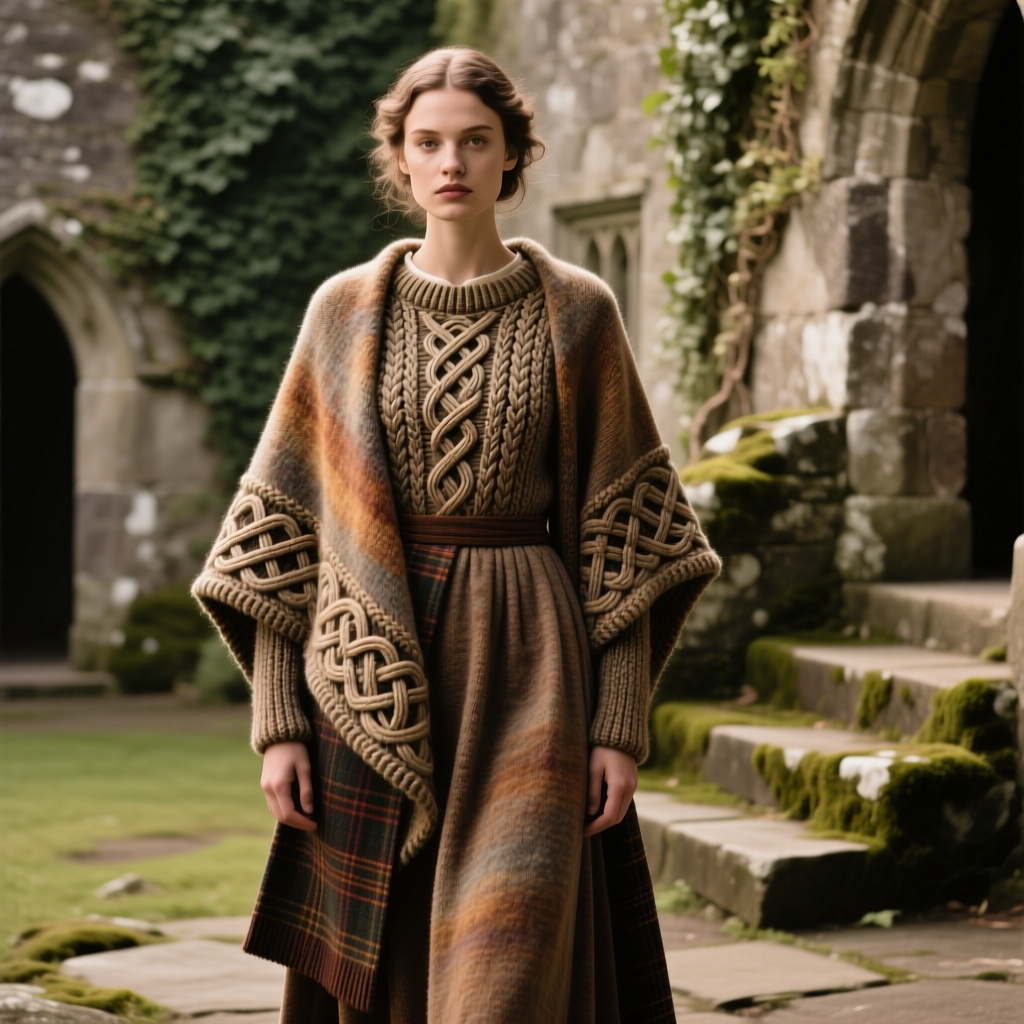
Perhaps no garment is more synonymous with Ireland than the Aran sweater. Originating from the rugged Aran Islands off the west coast of Galway, these sweaters were knit from báinín—an undyed, cream-colored wool rich in natural oils. The intricate cable, diamond, and honeycomb stitches were designed to provide maximum insulation and flexibility for fishermen battling the treacherous Atlantic. The history of the Aran sweater is one of practical necessity evolving into a global fashion icon, with each stitch pattern carrying its own folklore and symbolism.
Donegal Tweed
In the northwest of Ireland, the harsh landscape gave birth to Donegal tweed. This fabric is characterized by its distinctive "flecked" appearance, achieved by weaving small, brightly colored neps of dyed wool into a base of undyed grey or brown yarn. The colors of the neps were traditionally inspired by the local flora: moss greens, heather purples, and gorse yellows. Donegal tweed became the fabric of choice for rural workers, hunters, and eventually, high-fashion tailors worldwide. Discover the rich history of Donegal tweed and its journey from rural cottages to international runways.
The Galway Shawl
For women in the west of Ireland, the Galway shawl was a vital piece of traditional attire. Unlike the delicate lace shawls of the urban elite, the Galway shawl was a heavy, fringed garment, often woven with a central medallion and bordered with deep, contrasting colors. It was worn draped over the shoulders and crossed at the waist, providing essential warmth. The shawl was often a woman's most prized possession, passed down through generations as a family heirloom and worn on special occasions, weddings, and religious holidays.
Regional Variations Across the Emerald Isle
Ireland may be a small island, but its diverse geography and historical clan divisions led to distinct regional variations in traditional clothing. The garments worn in the rugged west differed vastly from those in the more anglicized east.
The Rugged West: Survival and Wool
In counties like Galway, Mayo, and Donegal, the climate dictated a heavy reliance on thick, unscoured wools. The clothing here was designed for survival against the elements. The Aran sweaters, heavy tweed skirts, and thick woolen shawls were uniform necessities. The weaving and knitting in these regions were largely domestic industries, carried out in small cottages where the rhythm of the loom and the knitting needles were the background music of daily life.
The East and South: Linen and Trade
In the eastern and southern provinces, where the climate was slightly milder and trade with continental Europe was more frequent, clothing tended to be lighter and more influenced by broader European trends. The linen industry thrived in the north and east, leading to finer, more delicate garments. In cities like Dublin and Cork, the urban populace adopted modified versions of English and French fashions, though rural women continued to wear the traditional red or grey woolen petticoats and cloaks well into the modern era.
The Influence of Irish Lace
While wool and linen were the fabrics of the working class, the 19th century saw the rise of Irish lace making as a premier cottage industry. Intricate crochet and needlepoint lace, developed as a famine-relief initiative, became highly sought after by royalty and the aristocracy across Europe. Lace collars, cuffs, and veils became a vital component of traditional Irish formal wear, adding a layer of delicate refinement to the robust woolen garments.
Occasions for Wearing Traditional Irish Attire
While everyday wear in Ireland has naturally aligned with global modern fashion, traditional garments are still proudly worn during specific cultural, social, and celebratory occasions.
Céilí Dancing and Cultural Festivals
The most visible display of traditional Irish clothing today occurs during Céilí dancing and cultural festivals. Female step dancers often wear elaborately embroidered dresses featuring Celtic knotwork and interlacing patterns inspired by the Book of Kells. While these heavily embellished "céilí dresses" are actually a mid-20th-century invention rather than ancient historical garb, they have become an accepted and beloved standard of Irish cultural performance. Male dancers frequently wear tweed trousers, flat caps, and sometimes the saffron kilt (a modern nationalist adaptation, discussed below).
Weddings and Heritage Celebrations
Many Irish couples choose to incorporate traditional elements into their wedding attire. Grooms might opt for a suit crafted from authentic Donegal tweed or wear a traditional Irish cloak over their shoulders for outdoor ceremonies. Brides may incorporate vintage Irish crochet lace into their veils or gowns, honoring the intricate craftsmanship of their ancestors. These choices serve as a beautiful bridge between the past & the present.
Everyday Heritage Wear
Beyond formal occasions, items like the Aran sweater, tweed caps, and woolen scarves remain staple items in the everyday Irish wardrobe, particularly during the colder months. They are worn not as costumes, but as practical, high-quality garments that carry a quiet, enduring sense of national pride.
The Cultural Significance and Heritage of Irish Dress
To ask what traditional Irish clothing is called is to ask about the identity of the Irish people themselves. Clothing in Ireland has never been merely about covering the body; it has been a tool of resistance, a marker of survival, and a medium for storytelling.
During periods of colonization, the English government frequently enacted sumptuary laws designed to eradicate native Irish culture by banning traditional dress, the Irish language, and native customs. The refusal of the rural Irish to abandon their woolen mantles and saffron dyes was a quiet but powerful act of rebellion. The brat became a symbol of the "wild" Irish, feared by colonizers because it allowed rebels to sleep outdoors in the mountains, surviving the harsh elements while evading capture.
Furthermore, the creation of these garments fostered deep community bonds. The spinning, dyeing, weaving, and knitting were communal activities, often accompanied by songs, stories, and the sharing of local news. The stitches of an Aran sweater or the weave of a tweed cloth were physical manifestations of a community's collective knowledge and care for one another. Today, preserving these Celtic textiles and techniques is a vital part of safeguarding Ireland's intangible cultural heritage.
Frequently Asked Questions
Do Irish people wear kilts?
The kilt is historically and traditionally a Scottish Highland garment, not an Irish one. However, in the late 19th and early 20th centuries, during the Gaelic Revival, Irish nationalists adopted a solid-colored (usually saffron or green) kilt as a symbol of Celtic solidarity and national pride. Today, while you will see saffron kilts worn by Irish pipe bands and step dancers, it is not an ancient native Irish garment like the léine or brat. For a deeper comparison, read our guide on Scottish kilts vs. Irish kilts.
What is the traditional Irish dress for women?
Historically, the traditional dress for Irish women consisted of a linen léine (tunic) layered under a heavy woolen brat (cloak), secured with a woven crios (belt) and a brooch. In more recent centuries, rural women traditionally wore heavy woolen skirts, often dyed red with madder root, paired with a bodice and a large fringed shawl, such as the famous Galway shawl. Formal wear later incorporated the exquisite Irish crochet lace that gained worldwide fame.
Are Aran sweater stitches really clan identifiers?
The popular myth that specific Aran sweater stitches were used to identify the bodies of drowned fishermen by their clan patterns is largely a romanticized fiction created in the mid-20th century to boost sales. In reality, the stitches were developed for their structural integrity, warmth, and aesthetic appeal. While families and local knitters certainly had their own preferred patterns and variations, they were not strict, registered clan identifiers like Scottish tartans. The true history of the Aran sweater is one of regional creativity rather than rigid heraldry.
What colors were traditionally used in Irish clothing?
Before the advent of synthetic dyes, Irish clothing relied on the colors of the natural landscape. Undyed wool provided a spectrum of creams, browns, and greys. Linen was often left in its natural pale beige or bleached in the sun. When dyes were used, saffron (yielding deep yellow/mustard), madder root (reds and rusts), and various lichens and woad (purples and blues) were popular. The Brehon Laws and later English edicts heavily regulated who could wear certain colors, with brighter, multi-colored garments often reserved for the nobility and the learned classes.
How has traditional Irish clothing influenced modern fashion?
Traditional Irish clothing has had a profound impact on global fashion, particularly through the medium of knitwear and tweed. The Aran sweater has been endlessly reinterpreted by high-fashion houses, becoming a perennial autumn and winter staple. Similarly, Donegal tweed is prized by bespoke tailors worldwide for its unique texture and heritage. The emphasis on sustainability, slow fashion, and natural fibers in the modern era has also brought renewed appreciation for the ancient, eco-friendly methods of Irish spinning, weaving, and natural dyeing.
Understanding what traditional Irish clothing is called requires looking beyond a single garment. It is a rich vocabulary of textiles—from the ancient léine and brat to the iconic Aran sweater and Donegal tweed. Each thread, stitch, and weave carries the weight of Irish history, reflecting a culture that has always found a way to weave beauty, resilience, and identity into the very fabric of its existence.