Traditional Mexican Clothing: A Complete Guide to Male & Female Garments
Traditional Mexican Clothing: A Complete Guide to Male & Female Garments
Mexico's traditional clothing is a vibrant tapestry woven from thousands of years of indigenous heritage, colonial influence, and regional identity. From the intricately embroidered huipiles of Oaxaca to the bold, silver-adorned charro suits of Jalisco, every garment tells a story of community, craftsmanship, and cultural pride. Unlike many nations where traditional dress has faded into museum displays, Mexican clothing remains a living tradition — worn at festivals, weddings, religious ceremonies, and everyday life across the country's diverse landscapes.
This comprehensive guide explores the rich world of traditional Mexican clothing for both men and women, examining the origins, defining characteristics, regional variations, and enduring cultural significance of these iconic garments. Whether you are a fashion historian, a cultural enthusiast, or simply curious about Mexico's sartorial heritage, this guide will deepen your understanding of one of the world's most colorful and meaningful clothing traditions.
Origins & Historical Foundations of Mexican Traditional Dress
To understand traditional Mexican clothing, one must look back to the civilizations that flourished long before European contact. The Aztec, Maya, Zapotec, Mixtec, and countless other indigenous peoples developed sophisticated textile traditions using locally sourced materials such as cotton, agave fibers (ixtle), and animal hides. Clothing in pre-Columbian Mexico was deeply symbolic — the type of fabric, the complexity of decoration, and the style of a garment immediately communicated the wearer's social rank, community affiliation, and spiritual beliefs.
Women typically wore a huipil (a loose, tunic-like blouse) paired with a quechquémitl (a cape-like shoulder garment) and a long wraparound skirt secured with a woven sash. Men wore a maxtlatl (loincloth) and a tilmatli (a rectangular cape tied at the shoulder), with elaborate featherwork and jade beadwork reserved for nobility and warriors.
The Spanish conquest in the early 16th century introduced new materials — wool, silk, and linen — along with European tailoring techniques, buttons, and the concept of fitted garments. The resulting fusion created an entirely new sartorial vocabulary. Indigenous weaving and embroidery traditions merged with Spanish silhouettes, producing garments like the china poblana outfit and the guayabera shirt. Over centuries, each region of Mexico developed its own distinctive styles, influenced by local climate, available resources, and the particular blend of indigenous and European heritage present in that area.
The colonial period also introduced sumptuary laws that attempted to restrict what indigenous and mixed-race people could wear. Ironically, these restrictions fueled creative resistance — communities embedded coded symbols, ancestral motifs, and subversive meanings into their embroidery and weaving patterns, ensuring that cultural identity survived despite colonial pressure. This spirit of resilience and adaptation remains visible in Mexican clothing to this day.
Iconic Traditional Garments for Women
Mexican women's traditional clothing is among the most recognizable and celebrated in the world. Characterized by bold colors, intricate embroidery, and flowing silhouettes, these garments represent centuries of artistic evolution and cultural storytelling.
The Huipil
The huipil is arguably the most iconic garment in all of Mexican women's traditional dress. This loose-fitting tunic, constructed from two or three rectangular panels of fabric joined together, has been worn continuously for over two thousand years. Huipiles are typically made from cotton or wool and are decorated with elaborate embroidery or brocade weaving that varies dramatically by region.
In Oaxaca, huipiles from the Isthmus of Tehuantepec feature large, vivid floral embroidery on dark velvet, while those from the Mixtec region showcase geometric brocade patterns woven directly on a backstrap loom. In Chiapas, Tzotzil and Tzeltal weavers create huipiles with diamond motifs representing the cosmos and serpentine patterns symbolizing fertility. Each village's huipil design is so distinctive that knowledgeable observers can identify a wearer's hometown simply by examining her garment.
The Rebozo
The rebozo is a long, flat shawl that serves as one of the most versatile garments in Mexican culture. Worn draped over the shoulders, wrapped around the head, or used to carry babies and goods, the rebozo is both practical and deeply symbolic. The finest rebozos are woven from silk or fine cotton and feature intricate rapacejo (fringe) work that can take months to complete by hand.
The town of Tenancingo in the State of Mexico is renowned for producing some of the country's finest rebozos, while the ikat-dyed rebozos of Santa María del Río in San Luis Potosí are prized for their complex patterns. A rebozo is often passed down through generations as a family heirloom, and in many communities, the way a woman wears her rebozo communicates her marital status or social role. Explore more about the artistry behind these traditional shawls and wraps in our dedicated guide.
The China Poblana
The china poblana ensemble is one of Mexico's most nationally recognized outfits, often considered the country's unofficial national dress for women. The outfit consists of a white, embroidered blouse with short puffed sleeves, a brightly colored and sequined skirt (the castor) featuring the green, white, and red of the Mexican flag, and a silk rebozo draped over the shoulders.
The origins of the china poblana are steeped in legend. Popular tradition attributes the style to an enslaved Asian woman brought to Puebla via the Manila galleon trade, whose exotic garments inspired local adaptations. Historians suggest the name more likely derives from the term china, which in colonial Mexico referred to a mixed-race woman of the servant or working class. Regardless of origin, the china poblana outfit became a symbol of Mexican national identity in the 19th century and remains a staple of patriotic celebrations and folkloric dance performances.
The Tehuana Dress
The Tehuana dress, originating from the Isthmus of Tehuantepec in Oaxaca, is perhaps the most visually striking of all Mexican traditional garments. The ensemble features a heavily embroidered velvet huipil (the huipil de tapar), a long matching skirt, and an elaborate lace headdress called a resplandor. The resplandor frames the face in a halo of white lace and can be worn folded atop the head or spread wide for ceremonial occasions.
The Tehuana dress gained international fame when artist Frida Kahlo adopted it as her signature style, using it to express her pride in indigenous Mexican heritage and her political solidarity with the matriarchal Zapotec culture of the Isthmus. Today, Tehuana dress remains everyday wear for many women in Juchitán and Tehuantepec and is worn with immense pride at festivals and velas (community celebrations).
Iconic Traditional Garments for Men
While women's traditional clothing in Mexico tends to receive more international attention, men's traditional garments are equally rich in history, craftsmanship, and cultural meaning. From the ranchlands of the north to the jungles of the Yucatán, Mexican men's traditional dress reflects the diverse lifestyles and environments of the country's many regions.
The Charro Suit
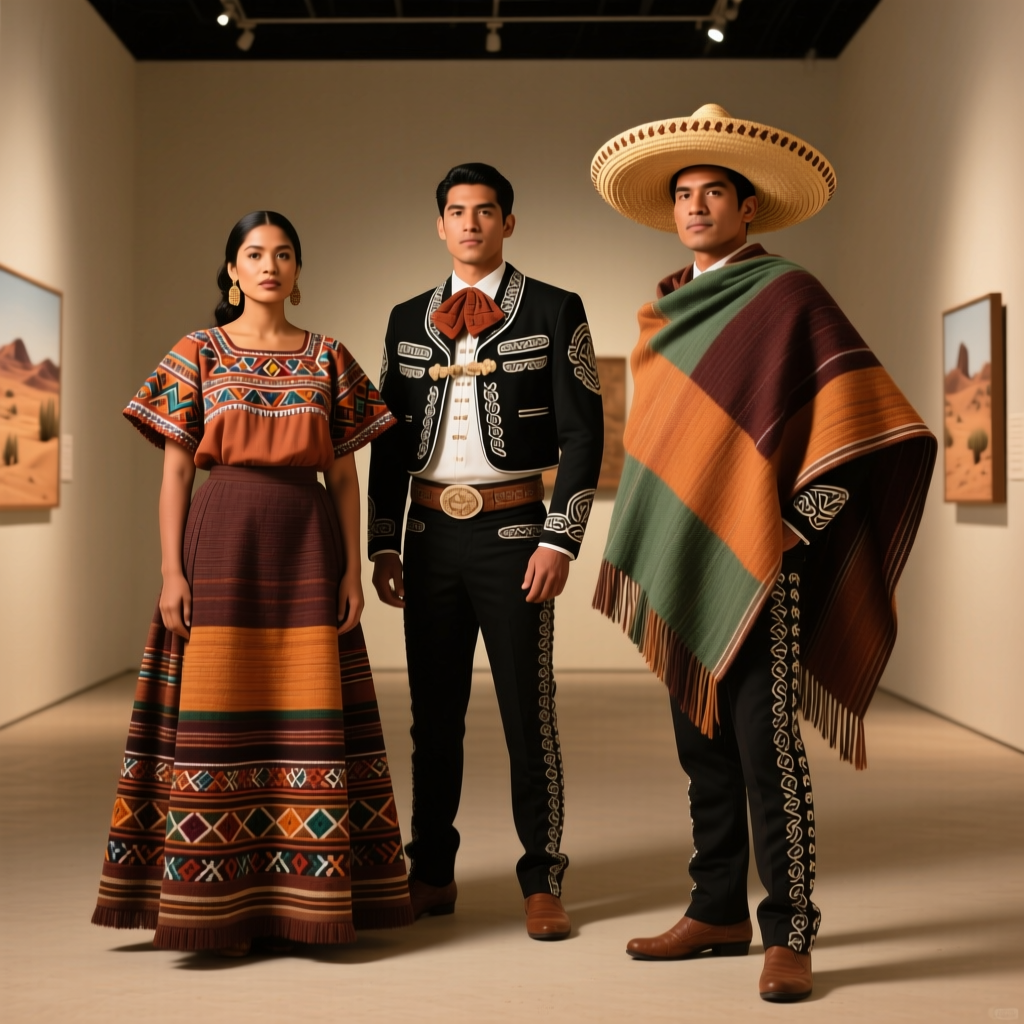
The traje de charro is Mexico's most internationally recognized men's garment — the iconic suit of the Mexican horseman. Originating from the hacienda culture of Jalisco and the central highlands, the charro suit consists of a short, fitted jacket with ornate silver or embroidered detailing, tight-fitting trousers adorned with rows of silver buttons (botaduras) along the outer seams, a wide-brimmed sombrero, a bow tie or corbata de rebozo, and polished boots with spurs.
The charro tradition is governed by strict codes of etiquette and dress. There are several variations: the charro de faena (working suit) is simpler and more practical, while the charro de gala (formal suit) features elaborate silverwork and fine wool or suede construction. The charro suit is the official uniform of charrería, Mexico's national sport, which was recognized by UNESCO as an Intangible Cultural Heritage of Humanity. Learn more about this tradition in our guide to ceremonial and festival clothing.
The Guayabera
The guayabera is a lightweight, loose-fitting shirt characterized by its vertical rows of pleats (alforzas) and multiple pockets. Typically made from linen or cotton, the guayabera is the quintessential warm-weather garment across Mexico, the Caribbean, and much of Latin America. In Mexico, it is especially associated with the Yucatán Peninsula, Veracruz, and other tropical regions.
While the guayabera's exact origins are debated — with Mexico, Cuba, and the Philippines all claiming its invention — the garment has become thoroughly integrated into Mexican culture. In the Yucatán, the guayabera is considered formal attire and is worn at weddings, government functions, and religious celebrations. Yucatecan guayaberas often feature delicate embroidery along the pleats, and local artisans have adapted the design with regional motifs inspired by Maya iconography. Discover how this shirt compares to other traditional Latin American shirts in our regional guide.
The Sarape and Jorongo
The sarape (also spelled serape) is a brightly colored, blanket-like shawl or cloak worn over the shoulders, typically by men in northern and central Mexico. The most famous sarapes come from Saltillo, Coahuila, where weavers have produced these iconic garments for centuries using intricate diamond and zigzag patterns in vivid combinations of red, blue, green, yellow, and black.
The jorongo is a similar but more structured garment — essentially a poncho-style blanket with a head opening, providing warmth and protection from the elements. In rural communities across the central highlands, the jorongo remains everyday wear for men working in the fields or tending livestock. Both garments showcase the exceptional skill of Mexican weavers, who use pedal looms introduced during the colonial era to create textiles of extraordinary density and color complexity.
The Calzón de Manta and Traditional Workwear
In many rural and indigenous communities, men continue to wear calzón de manta — loose, white cotton trousers paired with a simple cotton shirt, a woven sash (faja), and a straw or palm sombrero. This outfit has its roots in the colonial-era dress imposed on indigenous laborers but has been reclaimed and maintained as a source of cultural pride.
Among the Purépecha communities of Michoacán, men wear hand-woven calzones with embroidered fajas that indicate community affiliation. In the Nahua communities of Guerrero and Puebla, men's ceremonial attire includes elaborately embroidered cotton shirts and handwoven sashes featuring animal and floral motifs. These garments represent a direct, unbroken connection to ancestral traditions and are worn with deep pride during community fiestas and religious processions.
Regional Variations Across Mexico
Mexico's enormous geographic and cultural diversity means that traditional clothing varies dramatically from one region to another. Climate, indigenous heritage, colonial history, and local resources all shape the distinctive styles found across the country's 32 states.
Oaxaca & Southern Mexico
Oaxaca is often called the soul of Mexican textile tradition, home to over 16 indigenous groups, each with its own distinct clothing customs. The Zapotec weavers of Teotitlán del Valle produce stunning wool rugs and sarapes using natural dyes derived from cochineal, indigo, and marigold. The Mixtec communities of the Mixteca Alta maintain backstrap loom weaving traditions that produce huipiles with complex brocade patterns depicting birds, flowers, and geometric symbols. In the coastal regions, lighter cotton garments prevail, adapted to the tropical heat.
Central Highlands & Mexico City
The central highlands, including states like Puebla, Tlaxcala, Hidalgo, and the State of Mexico, showcase a blend of Nahua, Otomí, and colonial Spanish influences. The embroidered blouses of Puebla — featuring floral cross-stitch in bright colors — are among the most widely recognized Mexican garments. In Hidalgo's Sierra Gorda, Otomí women create quetquémitls with elaborate animal and human figures woven in brocade. The china poblana tradition is centered in Puebla, while the charro tradition thrives in Jalisco and surrounding states.
The Yucatán Peninsula
The Yucatán Peninsula's hot, humid climate has shaped a distinctive clothing tradition centered on lightweight, white cotton. Women traditionally wear the terno, a three-piece ensemble consisting of a sleeveless undergarment (justán), a huipil-style blouse (hipil) with colorful cross-stitch embroidery at the neckline and hem, and a matching skirt. Men wear the guayabera with white cotton trousers and a jipijapa (Panama-style) hat. The Maya heritage of the region is reflected in the embroidery motifs, which often incorporate pre-Columbian symbols alongside colonial-era floral designs.
Northern Mexico
Northern Mexican traditional clothing reflects the region's ranching culture, arid climate, and proximity to the United States. The norteño style incorporates leather boots, wide-brimmed hats, denim, and the sarape. In states like Chihuahua and Sonora, the influence of vaquero (cowboy) culture is evident in men's clothing, while women's traditional dress often features the adelita style — a high-necked blouse with a long, flowing skirt, reminiscent of the women soldiers of the Mexican Revolution. The Tarahumara (Rarámuri) people of the Copper Canyon region maintain their own distinctive dress, including colorful patterned skirts and headbands for women and loincloth-and-blanket ensembles for men.
Chiapas & the Southeast
Chiapas is home to some of Mexico's most visually stunning traditional clothing. The Tzotzil women of Zinacantán wear hand-woven huipiles featuring bold red and purple stripes with brocade flowers and animals, while the women of San Juan Chamula wear thick, dark wool skirts and shawls suited to the highland cold. The Lacandón Maya of the jungle regions maintain simpler, undyed cotton garments that reflect their forest environment. In neighboring Tabasco, the Tabasqueña dress features a white blouse with colorful embroidery depicting tropical flowers, paired with a full, brightly colored skirt.
Cultural Significance & Modern Relevance
Traditional Mexican clothing is far more than a collection of beautiful garments — it is a living system of cultural expression that connects wearers to their ancestors, their communities, and their land. Every embroidered motif carries meaning: the double-headed eagle of the Zapotec represents duality and balance; the diamond patterns of Maya textiles symbolize the four cardinal directions; the floral designs of Puebla celebrate the natural abundance of the region.
In indigenous communities, traditional dress serves as a marker of identity and belonging. A woman's huipil communicates her village, her marital status, her role in the community, and even the occasion for which she is dressing. Men's ceremonial garments connect wearers to spiritual traditions and communal governance structures that have endured for centuries. The act of weaving, embroidering, and dyeing textiles is itself a cultural practice passed from generation to generation, primarily by women, and represents a profound form of knowledge transmission.
In contemporary Mexico, traditional clothing occupies a complex cultural space. On one hand, there is growing national and international appreciation for Mexican textiles, with designers, museums, and collectors celebrating the artistry of indigenous weavers and embroiderers. On the other hand, issues of cultural appropriation and exploitation remain pressing concerns. When multinational fashion brands copy indigenous designs without credit or compensation, communities lose both cultural sovereignty and economic opportunity. Organizations like the Instituto Nacional de los Pueblos Indígenas and various artisan cooperatives are working to protect traditional designs through intellectual property frameworks and fair-trade initiatives.
Traditional Mexican clothing also plays a vital role in national celebrations and public life. During Día de los Muertos, Fiestas Patrias, weddings, quinceañeras, and religious festivals, millions of Mexicans don traditional garments as an expression of cultural pride. Folkloric dance troupes across the country and around the world preserve and perform regional dress traditions, ensuring that each state's distinctive style remains visible and celebrated. For a deeper look at how these garments function in celebratory contexts, visit our cultural heritage garments resource page.
The sustainability inherent in traditional Mexican clothing is also gaining recognition. Hand-woven, naturally dyed, and made to last for decades, these garments represent an alternative to fast fashion that resonates with growing global interest in ethical and sustainable clothing practices. Supporting artisan communities by purchasing authentic, fairly traded traditional garments helps preserve these traditions while providing economic empowerment to the communities that create them.
Frequently Asked Questions
What is the most common traditional garment worn by Mexican women?
The huipil is the most widespread and enduring traditional garment for Mexican women. This tunic-like blouse has been worn for over two millennia and continues to be everyday dress in many indigenous communities across southern and central Mexico. The huipil's design, embroidery patterns, and materials vary enormously by region, making each one a unique expression of local identity and artistic tradition. In communities from Oaxaca to Chiapas, women may own dozens of huipiles for different occasions — from simple daily-wear versions to elaborate ceremonial pieces that take months to complete.
Is the sombrero considered traditional Mexican clothing?
Yes, the sombrero is a deeply traditional element of Mexican dress, though it encompasses many different styles rather than a single design. The wide-brimmed sombrero de charro, made from felt or straw and often decorated with silver or embroidery, is associated with the horseman tradition of Jalisco and the central highlands. The sombrero de palma (palm sombrero) is a practical, everyday hat worn by rural workers across the country. In the Yucatán, the jipijapa hat — woven from fine palm fiber — is the traditional headwear. The sombrero's primary function is protection from Mexico's intense sun, and its wide brim is a practical adaptation to the country's climate.
What is the difference between a huipil and a quechquémitl?
Both are pre-Columbian garments still worn today, but they serve different purposes. The huipil is a tunic or blouse — the primary upper-body garment — constructed from rectangular panels of woven fabric joined together, with an opening for the head. The quechquémitl is a smaller, cape-like garment worn over the shoulders, typically constructed from two triangular pieces of fabric that create a diamond-shaped opening for the head. The quechquémitl is primarily associated with Nahua, Otomí, and Huastec communities in central Mexico and is often worn as an additional layer over a huipil or blouse for warmth or ceremonial purposes. Both garments feature intricate weaving and embroidery that encode cultural meanings and community identity.
Can non-Mexicans wear traditional Mexican clothing respectfully?
Yes, but context and intent matter significantly. Wearing authentic, fairly purchased traditional Mexican garments — such as a huipil bought directly from an artisan cooperative or a guayabera from a Mexican designer — is generally viewed positively, especially when the wearer understands and respects the garment's cultural significance. Problems arise when traditional designs are mass-produced without attribution, worn as costumes or caricatures, or used in ways that trivialize their cultural meaning. The key principles are to purchase from authentic sources that compensate artisan communities fairly, to learn about the garment's origins and meaning, and to wear it in appropriate contexts rather than as a novelty. For more guidance, explore our resources on ethical fashion and cultural heritage.
Where can I buy authentic traditional Mexican clothing?
The best way to purchase authentic traditional Mexican clothing is directly from artisan communities or certified fair-trade organizations. In Mexico, markets like the Mercado de Artesanías in Mexico City, the textile markets of Oaxaca, and community cooperatives in Chiapas and Puebla offer direct access to artisans. Online, organizations such as Fondo Nacional para el Fomento de las Artesanías (FONART), Nest, and various artisan cooperatives sell authenticated pieces with fair compensation to makers. When shopping, look for signs of handcraftsmanship — slight irregularities in weaving, hand-embroidered details, and natural dye variations — as indicators of authenticity. Mass-produced imitations, often manufactured overseas, undermine artisan livelihoods and dilute the cultural integrity of these traditions. Investing in authentic pieces supports the continuation of centuries-old craft traditions and ensures that the communities who created these designs benefit from their cultural heritage.