Traditional Clothing for Indian Men: A Comprehensive Cultural Guide
India's textile heritage stretches back thousands of years, weaving together a tapestry of culture, religion, climate, and artistry that is virtually unmatched anywhere on Earth. For Indian men, traditional clothing is far more than a matter of fabric and stitching — it is an expression of identity, regional pride, spiritual belief, and social standing. From the sun-drenched villages of Rajasthan to the lush backwaters of Kerala, the garments worn by Indian men tell stories of dynasties, trade routes, colonial encounters, and living traditions that continue to evolve with each generation.
The story of men's clothing in India begins in antiquity. Archaeological evidence from the Indus Valley Civilization suggests that men draped themselves in unstitched lengths of cotton cloth, a practice that would persist for millennia. The ancient texts, including the Vedas and the Mahabharata, reference garments such as the antariya (a lower-body drape) and the uttariya (an upper-body scarf or shawl), establishing a foundation upon which centuries of innovation would build. As empires rose and fell — the Mauryas, the Guptas, the Mughals, and the Marathas — each left an indelible mark on what Indian men wore, adding layers of complexity, opulence, and regional distinction.
Today, traditional Indian clothing for men remains a vibrant and essential part of daily life, festivals, weddings, and religious ceremonies. While Western attire has become commonplace in urban settings, the pull of heritage garments endures, often blending seamlessly with contemporary fashion sensibilities. This guide explores the most significant traditional garments worn by Indian men, their origins, characteristics, regional variations, and the deep cultural meanings they carry.
The Dhoti, Lungi, and Mundu: The Ancient Draped Garments
Among the oldest forms of clothing worn by Indian men, the dhoti is an unstitched rectangular piece of cloth, typically cotton, that is wrapped around the waist and legs. Its history can be traced back to the Indus Valley Civilization, making it one of the most enduring garments in human history. The dhoti is usually white or cream-colored, though regional variations introduce checks, borders, and even vibrant hues. The art of draping a dhoti — which involves pleating, tucking, and knotting without any pins or fasteners — is a skill passed down through generations.
The dhoti holds particular significance in religious and ceremonial contexts. Hindu priests, temple attendees, and participants in sacred rituals almost universally wear the dhoti, as unstitched cloth is considered pure and auspicious in many Hindu traditions. In Bengal, the dhoti is paired with a punjabi (a loose kurta) during Durga Puja and other festivals. In Maharashtra, the dhoti — known locally as the dhotar — is worn with a distinctive draping style that involves pulling the fabric between the legs and tucking it at the back, creating a trouser-like silhouette.
The lungi, a close relative of the dhoti, is more casual and widely worn across South India, particularly in Tamil Nadu, Kerala, Karnataka, and Andhra Pradesh. Unlike the dhoti, the lungi is often stitched into a tube shape and is available in a dazzling array of colors, checks, and patterns. It is the everyday garment of choice for millions of men, valued for its comfort in hot and humid climates. The lungi is typically worn at home or in informal settings, and it is common to see men fold it up to knee-length for ease of movement during work or travel.
In Kerala, the mundu (also called veshti in Tamil Nadu) serves a similar function but carries greater formality. The mundu is typically white with a colored or gold border known as the kara. For formal occasions, men wear the kasavu mundu, which features a distinctive gold zari border and is considered the traditional attire of Malayali men. Paired with a white or cream shirt, the kasavu mundu is a staple at weddings, Onam celebrations, and temple festivals across Kerala. Explore more about these draped garments in our guide to South Indian traditional drapes.
The Kurta, Kameez, and Pathani Suit: Everyday Elegance
The kurta is perhaps the most universally worn traditional garment among Indian men today. A loose, collarless shirt that typically falls to the knees or slightly below, the kurta is prized for its versatility, comfort, and understated elegance. Its origins can be traced to Central Asian influences that entered India through centuries of trade and conquest, particularly during the medieval period. The word "kurta" itself is derived from Persian, reflecting the deep cultural exchanges that shaped Indian sartorial traditions.
Kurtas are crafted from a wide range of fabrics depending on the season and occasion. Cotton kurtas are everyday staples, offering breathability during India's intense summers. Silk, brocade, and linen kurtas are reserved for festive occasions and celebrations. The garment is typically paired with a pajama (loose drawstring trousers), a churidar (tightly fitted trousers that bunch at the ankles), or a dhoti for a more traditional look. The combination of kurta and pajama — often called the kurta-pajama — is acceptable attire in nearly every setting in India, from casual gatherings to semi-formal events.
The shalwar kameez, consisting of a long tunic (kameez) paired with loose-fitting trousers (shalwar), is the dominant traditional attire in North India, particularly in Punjab, Jammu & Kashmir, and regions with strong cultural ties to the northwest frontier. The Pathani suit, a variation of the shalwar kameez, features a longer, straighter-cut kameez with a collar, breast pockets, and sometimes cuffed sleeves. It is closely associated with Pashtun and Pathan communities and has been widely adopted across North India as formal and semi-formal wear. The Pathani suit projects a rugged, masculine elegance and is frequently worn at weddings, Eid celebrations, and political gatherings.
Embroidery plays a significant role in elevating the kurta from everyday wear to festive attire. Chikankari embroidery from Lucknow, with its delicate white-on-white threadwork, is among the most celebrated styles. Other notable embroidery traditions include phulkari from Punjab, kantha from Bengal, and zardozi — a luxurious form of gold and silver thread embroidery with Mughal origins. Learn more about these textile arts in our guide to Indian embroidery techniques.
The Sherwani, Bandhgala, and Achkan: Royal and Ceremonial Attire
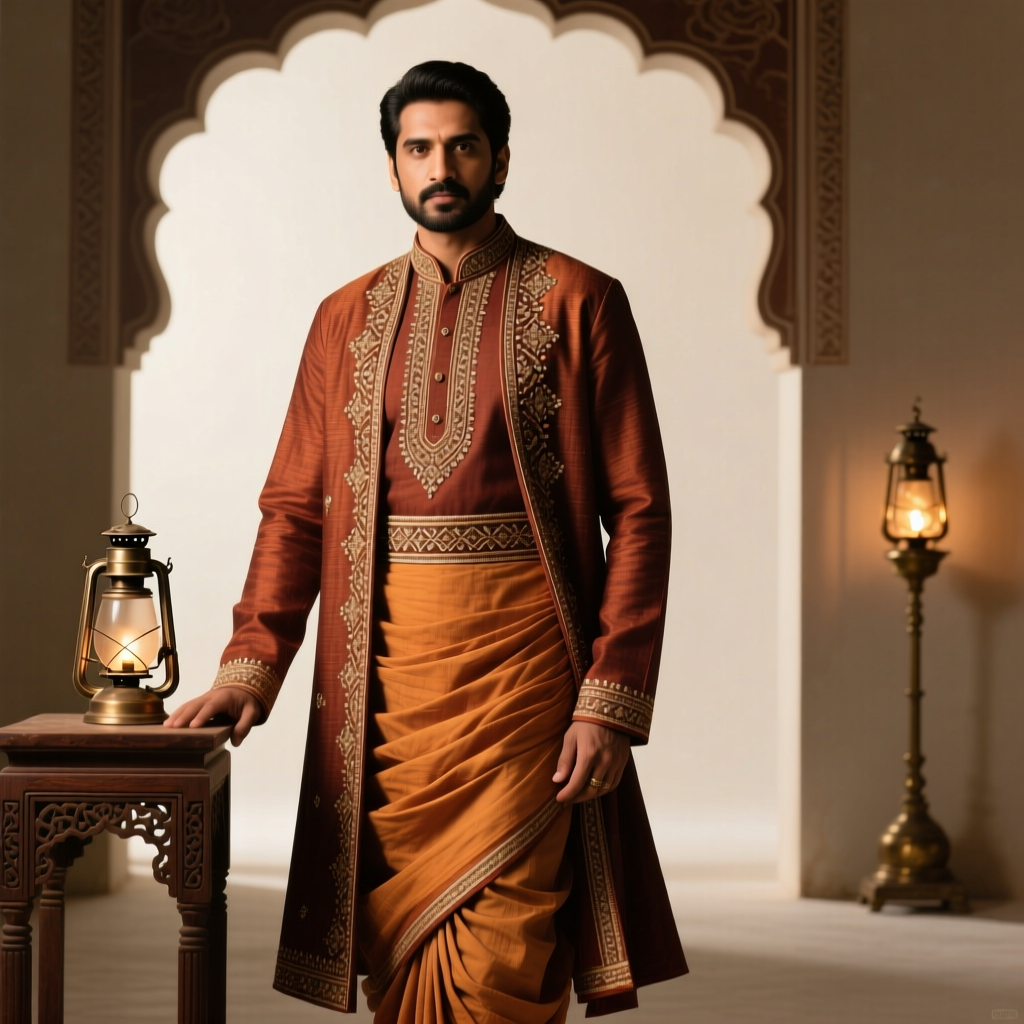
When it comes to grandeur and formality, few garments rival the sherwani. This long, coat-like garment, buttoned to the neck and falling below the knees, is the quintessential attire for Indian grooms and formal occasions. The sherwani's origins lie in the Mughal courts, where it evolved from the angarkha — a tied, overlapping garment worn by nobility. Over centuries, the sherwani absorbed European tailoring influences during the colonial period, resulting in the structured, fitted silhouette recognized today.
Modern sherwanis are crafted from rich fabrics such as raw silk, velvet, brocade, and jacquard, and are often adorned with intricate embroidery, sequins, and stone work. The garment is traditionally paired with a churidar or a salwar, and is complemented by accessories such as a dupatta (scarf) draped across the chest, an embroidered mojari (traditional footwear), and a turban or safa. The sherwani's popularity as wedding attire has only grown over time, with designers continually reimagining it through contemporary cuts, pastel color palettes, and fusion styling while preserving its regal essence.
The bandhgala, also known as the Jodhpuri suit, is another iconic formal garment with royal lineage. Originating in the princely state of Jodhpur in Rajasthan, the bandhgala is a closed-neck jacket with a Nehru-style collar, typically worn over a kurta and paired with trousers or a churidar. The bandhgala strikes a balance between Indian tradition and Western tailoring, making it a popular choice for formal dinners, receptions, and diplomatic events. The garment is often crafted from wool, silk, or velvet and may feature subtle embroidery or be left plain to emphasize its clean, structured lines.
The achkan is closely related to the sherwani but is distinguished by its lighter construction and side-opening (rather than center-front buttons). Historically worn by noblemen and courtiers across North India, the achkan was popularized in modern times by leaders such as Jawaharlal Nehru, who frequently wore a hip-length version that later became known internationally as the "Nehru jacket." The achkan remains a dignified choice for formal and ceremonial occasions, particularly in Rajasthan, Uttar Pradesh, and Hyderabad. For more on India's royal sartorial heritage, visit our page on Mughal influence on Indian textiles.
Turbans, Pagdis, and Headgear: The Crown of Identity
No discussion of traditional Indian men's clothing is complete without addressing the extraordinary diversity of headgear found across the subcontinent. In India, the turban is far more than a piece of cloth — it is a powerful symbol of honor, community identity, religious faith, and regional pride. The style, color, fabric, and method of tying a turban can reveal a man's state of origin, caste, community, marital status, and even the season or occasion.
In Rajasthan, the pagdi (or safa) is an essential element of men's attire, with each region and community boasting a distinctive style. The Rajput pagdi is known for its bold colors and dramatic folds, while the Marwari turban tends to be more compact and tightly wound. During festivals such as Teej and Gangaur, men don brightly colored turbans in hues of saffron, pink, and red, transforming the streets into rivers of color. The turban also plays a central role in Rajasthani wedding ceremonies, where the groom's sehra — a turban adorned with strings of flowers or beads — is a focal point of the ritual.
In Punjab, the dastar (or pagh) holds deep religious significance for Sikh men, who are mandated by their faith to wear a turban as an article of devotion. The Sikh turban is meticulously tied in a distinctive style, often using five to seven meters of fine cotton or voile fabric. The color of the turban may carry symbolic meaning — saffron for sacrifice and courage, white for peace and wisdom, and navy blue for the warrior tradition. The dastar is a sacred identity marker and a source of immense pride within the Sikh community.
In South India, headgear takes different forms. The mysore peta, a traditional turban from Karnataka made of silk and gold-threaded fabric, was historically worn by the Wodeyar kings and is now used in ceremonial contexts and as a mark of honor bestowed upon distinguished individuals. In Maharashtra, the pheta — a turban tied in a distinctive flat, fan-shaped style — is worn during weddings and cultural festivals. Discover more about these regional traditions in our guide to Indian headgear traditions.
Regional Variations and Occasion-Specific Dressing
India's vast geographical and cultural diversity means that traditional men's clothing varies dramatically from one region to another. In the northeastern states — including Nagaland, Manipur, Meghalaya, and Mizoram — men wear distinctive handwoven shawls and wraparound garments that are unique to each tribe and community. These textiles, often featuring bold geometric patterns and symbolic motifs, serve as markers of tribal identity, social status, and achievement. The Naga shawl, for instance, uses specific patterns to denote whether the wearer has performed certain feasts of merit or earned warrior honors.
In Gujarat, the traditional kediyu (a short, flared, tightly gathered jacket) paired with a dhoti or chorno (loose gathered trousers) is the iconic attire of rural men, particularly those from the Rabari and Bharwad pastoral communities. The kediyu is often white and may be embellished with mirrorwork embroidery — a hallmark of Gujarati textile art. During Navratri, men across Gujarat don colorful kediyus and kurtas to perform the energetic garba and dandiya raas dances.
In Bengal, the panjabi (a variant of the kurta, typically made from fine cotton or silk) paired with a dhoti is the traditional attire for festivals, weddings, and cultural events. The Bengali dhoti is draped in a distinctive style with deep pleats at the front and the pallu (loose end) thrown over the left shoulder. During Durga Puja, the streets of Kolkata come alive with men wearing crisp white dhotis and off-white panjabis, creating a visual symphony of understated elegance.
The occasion dictates the choice of garment with remarkable precision in Indian culture. For religious ceremonies and temple visits, the dhoti or veshti is preferred for its ritual purity. For weddings, the groom typically wears a sherwani or an achkan, while male guests may opt for bandhgalas, kurta-pajamas, or silk kurtas depending on the formality of the event. For festivals such as Diwali, Eid, and Pongal, new clothing is considered essential, and men invest in fine kurtas, silk shirts, or occasion-specific traditional attire. Even in professional settings, many Indian men choose to wear well-tailored kurtas or bandhgalas as a statement of cultural confidence. Browse our complete guide to Indian wedding attire for detailed occasion-based recommendations.
Cultural Significance and Modern Relevance
Traditional clothing for Indian men carries layers of meaning that extend far beyond aesthetics. These garments are deeply intertwined with religious practice, social hierarchy, community identity, and the preservation of artisanal traditions that sustain millions of weavers, dyers, embroiderers, and tailors across the country. The choice of fabric, color, and style communicates values — white for purity and mourning in many Hindu traditions, saffron for renunciation and courage, green for prosperity and Islamic identity, and red for celebration and marital bliss.
The handloom movement in India has played a critical role in preserving traditional men's garments. Fabrics such as khadi — handspun and handwoven cotton championed by Mahatma Gandhi as a symbol of self-reliance and resistance during the independence movement — remain deeply respected. Wearing khadi is not merely a fashion choice but a political and philosophical statement about sustainability, self-sufficiency, and national pride. Similarly, the revival of regional handloom traditions — from Banarasi silk to Chanderi cotton, from Pochampally ikat to Muga silk of Assam — has ensured that traditional garments continue to be made using time-honored techniques.
In contemporary India, there is a growing movement among younger men to embrace traditional clothing not as relics of the past but as living, evolving expressions of identity. Designers and brands are reinterpreting classic silhouettes with modern cuts, innovative fabrics, and fusion styling that appeals to a generation that moves fluidly between global and local cultural contexts. The kurta has been paired with jeans, the bandhgala with sneakers, and the dhoti-pant hybrid has emerged as a popular fusion garment. This creative reinvention ensures that traditional Indian men's clothing remains relevant, dynamic, and deeply meaningful for generations to come.
The sustainability inherent in many traditional garments — their unstitched construction, natural fabrics, handwoven textiles, and artisanal embellishments — also resonates strongly with the growing global conversation around ethical fashion and slow clothing. In this sense, the traditional clothing of Indian men offers not only a window into a rich cultural past but also a compelling vision for a more conscious and culturally rooted future. Explore our heritage page on handloom weaving in India to learn more about the artisans behind these timeless garments.
Frequently Asked Questions
What is the most common traditional outfit for Indian men?
The kurta-pajama is arguably the most commonly worn traditional outfit among Indian men across the country. Its simplicity, comfort, and versatility make it suitable for everyday wear, religious occasions, festivals, and semi-formal gatherings. In South India, the dhoti (or veshti/mundu) paired with a shirt or angavastram is equally ubiquitous. The specific choice often depends on regional customs, climate, and the formality of the occasion.
What do Indian men traditionally wear to weddings?
Indian grooms typically wear a sherwani, often richly embroidered and paired with a churidar, a dupatta, and traditional mojari footwear. A turban or safa is an essential accessory in many communities, particularly in North India. Male wedding guests commonly wear bandhgalas, silk kurtas with churidars, or formal kurta-pajama sets. In South Indian weddings, men often wear silk veshtis (mundus) with matching angavastrams (shoulder cloths) and traditional silk shirts.
What is the difference between a sherwani and a bandhgala?
The sherwani is a long, coat-like garment that extends below the knees, typically featuring center-front buttoning and elaborate embroidery. It has Mughal origins and is considered the most formal traditional garment for men, especially at weddings. The bandhgala, on the other hand, is a shorter, hip-length closed-neck jacket with a Nehru collar, originating from the royal courts of Jodhpur. It is generally less ornate than a sherwani and is paired with trousers or churidars, making it suitable for formal dinners, receptions, and evening events.
Why do Indian men wear turbans, and what do different styles signify?
Turbans in India serve multiple purposes — they are markers of religious faith (particularly in Sikhism), symbols of honor and dignity, indicators of regional and community identity, and practical protection against the sun. Different styles, colors, and tying methods signify the wearer's state of origin, community, caste, and the occasion. For example, a Rajasthani safa differs dramatically from a Sikh dastar or a Maharashtrian pheta in shape, fabric, and cultural meaning. Turbans are also gifted as marks of respect and are integral to wedding ceremonies in many communities.
Can traditional Indian clothing for men be worn in modern, everyday settings?
Absolutely. The kurta, in particular, has been widely adopted as everyday wear by men across India and in the Indian diaspora. Cotton kurtas paired with jeans or chinos have become a popular casual look. The bandhgala is frequently worn to formal and business events as an alternative to the Western suit. Contemporary designers have also created fusion garments — such as dhoti-pants, short kurtas, and structured Nehru jackets — that blend traditional aesthetics with modern silhouettes, making heritage clothing accessible and stylish for daily life.