Mastering the Da Hua Lou Loom: 2026 Yunjin Weaving Guide
The Resurgence of Ancient Looms in 2026 Fashion
The year 2026 marks a pivotal shift in the Xin Zhongshi (New Chinese Style) movement. While previous years focused heavily on superficial design elements like mandarin collars and frog buttons, the 2026 runway and haute couture scenes demand structural and material authenticity. At the absolute pinnacle of this textile renaissance is the revival of the Da Hua Lou (large drawloom) and the meticulous recreation of Yunjin (cloud brocade). As modern designers seek to differentiate their collections through unparalleled craftsmanship, understanding the mechanics, sourcing, and operation of these ancient Chinese looms has become essential for serious textile artisans and fashion historians alike.
Anatomy of the Da Hua Lou (Drawloom)
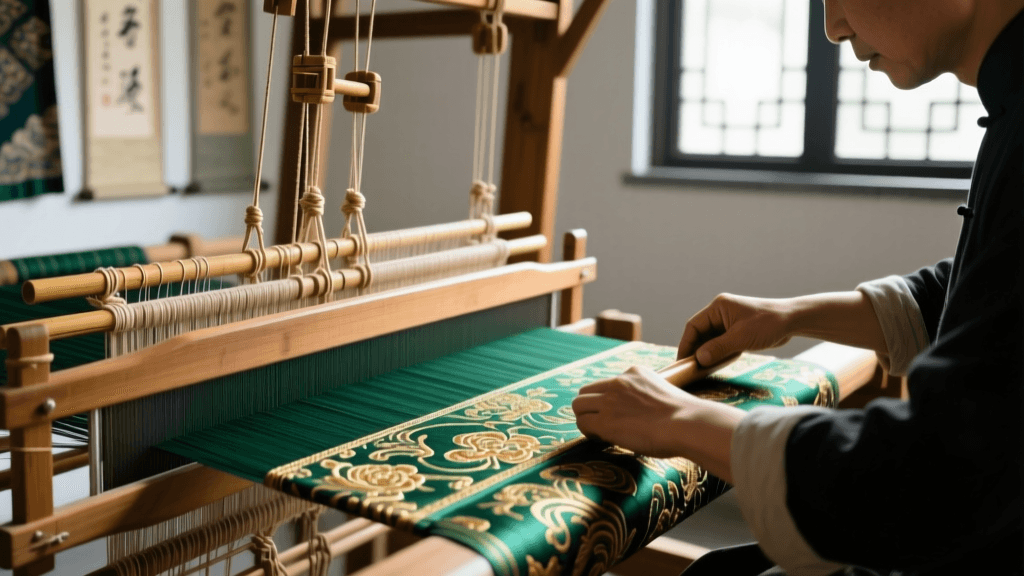
The Da Hua Lou is a marvel of pre-industrial engineering, predating the European Jacquard loom by several centuries. To appreciate its role in 2026's luxury textile market, one must understand its imposing physical and mechanical structure. A traditional replica loom, such as those utilized in contemporary Nanjing workshops, measures approximately 5.6 meters in length, 1.4 meters in width, and stands 4 meters tall. It is constructed entirely from interlocking hardwoods, utilizing no metal nails, which allows the frame to flex slightly under the immense tension of the silk warps.
The loom requires a highly synchronized two-person operation. The primary weaver sits at the front, managing the shuttle and the beat-up process, while the 'drawboy' (or pattern puller) sits atop the 4-meter pattern tower. The tower houses the pattern harness—a complex matrix of knotted cords that act as the loom's 'memory.' According to the Victoria and Albert Museum, this intricate system of draw cords allows for the lifting of specific warp threads to create the elaborate, asymmetrical, and multi-colored patterns characteristic of Chinese brocades, a feat that would later inspire the punch-card systems of the Industrial Revolution.
Yunjin Brocade: The 'Inch of Gold' Technique
Yunjin, translating to 'cloud brocade,' is renowned for its vibrant color palettes and the integration of precious metals. The defining technique of the Da Hua Lou when weaving Yunjin is 'tong jing duan wei' (warp-through, weft-broken). Unlike standard tabby or twill weaves where the weft thread travels from one selvage to the other, the weft in Yunjin is woven only within the specific boundary of the colored pattern block. This allows the weaver to introduce dozens of different colors in a single row without carrying the unused threads across the back of the fabric, keeping the textile relatively lightweight despite its visual density.
In 2026, authentic Yunjin weaving incorporates not just premium mulberry silk, but also flat threads made from real gold leaf applied to paper or synthetic backing, and occasionally, yarns spun with iridescent peacock feather filaments. The result is a fabric that literally shifts in luminosity depending on the angle of the light, making it a highly sought-after material for statement panels in modern Xin Zhongshi evening wear and bridal couture.
Comparative Analysis of Traditional Chinese Looms
While the Da Hua Lou is the most complex, it is part of a broader ecosystem of traditional Chinese weaving. The table below compares the primary looms used in the 2026 heritage textile market:
| Loom Type | Region of Origin | Weaver Count | Signature Fabric | 2026 Xin Zhongshi Application |
|---|---|---|---|---|
| Da Hua Lou (Drawloom) | Nanjing, Jiangsu | 2 (Weaver + Puller) | Yunjin (Cloud Brocade) | Haute Couture Panels, Bridal Wear |
| Shu Brocade Loom | Chengdu, Sichuan | 1 to 2 | Shu Brocade | Ready-to-Wear Jackets, Structured Bags |
| Zhuang Brocade Loom | Guangxi Province | 1 | Zhuang Brocade | Accessories, Trim, Streetwear Accents |
| Dingzhou Kesi Loom | Suzhou / Dingzhou | 1 | Kesi (Silk Tapestry) | Art Pieces, Luxury Scarves, Framed Textiles |
Sourcing Materials and Workshop Access in 2026
For artisans and design houses looking to integrate authentic drawloom-woven textiles into their 2026 collections, sourcing raw materials requires navigating a specialized market. Premium Grade 6A mulberry silk, the standard for Yunjin warp threads, has seen price stabilization in early 2026, hovering around $115 to $130 per kilogram for raw, unspun skeins. However, the metallic threads require specialized suppliers. Modern heritage weavers have largely transitioned from pure gold leaf (which is prone to oxidation and flaking over decades) to advanced tarnish-resistant metallic alloys coated in 24k gold vapor, providing the historical aesthetic with modern archival durability.
Access to operational Da Hua Lou looms is heavily concentrated in Nanjing. The Nanjing Yunjin Museum and affiliated intangible cultural heritage workshops offer residency programs for international designers. These programs allow designers to collaborate directly with master weavers, translating 2026 CAD (Computer-Aided Design) drafts into the physical knotted cord matrices required by the drawloom's pattern tower.
Step-by-Step: Drafting a Basic Cloud Motif Harness
Translating a digital design into the physical 'memory' of the drawloom is a meticulous process. Here is a simplified overview of how a traditional pattern harness is set up for a standard auspicious cloud motif:
- Step 1: Grid Mapping. The digital 2026 design is mapped onto a traditional grid, where each square represents one intersection of warp and weft. A standard cloud motif may require a grid of 400 warp threads by 600 weft picks.
- Step 2: Cord Tying (Jie Ben). The pattern puller translates the grid into a series of knotted cords. Each cord corresponds to a specific warp thread that needs to be lifted to create the pattern's outline.
- Step 3: Harness Threading. The individual warp threads are passed through the heddle eyes in the exact sequence dictated by the cord matrix. This step alone can take a team of three artisans up to two weeks for a complex, full-width brocade.
- Step 4: Tension Calibration. The warp beam is tensioned. Because Yunjin uses varying thicknesses of metallic and silk threads, the tension must be dynamically adjusted using traditional wooden wedges to ensure an even beat-up.
- Step 5: Test Weaving. The first 10 centimeters are woven as a test piece to check for 'float' errors (where a thread skips incorrectly) before the actual garment panel production begins.
Preserving the Craft: Institutional Support
The survival of the Da Hua Lou and Yunjin weaving is not left to chance; it is heavily backed by international and domestic cultural preservation efforts. Recognized by the UNESCO Intangible Cultural Heritage list, Nanjing Yunjin brocade represents a living lineage of textile engineering that cannot be fully replicated by modern power looms. The 'tong jing duan wei' technique, with its infinite color variations and discontinuous wefts, remains a strictly manual endeavor.
As the Xin Zhongshi movement matures in 2026, the fashion industry's appreciation for these ancient technologies has shifted from mere aesthetic borrowing to deep, structural respect. Designers who invest the time to understand the Da Hua Lou, collaborate with master weavers, and source ethical, high-grade silk are not just creating garments; they are participating in the active preservation of one of humanity's most complex mechanical and artistic legacies. Whether you are a textile student, a luxury brand sourcing director, or a heritage enthusiast, the drawloom offers a profound connection to the very fabric of Asian history.