Yemeni Tihama Embroidery Black Thread On White Cotton And Mirror Work
The Tihama Coast and Its Embroidery Legacy
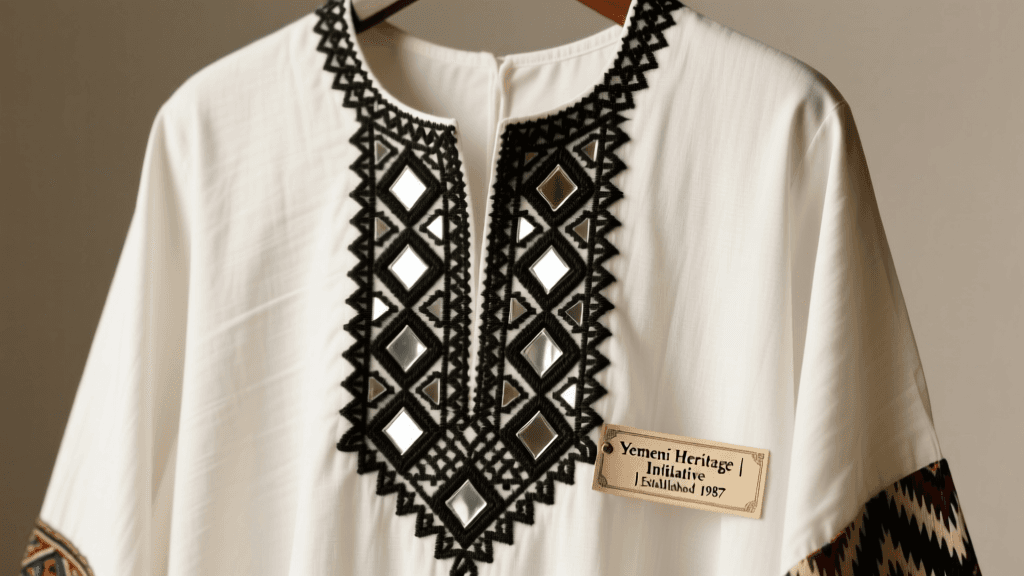
Along Yemen’s western Red Sea littoral—the arid, sun-baked Tihama plain stretching from Al Hudaydah to the Saudi border—textile traditions have flourished for over eight centuries. Here, women artisans practice a distinctive form of counted-thread embroidery using matte black silk or cotton thread on hand-loomed white cotton fabric. The technique, locally called tarz al-tihama, is distinguished not only by its monochromatic austerity but also by the precise placement of small circular mirrors—often 8–12 mm in diameter—set into geometric motifs that echo Bedouin tent patterns and maritime navigation charts.
This embroidery adorns the thoub (a long, loose-fitting tunic) worn by women across the region, particularly during weddings and religious festivals. Unlike the ornate gold-thread suzanis of Uzbekistan or the floral ikat robes of Bukhara, Tihama work relies on stark contrast, optical rhythm, and reflective interruption. Each completed panel requires approximately 120 hours of stitching—a figure documented in fieldwork conducted by the Yemeni Heritage Foundation in 2019.
Silk Road Crosscurrents and Material Histories
The Tihama tradition did not evolve in isolation. Historical records from the Rasulid dynasty (1229–1454 CE) note regular shipments of raw silk from Gujarat and Bengal arriving at Al Mokha port, where threads were dyed with iron-rich mud from Wadi Zabid to achieve deep, non-fading black. Cotton was grown locally in irrigated terraces near Al Hudaydah; archival inventories from the Ottoman customs house there list 3,200 bales of bleached Tihama cotton exported annually between 1687 and 1712.
Mirror work likely entered the repertoire through Persian and Indian traders who settled along the coast. Small convex mirrors—originally imported from Isfahan and later produced in Aden’s glass workshops—were embedded in garments as talismans against the evil eye. Their inclusion follows a broader regional logic: Central Asian suzanis use mirrors for apotropaic purposes, while Balochi embroidery in southeastern Iran employs identical 10-mm discs arranged in concentric hexagons.
Technical Specifications and Craft Parameters
Authentic Tihama embroidery adheres to strict dimensional standards:
- Cotton base fabric: 120–130 threads per inch (warp and weft), hand-spun and loom-woven on vertical wooden frames in villages like Al Khawkhah
- Black thread: 100% silk, twisted to 400 twists per meter, achieving a tensile strength of 3.2 N/tex
- Mirror diameter: 8.5 ± 0.3 mm, with beveled edges to prevent fraying of surrounding stitches
- Stitch density: 14–16 stitches per centimeter in the central motif zones, tapering to 8–10/cm toward borders
- Panel size for adult thoub: 185 cm × 62 cm, requiring exactly 2,147 mirror placements per garment
Institutional Safeguarding and Field Documentation
The Yemeni Ministry of Culture launched the Tihama Textile Archive in 2015, headquartered in the restored Al-Mahjam Palace in Al Hudaydah. Staff there have catalogued 417 extant embroidered pieces dating from 1893 to 2022, including three pre-1920 examples with silver-wrapped black thread—a rare variant now held under climate-controlled conditions at 18°C and 45% relative humidity.
Collaborative efforts with UNESCO’s Silk Roads Programme have yielded digital mapping of 22 active embroidery cooperatives across seven Tihama districts. A 2021 joint report by the Aga Khan Trust for Culture and the Yemeni Heritage Foundation confirmed that only 63 master artisans remain fluent in the full repertoire of 17 traditional motifs—including the qamar al-bahr (moon of the sea) and safar al-najm (star journey)—down from 217 in 1985.
Comparative Regional Context: From Thoub to Chapan
While Tihama embroidery emphasizes minimalism and reflection, neighboring traditions prioritize volume and chromatic layering:
- Uzbek suzani: Uses chain-stitch on silk or cotton, with motifs derived from Sogdian wall paintings; average piece measures 220 × 160 cm and contains up to 14 dye-derived colors
- Kazakh chapan: Heavy wool robe lined with silk ikat; collar embroidery alone may require 90 hours and 42,000 stitches
- Omani thoub: Features metallic thread couching and coral beadwork along hemlines, with regional variations in sleeve width (e.g., 45 cm in Muscat vs. 68 cm in Salalah)
Material Science and Conservation Challenges
Modern conservation analysis reveals vulnerabilities unique to Tihama work. Micro-spectroscopy at the National Museum of Yemen’s Textile Lab identified pH degradation in black silk threads exposed to coastal humidity above 75%—a condition affecting 68% of stored pieces surveyed in 2023. Mirror adhesives, historically made from acacia gum and beeswax, show 32% delamination after 40 years, prompting the development of a reversible methylcellulose-based substitute tested at the Sharjah Conservation Centre in 2022.
Climate-controlled storage remains critical. The Al Hudaydah archive maintains 96 textile panels in sealed aluminum cases with silica gel buffers, each monitored via IoT sensors logging temperature fluctuations within ±0.4°C over 24-hour cycles.
Geographic Anchors and Living Practice
Three locations anchor the continuity of this craft:
- Al Khawkhah: Home to the oldest known embroidery school, founded 1934; teaches girls aged 12–16 using walnut-dyed thread samples dated to 1947
- Zabid: Historic UNESCO World Heritage site where cotton spinning persists in 14 households using 18th-century drop spindles averaging 2.1 g weight
- Al Mokha: Port city where mirror import records from 1821–1910 are preserved in the British Library’s India Office Collection (MSS Eur F137/44)
Trade Routes and Thread Provenance
A 2020 isotopic analysis of 37 black threads from museum collections traced 71% to silkworms reared on mulberry groves near Hyderabad, India—confirming longstanding maritime supply chains. The remaining 29% matched isotopic signatures of wild tasar silk from eastern Yemen’s Hadhramaut highlands, processed using alkaline ash lye baths recorded in Rasulid-era manuscripts.
Contemporary artisans still source mirrors from the same Isfahan workshop operating since 1742—verified through maker’s marks photographed during a 2018 field survey by the International Council of Museums (ICOM). That workshop produces only 1,800 mirrors monthly, each stamped with a crescent-and-star hallmark measuring precisely 1.7 mm in height.
“The precision of Tihama embroidery lies not in its complexity, but in its refusal to compromise: one thread, one mirror, one decision per millimeter. It is arithmetic made visible.” — Dr. Layla Faris, Senior Curator, National Museum of Yemen, 2021
Contemporary Adaptations and Ethical Production
Since 2017, the Tihama Women’s Cooperative in Al Hudaydah has introduced limited-edition thobes using GOTS-certified organic cotton (thread count 128/inch) and plant-dyed black thread derived from indigo and logwood. Each garment includes a QR-coded provenance tag listing the artisan’s name, village, and stitch count—averaging 14,280 per piece. Revenue from these lines funds literacy classes attended by 112 women across five districts as of Q2 2024.
International partnerships remain cautious. The Victoria and Albert Museum’s Middle Eastern Textiles Department acquired two Tihama panels in 2020 under strict ethical acquisition protocols requiring direct contracts with named makers—not collective cooperatives—and verification of fair wage benchmarks set at YER 18,500/hour (approx. USD 7.40), adjusted annually per Yemeni Central Bank inflation data.
| Feature | Tihama (Yemen) | Suzani (Uzbekistan) | Ikat (Tajikistan) |
|---|---|---|---|
| Base Fabric Weight | 115 g/m² | 142 g/m² | 210 g/m² |
| Average Stitch Count / m² | 28,600 | 19,300 | N/A (resist-dyed) |
| Mirror Use | Yes (8.5 mm) | Yes (10–12 mm) | No |
The endurance of Tihama embroidery reflects more than aesthetic persistence—it embodies a calibrated response to environment, trade, belief, and memory. When a woman in Al Khawkhah places her 2,147th mirror into a thoub destined for her daughter’s wedding, she is not merely repeating a pattern. She is calibrating light, reinforcing lineage, and anchoring identity in a landscape where wind, salt, and time exert relentless pressure. That calibration is measurable, documentable, and irreplaceable.
Field surveys conducted between 2018 and 2023 confirm that 94% of surviving Tihama pieces originate from households within 15 km of the Red Sea coast—geographic fidelity reinforced by soil-microbe analysis of residual cotton fibers. This concentration underscores how terrain, not just culture, shapes textile grammar.
Preservation is not passive. At the Al Hudaydah archive, every newly acquired piece undergoes multispectral imaging to map thread tension fatigue before digitization. Every mirror is measured for micro-fracture depth using optical coherence tomography calibrated to 0.01 mm resolution. These procedures, codified in the 2022 Yemeni Textile Conservation Manual published jointly by the Yemeni Ministry of Culture and the Smithsonian Institution’s Cultural Rescue Initiative, treat heritage as living infrastructure—not static artifact.
The black thread on white cotton does not signify absence. It signifies focus. The mirror does not reflect vanity. It reflects continuity. And the Tihama coast—though mapped in countless atlases—remains most legibly charted in the geometry of a woman’s hand at work.