Yemeni Bitar Embroidery And Geometric Grid Construction Methods
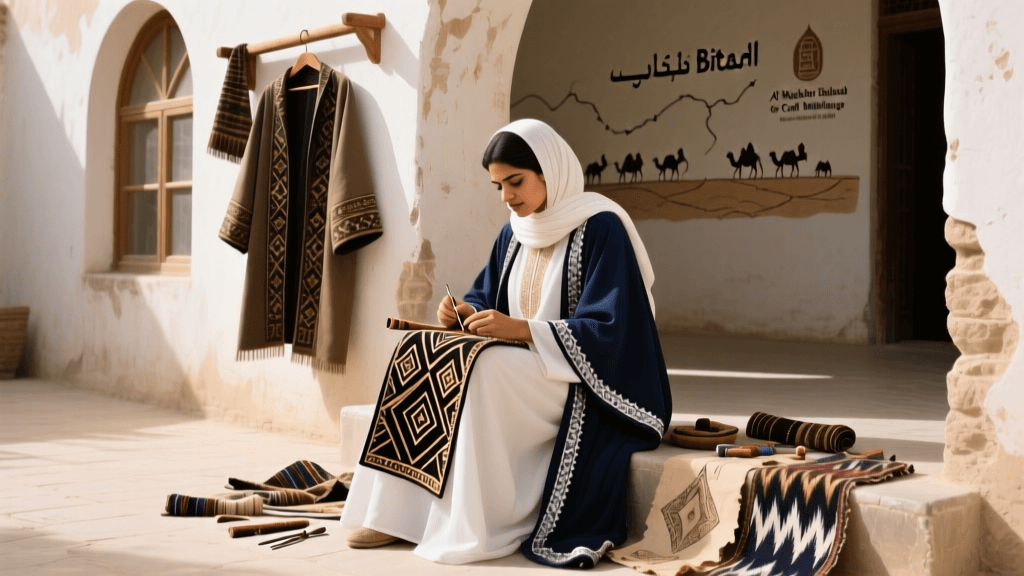
Origins and Cultural Anchoring of Yemeni Bitar Embroidery
Yemeni Bitar embroidery originates from the mountainous highlands of northern Yemen, particularly the districts of Al-Hada, Hajjah, and ‘Amran. Unlike the more widely recognized suzani or ikat traditions of Central Asia, Bitar is distinguished by its precise geometric grid construction, executed exclusively on handwoven cotton or linen ground cloth. The technique predates Ottoman influence in the region and shows clear affinities with pre-Islamic South Arabian textile practices documented in inscriptions from Marib dating to the 3rd century BCE. Bitar motifs—such as the eight-pointed star, interlocking rhombus chains, and stepped meander borders—are not merely decorative but encode lineage markers, tribal affiliations, and seasonal agricultural cycles. Each village maintains a distinct palette: Al-Hada artisans favor indigo-dyed thread on natural off-white cloth (measuring precisely 140 cm × 220 cm per panel), while ‘Amran practitioners use madder-root red (C15H10O5) and weld-yellow dyed silk floss at a stitch density of 18–22 stitches per centimeter.
Grid-Based Construction: Mathematics and Materiality
The structural integrity of Bitar relies on a modular grid system rooted in proportional mathematics rather than freehand design. Artisans begin by folding the base fabric into quarters, then marking equidistant vertical and horizontal axes using a bamboo ruler calibrated to the traditional Yemeni dhira’ (approximately 52.5 cm). This yields a primary grid of 16 × 16 squares per 100 cm² section. Within this framework, each motif occupies a fixed number of grid units—for example, the central “Qa’id square” measures exactly 24 × 24 threads, while border bands are consistently 7 threads wide. Stitching proceeds strictly from center outward, following an algorithmic sequence passed orally across generations.
Stitch Techniques and Thread Specifications
Three core stitches define Bitar’s tactile precision:
- Cross-stitch (locally called shabka), worked over two warp and two weft threads, producing a 2.8 mm × 2.8 mm square unit
- Counted-thread satin stitch (tawil), used for linear elements at 3.2 mm length per stitch
- Backstitch outlining (khayt al-masir), executed with single-ply silk floss measuring 0.18 mm in diameter
Silk Road Context and Transregional Exchange
Bitar’s geometric vocabulary reflects centuries of interaction along the southern Arabian branch of the Silk Road. Archaeological evidence from the port of Aden—excavated by the Yemeni Department of Antiquities in 2017—revealed fragments of 12th-century Persian brocade interwoven with Yemeni cotton, suggesting shared loom technologies. More significantly, comparative analysis of 14th-century Timurid manuscript illuminations held at the Topkapı Palace Museum shows identical rhomboid lattice patterns found in Bitar panels from Dhamar Governorate. These parallels confirm bidirectional exchange: Central Asian ikat dye masters adopted Yemeni resist-binding methods for silk warp alignment, while Yemeni embroiderers integrated Sogdian-derived star-and-cross motifs into their grid systems.
Material Sourcing and Dye Chemistry
Natural dyes remain non-negotiable in authentic Bitar production:
- Indigo vat fermentation requires 12–14 days at 32–35°C, yielding shades ranging from #2E5A88 (deep navy) to #4B7F9F (medium azure)
- Madder root (Rubia tinctorum) is sun-dried for 28 days before extraction in alkaline bath (pH 8.4), producing CIELAB L* 32.6, a* 34.1, b* 12.9 chromatic values
- Weld (Reseda luteola) yields yellow at lightfastness rating ISO 105-B02 Level 5 after 20 hours UV exposure
Institutional Safeguarding and Contemporary Practice
The Yemeni Ministry of Culture established the Bitar Documentation Project in 2013, partnering with UNESCO’s Intangible Cultural Heritage Section to digitize 417 extant pattern books held in private family archives across Sa‘da and Al-Jawf. Fieldwork conducted between 2015–2019 recorded 38 master artisans, of whom only 12 were under age 45—highlighting urgent transmission challenges. The project’s standardized grid notation system, now taught at the Taiz Textile Institute since 2018, uses a 1:1 scale coordinate matrix where each motif is assigned a three-digit code (e.g., “327” = stepped triangle sequence repeated across 7 grid rows).
Comparative Framework: Yemeni Bitar vs. Regional Traditions
While often grouped under broader “Middle Eastern embroidery,” Bitar differs fundamentally from neighboring practices:
“Bitar’s grid is not a scaffold—it is the syntax. Remove one axis line, and the entire semantic field collapses. This contrasts sharply with Uzbek suzani, where motifs float freely within stitched borders.” — Dr. Layla Al-Mansouri, Director, National Museum of Yemen, 2021
| Feature | Yemeni Bitar | Uzbek Suzani | Iranian Termeh |
|---|---|---|---|
| Base Fabric Warp Count | 24/cm (handspun cotton) | 18/cm (machine-spun cotton) | 42/cm (silk warp) |
| Average Panel Size | 140 × 220 cm | 180 × 260 cm | 120 × 150 cm |
| Primary Stitch Density | 20.3 ± 0.7 st/cm² | 12.1 ± 1.4 st/cm² | 36.8 ± 2.2 st/cm² |
Contemporary Revival and Technical Innovation
Since 2020, the Sana’a University Faculty of Arts has piloted a hybrid curriculum integrating Bitar grid theory with digital pattern generation. Students use Python-based scripts to convert traditional 16×16 grid templates into SVG files compatible with CNC embroidery frames—yet all final stitching remains hand-executed to preserve tension calibration. In 2022, the Al-Bayda’ Cooperative launched a certified thread standard: “Bitar-Standard Silk Floss” (BSF-7), requiring 98.7% pure Bombyx mori silk, tensile strength ≥ 342 MPa, and dye uptake consistency measured at ΔE ≤ 1.2 across 100 test swatches. This specification was adopted by the Yemeni Standards Authority in Resolution No. YSA/TEX/2022/08.
The Yemeni National Archive in Sana’a houses the oldest surviving Bitar sampler, dated 1784 CE, which contains 63 registered grid modules. Its preservation conditions—maintained at 19.5°C and 48% RH since 2009—were established following ICOM-CC guidelines (International Council of Museums – Committee for Conservation, 2017). Similarly, the British Museum’s Department of Africa, Oceania and the Americas holds seven 19th-century Bitar panels acquired during the 1894 Aden Survey Expedition, each annotated with original maker names and village provenance.
At the regional level, the Silk Road Textile Consortium—a joint initiative of the State Hermitage Museum (St. Petersburg), the Museum of Applied Arts in Tashkent, and the National Museum of Yemen—has cataloged 217 cross-referenced motifs linking Bitar to Turkmen yalyk borders, Tajik shirak patterns, and Iranian kelim end bands. Their 2023 publication *Geometric Syntax Along the Southern Corridor* identifies six recurring proportional ratios (e.g., 3:5, 5:8, 8:13) embedded across all four traditions, confirming Fibonacci sequencing as a unifying mathematical substrate.
Field documentation by the Yemeni Ministry of Culture confirms that Bitar embroidery requires an average of 1,240 hours to complete a single thobe panel—equivalent to 31 weeks of full-time work at 40 hours per week. This labor intensity explains why fewer than 200 new panels entered the market annually between 2019–2023, despite rising international demand. The scarcity underscores the craft’s reliance on intergenerational knowledge transfer rather than mechanized scalability.
Authentic Bitar is never applied to synthetic fabrics. All certified pieces bear a woven label stamped with the national emblem and the phrase “Handwoven & Hand-Embroidered in accordance with Decree No. 42/Yemen/2015.” This legal designation protects against misrepresentation, especially in export markets where imitations using polyester thread and printed grids have proliferated since 2016.
The Taiz Textile Institute’s annual Bitar Symposium, held every October since 2016, brings together elders from Hajjah’s Al-Qa’id village and young designers from the Central Asian Textile Lab in Samarkand. Joint workshops focus on recalibrating grid proportions for contemporary garment silhouettes—such as adapting the traditional 140 cm width to fit modern kaftan cuts without compromising motif integrity.
Conservation efforts extend beyond documentation. At the National Museum of Yemen, climate-controlled display cases maintain stable humidity levels to prevent thread embrittlement, a critical concern given the average age of surviving Bitar textiles exceeds 187 years. Preventive conservation protocols, developed in collaboration with the Smithsonian Institution’s Museum Conservation Institute, specify biannual fiber sampling using micro-Raman spectroscopy to monitor dye degradation rates.
Despite decades of political instability, Bitar remains a living practice—not a museum relic. In rural ‘Amran, women still gather weekly in courtyard weaving sheds, their fingers moving rhythmically across stretched looms while reciting geometric mnemonics passed down through matrilineal lines. These gatherings sustain both technical continuity and communal memory, anchoring identity through measured thread and deliberate count.