Authentic Viking Apron Dress Guide 2026: Patterns & Brooches
The Evolution of Nordic Reenactment in 2026
As we navigate the historical reenactment and folk festival landscape in 2026, the demand for absolute authenticity in Nordic and Viking traditional garments has reached an all-time high. The days of Hollywood-inspired leather armor, excessive fur collars, and anachronistic cotton garments are firmly in the past. Today’s European folk dress enthusiasts, experimental archaeologists, and heritage festival attendees are turning to rigorous textile analysis and museum-grade reconstructions. At the forefront of this movement is the iconic Viking apron dress, historically referred to as the smokkr or hangerock, paired with its indispensable hardware: the oval tortoise brooches.
Whether you are preparing for the 2026 Moesgaard Viking Moot in Denmark, the Wolin Slavs and Vikings Festival in Poland, or simply seeking to connect with your Celtic and Nordic heritage through accurate garment construction, this comprehensive guide will walk you through the materials, patterns, and hardware required to build an authentic Viking wardrobe this year.
The Anatomy of the Smokkr (Apron Dress)
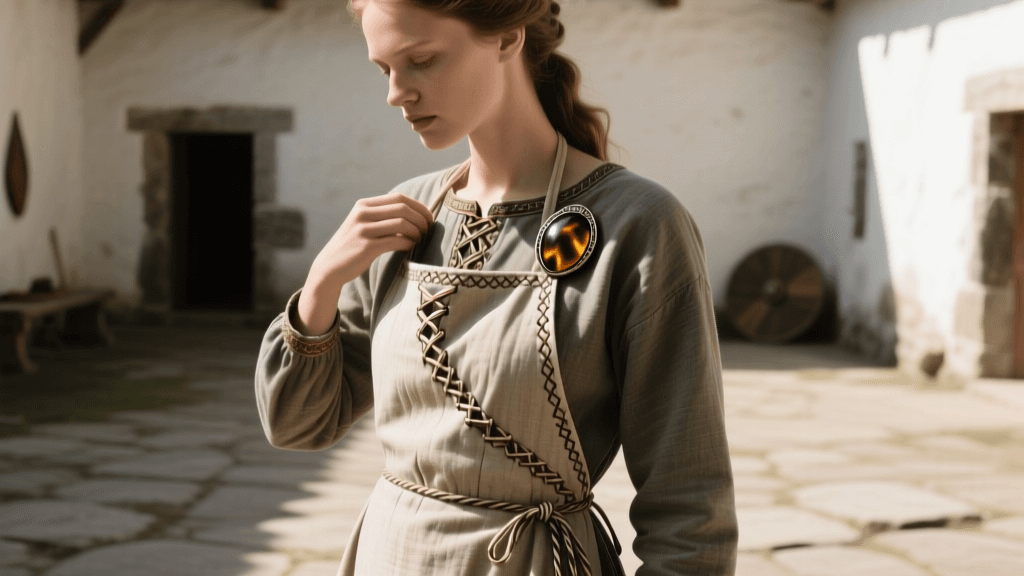
The apron dress was a staple of the Norse woman’s wardrobe from the 8th to the 11th centuries. Suspended from the shoulders by linen or wool straps and fastened at the collarbone with a pair of oval brooches, the smokkr served as both a protective overgarment and a canvas for displaying wealth through imported silks, glass beads, and intricate tablet-woven trims.
According to the National Museum of Denmark, the apron dress was typically constructed from wool, though high-status garments found in graves at Birka and Hedeby show evidence of luxurious linen and even imported silk samite. The silhouette of the dress has been heavily debated among historians, but the current consensus in 2026 favors a tubular or wrapped rectangular construction that allows for ease of movement and versatile layering over the base serk (underdress).
Key Design Features
- No Tailored Waist: The garment relies on the drape of the fabric and the tension of the shoulder straps rather than fitted seams.
- Strap Configurations: Straps can be continuous loops or separate front and back bands, often reinforced with tablet weaving to prevent stretching.
- Hemline Variations: Depending on the region and the wearer's status, hems could be ankle-length for formal occasions or calf-length for daily labor.
Sourcing Authentic Textiles: A 2026 Buyer’s Guide
The foundation of any accurate Nordic folk dress is the textile. In 2026, the historical textile market has expanded, making it easier than ever to source historically accurate, naturally dyed, and hand-woven fabrics. When selecting wool for your smokkr, you must consider the weave pattern, the sheep breed, and the dye source. Commercial synthetic dyes and modern twill weaves will immediately mark a garment as inauthentic at strict heritage events.
| Fabric Type | Weave Pattern | Authenticity Level | 2026 Est. Cost (per meter) | Best Use Case |
|---|---|---|---|---|
| Icelandic Wool | Diamond Twill | High (Museum Grade) | $95 - $140 | Outer Smokkr, Winter Festivals |
| Spelsau Sheep Wool | Tabby / Plain Weave | Medium-High | $55 - $80 | Everyday Reenactment, Summer |
| Hand-dyed Linen | Plain Weave | High (Underdress) | $40 - $65 | Serk (Underdress) & Straps |
| Commercial Wool Blend | Herringbone | Low (Starter Kit) | $25 - $40 | Beginners, Casual Cosplay |
For the most discerning reenactors, naturally dyed diamond twill wool remains the gold standard. Madder root yields rich reds and oranges, woad provides deep blues, and weld or onion skins produce vibrant yellows. When purchasing from heritage weavers in 2026, always request a burn test or certification of natural fiber content to ensure you are not inadvertently buying a wool-polyester blend.
The Tortoise Brooch: Function and Artistry
You cannot construct a Viking apron dress without addressing its most iconic hardware: the oval or "tortoise" brooch. These paired bronze or brass castings are not merely decorative; they are the structural linchpins of the entire garment, bearing the weight of the wool dress, the shoulder straps, and often heavy strings of imported glass and amber beads.
Recent excavations and ongoing textile analyses highlighted by BBC History confirm that Viking women's clothing was highly colorful and heavily accessorized, with the brooches serving as a primary indicator of social status and regional origin.
Choosing the Right Brooches for Your Persona
In 2026, artisan foundries across Europe and North America offer a wide array of historically accurate brooch replicas. When selecting your pair, consider the following:
- Material: Cast bronze is the most historically accurate and durable choice. Avoid cheap zinc alloys or pewter, which lack the correct weight and can snap under the tension of heavy wool.
- Pin Mechanism: Authentic brooches feature a long, iron or bronze spring-pin that crosses the entire width of the brooch. This is essential for gripping multiple layers of fabric and bead strings securely.
- Motif and Origin: Choose a motif that matches your specific regional persona. The Birka style features intricate gripping-beast interlace, while the Tongue-shaped or Borre styles are more common in Norwegian and Danish contexts.
"The oval brooch was the ultimate status symbol for a Norse woman. A matched pair of heavily gilded or silver-inlaid brooches communicated wealth, trade connections, and familial standing across the Viking world." — Experimental Archaeology Textile Symposium, 2026
Step-by-Step Construction and Tailoring
Constructing the smokkr requires a departure from modern sewing habits. Viking garments were designed to minimize fabric waste, utilizing the full width of the loom-woven cloth. Here is a standard approach to constructing a wrapped rectangular apron dress for the 2026 festival season.
1. Taking Measurements
Measure from your collarbone (where the brooch will sit) down to your desired hemline (usually mid-calf). Add 4 inches for hemming and top-folding. Next, measure the circumference of your bust and hips, adding 6 to 8 inches for ease and overlapping.
2. Cutting the Fabric
Cut your main wool panel to the calculated width and length. If your fabric is not wide enough, you will need to sew two panels together using a flat-felled seam or a historical running stitch reinforced with whipstitching. Cut two shoulder straps, each roughly 2.5 inches wide and long enough to reach from the top front edge, over your shoulder, to the top back edge.
3. Historical Stitching Techniques
To achieve a truly authentic finish, avoid the modern sewing machine for visible seams. Instead, utilize historical hand-stitching methods:
- Herringbone Stitch: Ideal for hemming the bottom edge and top facing, providing a flexible and decorative finish that prevents fraying.
- Running Stitch with Backstitch Reinforcement: Use this for the main structural seams, ensuring the wool can withstand the rigors of outdoor festival environments.
- Tablet Weaving Integration: Many high-status dresses featured silk or fine wool tablet-woven bands sewn directly over the seams or along the top edge. Sourcing handmade tablet weaving from specialized artisans is a major trend in 2026.
Layering: The Serk and Shawl
The apron dress is never worn alone. It is the middle layer of a sophisticated three-part system. Beneath the smokkr lies the serk, a long-sleeved linen underdress. In 2026, the pleated serk—achieved by wetting the linen, twisting it tightly, and allowing it to dry—remains a highly popular choice for high-status personas, particularly those portraying Swedish or Eastern trade-route Vikings.
Over the shoulders, a woven wool shawl or rectangular cloak is essential for the unpredictable weather of Northern European heritage festivals. Fastened with a simple ring brooch or a trefoil brooch at the center of the chest, the shawl completes the silhouette and provides vital insulation.
Accessorizing the Nordic Wardrobe
No Viking apron dress is complete without the swag of beads suspended between the two tortoise brooches. In 2026, the reenactment community strongly advocates for historically accurate bead compositions. Avoid modern plastic or perfectly uniform glass beads. Instead, source asymmetrical, hand-blown glass beads, melon beads, and raw Baltic amber from specialized historical glassworkers. Adding a small iron or bronze sewing kit (including a needle case and thread winder) suspended from the right-hand brooch adds both historical accuracy and practical utility to your festival attire.
Final Thoughts for the 2026 Season
Embracing the Celtic, Nordic, and Viking textile traditions is a deeply rewarding journey into experimental archaeology. By prioritizing natural fibers, historically accurate weaves, and proper structural hardware, you ensure that your garments not only look spectacular but also honor the incredible craftsmanship of the ancient Norse weavers and metalworkers. As you prepare your kit for the 2026 festival circuit, remember that every hand-stitched seam and naturally dyed thread is a direct connection to the vibrant folk dress of Europe's rich heritage.