Vanuatu Barkcloth Ochre Painting And Ritual Symbol Transfer Technique
Vanuatu’s Living Canvas: Barkcloth as Ritual Archive
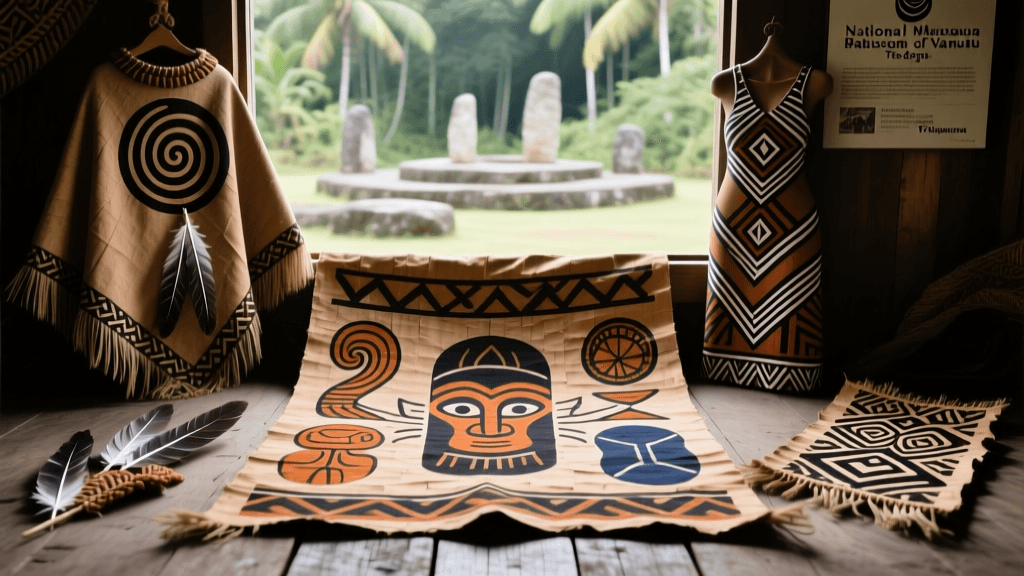
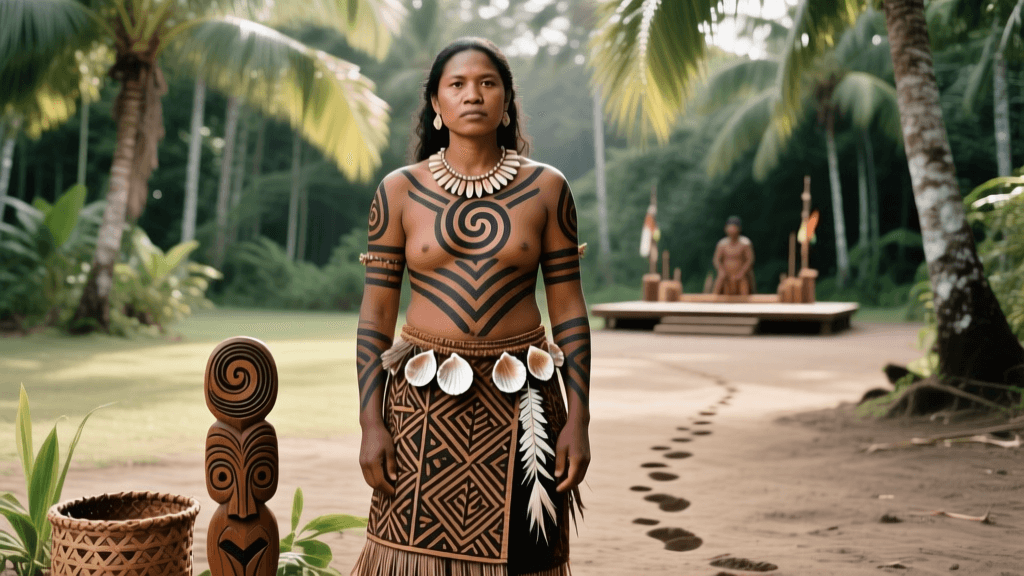
In the volcanic archipelago of Vanuatu, barkcloth—locally known as tapo or ngatu—is far more than textile. It is a substrate for ancestral memory, a medium through which ritual knowledge is inscribed, activated, and transferred across generations. Unlike Polynesian kapa or Fijian masi, Vanuatu’s barkcloth traditions emphasize ochre-based painting and symbolic transfer techniques rooted in Melanesian cosmology, where pigment, gesture, and intention coalesce into sacred practice. This is not decorative artistry; it is performative epistemology.
Ochre Preparation and Material Sourcing
The foundation begins with the inner bark of the *Broussonetia papyrifera* (paper mulberry) and, more commonly in northern Vanuatu, the *Ficus prolixa* (banyan fig). Harvesting occurs during the dry season (May–October), when sap flow is minimal and fibre integrity is highest. Strips are soaked in freshwater streams for 3–5 days, then beaten with wooden mallets featuring grooved surfaces—each groove depth calibrated to 2.5 mm—to achieve uniform thinness without tearing. A single 1.8-meter sheet requires approximately 45 minutes of continuous beating by two artisans working in rhythmic alternation.
Natural Pigment Chemistry
Ochre pigments derive from iron-rich clays sourced from specific geological sites: the red earth of Ambae Island’s volcanic slopes (Fe₂O₃ content ≥ 68%), yellow ochre from Santo’s Nokowu clay beds (pH 5.2–5.7), and black charcoal from burnt candlenut (*Aleurites moluccanus*) shells. These are mixed with coconut oil (1 part oil to 3 parts pigment) and fermented breadfruit sap to enhance adhesion and luminosity. The resulting suspension remains stable for up to 72 hours under shaded, humid conditions—a critical window for ritual application.
Preparation protocols are governed by gendered taboos: only post-menopausal women may gather red ochre on Ambae, while men prepare black pigment under strict silence. Violation risks spiritual contamination—not merely social censure, but tangible ritual failure.
Ritual Symbol Transfer: Gesture, Breath, and Memory
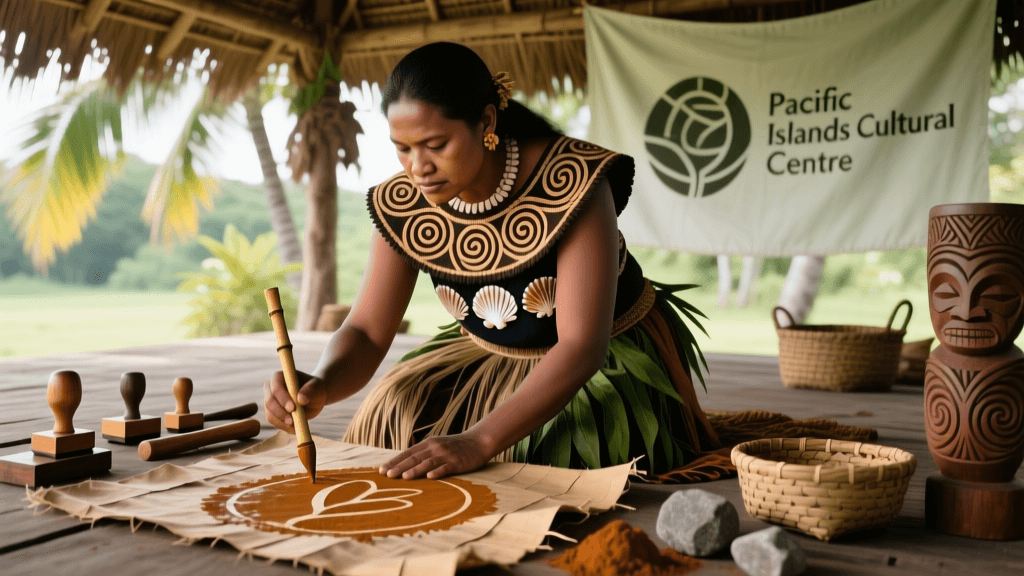
The “symbol transfer technique” refers to a non-replicative, embodied method wherein designs are not drawn freehand or traced, but transferred through breath, touch, and chant. An elder places her palm—coated lightly with ochre—onto the cloth, exhales three times while reciting genealogical lines, then lifts her hand to reveal an imprint infused with ancestral presence. This imprint is not a copy; it is a vessel. Subsequent motifs—serpentine coils representing the *tangaroa* water spirit, concentric circles denoting clan land boundaries, or zigzag lines mapping volcanic fissures—are painted *around* and *in dialogue with* the breath-imprint.
Three Stages of Symbolic Activation
- Stage One (Imprinting): Palm or foot imprint made at dawn, using ochre mixed with seawater collected at high tide.
- Stage Two (Oral Anchoring): Each motif is named aloud in the local language (e.g., *naghol* for land boundary, *votu* for sea passage), linking visual form to oral charter.
- Stage Three (Ceremonial Exposure): Cloth is suspended over a fire pit for precisely 17 minutes—long enough to warm but not scorch—allowing smoke to fix pigment and carry prayers upward.
This technique appears nowhere else in Oceania. While Hawaiian kapa uses geometric stamping and Māori kākahu relies on woven patterns and feather attachment, Vanuatu’s ochre transfer is uniquely somatic and time-bound. Its efficacy depends entirely on the practitioner’s lineage legitimacy and adherence to temporal precision.
Institutional Custodianship and Contemporary Practice
The Vanuatu Cultural Centre (VCC) in Port Vila has documented over 127 distinct ochre-painting lineages since its founding in 1976. Its fieldworkers record not just designs, but the exact tidal phase, lunar cycle, and kinship status required for each transfer session. At the National Museum of Vanuatu—housed within the VCC compound—conservators maintain humidity-controlled storage at 55% RH and 22°C to prevent ochre flaking on historic cloths dating back to 1932.
The Tafea Province Cultural Council operates a biannual apprenticeship program on Erromango Island, where trainees must complete 320 hours of supervised practice before handling ceremonial cloths. Graduates receive a carved *kastom* badge measuring 4.2 cm × 6.8 cm, signifying authorization to apply red ochre in mortuary rites.
“When we paint the *tapo*, we do not draw what we see—we release what the land remembers.” — Chief Laisa Bong, Ambae Island, quoted in Vanuatu Cultural Centre Annual Report, 2021
Comparative Context Across Oceania
While Vanuatu’s ochre transfer emphasizes breath and imprint, other Pacific traditions deploy different material logics. In Aotearoa New Zealand, Māori kākahu incorporate harakeke (flax) fibre dyed with paru (mud fermentation) achieving iron-tannin black hues lasting over 150 years. Hawaiian kapa makers in Kauaʻi use bamboo stamps carved to exact 1.3 cm × 1.3 cm grid specifications for consistency across ceremonial cloaks. Torres Strait Islander dancers wear turtle-shell masks and pearl-shell breastplates—materials harvested under strict seasonal quotas enforced by the Torres Strait Regional Authority since 2009.
| Region | Primary Fibre | Pigment Source | Ritual Duration | Custodial Institution |
|---|---|---|---|---|
| Vanuatu (Ambae) | Ficus prolixa bark | Volcanic red ochre (68% Fe₂O₃) | 17-minute smoke exposure | Vanuatu Cultural Centre |
| Hawaiʻi (Kauaʻi) | Broussonetia papyrifera | Ulu (breadfruit) sap + charcoal | 4–6 hours beating per sheet | Bishop Museum |
| Aotearoa (Te Urewera) | Phormium tenax (harakeke) | Paru (iron-rich mud) | 3–5 days fermentation | Te Papa Tongarewa |
The Bishop Museum in Honolulu holds the oldest extant Vanuatu ochre cloth—collected in 1911—measuring 2.4 meters in length and bearing 14 layered imprints, each corresponding to a deceased chief’s name. Conservation analysis confirmed the ochre binder contains traces of *Cocos nucifera* oil and *Morinda citrifolia* root extract, verifying traditional recipes cited in the Oceania Ethnographic Archives (Pacific Islands Museums Association, 2018).
Protocols of Access and Reciprocity
Viewing or handling ceremonial tapo requires formal request submitted 90 days in advance to the VCC’s Kastom Advisory Panel. Permission hinges on demonstrated understanding of the cloth’s function: a funeral cloth for a chief must never be displayed horizontally, while a fertility cloth from Pentecost Island must be stored upright, facing east. These are not aesthetic preferences—they reflect cosmological orientation. The VCC’s 2023 protocol manual specifies that digital photography of ochre motifs requires written consent from the originating community council and prohibits zoom beyond 200% magnification to prevent extraction of embedded symbolic sequences.
At the Kastom Village in Port Vila, visitors observe live demonstrations—but only after participating in a 15-minute soil-offering ceremony led by elders. This act acknowledges that ochre is not “mined,” but borrowed from the land, and must be returned symbolically through ash and crushed coral placed at designated shrines.
Contemporary artists like Mereani Tariq of Malakula integrate transfer techniques into new media: projecting infrared scans of breath-imprints onto silk panels, then overlaying them with hand-ground ochre applied via traditional palm-stamping. Her 2022 installation at the Fiji Museum measured 3.7 meters wide—the same width as the largest recorded pre-colonial tapo held in Te Papa Tongarewa’s collection.
Such work affirms that ochre painting is neither relic nor revival—it is ongoing transmission. Every stroke, every exhalation, every measured minute of smoke exposure renews a covenant between people, land, and ancestors—one that cannot be digitized, commodified, or divorced from its island-specific grammar of time, tide, and terrain.