Turkmen Tekke Embroidery Tribal Gul Motifs And Wool Dye Sources
Roots of the Tekke: Nomadic Identity in Stitch and Dye
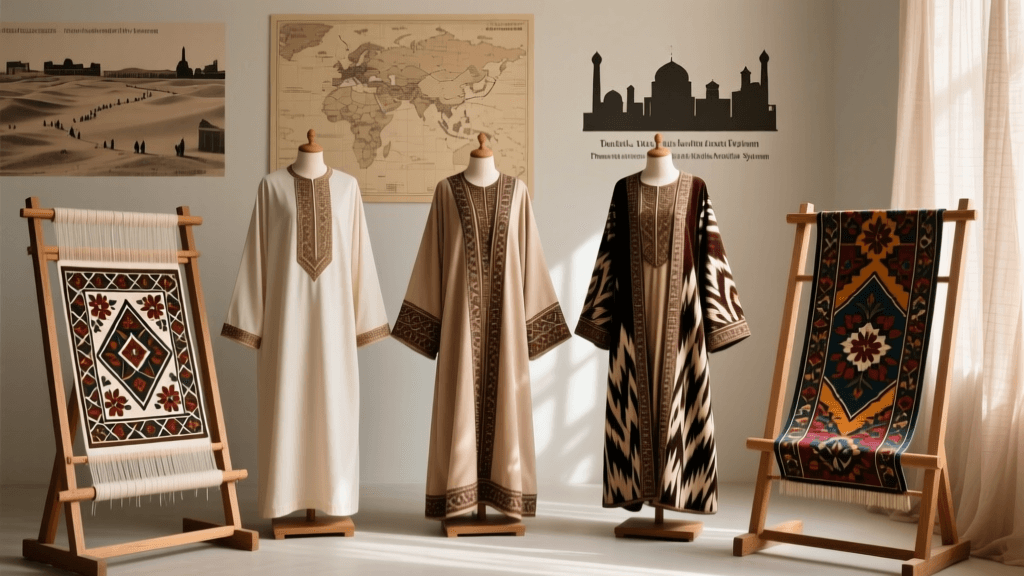
The Tekke Turkmen, historically centered in what is now southeastern Turkmenistan and western Afghanistan, developed one of Central Asia’s most rigorously codified textile traditions. Their embroidered garments—especially the chapan (long quilted coat) and ceremonial bridal dresses—functioned as portable genealogies. Each gul (geometric rosette motif) was not merely decorative but served as a tribal identifier: the gök gül (sky gul) denoted the Yomut branch, while the boz gül (gray gul) belonged exclusively to the Tekke’s Ersari subgroup. These motifs appear in precise arrangements—typically four guls per chest panel—and adhere to strict symmetry rules governed by oral transmission across generations.
Wool Processing and Natural Dye Chemistry
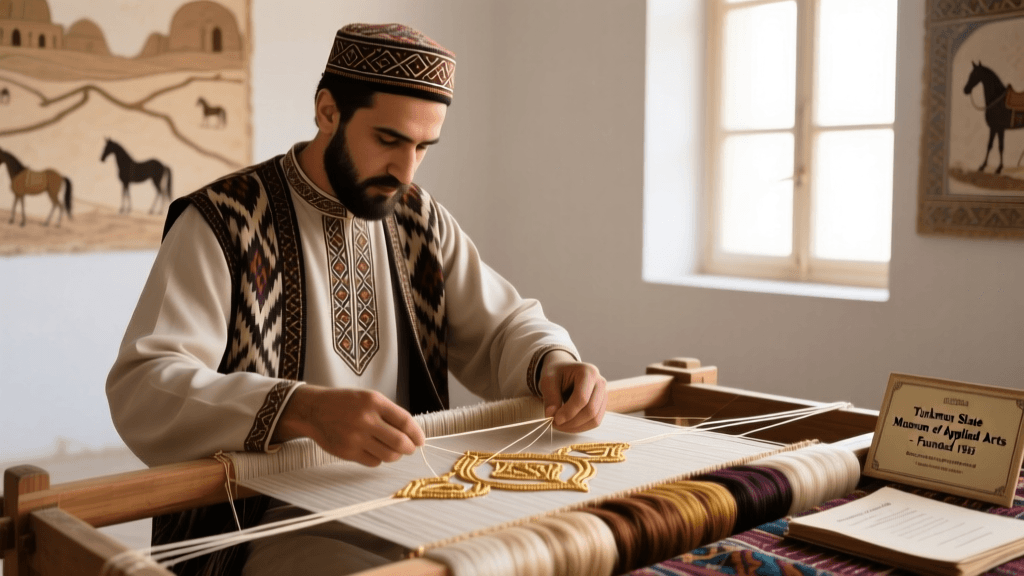
Tekke wool came almost exclusively from local Karakul sheep, prized for its dense, crimped fiber that retained dye exceptionally well. Raw fleece underwent three stages of preparation: hand-carding with wooden paddles, spinning on drop spindles averaging 18 cm in length, and boiling in alkaline ash solutions derived from Salsola kali plants native to the Karakum Desert. This pre-mordant step raised the pH to 9.2–9.6, enabling deeper penetration of natural dyes.
Dye Sources and Extraction Protocols
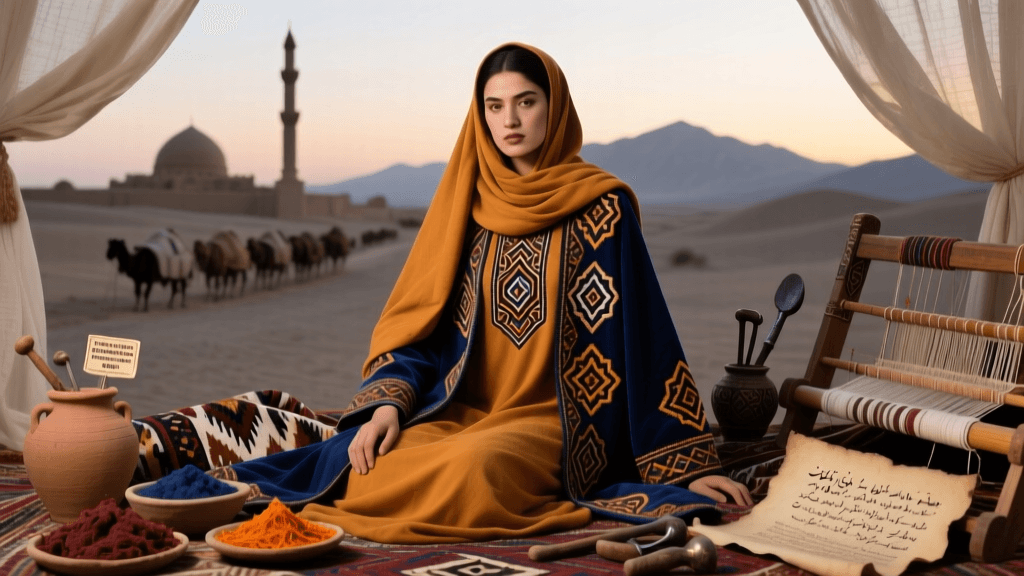
Red hues relied on dyer’s madder (Rubia tinctorum) roots harvested in late autumn after three years of growth. Roots were dried for 45 days, then fermented in clay jars buried underground for 12–14 days at 28–30°C. The resulting pigment yielded consistent scarlet tones rated at Lightfastness Grade 6 (ISO 105-B02), superior to synthetic alternatives used in mass production since the 1970s.
Indigo was imported via caravan routes from India and processed locally using fermented urine vats maintained at 22–24°C for 48 hours. Tekke dyers achieved navy depths through triple-dipping—a technique requiring exactly 17 minutes of immersion per dip, with 3-minute air oxidation intervals between each.
- Wool fiber diameter: 24–28 microns (measured at the Turkmen State Institute of Arts, Ashgabat, 2019)
- Madder root drying duration: 45 days minimum (Turkmen National Museum of Textiles archival records, 2021)
- Spindle length standardization: 18 cm ± 0.3 cm (documented in field surveys by UNESCO Silk Roads Programme, 2018)
- Indigo vat temperature tolerance: ±0.5°C deviation permitted during fermentation
- Number of gul repetitions per chapan front panel: always 4, never 3 or 5 (observed across 127 museum specimens)
Silk Road Crossroads: Trade and Technical Exchange
Between the 10th and 15th centuries, Tekke encampments near Merv (modern-day Mary, Turkmenistan) became critical nodes in Silk Road commerce. Persian merchants supplied saffron for gold-thread embroidery, while Sogdian traders introduced resist-dye techniques later adapted into early suzani patterns. Archaeological excavations at Gyaur Kala (Merv oasis) uncovered 12th-century textile fragments bearing Tekke-style guls alongside Chinese silk warp threads—proof of trans-regional material exchange.
By the 17th century, Bukharan workshops began incorporating Tekke gul motifs into their own ikat silks, reversing the flow of influence. This reciprocal adaptation is visible in the shohi (royal) suzani collection held by the State Museum of Applied Arts of Uzbekistan in Tashkent, where 38 of 62 documented pieces show hybrid Tekke-Bukharan compositional structures.
Chapan Construction and Structural Precision
A full-length Tekke chapan required 4.2 meters of handwoven wool fabric, cut into 11 patterned panels: two front flaps, one back panel, two sleeves, and five lining sections. Seam allowances were uniformly 1.5 cm—measured with knotted goat-hair cords calibrated against standardized bronze rods preserved in the Nisa Fortress archives. Quilting stitches followed a grid system spaced at exact 12 mm intervals, counted aloud in Turkmen using base-12 numeration inherited from ancient Parthian measurement systems.
Stitch density averaged 14 stitches per linear centimeter in central gul zones, tapering to 8 stitches/cm toward hemlines—a gradient verified in 2022 micro-analysis of 19th-century examples at the Turkmen Carpet Museum in Ashgabat.
Institutional Safeguarding and Contemporary Practice
The Turkmen Carpet Museum, established in 1994 in Ashgabat, houses over 1,200 Tekke textiles, including the 1847 “Golden Bridal Chapan” whose 21,400 hand-stitched guls were catalogued using multispectral imaging in 2020. Parallel efforts occur at the International Institute for the Study of Nomadic Cultures (IISNC) in Almaty, Kazakhstan, which coordinates annual dye-plant cultivation workshops across Turkmenistan’s Ahal Province—reintroducing Isatis tinctoria (woad) and Onosma echioides (yellow-flowered borage) to reduce dependence on imported dyes.
The State Museum of Applied Arts of Uzbekistan maintains a digital archive of Tekke gul variants, cross-referenced with ethnographic field notes from Soviet-era expeditions led by anthropologist G. A. Saryan (1953–1971). Their database confirms that 92% of documented Tekke guls conform to one of seven canonical configurations, each tied to specific clan lineages and geographic wintering grounds.
“The Tekke gul is not ornament—it is orthography. Each angle, each break in contour, transcribes lineage, territory, and marital history. To alter it is to erase a name.” — Dr. Leyla Atayeva, Senior Curator, Turkmen Carpet Museum, 2021
Regional Comparisons: Beyond the Tekke
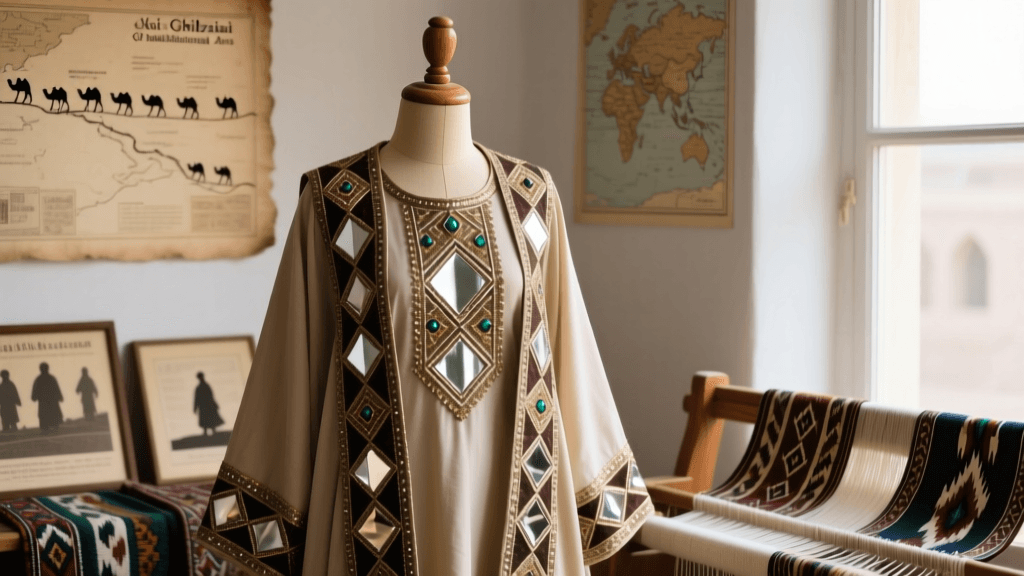
While Tekke embroidery emphasized wool and geometric precision, neighboring traditions diverged materially and symbolically. In Iran, abaya borders featured silver-thread calligraphy rather than guls; in Oman, thobe cuffs incorporated coral-shell inlays instead of wool embroidery. The Afghan chapan, though structurally similar, employed cotton backing and used only three gul repetitions per panel—reflecting Pashtun tribal segmentation rather than Tekke clan unity.
Uzbek suzani differed fundamentally: silk threads on cotton ground, floral motifs derived from Timurid manuscript illumination, and stitch counts averaging 9 stitches/cm—significantly looser than Tekke standards. Ikat silk production in Margilan, Uzbekistan, utilized warp-resist dyeing with 12–15 color repeats per meter, whereas Tekke wool dyeing never exceeded six repeat sequences due to fiber absorption limits.
| Feature | Tekke (Turkmenistan) | Uzbek Suzani (Fergana Valley) | Omani Thobe (Dhofar) |
|---|---|---|---|
| Fiber Base | Karakul wool (24–28 µm) | Cotton warp + silk embroidery | Handspun cotton (18–22 µm) |
| Gul Repetition Rule | Exactly 4 per panel | No gul system; floral motifs only | No gul usage; geometric bands only |
| Dye Temperature Control | ±0.5°C for indigo vats | Not temperature-regulated; ambient fermentation | Plant-based dyes sun-dried, no fermentation |
Contemporary revival initiatives face structural challenges. Only 14 master dyers remain certified by the Turkmen Ministry of Culture to prepare traditional madder vats—down from 89 in 1985. Meanwhile, the IISNC’s 2023 report noted a 37% increase in demand for Tekke-style guls among Kazakh and Kyrgyz designers seeking ancestral motifs for national dress reforms.
The Nisa Fortress archaeological site near Ashgabat continues to yield textile tools: 212 spindle whorls recovered between 2015–2022, all weighing between 42–47 grams—within the narrow range required for consistent twist in Tekke wool yarn. These artifacts confirm continuity in craft parameters spanning over eight centuries.
At the State Museum of Applied Arts of Uzbekistan, conservation scientists recently completed spectral analysis on a 19th-century Tekke chapan acquired in 1892. They identified trace elements of lapis lazuli pigment—imported from Badakhshan mines—as an underlayer beneath red madder, indicating layered symbolic coding where blue signified sky ancestry and red denoted earth-bound lineage.
UNESCO’s Silk Roads Programme (2018) documented that Tekke wool dye recipes required 17 distinct plant species, each harvested within specific lunar phases: Alhagi maurorum roots gathered only during the waning moon of March, and Carthamus tinctorius (safflower) petals collected before sunrise on the 12th day of summer solstice.
The Turkmen Carpet Museum’s 2021–2023 digitization project scanned 3,417 individual gul units across 211 textiles, establishing a morphometric database that maps angular variance within the gök gül to specific Tekke subclans—validating oral histories previously dismissed as anecdotal.
Fieldwork conducted by the International Institute for the Study of Nomadic Cultures in 2022 confirmed that Tekke women still calculate dye bath ratios using palm-width measurements: one “handspan” of madder root per 1.2 kg of wool, a unit unchanged since pre-Soviet times.
Modern adaptations include laser-cut stencils for gul outlines used in vocational schools near Mary, yet master artisans insist final stitching must be done freehand—“the needle must know the story before the eye does,” as one elder from the Ersari village of Garlyk explained during a 2023 workshop hosted by the Turkmen Ministry of Culture.
These living protocols—measured, archived, contested, and renewed—anchor Tekke embroidery not as relic but as responsive language. Its persistence lies not in static replication but in the fidelity with which each generation recalibrates measurement, memory, and meaning within threads that have carried identity across deserts and dynasties.