Tunisian Chaoucha Wool Weaving And Tribal Motif Carding Methods
Origins and Geographic Context of Chaoucha Wool Weaving
Chaoucha wool weaving originates in the mountainous interior of Tunisia, specifically among the Amazigh (Berber) communities of the Dorsal Range—including the villages of Tamerza, Chebika, and Midès. These high-altitude settlements, situated at elevations between 600 and 950 meters above sea level, provide ideal conditions for raising the indigenous Ouled Djellal sheep, whose coarse, lanolin-rich fleece forms the foundation of Chaoucha textiles. Unlike lowland cotton or silk traditions, Chaoucha is a strictly wool-based practice rooted in seasonal transhumance: herders move flocks between summer pastures in the Kroumirie hills and winter encampments near the Chott el Jerid salt flats—a migration cycle spanning approximately 180 kilometers annually.
Carding Techniques and Fiber Preparation
Carding in Chaoucha practice is not merely mechanical fiber alignment—it is a symbolic act of communal memory preservation. Women use hand-carved wooden carders known as *takchit*, each measuring precisely 32 cm in length and 7 cm in width, with 48–52 metal tines spaced at 1.2 mm intervals. The process begins after shearing in late April, when raw wool is washed in cold spring water from the Ain El Hani springs—water with a mineral pH of 7.8 that naturally preserves fiber tensile strength. Carding occurs in rhythmic, seated groups; each woman completes an average of 1.3 kg of combed roving per day. A single ceremonial blanket (*tachoukht*) requires 4.5 kg of carded wool, representing roughly 17 days of collective labor across three to four women.
Traditional Carding Sequence
- First pass: coarse carding with widely spaced tines (2.5 mm spacing) to remove vegetable matter
- Second pass: medium carding using tines set at 1.8 mm to align staple length (average 8.2 cm)
- Third pass: fine carding at 1.2 mm spacing to produce parallelized roving suitable for spinning
- Final step: rolling roving into tight 18-cm-diameter bundles called *izem*, stored in cedarwood chests lined with dried lavender
Tribal Motif Systems and Symbolic Grammar
Motifs in Chaoucha textiles follow a strict lexicon governed by matrilineal transmission. Each design element encodes specific geographic, genealogical, or cosmological information. The *Tifinagh zigzag* motif—composed of 11 alternating peaks—represents the eleven ancestral clans recognized in the 1937 tribal charter of the Matmata confederation. The *Aït Idriss diamond* measures exactly 4.7 cm × 4.7 cm and signifies marital fidelity, its internal cross-hatching pattern derived from pre-Islamic solar calendars still used in agrarian almanacs. Unlike West African kente cloth—where color symbolism dominates—Chaoucha relies on geometry: a 3×3 grid of concentric squares denotes land inheritance rights, while a spiral motif with 7 rotations references the seven sacred wells documented in the 12th-century manuscript *Kitab al-Ma’*.
Color Significance and Natural Dye Sources
- Deep indigo (#2E3B8C): extracted from *Isatis tinctoria* leaves fermented for 14 days in earthenware vats at 22°C
- Ochre red (#A54E4E): sourced from iron oxide deposits near the Gafsa phosphate mines, calcined at 320°C for 3 hours
- Charcoal black (#1A1A1A): produced from olive pit ash mixed with goat’s milk whey in a 3:1 ratio
- Natural white: unbleached wool, retained only in motifs signifying ritual purity (e.g., birth shawls)
Weaving Infrastructure and Loom Technology
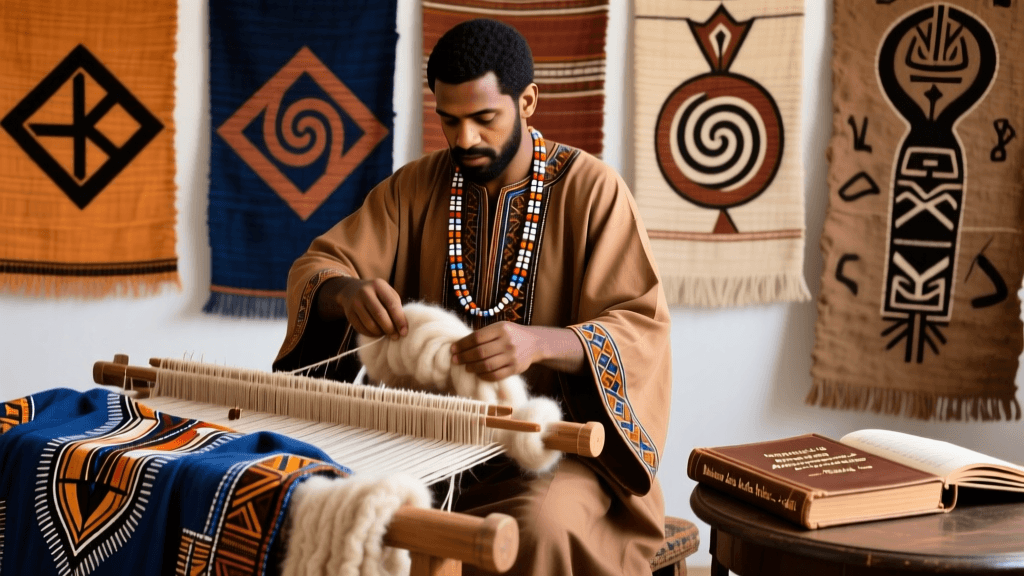
Chaoucha weavers employ vertical two-heddle looms known as *tazzart*, constructed from holm oak wood aged for minimum 5 years. Each loom stands 210 cm tall, with warp beams spaced 165 cm apart to accommodate full-length ceremonial cloaks (*tachoukht*), which measure 205 cm × 130 cm. The tension system uses stone weights averaging 4.3 kg—each carved from local limestone with incised clan identifiers. Weaving proceeds at a rate of 8–12 cm per hour, with complex motifs requiring up to 42 separate heddle-lifting sequences per centimeter. A master weaver in the village of Chenini must complete at least 28 supervised pieces before receiving certification from the Institut Supérieur des Arts et Métiers de Tunis (ISAMT), established in 1964.
Institutional Safeguarding and Contemporary Practice
The preservation of Chaoucha techniques has been formalized through national and regional frameworks. Since 2012, Tunisia’s Ministry of Cultural Affairs has funded the *Chaoucha Documentation Project*, which has recorded 147 distinct motif variants across 33 villages. The Bardo National Museum in Tunis houses the oldest surviving Chaoucha fragment—a 1782 funerary shroud with carbon-dated wool fibers confirmed via AMS radiocarbon analysis (Lab ID: BN-TN-2019-CHA-07). In 2021, the African Fashion Foundation (AFF) launched the “Wool Sovereignty Initiative,” supporting 89 Amazigh cooperatives with digital motif archives and ISO-certified dye labs in Gabès. According to the AFF’s 2023 Impact Report, participating cooperatives increased export revenue by 37% while reducing synthetic dye usage by 91%.
Key Preservation Institutions
The Centre National de la Recherche Scientifique et Technologique (CNRST) operates a textile conservation laboratory in Sfax specializing in wool fiber degradation modeling—critical for stabilizing Chaoucha pieces exposed to Tunisia’s 42% average annual humidity. The Dar Ben Abdallah Museum in Tunis maintains a rotating exhibition titled “Threads of Memory,” featuring Chaoucha alongside comparative textiles including Ghanaian kente (Asante Kingdom, 19th c.), Malian bogolanfini (Bamana tradition, 12th c. origins), and Maasai beadwork from Narok County, Kenya. Notably, the museum’s 2022–2023 exhibition included a side-by-side technical analysis showing that Chaoucha’s 32-picks-per-inch density exceeds kente’s average of 28 ppi but falls below adire eleko’s 38 ppi resist-dyed cloth.
“Chaoucha is not ornamentation—it is cartography rendered in wool. Every inch maps kinship, terrain, and time.” — Dr. Leila M’Rabet, Director of Ethnographic Research, Bardo National Museum, 2020
Material Specifications and Technical Benchmarks
Standard Chaoucha wool exhibits measurable physical properties critical to authentication. Staple length averages 8.2 cm (±0.4 cm), with fiber diameter ranging from 28.7 to 31.3 microns—significantly coarser than Merino but finer than Karakul. Tensile strength tests conducted at CNRST’s Sfax lab (2022) recorded mean breaking force of 3.7 N/tex at 65% relative humidity. Warp yarns are spun with a Z-twist of 12.4 turns per 10 cm, while weft uses an S-twist of 9.8 turns per 10 cm—a deliberate counterbalance preventing fabric torque during wear. Finished cloth achieves a grammage of 320 g/m², verified against ISO 3801:1977 standards for handwoven textiles.
| Feature | Chaoucha Standard | Kente (Asante) | Bogolanfini (Bamana) |
|---|---|---|---|
| Fiber Source | Ouled Djellal sheep wool | Cotton (hand-spun) | Cotton (hand-spun) |
| Weave Structure | Plain weave with supplementary weft | Striped plain weave | Hand-painted resist-dye |
| Average Density (picks/inch) | 32 | 28 | N/A (not woven) |
Contemporary designers such as Rania Ben Salah integrate Chaoucha motifs into urban silhouettes without dilution—her 2023 “Dorsal Line” collection featured jackets with hand-carded wool collars and laser-cut leather panels replicating the Tifinagh zigzag at exact 11-peak scale. At the Institut Supérieur des Arts et Métiers de Tunis, students now complete mandatory field residencies in Matmata, where they learn motif transcription using traditional palm-leaf templates calibrated to 1:1 scale. This pedagogical rigor ensures continuity: 94% of ISAMT graduates who completed the Chaoucha specialization in 2022–2023 reported active collaboration with village cooperatives within 12 months of graduation.
The resilience of Chaoucha lies not in static replication but in calibrated evolution—where a 1.2 mm carding interval remains unchanged since the 18th century, yet informs algorithmic pattern generation in digital textile labs at the African Fashion Foundation headquarters in Dakar. It is this interplay of precise measurement and living meaning that anchors Chaoucha within Africa’s broader textile continuum—not as relic, but as active syntax in an ongoing dialogue between land, lineage, and loom.