Traditional Japanese Clothing of the Edo Period: A Comprehensive Guide
The Edo period stands as a transformative golden age in the history of Japanese fashion and textile arts. Following centuries of civil unrest, the establishment of a unified, peaceful society allowed commerce, arts, and culture to flourish in unprecedented ways. During this era, traditional Japanese clothing evolved from strictly utilitarian garments and rigid military uniforms into a vibrant canvas of personal expression, artistic innovation, and social identity. The bustling urban centers became epicenters of style, where merchants, artisans, and samurai navigated complex social hierarchies through the very fabrics they wore.
For students of the history of the kimono and enthusiasts of global fashion heritage, the Edo period offers a fascinating study of how peace, prosperity, and strict governmental regulations paradoxically fueled immense creativity. This comprehensive guide explores the origins, defining characteristics, class distinctions, and enduring cultural significance of traditional Japanese clothing from this remarkable era.
The Origins and Evolution of Edo Fashion
The dawn of the Edo period marked a definitive shift from the battlefield to the bustling city. With the military class establishing a rigid social hierarchy, the population was divided into four main tiers: samurai, farmers, artisans, and merchants. While the samurai held the highest political power, it was the chōnin (townspeople)—comprising artisans & merchants—who eventually accumulated the most wealth. This economic shift fundamentally altered the fashion landscape.
As urban centers like Edo (modern-day Tokyo), Kyoto, and Osaka expanded, a vibrant consumer culture emerged. The chōnin class, despite their lower social standing, possessed the disposable income to commission luxurious garments. They became the primary trendsetters, driving the demand for exquisite silks, intricate dyeing techniques, and bold new patterns. The theater districts, particularly the Kabuki stages, and the pleasure quarters served as the ultimate runways of the era, where actors and courtesans debuted avant-garde styles that were rapidly copied by the general public.
However, this explosion of sartorial wealth did not go unnoticed by the ruling shogunate. To maintain the strict social order and prevent the merchant class from visually outshining the samurai, the government enacted a series of sumptuary laws. These edicts strictly regulated the types of fabrics, colors, and patterns that different classes were permitted to wear. Far from stifling creativity, these laws birthed a culture of sartorial rebellion and subtle sophistication. Townspeople developed ways to circumvent the restrictions, such as wearing plain, muted fabrics on the outside while lining their garments with outrageously vibrant, expensive silks—a practice that deeply influenced the aesthetic sensibilities of the time.
Defining Characteristics of Edo Period Garments
The clothing of the Edo period laid the direct groundwork for what the world recognizes today as traditional Japanese dress. The evolution of garment structure, accessorization, and textile decoration during this time was both profound and lasting.
The Transition from Kosode to Kimono
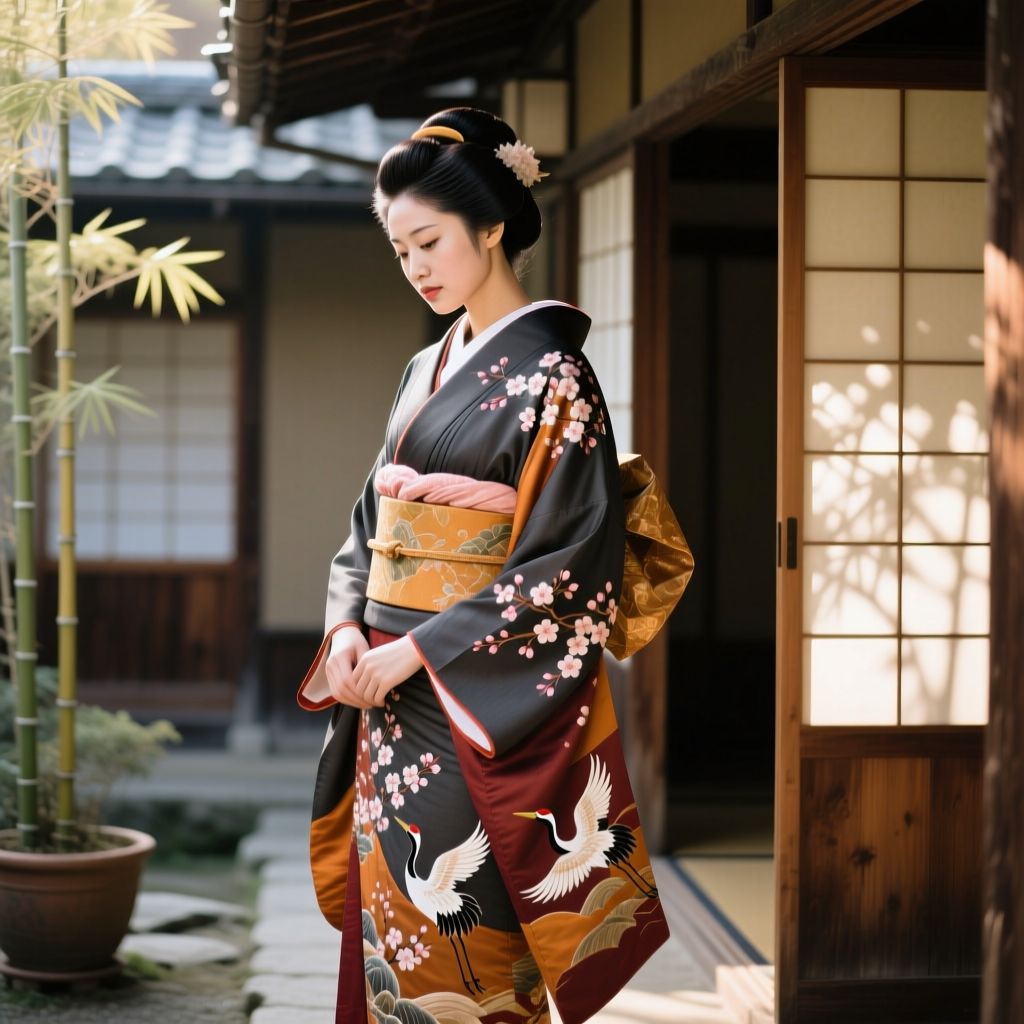
At the heart of Edo fashion was the kosode. Originally worn as an undergarment in previous centuries, the kosode emerged as the primary outer garment for both men & women across all social classes. Characterized by its T-shape, straight seams, and relatively small sleeve openings (the literal translation of kosode is 'small sleeve'), it provided a broad, continuous canvas for artistic expression. As the era progressed, the kosode's sleeves began to lengthen and widen, particularly for unmarried women, eventually evolving into the modern kimono and the dramatic furisode.
The Evolution of the Obi
In the early Edo period, the kosode was secured with a narrow, utilitarian cord or thin sash. However, as the garment became more ornate and the sleeves grew longer, the sash evolved into the obi. By the mid-to-late Edo period, the obi had transformed into a wide, heavily brocaded, and highly decorative sash. The method of tying the obi also shifted; while early styles featured knots tied at the front or side, the late Edo period saw the standardization of tying the obi at the back, a practice that allowed the front of the garment to remain unbroken and elegantly display the textile's primary motifs.
Revolutionary Textile Techniques
The era was a crucible for Japanese textile arts. The invention and popularization of Yūzen dyeing revolutionized garment decoration. This resist-dyeing technique, utilizing a rice-paste barrier, allowed artisans to paint highly detailed, pictorial designs directly onto silk, mimicking the fluid brushstrokes of fine art. This was a stark departure from the rigid geometric patterns of earlier woven brocades. Additionally, techniques like shibori (intricate tie-dyeing) and luxurious Nishijin weaving reached new pinnacles of complexity, allowing for an unprecedented interplay of texture, color, and light on the human form.
Garments for Every Occasion and Class
Clothing in the Edo period was not merely a matter of personal taste; it was a highly codified visual language that communicated one's social status, marital status, age, and the specific occasion at hand.
The Samurai and the Kamishimo
For the ruling warrior class, formal attire was defined by the kamishimo. This striking two-piece ensemble consisted of a kimono worn beneath a sleeveless, hakama-style trouser and a matching broad-shouldered vest (kataginu). The kamishimo was typically made of crisp, stiffened hemp or ramie, dyed in subdued, formal colors like navy, charcoal, or deep brown, and adorned with the wearer's family crest (mon). The rigid, angular silhouette of the kamishimo projected authority, discipline, and martial readiness, standing in stark contrast to the flowing, decorative garments of the townspeople.
Merchant and Artisan Everyday Wear
The chōnin class favored practicality intertwined with hidden luxury. For everyday work and street wear, men typically wore shorter-sleeved kosode paired with loose-fitting hakama or simple trousers. Due to sumptuary laws, their outer garments were often dyed in subdued shades of indigo, brown, or grey, utilizing subtle stripe patterns (shima) or micro-patterns (komon). However, the inner linings, under-kimono (juban), and the socks (tabi) were often crafted from the finest, most vibrantly dyed silks, serving as a private display of wealth and refined taste.
Women's Fashion and Marital Status
Women's fashion was highly stratified by age and marital status. Unmarried young women wore the furisode, characterized by its dramatically long, swinging sleeves, which served as a visual signal of their eligibility for marriage. These garments were lavishly decorated with auspicious motifs like cranes, pine trees, and cherry blossoms using Yūzen dyeing and heavy embroidery. Upon marriage, women transitioned to the tomesode, featuring shorter sleeves and a more restrained design, often with patterns concentrated below the waist and adorned with family crests. Courtesans and geisha, operating outside traditional societal bounds, pushed the envelope of fashion, wearing multiple layers of heavily brocaded silk with obi tied at the front to facilitate frequent changes.
Regional Variations and Textile Hubs
While the overarching silhouettes of Edo clothing were consistent across the archipelago, regional variations in textiles, dyeing methods, and aesthetic preferences were profoundly distinct, shaped by local climates, resources, and cultural attitudes.
Kyoto: The Epicenter of Luxury
As the imperial capital and historical heart of Japanese culture, Kyoto remained the undisputed center of luxury textile production. The Nishijin district produced the most exquisite brocades and damasks, favored by the aristocracy and the highest-ranking samurai. Kyoto was also the birthplace of Yūzen dyeing, and the city's artisans favored elegant, classical motifs drawn from literature, nature, and the changing seasons. The Kyoto aesthetic leaned heavily on refinement, historical continuity, and unparalleled technical mastery.
Edo: Boldness and Practicality
In stark contrast to the traditionalism of Kyoto, the shogunal capital of Edo was a rapidly growing, gritty, and dynamic metropolis. The fashion of Edo reflected the bold, pragmatic spirit of its inhabitants. Edoites favored striking, graphic patterns, bold geometric designs, and darker, more saturated colors that were practical for the muddy, bustling streets. The Edo komon technique, which produced incredibly fine, micro-patterns that appeared solid from a distance but revealed intricate designs up close, perfectly encapsulated the Edo preference for understated but technically impressive style.
Rural Regions: Hemp, Indigo, and Sashiko
Away from the urban centers, the rural populace—primarily farmers and peasants—were strictly forbidden from wearing silk. Their clothing was crafted from locally grown bast fibers like hemp, ramie, and eventually cotton. The defining characteristic of rural Edo fashion was the mastery of indigo dyeing (aizome), which not only provided a beautiful, deep blue hue but also acted as a natural insect repellent and fabric strengthener. In the harshest northern climates, rural women developed the techniques of sashiko and boro, using intricate running stitches to mend, reinforce, and insulate their garments, turning sheer necessity into a profound, textural textile art form.
The Cultural Significance and Legacy of Edo Clothing
The clothing of the Edo period was far more than mere bodily covering; it was a complex semiotic system that communicated the wearer's place in the universe. The era birthed the aesthetic philosophy of Iki, a concept of understated elegance, subtle sensuality, and refined spontaneity. Iki dictated that true style was not found in gaudy displays of wealth, but in the subtle drape of a fabric, the unexpected flash of a crimson lining beneath a muted grey kimono, and the effortless grace of the wearer. This philosophy continues to influence Japanese design and global fashion sensibilities to this day.
Furthermore, the Edo period cemented the deep connection between Japanese garments and the natural world. The motifs woven and dyed into the fabrics were not arbitrary; they were deeply tied to the seasons, poetry, and auspicious wishes. Wearing a garment adorned with autumn grasses in the spring would be considered a severe faux pas, reflecting a society that lived in deep, sartorial harmony with the rhythms of nature.
The legacy of Edo period clothing is monumental. It established the standard silhouette, construction methods, and decorative techniques of the modern kimono. The era's master artisans laid the foundations for Japanese textile arts that are still revered as Living National Treasures. By studying the garments of the Edo period, we gain invaluable insight into a society that navigated strict authoritarian rule through the quiet, resilient, and breathtakingly beautiful language of thread, dye, and silk.
Frequently Asked Questions
What was the most common garment worn during the Edo period?
The kosode was the foundational garment for almost everyone during the Edo period, regardless of gender or social class. While the fabrics, sleeve lengths, and decorative techniques varied wildly between a wealthy merchant's wife and a rural farmer, the basic T-shaped, straight-seamed structure of the kosode was the universal baseline of Japanese dress. Over the course of the era, the kosode evolved into what we now globally recognize as the kimono.
How did sumptuary laws affect Edo period fashion?
Sumptuary laws were government edicts designed to enforce class distinctions by restricting the lower classes (particularly wealthy merchants) from wearing luxurious fabrics like silk, or using vibrant colors and elaborate patterns. Paradoxically, these laws fueled immense creativity. Townspeople circumvented these restrictions by developing subtle dyeing techniques like micro-patterns (komon), using subdued colors on the exterior of their garments, and hiding outrageously expensive, vibrantly dyed silk linings on the inside. This cat-and-mouse game between the government and the townspeople gave rise to the sophisticated aesthetic of hidden luxury.
What is the difference between a kosode and a modern kimono?
Historically, the term kosode translates to 'small sleeve,' referring to the relatively narrow sleeve openings of the garment compared to the wide-sleeved court robes of earlier eras. During the Edo period, the kosode was the primary outerwear. As the era progressed, particularly for young, unmarried women, the sleeves began to grow significantly in length and width, leading to the furisode. The term 'kimono' simply means 'thing to wear' and was adopted later as a catch-all term for these traditional garments to distinguish them from Western clothing. Structurally, the late-Edo kosode and the modern kimono are virtually identical.
Which textile techniques originated or flourished during this era?
The Edo period was a renaissance for textile innovation. Yūzen dyeing flourished, allowing for painterly, free-flowing designs on silk. Edo komon (micro-pattern dyeing using intricate paper stencils) was perfected to create fabrics that appeared solid from a distance but revealed complex patterns up close. Additionally, rural techniques like sashiko (decorative reinforcement stitching) and aizome (natural indigo dyeing) were elevated from mere survival necessities to highly respected regional crafts.
How did social class dictate clothing choices in the Edo period?
Social class strictly dictated the materials, colors, and silhouettes one was legally permitted to wear. The samurai class wore the stiff, formal kamishimo made of hemp or ramie, adorned with family crests to denote rank and allegiance. Farmers and peasants were restricted to dull-colored hemp, ramie, or cotton, often dyed with indigo. The merchant and artisan classes, despite their wealth, were legally barred from overt displays of luxury, forcing them to adopt subdued outerwear while expressing their wealth through hidden linings, expensive accessories, and the patronage of highly skilled, clandestine dyers.