The Definitive Guide to Traditional Japanese Men's Clothing
Japanese traditional clothing, collectively known as 'wafuku', represents far more than mere fabric stitched together. It is a profound expression of cultural identity, social status, and aesthetic philosophy. For men, the evolution of these garments reflects a fascinating journey through centuries of martial history, rigid class structures, and an enduring reverence for nature. Unlike the highly ornate and heavily layered garments historically worn by women, traditional Japanese men's clothing has traditionally prioritized a balance between dignified restraint, mobility, and subtle elegance. From the sweeping hakama of the samurai class to the lightweight cotton yukata worn at summer festivals, every thread tells a story. In this comprehensive guide, we explore the origins, defining characteristics, and enduring cultural significance of traditional Japanese menswear. For a broader look at the foundations of these garments, explore our complete guide to kimono basics.
The Origins and Evolution of Japanese Menswear
The roots of Japanese menswear can be traced back to the early interactions with the Asian mainland, particularly during the Nara and Heian periods. Initially, court nobles adopted heavily influenced Chinese-style robes, characterized by wide sleeves and flowing silhouettes. However, as Japan turned inward during the Heian period, a distinct national aesthetic began to emerge. The kosode, a garment with small sleeve openings originally worn as an underlayer, gradually evolved into the primary outer garment for both men and women.
The true divergence in men's clothing occurred during the Kamakura and Muromachi periods, eras dominated by the rise of the samurai class. Warriors required garments that allowed for swift movement and martial prowess. This necessity birthed the hitatare and later the kamishimo, a formal two-piece suit consisting of a broad-shouldered sleeveless jacket and matching hakama trousers. The Edo period brought unprecedented peace and a rigid social hierarchy enforced by the Tokugawa shogunate. Sumptuary laws dictated exactly what fabrics, colors, and patterns commoners, merchants, and samurai could wear. Consequently, men of the merchant class developed a subtle aesthetic known as 'iki'—expressing wealth and taste through hidden linings, understated colors, and exquisite weaving techniques rather than overt displays of opulence. To understand the textiles that shaped these eras, delve into our archive of Japanese heritage textiles.
Core Garments: Characteristics and Components
To fully appreciate traditional Japanese men's clothing, one must understand the specific garments that compose a complete ensemble. The architecture of the male silhouette relies on layering, precise folding, and the interplay of matte and lustrous textures.
The Kimono and Nagagi
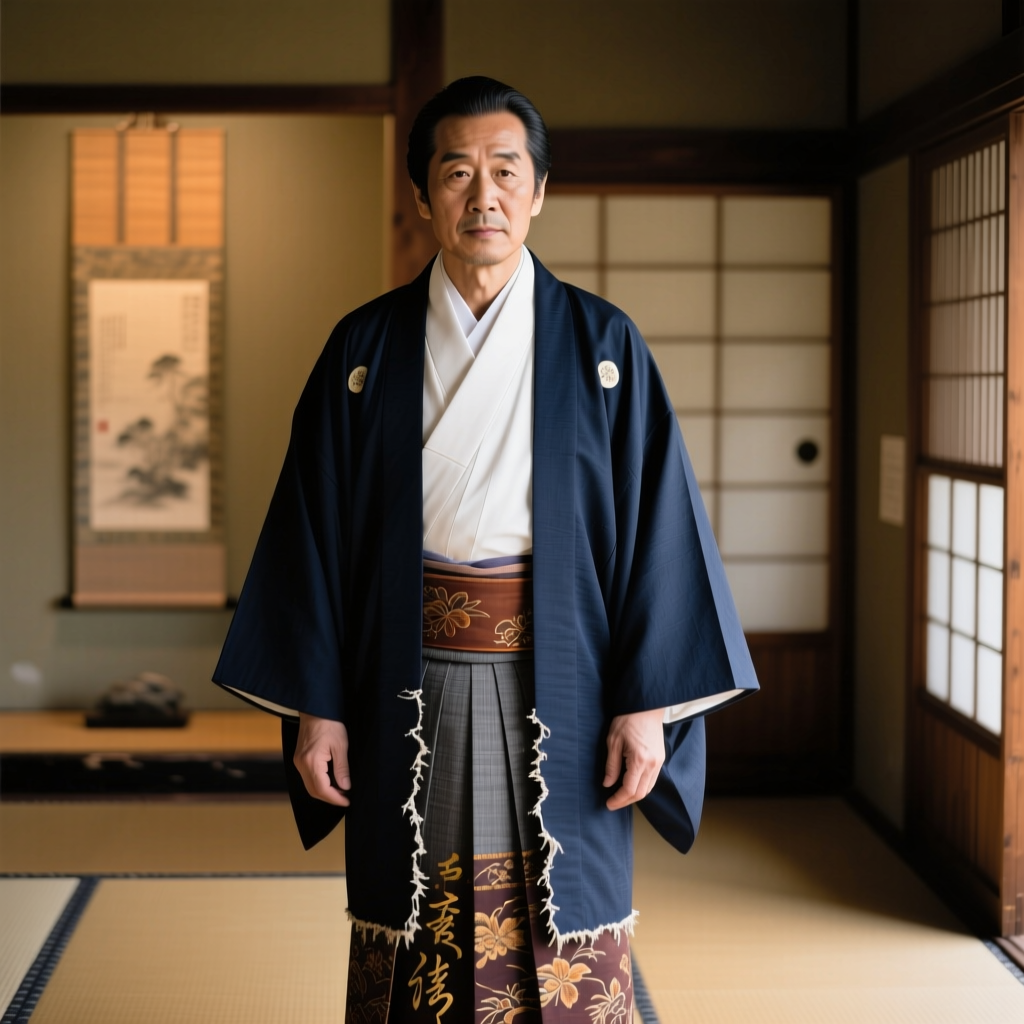
The foundational garment is the kimono, though for men, the term 'nagagi' is often used to describe the full-length robe. Men's kimonos are typically characterized by subdued colors such as navy, charcoal, olive, and deep brown. The sleeves are attached to the body of the garment with less depth than women's kimonos, reflecting a more structured and angular silhouette. The length is tailored precisely to the wearer's height, ensuring the hem rests just above the ankles.
The Hakama
Worn over the kimono, the hakama is a pleated, divided skirt or wide-legged trouser. Historically reserved for the samurai and court nobility, it is now the standard for formal occasions and martial arts. A traditional formal hakama features five or seven deep pleats, representing the virtues of the samurai code. The rigid back panel, known as the koshi-ita, ensures the garment sits properly at the waist and promotes an upright, dignified posture.
The Haori and Montsuki
The haori is a hip- or thigh-length jacket worn over the kimono. For the highest level of formality, men wear a 'montsuki haori', which is dyed solid black and adorned with up to five family crests, or 'kamon', in white. The haori is left open at the front, secured only by two short, braided silk ties called haori himo. These ties are often intricately knotted and serve as a subtle focal point of the ensemble.
The Yukata
Originally worn as a bathrobe by the aristocracy, the yukata evolved into the standard casual summer garment for all classes. Made from breathable, unlined cotton or hemp, men's yukata often feature geometric patterns, indigo dyes, or subtle stripes. Learn more about styling this casual staple in our yukata styling guide.
The Juban and Undergarments
Beneath the outer layers, men wear a 'juban' (under-kimono) to protect the expensive silk outer garments from sweat and oils. A crucial aesthetic element is the 'han-eri', a detachable collar attached to the juban that peeks out just above the kimono collar, offering a subtle flash of contrasting color or texture. The ensemble is held together by a 'kaku-obi', a stiff, woven silk sash that provides structural support to the lower back.
Dressing for the Occasion: Formality and Etiquette
In Japanese culture, the concept of TPO (Time, Place, & Occasion) is paramount when selecting traditional attire. The formality of a man's ensemble is dictated by the presence of family crests, the type of fabric, and the color palette. Misunderstanding these nuances can lead to social faux pas, making it essential to understand the rules of engagement.
Weddings and Highly Formal Ceremonies
For a groom or a guest at a formal wedding, the undisputed standard is the black montsuki ensemble. This includes a black silk kimono, a black hakama with fine white or silver pinstripes, and a black montsuki haori bearing five family crests. The ensemble is paired with pristine white tabi socks and formal zori sandals. The five crests represent the highest level of respect and formality, signaling the wearer's deep reverence for the event.
Tea Ceremonies and Cultural Gatherings
Tea ceremony practitioners favor garments that embody 'wabi-sabi'—the appreciation of rustic simplicity and quiet elegance. Men typically wear subdued, uncrested silk or high-quality linen kimonos in earth tones, paired with a hakama in a complementary muted shade. The focus is on harmony with the tea room and the season, avoiding any loud patterns or bright colors that might distract from the meditative ritual.
Festivals and Casual Outings
During summer matsuri (festivals), the yukata is the garment of choice. Men often pair their cotton yukata with a simple woven obi tied in a straightforward knot at the back or slightly off-center. Geta (wooden clogs) are worn barefoot or with casual tabi, completing a relaxed, festive silhouette that encourages movement and socialization.
Martial Arts Practice
Disciplines such as Kendo, Iaido, and Kyudo utilize specialized variations of the hakama and kimono, often referred to as a 'gi' or 'keikogi'. These garments are constructed from heavy-duty cotton or synthetic blends designed to withstand rigorous physical exertion while maintaining the dignified lines of traditional samurai attire. Discover the intersection of dress and discipline in our guide to martial arts attire.
Regional Variations and Artisan Textiles
Japan's diverse climate and isolated historical provinces have given rise to remarkable regional variations in men's traditional clothing. The interplay of local resources, climate, and cultural isolation has birthed textiles that are highly prized by collectors and historians alike.
Kyoto and the Nishijin Weave
Kyoto remains the epicenter of high-end textile production. The Nishijin district is famous for its incredibly complex, multi-colored brocades. While men's outer garments remain visually understated, a wealthy patron might commission a Nishijin-woven obi or a haori lining featuring breathtaking landscapes or mythical dragons. This hidden luxury is only visible when the jacket moves or is removed, perfectly encapsulating the 'iki' aesthetic of the Edo period.
Okinawa and the Ryusou
In the southern Ryukyu islands, the traditional garment is the 'Ryusou'. Influenced by both Japanese and Southeast Asian trade, the Ryusou is characterized by its loose, flowing fit, designed to accommodate the subtropical climate. It is frequently crafted from 'bashofu' (banana fiber cloth) or lightweight ramie, featuring vibrant, nature-inspired motifs dyed using the resist-dyeing technique known as 'bingata'.
Tohoku and Winter Workwear
In the harsh, snow-heavy winters of the northern Tohoku region, functionality dictated design. Men historically wore heavy, multi-layered garments made from hemp and cotton, heavily reinforced with 'sashiko' (decorative and functional running stitch embroidery). The indigo-dyed 'noragi' (farmer's jacket) is a prime example, where generations of mending created a thick, insulated textile that is now highly prized by vintage collectors and sustainable fashion advocates.
The Art of Aizome (Indigo Dyeing)
Across regions like Tokushima, the art of 'aizome' has been essential to men's workwear and casual wear. Indigo was not only prized for its deep, rich blue hue but also for its practical properties: it repels insects, masks dirt, and strengthens cotton fibers. A well-worn, naturally dyed indigo kimono or hakama develops a unique patina over time, reflecting the wearer's life and labor. Explore the deep blues of traditional dyeing in our Japanese indigo heritage page.
The Cultural Significance and Modern Revival
Traditional Japanese men's clothing is deeply intertwined with the nation's philosophical and spiritual frameworks. The act of wearing a kimono and hakama requires mindfulness. The wrapping of the left side over the right—a rule strictly observed, as the reverse is reserved for dressing the deceased—the precise tying of the obi, and the mindful posture required to keep the hakama pleats neat all demand a physical awareness that aligns with Zen principles.
Furthermore, the concept of seasonal awareness, or 'kisetsukan', is embedded in the wardrobe. A man of refined taste will transition from the lined silk kimonos of autumn to the unlined, sheer 'ro' or 'sha' silk garments of high summer, adjusting not just for temperature, but to visually reflect the changing natural world. Motifs on the lining or the obi might feature autumn leaves in October or pine branches in winter, connecting the wearer to the immediate environment.
In contemporary society, while Western suits dominate the corporate landscape, traditional garments are experiencing a vibrant revival. Younger generations are reclaiming the yukata and kimono as expressions of individuality and cultural pride. Artisans and modern designers are collaborating to create washable silks, stretch-fabric hakama, and contemporary obi designs that bridge the gap between historical reverence and modern convenience. This synthesis ensures that the traditional Japanese male silhouette will continue to evolve, remaining a vital, living component of global sartorial heritage.
Frequently Asked Questions
What is the difference between a kimono and a yukata for men?
The primary differences lie in the material, formality, and layering. A kimono is typically made of silk or high-quality synthetic blends, is fully lined, and requires a complex undergarment system (juban) and formal footwear. It is worn for ceremonies, weddings, and formal gatherings. A yukata is an unlined, casual garment made of breathable cotton or hemp, worn directly over basic undergarments, and paired with casual wooden geta. It is reserved for summer festivals, relaxing at ryokans (traditional inns), and informal outings.
How do men properly tie a hakama?
Tying a hakama is a meticulous process that ensures the garment sits flat against the back and the pleats remain aligned. The hakama is first wrapped around the waist over the kimono. The front ties are brought around the back, crossed, and then tied in a specific, flat knot at the front. The back ties are then brought forward and tucked or tied beneath the front knot. The rigid koshi-ita (back panel) must rest securely just below the obi of the underlying kimono to maintain proper posture and silhouette.
Are traditional garments still worn daily in Japan?
While Western clothing is the standard for daily life, business, and education, traditional garments are still worn regularly by specific demographics. Shinto priests, Buddhist monks, traditional artisans, and practitioners of classical arts (such as tea ceremony, kabuki, and rakugo) wear wafuku as their daily uniform. Additionally, many men choose to wear yukata or casual kimonos on weekends, during holidays, and at summer festivals to stay connected to their heritage.
What footwear is worn with traditional Japanese menswear?
Footwear is strictly categorized by formality. For formal events, men wear 'zori'—flat, woven sandals made of rush grass, cloth, or leather—paired with white split-toe 'tabi' socks. For casual wear and summer festivals, 'geta' (wooden clogs with elevated teeth) are worn, often without tabi or with casual, colored tabi. For indoor settings, such as tea rooms or traditional homes, all outdoor footwear is removed, and one walks either in tabi socks or barefoot. Read more about these essential accessories in our guide to traditional Japanese footwear.
How should traditional silk garments be cared for?
High-quality silk kimonos and haori require specialized care. They should never be washed in water or machine laundered. Instead, they are traditionally cleaned through a process called 'arai-hari', where the garment is completely unstitched, washed as flat bolts of fabric, stretched, and then re-sewn. For modern maintenance, professional dry cleaning specializing in Japanese garments is recommended. Between wears, silk garments should be aired out in the shade to remove moisture and odors, and stored flat in specialized paper wrappers with natural desiccants to prevent mold and humidity damage.