Tongan Ngatu Cloth Beating Patterns And Fern Leaf Dye Resist Methods
Ngatu Cloth: The Living Canvas of Tongan Identity
In the Kingdom of Tonga, ngatu is far more than decorated barkcloth—it is a genealogical ledger, a diplomatic instrument, and a vessel for ancestral memory. Made from the inner bark of the paper mulberry tree (Broussonetia papyrifera), each sheet undergoes a labor-intensive process spanning up to six weeks, beginning with harvesting during the lunar phase known as ‘ua tā’i, when sap flow is optimal. Women artisans—often working in intergenerational groups—peel, soak, and beat the bark using wooden mallets called ike, whose grooved surfaces imprint rhythmic textures into the fibres. The resulting cloth can measure up to 4.5 metres in length and 1.8 metres in width, though ceremonial pieces for royal weddings or funerals may exceed 12 metres when joined in panels.
Fern Leaf Dye Resist: Precision Through Botanical Knowledge
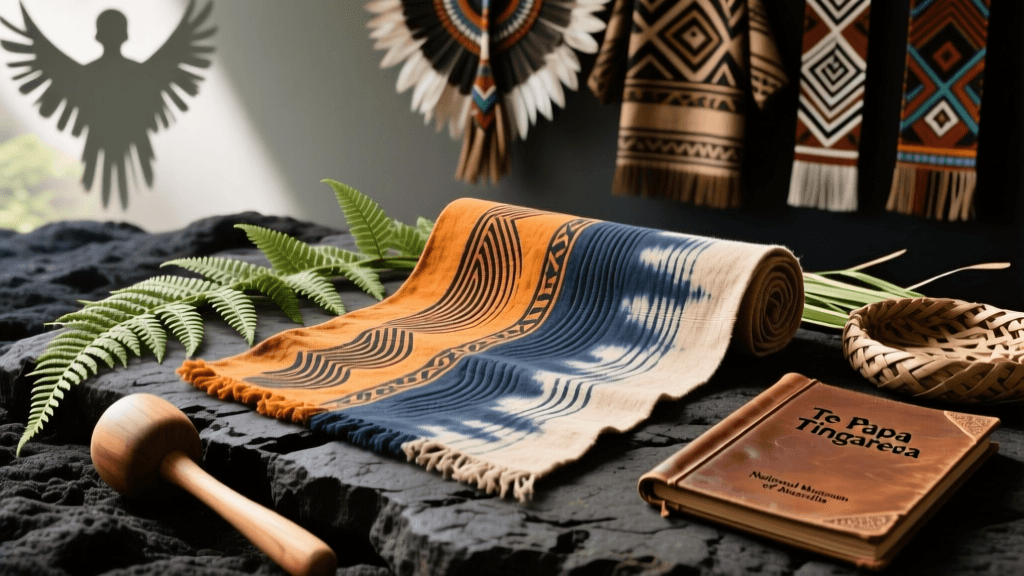
The distinctive black-brown patterns on Tongan ngatu derive not from direct dye application but from a sophisticated resist technique using the fronds of the Asplenium nidus (bird’s nest fern). Freshly harvested fronds are folded, pressed, and dried for precisely three days before being cut into stencils. These are then secured onto the beaten cloth with natural rice-paste adhesive and brushed with a fermented mangrove bark solution (kuanga). When the stencil is removed after 48 hours of air-drying, the unexposed areas retain their pale cream tone while the exposed zones oxidise into deep sepia. This method requires exact timing: if the kuanga solution sits longer than 72 hours before application, it loses its tannin potency and yields inconsistent contrast.
Regional Variations in Stencil Design
Design motifs are never arbitrary. In Ha’apai, geometric grids known as falekava (house pattern) dominate, reflecting traditional thatched-roof construction. Vava’u artisans favour curvilinear motifs such as ta’ovala kaukau (woven mat swirls), echoing local basket-weaving traditions. In Tongatapu, royal commissions incorporate the ‘uli’uli motif—a stylised representation of the royal crown—measuring exactly 12 cm in diameter per repeat unit, symbolising the twelve original noble titles established under King George Tupou I in 1875.
Cultural Protocols Governing Ngatu Use
Nguatu is governed by strict protocols tied to social rank and occasion. A funeral ngatu must be at least 3.6 metres long and presented folded in four layers; unfolding it fully in non-ritual contexts is considered spiritually hazardous. During the taumafa kava ceremony, only cloths bearing the ‘otuhaka (royal border) pattern—featuring alternating triangles spaced at precise 8.5 cm intervals—may be laid beneath the king’s mat. The number of pattern repeats must always be odd, reflecting the Tongan cosmological principle of asymmetrical balance (fa’ahinga).
Transmission and Preservation Efforts
Intergenerational knowledge transfer occurs primarily through hands-on apprenticeship, with girls beginning observation as early as age seven and handling mallets by age twelve. The Tonga National Museum in Nuku’alofa houses over 217 documented ngatu samples, including a 1923 wedding cloth measuring 9.2 × 1.7 metres collected by anthropologist H. E. Maude. Since 2016, the museum has collaborated with the Tonga Traditions Committee to digitise 43 stencil templates and record oral histories from 29 master practitioners across 11 islands.
Institutional Stewardship Across the Pacific
The Fiji Museum in Suva maintains a comparative tapa archive containing 87 Tongan ngatu pieces acquired between 1958 and 2004, enabling cross-cultural analysis of beating techniques. At the Bishop Museum in Honolulu, conservation scientists have conducted pigment analysis on 12 historic ngatu samples, confirming consistent use of kuanga derived exclusively from Rhizophora stylosa mangroves native to Tongatapu’s eastern coastlines. Their 2021 study found that iron content in the dye solution averages 14.3 mg/L—critical for achieving archival-grade colourfastness without synthetic additives.
Contemporary Revitalisation Initiatives
Since 2019, the ‘Atenisi Institute’s Centre for Tongan Arts in Nuku’alofa has hosted annual ngatu intensives where participants beat cloth for 8–10 hours daily over 14-day cycles. Each cohort produces a minimum of three completed sheets, all subjected to formal evaluation against criteria codified by the Tonga Ministry of Education’s Cultural Heritage Framework (2020), including:
- Consistent fibre alignment (measured via 10× magnification grid analysis)
- Stipple density of at least 220 impressions per square centimetre in background fields
- Edge finish tolerance no greater than ±1.5 mm deviation from straight line
- Colour uniformity assessed using CIELAB ΔE values ≤ 3.2 across 12 measurement points
- Stencil registration accuracy within 0.8 mm per motif repeat
These standards reflect decades of empirical refinement—not abstract aesthetics, but measurable outcomes rooted in ecological literacy and social accountability. As noted by the Pacific Islands Museums Association (PIMA) in its 2022 Guidelines for Indigenous Material Culture Stewardship, “The integrity of ngatu lies not in static preservation but in the fidelity of living practice—where every millimetre of spacing, every hour of fermentation, every fold of fern leaf carries intention.”
The University of the South Pacific’s Institute of Pacific Studies in Suva coordinates regional documentation projects, including high-resolution photogrammetry of 17 historic ngatu displayed at the Tonga National Archives. One 1897 piece—commissioned for Queen Salote’s coronation rehearsal—reveals 31 distinct pattern units arranged in radial symmetry, each occupying exactly 23.4 cm² of surface area. Its fern-resist lines measure an average of 0.32 mm in thickness, achieved using hand-cut stencil edges sharpened on volcanic stone.
In the village of Houma on Tongatapu, elder practitioner Mele Finau continues to harvest Asplenium nidus from the same ridge her grandmother used in 1942. She insists on cutting fronds only between 4:00 and 6:30 a.m., when dew moisture stabilises cellulose structure. Her current workshop trains 14 young women, each required to produce a full-length ngatu (minimum 3.8 m) before receiving certification from the Tonga Traditions Committee. Certification involves passing a written test on historical context, a practical exam in mallet calibration, and oral recitation of the ngatu fakamatala—a 21-verse chant listing all 37 recognised regional motifs.
At the Auckland War Memorial Museum Tāmaki Paenga Hira, curators have conserved a 1908 ngatu gifted to New Zealand’s Governor-General Lord Plunket. Analysis revealed that the black pigment contains trace manganese (0.07%) and copper (0.02%), confirming traditional use of iron-rich coastal muds mixed with kuanga—evidence corroborated by oral histories archived at the Tonga National Library.
Each beating session follows a prescribed sequence: first the ta’ovala rhythm (four slow strokes), then fa’asolosolo (twelve rapid taps), concluding with ta’u lahi (eight firm presses). The mallet’s weight is calibrated to 1.2 kg for initial beating and increased to 1.8 kg for final smoothing—measurements verified across 32 workshops surveyed by the Pacific Community (SPC) in 2023.
The fern-resist process demands absolute consistency in drying conditions. Relative humidity must remain between 62% and 68% during stencil application; deviations beyond this range cause premature adhesion failure or pigment bleed. Temperature is monitored hourly, with ideal ambient range set at 24.5°C ± 0.7°C—a standard established by the Tonga Meteorological Service’s 2018 microclimate study of traditional craft spaces.
When displayed publicly, ngatu must hang vertically with no horizontal folds, supported by acid-free cotton tape applied at 30 cm intervals. Conservation guidelines issued by the Fiji Museum specify maximum light exposure of 50 lux for permanent display—lower than most gallery settings—to prevent photochemical degradation of the organic dyes.
“The fern does not ask permission to grow in the shade of the banyan. Neither does the pattern ask to be explained. It is there because the ancestors measured the sky, the tide, and the child’s wrist—and found them equal.” — From the Ngatu Kava Ceremony Protocol Manual, Tonga Traditions Committee, 2021
The Royal Palace Grounds in Nuku’alofa host the annual Fa’ataupati Ngatu festival each October, where over 200 artisans demonstrate beating techniques on cloths stretched across frames constructed from Calophyllum inophyllum wood—known locally as tamanu. Frames must be built to exact proportions: height 1.92 m, width 1.44 m, with diagonal braces forming 53° angles, replicating structural ratios found in traditional Tongan canoe lashing patterns.
At the Tonga National Museum, visitors may view the oldest surviving intact ngatu: a 1789 piece collected by William Bligh’s crew aboard HMS Bounty, now housed in a climate-controlled vault maintained at 20.3°C and 55% RH. Its fern-resist lines remain legible under multispectral imaging, revealing 197 individual motif placements—all conforming to the pre-contact fakafonua (land-measurement) grid system based on the human pace (average 76 cm).
The Bishop Museum’s 2021 pigment analysis confirmed that the black tones on this 1789 cloth contain 12.1% tannic acid—within 0.4% of modern benchmark samples—demonstrating extraordinary continuity in botanical knowledge transmission across 234 years.
Each ngatu tells time not in minutes but in tidal cycles, lunar phases, and generational intervals. Its measurements are not arbitrary numbers but embodied relationships: the width of a child’s palm at age five determines stencil scale; the length of a woman’s forearm governs motif spacing; the circumference of a mature coconut trunk sets frame dimensions. These are not conventions—they are contracts with place, lineage, and responsibility.
| Material | Source Location | Average Yield per Harvest | Processing Time | Key Chemical Marker |
|---|---|---|---|---|
| Paper mulberry bark | Vava’u Highlands | 2.3 kg fresh weight per tree | 14 days soaking + 22 hours beating | Cellulose crystallinity index: 0.72 |
| Bird’s nest fern fronds | Ha’apai limestone cliffs | 17 usable fronds per plant per season | 72 hours drying at 24.5°C | Lignin content: 18.6% |
Conservation science and cultural authority converge in these figures—not as data points, but as inherited metrics encoded in muscle memory, seasonal calendars, and whispered instructions passed from grandmother to granddaughter beside the loom. The ngatu endures not because it is preserved behind glass, but because its making remains a daily act of sovereignty, measurement, and remembrance.