Pacific Northwest Button Blankets: Tlingit & Haida Regalia 2026
The Living Mantle: Pacific Northwest Button Blankets in 2026
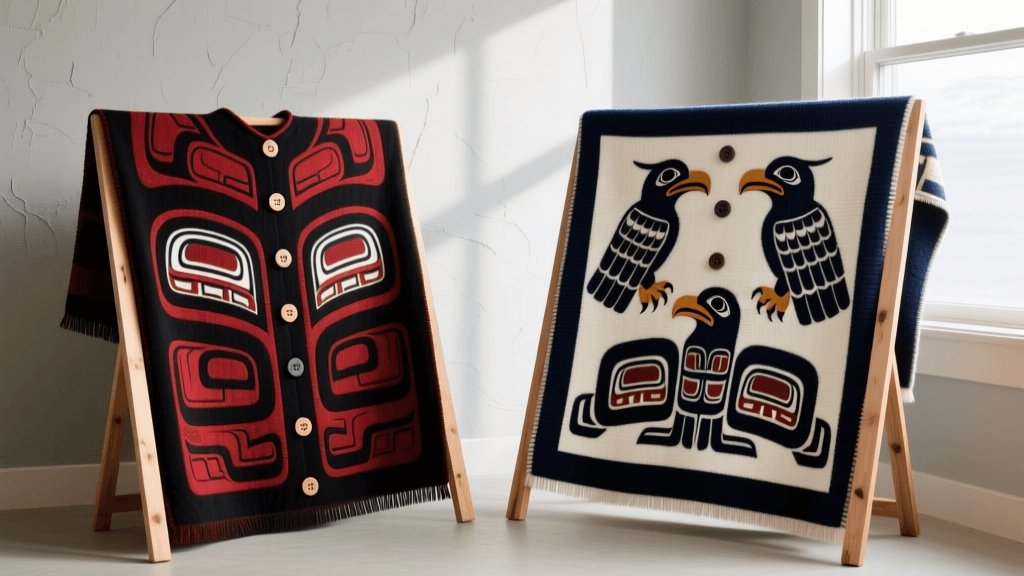
The button blanket, known in the Tlingit language as yeil koowú or simply referred to as a robe, stands as one of the most visually striking and culturally profound garments in Indigenous North America. Emerging in the 19th century through the integration of European trade goods with ancient formline design systems, the button blanket has evolved from a trade-item adaptation into a sacred, living document of lineage, law, and spiritual power. As we navigate the cultural renaissance of 2026, a new generation of Indigenous artisans, historians, and ceremonial leaders are not only preserving these traditions but actively expanding them, utilizing both ancestral techniques and modern sustainable sourcing to craft regalia that honors the past while asserting Indigenous presence in the modern world.
Unlike Western fashion, which is often driven by seasonal trends, a button blanket is a legal and spiritual mantle. It is not merely 'worn'; it is 'danced' and 'witnessed.' According to the Sealaska Heritage Institute, these robes are classified as at.oow—sacred objects that embody the spirits of the ancestors and the legal rights of the clan. To understand the button blanket in 2026 is to understand a complex intersection of textile arts, Indigenous law, and regional tribal identity.
Regional and Tribal Distinctions: Tlingit, Haida, and Tsimshian
While the untrained eye might group all Pacific Northwest regalia into a single category, the realities of Indigenous North American dress traditions are highly localized. The button blanket traditions of the Tlingit, Haida, and Tsimshian peoples share the foundational formline art system, yet they diverge significantly in their moiety structures, color preferences, and ceremonial applications.
The Tlingit Tradition
The Tlingit people of Southeast Alaska operate on a strict moiety system: Eagle (or Wolf) and Raven. A Tlingit button blanket will almost exclusively feature the crest of the wearer's clan, which is inherited matrilineally. In 2026, Tlingit regalia makers heavily emphasize the use of abalone shell inlay, particularly in the eyes and joints of the crest figures, to catch the firelight during indoor ceremonial dances. The dominant colors remain a deep, oxblood red and black, with the red broadcloth appliqué representing the lifeblood of the clan.
The Haida Tradition
Originating from Haida Gwaii and the southern half of Prince of Wales Island, Haida button blankets are renowned for their bold, highly structured formline ovoids and U-shapes. The Haida moiety system consists of Eagle and Raven. Haida artisans in 2026 often incorporate intricate cross-stitch or seed-bead borders alongside the traditional pearl buttons, a technique that gained prominence in the late 20th century and has now become a hallmark of contemporary Haida textile arts. The UBC Museum of Anthropology notes that Haida formline tends to be more expansive and fluid, often filling the entire back of the robe with a single, massive crest figure, such as the Bear or the Killer Whale.
The Tsimshian Tradition
The Tsimshian, located further south in British Columbia and Alaska, possess a four-clan system (Eagle, Raven, Wolf, and Killer Whale). Tsimshian button blankets frequently feature more complex, multi-figure compositions on the back of the robe, sometimes depicting entire mythological narratives rather than a single clan crest. Their use of color occasionally incorporates vibrant blues and greens in the appliqué, reflecting a distinct regional aesthetic that separates them from their northern neighbors.
Comparative Data: Tribal Regalia Profiles
| Feature | Tlingit | Haida | Tsimshian |
|---|---|---|---|
| Moiety / Clan System | Eagle/Wolf & Raven | Eagle & Raven | Eagle, Raven, Wolf, Killer Whale |
| Primary Appliqué Colors | Red & Black | Red, Black, occasionally Blue | Red, Black, Blue, Green |
| Signature Embellishment | Abalone inlay, pearl buttons | Seed-bead borders, large ovoids | Multi-figure narrative crests |
| Ceremonial Context | Ku.éex (Memorial Potlatch) | Potlatch, Treaty Witnessing | Feasts, Pole Raisings |
The Anatomy of Formline Design in Textile
Translating formline art—a system originally developed for carving cedar and painting on bentwood boxes—into a flexible textile medium requires immense spatial awareness. The formline system relies on continuous, flowing lines that swell and taper, creating ovoids, U-forms, and split U-forms.
When drafting a pattern for a button blanket in 2026, artisans typically use large rolls of butcher paper to map out the design at a 1:1 scale. The primary formline (the black outline) is created using black wool felt or bias tape, while the secondary spaces are filled with red broadcloth. The negative space—the dark wool of the base blanket—becomes an active part of the design, often forming the background or the tertiary elements of the crest. Master artists emphasize that the 'tension' of the formline must remain consistent; a swollen ovoid on the left shoulder must perfectly mirror the visual weight of the corresponding element on the right.
Material Sourcing and Economics in 2026
The creation of a high-quality, ceremonial-grade button blanket is a significant financial and temporal investment. The materials required have shifted over the centuries, and the 2026 market presents both challenges and innovations for regalia makers.
The Base: Melton Wool Broadcloth
Historically, Indigenous traders acquired Hudson's Bay point blankets or strouding cloth. Today, the gold standard is 100% Melton wool broadcloth. In 2026, a high-quality, 24oz to 32oz Melton wool costs between $55 and $75 per yard. An adult-sized robe requires approximately 4 to 5 yards of base fabric, plus an additional 2 yards for the contrasting red appliqué. Artisans must pre-shrink the wool using industrial steamers before cutting to ensure the garment does not warp after years of ceremonial use and dry cleaning.
The Embellishments: Buttons and Shells
The 'buttons' that give the blanket its name were originally large pearl buttons acquired from European and Asian traders. Today, sourcing ethical and visually stunning buttons is a major focus for artisans.
- Vintage Mother-of-Pearl: Sourced from antique stores and specialized textile dealers, vintage shell buttons from the mid-20th century are highly prized for their iridescence. In 2026, these can cost $2.00 to $5.00 per button.
- Contemporary Indo-Pacific Shell: Modern, ethically harvested mother-of-pearl buttons are imported from sustainable fisheries in the Indo-Pacific. These cost roughly $0.80 to $1.50 each.
- Abalone Shell: Due to strict environmental protections and the endangered status of many North American abalone species, wild harvesting is heavily restricted. Artisans in 2026 rely on pre-ban stockpiles, legally imported New Zealand Paua shell, or collaborate with state-sponsored aquaculture programs to acquire the thin, brilliant shell pieces used for inlay work.
A single, densely buttoned robe can require upwards of 3,000 individual buttons. The material cost alone for a premium blanket frequently exceeds $2,500, not including the hundreds of hours of labor.
Construction Techniques and Measurements
The standard dimensions for an adult button blanket are approximately 60 inches in width and 70 inches in length, allowing the garment to drape elegantly over the shoulders and cascade down the back of the dancer. The construction process is meticulous:
- Pattern Drafting: The design is drawn on paper, then traced onto the red appliqué fabric.
- Blind Stitching: The red fabric is pinned to the black wool base. Artisans use a blind stitch (or slip stitch) to secure the appliqué, ensuring that no thread is visible on the front of the garment. This creates a seamless, painted illusion.
- Formline Outlining: Black wool yarn or thick bias tape is couched over the edges of the red fabric to define the formline.
- Button Placement: Buttons are sewn along the formline lines, outlining the crest. The rhythmic sound of the heavy shell buttons clacking together is an essential auditory component of the dance.
Ceremonial Protocols and the Weight of the At.oow
It is vital for non-Indigenous observers, collectors, and fashion historians to understand that a button blanket is not a costume, nor is it a commodity to be casually bought and worn. According to resources curated by the Smithsonian National Museum of the American Indian, Indigenous regalia is deeply tied to intellectual property, clan ownership, and spiritual stewardship.
A newly crafted button blanket does not truly become an at.oow until it is brought out at a Potlatch (or Ku.éex) and formally witnessed by opposing clans. During this ceremony, the history of the crest is recited, the maker is compensated, and the spiritual weight of the ancestors is called into the room. Once witnessed, the blanket becomes a legal entity. It can be used to settle debts, honor the deceased, or validate the transfer of names and titles. To wear a blanket bearing a clan crest that you do not have the hereditary right to claim is considered a severe violation of Indigenous law, akin to identity theft and forgery in Western legal systems.
Conclusion: A Thread Unbroken
The Pacific Northwest button blanket remains a testament to Indigenous resilience and adaptability. In 2026, as Tlingit, Haida, and Tsimshian artists continue to source sustainable materials, teach apprentices the rigorous mathematics of formline design, and dance their crests into the firelight, the button blanket endures. It is a garment that wraps the wearer in the embrace of their ancestors, a brilliant mosaic of shell and wool that declares, unequivocally, that the people and their cultures are still here, still creating, and still governing their own narratives.