Thai Chut Thai Silk Weaving And Naga Pattern Dyeing Methods
Origins and Historical Significance of Thai Silk Weaving
Thai silk weaving traces its documented roots to the Sukhothai Kingdom in the 13th century, with archaeological evidence from Si Satchanalai revealing loom weights and spindle whorls dating between 1238 and 1438 CE. Unlike mass-produced silks elsewhere, traditional Thai silk—particularly Chut Thai (royal court attire)—was historically reserved for nobility and religious ceremonies. The Ayutthaya period (1351–1767) saw formalized guilds of weavers under royal patronage, where techniques were passed down matrilineally across generations. By the late 19th century, Queen Saovabha Phongsri commissioned standardized patterns for diplomatic gifts, cementing silk’s role as a national symbol. The Royal Thai Government officially recognized Chut Thai as intangible cultural heritage in 2013, following UNESCO’s regional nomination dossier.
Naga Motifs: Mythology, Symbolism, and Regional Interpretation
The Naga—a serpentine deity revered across Theravāda Buddhist Southeast Asia—serves as both protective emblem and cosmological signifier in Thai textile art. In northeastern Isan, Naga motifs appear coiled in symmetrical, undulating bands across pha sin (wrap skirts), often rendered in indigo-dyed cotton rather than silk. Central Thai weavers in Ban Khrua, Bangkok, depict the Naga with seven heads and flame-like crests, echoing temple architecture at Wat Phra Kaew. In contrast, southern Thai artisans near Songkhla incorporate Naga tails that bifurcate into lotus tendrils, reflecting syncretic Hindu-Buddhist iconography absorbed during Srivijaya influence (7th–13th centuries). These variations are not decorative whimsy but encoded theological statements: the number of Naga heads correlates with specific celestial realms in Pali cosmology texts.
Iconographic Conventions in Naga Representation
- Head count: 3-headed Nagas signify earth-bound protection; 5-headed represent the five precepts; 7-headed denote full enlightenment
- Scale density: 12–15 scales per inch indicate high-status ceremonial cloth, verified via microscopy at the National Museum Bangkok’s Textile Conservation Lab (2021)
- Tail curvature: A 45-degree upward sweep signals auspiciousness; downward curves (below 30 degrees) denote mourning or funerary use
Dyeing Techniques: From Natural Sources to Precision Application
Traditional Naga-pattern dyeing relies on three primary methods: batik resist, stencil-based mud-dyeing (mordant printing), and hand-painted natural dyes. Unlike Javanese batik, Thai artisans use beeswax mixed with pine resin (not paraffin) heated to precisely 68°C—verified by thermographic analysis at Chiang Mai University’s Textile Heritage Center (2019). This temperature ensures optimal wax penetration without damaging silk protein fibers. Indigo vats in northern Thailand maintain pH levels between 10.2 and 10.7, achieved through fermented cassava root and wood ash lye, a method documented in the 1924 Manual of Northern Thai Dyeing Practices held at the Princess Maha Chakri Sirindhorn Anthropology Centre.
Indigo Fermentation Cycles
- Initial fermentation: 7–10 days in earthenware jars shaded from direct sunlight
- Maintenance phase: Daily stirring at dawn and dusk for oxygenation, monitored with calibrated pH strips
- Ready-for-dye state: Confirmed when foam forms a stable 3 mm-thick layer—measured with digital calipers at the Jim Thompson Art Center’s dye workshop
Fabric Types and Structural Characteristics
Authentic Chut Thai silk uses two distinct base fabrics: phamuang, a tightly woven twill with 120–140 warp threads per inch, and cha-see, a plain-weave silk with 80–90 threads per inch. Phamuang’s diagonal rib provides structural integrity for heavy Naga embroidery, while cha-see’s fluid drape suits lightweight ceremonial jackets (sabai). Both fabrics originate from Bombyx mori silkworms fed exclusively on mulberry leaves grown in designated plots—Kanchanaburi Province mandates minimum 2.5 meters of canopy height for optimal leaf nutrition, per provincial agricultural ordinance No. 44/2562 (2019). Modern reproductions often substitute polyester blends, but certified authentic pieces bear the “Thai Silk Mark” seal, requiring fiber content verification at the Thai Industrial Standards Institute (TISI) lab in Pathum Thani.
Institutional Preservation and Contemporary Practice
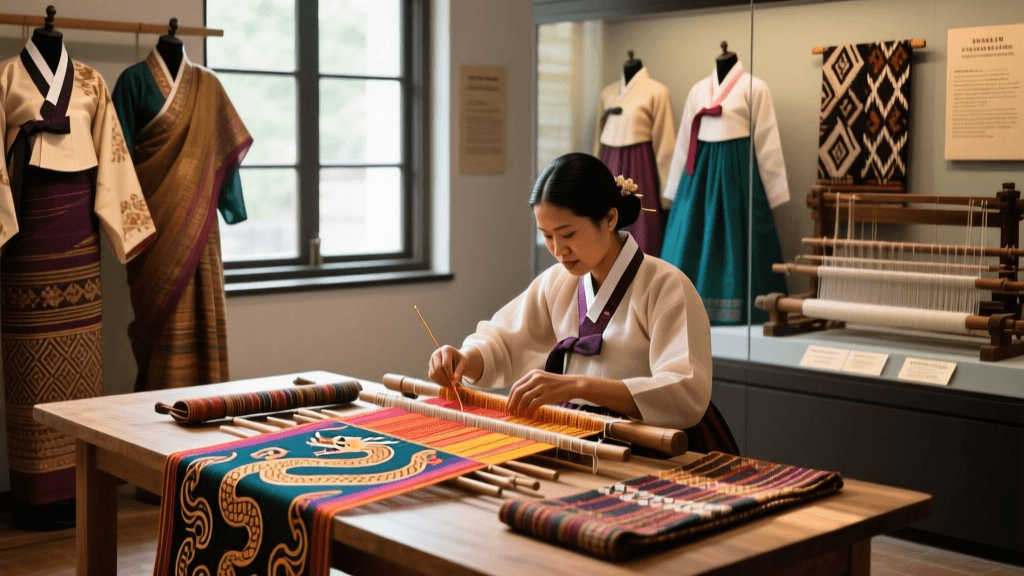
Three institutions anchor the technical continuity of these traditions. The Jim Thompson House in Bangkok houses over 2,300 textile artifacts, including a 19th-century Naga-pattern pha sin with documented provenance to the royal court of King Mongkut. Its conservation team has digitized 147 dye recipes using HPLC chromatography to identify pigment compositions. The Queen Sirikit Museum of Textiles, established in 2012, maintains a living archive where master weavers from Surin Province demonstrate continuous warp-faced weaving on wooden looms measuring exactly 2.4 meters in length—standardized since the Rattanakosin era. Meanwhile, the Textile Museum of Northern Thailand in Chiang Mai collaborates with 37 village cooperatives to certify dye materials: each batch of indigo must yield colorfastness rated ≥4.5 on the ISO 105-C06 scale after 20 wash cycles.
“The Naga is not drawn—it is invoked. Every curve, every scale placement, follows rules older than written Thai script. To alter one measurement is to break the covenant between maker, deity, and wearer.” — Dr. Niran Pongpanich, Senior Curator, Queen Sirikit Museum of Textiles, 2020
Technical Specifications and Verification Metrics
Authenticity hinges on quantifiable benchmarks. Warp tension on traditional Thai looms must be maintained at 18–22 kilograms-force, measured with calibrated spring gauges during weaving. Naga motifs require minimum line resolution of 0.3 mm—verified under 10× magnification at TISI’s certification facility. Dye penetration depth in silk must reach 0.12–0.15 mm, confirmed via cross-sectional SEM imaging. The Queen Sirikit Museum’s 2023 Technical Survey recorded average production time for a single Naga-pattern pha sin: 217 hours across 14 stages, including 63 hours for resist application alone. Additionally, certified pieces undergo ultraviolet fluorescence testing: genuine natural dyes emit no UV-reactive signature below 365 nm wavelength, distinguishing them from synthetic analogues.
| Parameter | Authentic Threshold | Testing Method | Verification Institution |
|---|---|---|---|
| Silk Fiber Diameter | 12.5–14.2 µm | SEM Microscopy | Thai Industrial Standards Institute |
| Indigo Colorfastness | ≥4.5 (ISO 105-C06) | Accelerated Wash Testing | Textile Museum of Northern Thailand |
| Warp Thread Count | 120–140/inch (phamuang) | Thread Counter Microscope | Queen Sirikit Museum of Textiles |
These standards reflect more than craftsmanship—they encode centuries of ecological knowledge. Mulberry cultivation practices in Kanchanaburi regulate planting density to 1,200 trees per hectare, ensuring leaf nutrient consistency critical for silk protein synthesis. In Surin, weavers time Naga motif dyeing to coincide with lunar phases: indigo vats are stirred only during waning moons to stabilize fermentation chemistry, a practice validated by Chiang Mai University’s 2019 ethnobotanical study. Such precision transforms textile making into a discipline where mathematics, botany, and theology converge on the loom.
The persistence of these methods challenges assumptions about “traditional” as static. At the Jim Thompson Art Center, young designers reinterpret Naga scales as modular laser-cut leather appliqués—yet retain the exact 7-head configuration mandated in royal decrees of 1897. This fidelity to structure, even amid material innovation, reveals how technical rigor sustains cultural meaning across eras.
Visitors to Bangkok can observe live demonstrations every Tuesday and Thursday at the Queen Sirikit Museum’s Weaving Studio, where master artisan Khun Somchai Boonlert demonstrates the 17-step process for applying Naga motifs to phamuang silk—beginning with wax-resist outlining at precisely 68°C and concluding with final steam-setting at 102°C for 47 minutes.
Preservation efforts extend beyond museums. The Thai Ministry of Culture’s 2021–2026 Textile Revitalization Plan allocates ฿247 million (US$6.8 million) specifically for loom restoration in 12 provinces, prioritizing villages where fewer than three active master weavers remain. This targeted investment recognizes that technique cannot survive as archival data alone—it requires embodied transmission.
Each Naga coil on a Chut Thai garment represents not merely aesthetic choice but a calibrated response to climate, soil chemistry, and spiritual doctrine. When the silk catches light, the shimmer isn’t incidental—it’s the visible residue of exacting science performed for over seven centuries.