Authentic Tenancingo Rebozo Guide 2026: Ikat Weaving & Buyer Tips
The Enduring Legacy of the Tenancingo Rebozo in 2026
In the vibrant and ever-evolving landscape of Latin American traditional garments, few pieces carry the cultural weight, historical depth, and sheer artisanal mastery of the Mexican rebozo. As we navigate the global fashion and textile markets in 2026, the demand for authentic, handwoven rebozos has surged dramatically. This is largely driven by a worldwide pivot toward slow fashion, indigenous rights, and the preservation of ancestral textile arts. Among the various regional styles, the Tenancingo rebozo—originating from the town of Tenancingo in the State of Mexico—stands out as a pinnacle of Mesoamerican weaving excellence.
The rebozo is far more than a simple shawl or scarf. Historically, it has served as a baby carrier, a ceremonial veil, a mourning shroud, and a profound symbol of Mexican womanhood and indigenous identity. Today, in 2026, owning an authentic Tenancingo rebozo is not just a fashion statement; it is an investment in a living heritage. This comprehensive guide will walk you through the intricate ikat dyeing processes, the demanding weaving techniques, and the essential market knowledge you need to acquire a genuine piece this year.
Historical Roots and Cultural Synthesis
To truly appreciate the Tenancingo rebozo, one must understand its syncretic origins. The garment represents a physical blending of indigenous Mesoamerican backstrap weaving traditions with European and Asian influences introduced during the Spanish colonial period. The introduction of silk via the Manila Galleon trade in the 16th and 17th centuries fundamentally transformed the rebozo. Artisans in Tenancingo adapted their ancestral cotton-weaving techniques to accommodate fine silk threads, resulting in the luxurious rebozo de bolita (named for the way the fine silk could be balled up into a tiny sphere) that remains highly coveted today.
In 2026, the town of Tenancingo remains the undisputed capital of the rebozo. Despite the pressures of industrialization and fast fashion, local artisan cooperatives have fiercely protected their ancestral knowledge, passing down complex mathematical dyeing formulas and weaving rhythms from generation to generation.
The Mathematics of Color: Understanding the Jaspe (Ikat) Technique
The defining visual characteristic of a traditional Tenancingo rebozo is its jaspe pattern—a blurred, feathered geometric design that is achieved through a meticulous resist-dyeing process known globally as ikat. According to Britannica's comprehensive guide on ikat, this ancient resist-dyeing method involves binding specific sections of the yarn to prevent dye penetration before the weaving even begins. However, the Mexican jaspe technique is uniquely complex because it is applied exclusively to the warp threads (the longitudinal threads held in tension on the loom).
The process begins with the artisan measuring and stretching hundreds of warp threads. Using waxed cotton strings or strips of plastic, the weaver tightly binds tiny, precise sections of the thread bundle. This binding is done entirely from memory or based on inherited mathematical charts, as the pattern must align perfectly once woven. The bound bundle is then submerged in vats of natural or synthetic dyes. The tied sections resist the dye, remaining the original color of the thread. For multi-colored rebozos, this binding and dyeing process is repeated multiple times, requiring the artisan to untie and re-tie microscopic sections of the warp with astonishing precision.
In 2026, while some master dyers still utilize natural dyes derived from indigo, cochineal, and marigold, the majority of commercial Tenancingo rebozos use high-quality, colorfast synthetic dyes to achieve the vibrant, diverse color palettes demanded by the contemporary market without compromising the structural integrity of the silk or cotton.
From Loom to Fringe: The Weaving and Rapacejo Process
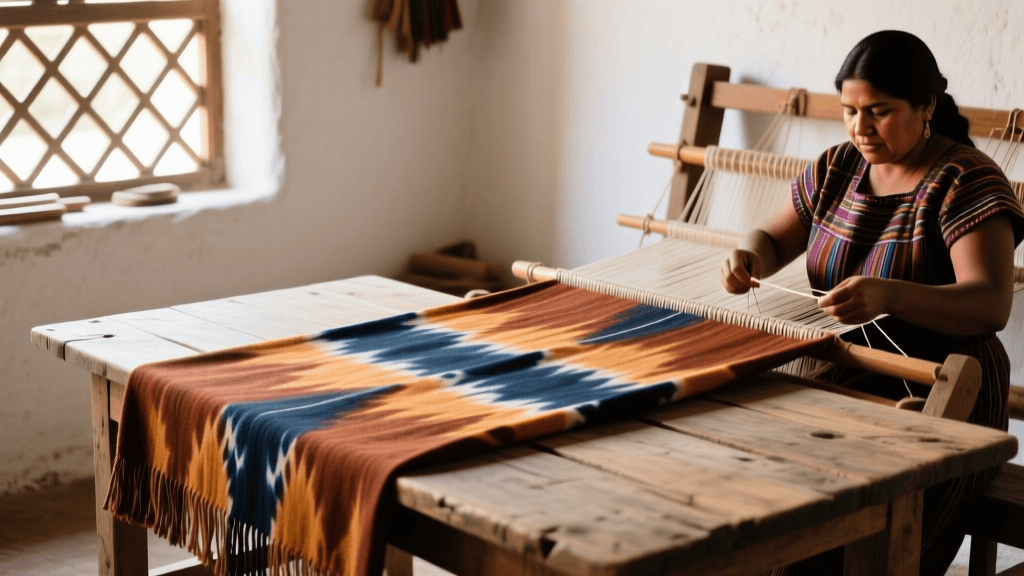
Once the warp threads are dyed and dried, they are mounted on the loom. Traditionalists in Tenancingo utilize two primary types of looms: the pre-Hispanic backstrap loom (telar de cintura) and the colonial-era wooden pedal loom (telar de pedal). The backstrap loom, which relies on the weaver's body weight to maintain tension, produces a tighter, denser, and more highly valued fabric. Weaving a fine silk rebozo on a backstrap loom is physically grueling and can take anywhere from three to six months of daily labor.
However, the weaving is only half the battle. The most iconic and time-consuming element of the Tenancingo rebozo is the rapacejo—the elaborate, hand-knotted fringe at both ends of the garment. The rapacejeras (fringe tiers) use their fingers to tie thousands of microscopic knots, creating intricate patterns that often mirror the jaspe design of the main body. A master rapacejera can spend up to four weeks tying the fringe on a single, high-end silk rebozo. In 2026, the complexity of the rapacejo remains the primary indicator of a rebozo's quality and a major driver of its final market price.
How to Distinguish Handwoven from Machine-Made Rebozos
As the popularity of Latin American textiles has grown, so has the influx of counterfeit, machine-made imitations flooding the market. In 2026, it is crucial for buyers to know how to identify an authentic handwoven Tenancingo rebozo. First, examine the jaspe pattern. On a genuine hand-dyed rebozo, the pattern will have a slight, organic blurriness to the edges, and the reverse side of the fabric will look nearly identical to the front because the threads were dyed before weaving. Machine-printed imitations will have sharp, pixelated edges, and the reverse side will be significantly faded or white.
Second, inspect the rapacejo. Hand-tied fringe will have slight, human irregularities and a distinct three-dimensional texture. Machine-made fringe is often sewn on as a separate piece and lacks the structural integration of hand-knotting. Finally, check the selvage (the side edges of the fabric). A true backstrap-woven rebozo will have perfectly finished, tight selvages without any serging or machine stitching.
2026 Buyer’s Guide: Sourcing Authentic Rebozos
Purchasing an authentic Tenancingo rebozo in 2026 requires navigating a market that has seen significant price adjustments due to the rising costs of imported silk and a long-overdue increase in fair-trade wages for indigenous artisans. To ensure your purchase directly supports the community, it is highly recommended to buy directly from artisan cooperatives in Tenancingo, or through verified government and cultural institutions. Organizations like FONART (Fondo Nacional para el Fomento de las Artesanías) work tirelessly to authenticate, protect, and promote the work of Mexican artisans, offering a secure avenue for international buyers to acquire genuine pieces.
Material and Price Comparison (2026 Market Data)
The following table outlines the current market expectations for authentic Tenancingo rebozos in 2026, categorized by material and weaving technique.
| Material & Type | Loom Type | Estimated 2026 Price (USD) | Weight & Drape | Best Use Case |
|---|---|---|---|---|
| 100% Silk (Rebozo de Bolita) | Backstrap | $650 - $1,400 | Featherlight, fluid, passes through a ring | Ceremonial, heirloom, high-end fashion |
| 100% Cotton (Hilo Fino) | Backstrap | $250 - $500 | Medium weight, breathable, structured | Daily wear, baby carrying, summer climates |
| Cotton/Silk Blend | Pedal | $180 - $350 | Lightweight, slightly stiffer drape | Evening wear, contemporary styling |
| Articela (Rayon/Synthetic) | Pedal | $80 - $150 | Heavy, shiny, less breathable | Budget-friendly, decorative, costume |
Care and Maintenance for Your Rebozo
Proper care is essential to preserve the integrity of the jaspe dyes and the delicate rapacejo fringe. For silk rebozos, dry cleaning is generally recommended in 2026, as modern silk dyes can sometimes bleed if submerged in water without professional fixatives. If you must wash a cotton rebozo at home, use cold water and a pH-neutral, eco-friendly detergent. Never wring or twist the fabric, as this will permanently distort the warp alignment and ruin the geometric patterns.
To store your rebozo, avoid hanging it by the fringe, which can stretch the knots over time. Instead, gently roll the garment around a tube of acid-free tissue paper and store it in a breathable cotton bag away from direct sunlight. This prevents creasing and protects the natural or synthetic dyes from UV fading.
Conclusion
The Tenancingo rebozo is a masterclass in textile engineering, a canvas of indigenous mathematics, and a profound symbol of Mexican cultural resilience. As the global textile community in 2026 continues to reject mass-produced fast fashion in favor of garments with a soul, the rebozo stands as a testament to the irreplaceable value of human hands and ancestral knowledge. By understanding the intricate jaspe process, recognizing the hallmarks of authentic craftsmanship, and purchasing ethically, you do more than acquire a beautiful garment—you become a custodian of Latin American history.