Zero-Waste Kimono Construction: Tanmono Cutting Guide 2026
Introduction to Tanmono and the Zero-Waste Philosophy
In 2026, the global fashion industry is under immense pressure to eliminate textile waste, driving designers and artisans to look toward historical Asian dress traditions for sustainable solutions. At the forefront of this movement is the Japanese tanmono straight-line cutting method, the foundational construction technique of the traditional kimono. Unlike modern Western pattern drafting, which relies on curved seams and discards up to 20% of fabric on the cutting room floor, the kimono is a masterclass in geometric efficiency. Every single thread of the textile is utilized, preserved, and integrated into the final garment.
For contemporary makers, vintage collectors, and sustainable fashion advocates in 2026, understanding the architecture of the kimono is not just an exercise in cultural appreciation; it is a practical blueprint for zero-waste garment creation. This guide explores the precise measurements, construction techniques, and modern applications of the tanmono system, providing actionable insights for today's textile artisans.
The Geometry of the Kimono: Straight-Line Cutting
The fundamental difference between Western tailoring and traditional Japanese garment construction lies in the relationship between the fabric and the human body. Western clothing is sculpted to mimic the body's curves through darts, princess seams, and bias cutting. The kimono, however, treats the fabric as a sacred, unbroken canvas. The garment is constructed entirely from rectangular panels cut parallel or perpendicular to the selvedge.
According to The Metropolitan Museum of Art's Heilbrunn Timeline of Art History, the kimono's T-shaped, straight-line construction evolved to maximize the use of hand-woven silk bolts while allowing the intricate surface designs to remain uninterrupted by complex seams. Because the fabric is never cut on a curve, the structural integrity of the hand-woven threads remains intact, resulting in a garment that can endure for centuries.
Standard Tanmono Measurements and Yield
A standard tanmono (fabric bolt) is woven to specific dimensions designed to yield exactly one adult kimono with zero waste. In 2026, while custom widths exist for modern textiles, traditional silk bolts still adhere to the historical standard. The bolt is typically 36 to 38 centimeters (about 14 inches) wide and 11.5 to 12 meters long.
Below is the breakdown of the rectangular panels required to construct a standard women's kimono:
| Panel Name | Japanese Term | Quantity | Dimensions (Approx.) | Function |
|---|---|---|---|---|
| Body Panels | Migoro | 2 | 36cm x 125cm | Forms the front and back main body |
| Front Overlaps | Okumi | 2 | 15cm x 125cm | Creates the triangular front overlap |
| Sleeves | Sode | 2 | 36cm x 110cm | Forms the draped sleeve and pouch |
| Collar | Eri | 1 | 15cm x 110cm | The neckband and lapel |
| Collar Core | Kake-eri | 1 | 15cm x 50cm | Reinforcement for the back neck |
Notice that the Okumi and Eri panels are exactly half the width of the main bolt. When these narrower panels are cut, the remaining 21cm width is not discarded. Instead, it is utilized for the Kake-eri (collar core), sleeve cuffs, or internal reinforcement patches. This mathematical perfection ensures 100% fabric utilization.
Step-by-Step Construction Technique
Constructing a kimono requires a departure from standard sewing machine practices. The seams are designed to be temporary and reversible, a concept deeply tied to the Japanese practice of arai-hari (taking the garment apart for washing and restretching).
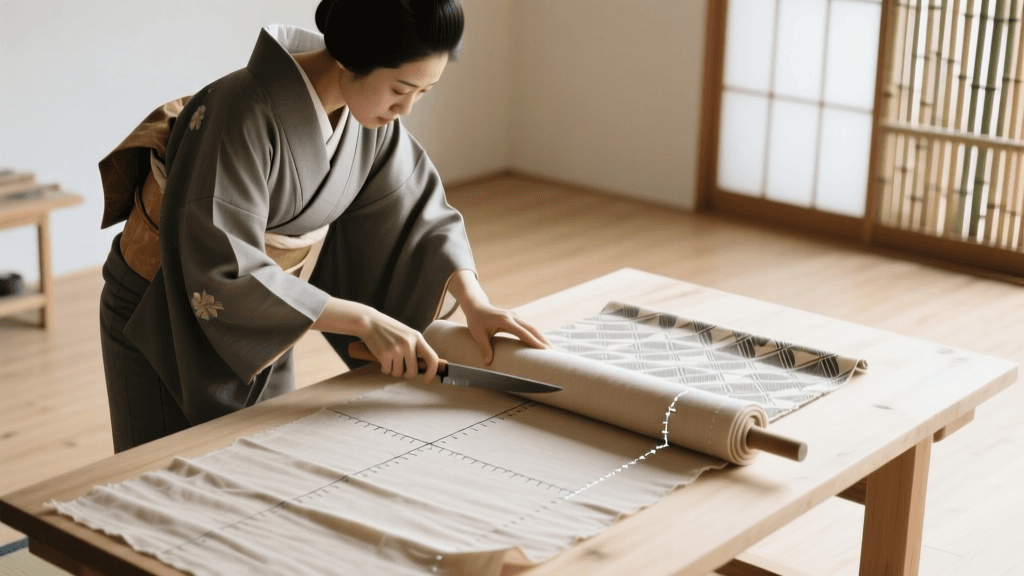
Step 1: Marking Without Cutting
Instead of using chalk or fabric pens which can stain delicate silks, traditional artisans use a hera—a smooth, flat bamboo or bone spatula. By pressing the hera firmly along a ruler on the fabric, a temporary, invisible crease is created. In 2026, modern makers working with upcycled cottons or linens can use water-soluble marking pens, but mastering the hera remains essential for working with vintage silk chirimen (crepe).
Step 2: The Hidden Seam Allowance
In Western sewing, a 1.5cm seam allowance is standard, and excess fabric is trimmed away. In kimono construction, the selvedge edges (known as mimi) are never cut off. When joining the two Migoro (body) panels, the sewer folds the fabric inward, utilizing the entire width of the selvedge as the seam allowance. This folded fabric remains inside the garment, providing structural weight and allowing the seams to be let out or adjusted for different wearers over the garment's lifespan.
Step 3: The Running Stitch and Tension
While machine sewing is common for casual 2026 yukata and daily-wear kimono, high-end silk garments are still assembled using a specific hand-sewn running stitch (shishu). The stitch length is typically 3 to 4 millimeters. The critical factor is tension: the thread must be pulled just tight enough to hold the panels, but loose enough to allow the silk to drape naturally without puckering. Artisans use a kakehari (a wooden tensioning stick with a needle at one end) to hold the fabric taut while sewing, a technique that prevents the bias stretch that often plagues modern machine-sewn replicas.
Essential Tools and 2026 Market Costs
For those looking to begin their journey into tanmono construction, sourcing the right tools and materials is the first step. The market for traditional Japanese sewing implements has seen a resurgence in 2026, driven by the global slow-fashion movement.
- Shaku (Traditional Ruler): While metric measurements are standard today, understanding the traditional shaku (approx. 37.8cm) is vital for reading vintage pattern books. A high-quality bamboo shaku costs around $45 to $70 USD in 2026.
- Hera (Marking Spatula): Essential for creasing silk. Authentic bamboo hera tools are priced between $15 and $30 USD.
- Kakehari (Tensioning Stick): Crucial for hand-sewing long seams without puckering. Expect to pay $25 to $50 USD for a traditional wooden model.
- Silk Thread (Fujix or Similar): For authentic construction, #50 weight silk thread is required. A 2026 spool of premium Japanese silk thread averages $12 to $18 USD.
- The Tanmono Bolt: A brand-new, hand-woven silk tanmono bolt from a Kyoto weaver in 2026 averages ¥60,000 to ¥120,000 ($400 to $800 USD). However, upcycled cotton, hemp, or linen bolts cut to tanmono widths are widely available from sustainable textile mills for $90 to $150 USD.
Modern 2026 Adaptations: Upcycling and Non-Silk Textiles
One of the most exciting developments in 2026 is the adaptation of the tanmono cutting system for non-traditional fabrics. Sustainable fashion brands and independent makers are weaving heavy-weight selvedge denim, organic hemp, and deadstock linen into 36cm wide bolts. By applying the straight-line cutting method to these durable textiles, makers are creating modern, unlined kimono-jackets and wrap coats that require zero fabric waste.
'The brilliance of the tanmono system is not just that it wastes nothing, but that it democratizes the cutting process. You do not need complex grading or curved pattern blocks; you only need to understand the geometry of the rectangle and the proportions of the human form.' — Textile Conservation Report, 2026.
When working with heavier fabrics like denim or wool, the traditional folded seam allowance can become too bulky. Modern artisans have adapted by utilizing flat-felled seams or binding the selvedge edges with lightweight silk bias tape, maintaining the zero-waste ethos while accommodating the physical properties of thicker textiles.
Deconstructing and Reconstructing: The Cycle of Wear
Perhaps the most profound aspect of tanmono construction is its end-of-life protocol—or rather, its lack thereof. Because the kimono is assembled using straight lines and untrimmed seam allowances, it can be completely deconstructed back into its original rectangular panels. The Victoria and Albert Museum's Asian Collections frequently highlights how historical garments were passed down through generations, unstitched, washed, re-dyed, and sewn back together to hide stains or update the fashion silhouette.
In 2026, this concept of 'circularity' is the holy grail of sustainable design. A tanmono-constructed garment can be disassembled in under an hour. The fabric panels can then be repurposed into entirely new garments, household textiles, or re-woven. By adopting the straight-line cutting technique, modern sewists are not just making clothes; they are participating in a centuries-old cycle of respect for the textile, ensuring that the labor of the weaver is honored long after the initial garment has served its primary purpose.
Conclusion
The tanmono straight-line cutting technique is a testament to the ingenuity of traditional Asian dress construction. By prioritizing the integrity of the textile over the immediate contour of the body, the kimono achieves a level of sustainability that modern fashion is only now beginning to replicate. Whether you are working with a $600 vintage silk bolt or an upcycled linen weave, mastering these geometric construction techniques will fundamentally change how you approach pattern drafting, seam finishing, and the lifecycle of the garments you create in 2026 and beyond.