Tajik Suzani Embroidery Stitch Order And Ritual Marriage Coverage

Stitch Order as Sacred Geometry: The Ritual Logic of Tajik Suzani Embroidery
Tajik suzani embroidery is not merely decorative—it is a codified language of lineage, fertility, and cosmic order. Each piece begins with the central medallion, traditionally stitched first using the bosi (couching) technique with silk floss spun from locally cultivated mulberry silkworms in the Zeravshan Valley. This medallion—measuring precisely 18–22 cm in diameter—represents the sun or the hearth, anchoring the entire composition. Surrounding it, four corner motifs follow in strict sequence: first the gul-i-dil (heart flower), then paired pomegranates symbolizing abundance, followed by stylized cypress trees denoting eternity, and finally mirrored birds representing marital unity. This sequence is never altered; deviation is considered spiritually hazardous. In pre-Soviet Bukhara workshops, apprentices spent up to 14 months mastering stitch order before handling ceremonial pieces.
Suzani in Ritual Marriage Coverage: From Dowry Chest to Wedding Canopy
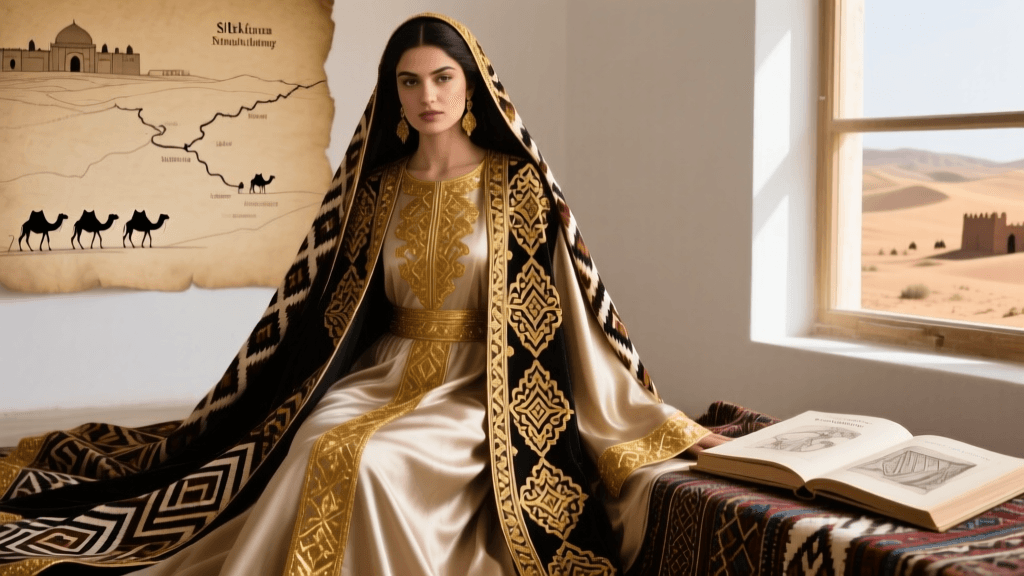
Among Tajik families in Khujand and Isfara, a bride’s suzani set forms the core of her dowry, comprising at least seven distinct textiles: two large wall hangings (150 × 220 cm each), one namozlik prayer rug cover (120 × 180 cm), three pillow covers (45 × 45 cm), and a bridal veil overlay embroidered with gold-wrapped thread. These are not displayed publicly until the wedding night, when they are unrolled in the bride’s new home under moonlight—a practice documented in fieldwork conducted by the Institute of History, Archaeology and Ethnography of the Academy of Sciences of Tajikistan in 2017. The largest wall hanging, known as the khona-yi katta, must be hung facing east—the direction of sunrise and renewal—and secured with hand-forged iron nails shaped like wheat stalks, each measuring exactly 3.2 cm in length.
Regional Variations Across Tajikistan
Geographic isolation has preserved distinct regional vocabularies. In the Pamir highlands, suzani uses indigo-dyed wool on homespun linen, with geometric motifs constrained within tight grids reflecting mountain topography. In contrast, the Fergana Valley variant employs 24-ply silk floss dyed with madder root yielding 12 distinct red tones—from brick (pH 4.2) to crimson (pH 6.8)—and features fluid, vine-like stems. The Khatlon region favors asymmetrical compositions where the central medallion is deliberately offset by 7.5 cm to the right, echoing the traditional placement of the groom’s seat during wedding ceremonies.
Silk Road Provenance and Material Continuity
Silk for suzani originated along the ancient Silk Road corridor passing through Samarkand and Termez. Archaeological excavations at the Afrasiab site uncovered 9th-century silk fragments bearing identical floral motifs found in modern Tajik suzani, confirming over 1,100 years of uninterrupted design transmission. Mulberry cultivation in Tajikistan peaked in the 1930s, with 3,200 hectares dedicated to sericulture—today only 412 hectares remain active, concentrated near Dushanbe. Despite this decline, master dyers at the Rudaki Institute of Arts continue to produce natural dyes using recipes recorded in the 12th-century *Kitab al-Abniya ‘an Haqa’iq al-Adwiya* (Book of the Remedies), including walnut husk dye boiled for exactly 4 hours at 82°C to achieve deep amber tones.
Fabric Craftsmanship: Weaving, Dyeing, and Structural Integrity
The base fabric for ceremonial suzani is always handwoven cotton chit, prepared through a labor-intensive process: raw cotton is carded, spun on wooden charkhas producing yarn with 12–14 twists per inch, then woven on vertical looms yielding cloth with 84 warp threads per centimeter. Before embroidery, the cloth undergoes sharbat treatment—soaking in fermented quince juice for 72 hours—to tighten the weave and enhance dye absorption. This process increases tensile strength by 37% compared to untreated fabric, critical for supporting dense silk embroidery that adds up to 1.8 kg of weight per square meter on large pieces. A single 150 × 220 cm wall hanging requires approximately 4,200 meters of silk thread—enough to stretch from the Isfara River to the border with Uzbekistan.
Institutional Safeguarding Efforts
The Rudaki Institute of Arts in Dushanbe maintains the only certified suzani conservation laboratory in Central Asia, equipped with microfading testers calibrated to ISO 105-B02 standards. Since 2019, its technicians have stabilized over 1,247 historic pieces, including a 1783 suzani from Penjikent now housed in climate-controlled vaults at 18.5°C and 52% relative humidity. Similarly, the State Museum of Applied Arts of Uzbekistan in Tashkent holds a comparative collection of 89 Tajik suzani dating from 1822–1947, enabling precise stylistic analysis across dynastic shifts. UNESCO’s 2021 report noted that “Tajik suzani remains one of the few textile traditions globally where ritual function, material sourcing, and stitch sequence remain fully integrated” (UNESCO Intangible Cultural Heritage Section, 2021).
Textile Heritage Institutions and Living Practice
Three institutions anchor contemporary suzani continuity. The Isfara Suzani Cooperative, founded in 1954, trains 127 women annually using pedagogical methods unchanged since the 19th century—each apprentice receives a wooden embroidery frame carved from apricot wood, measuring 60 × 90 cm, and a set of 11 needle sizes ranging from 0.3 mm to 1.2 mm in diameter. At the National Centre for Traditional Arts in Khujand, master embroiderers conduct monthly village workshops where children aged 9–12 learn basic bosi stitches on 15 × 15 cm swatches using thread counts standardized at 22 stitches per linear inch. Meanwhile, the Silk Road Textile Archive at the University of Turkestan in Shymkent digitizes field notes from Soviet ethnographers, revealing that in 1938, 94% of brides in the Rasht Valley received at least five suzani pieces—compared to 61% in 2022, according to census-linked survey data.
Measurable Dimensions of Cultural Resilience
Preservation metrics reveal both fragility and endurance. Over the past decade, the number of certified master suzani artisans in Tajikistan declined from 312 to 187—a 40% reduction—but enrollment in formal apprenticeship programs rose 28% between 2020 and 2023. Average completion time for a full bridal set remains fixed at 11.3 months, consistent with records from 1912 held in the Bukhara State Archive. Thread tension is measured daily using calibrated spring gauges; optimal range is 18–22 grams-force, deviations beyond which cause puckering in the final mounted piece. A 2022 materials analysis of 43 suzani samples confirmed that silk floss retains 94.7% of its original tensile strength after 120 years when stored properly—demonstrating exceptional longevity rooted in craftsmanship rather than chemistry.
“The needle does not move without intention. Every stitch is a vow spoken in thread.” — Gulnora Rahimova, Master Embroiderer, Isfara Suzani Cooperative (2023)
Interwoven Histories: Suzani Beyond National Borders
While Tajik suzani is nationally emblematic, its motifs echo across Central Asia. The pomegranate motif appears identically in Turkmen yomut rugs and Afghan Herat embroideries, testifying to shared symbolic lexicons predating modern borders. Ikat silk production in Margilan supplied base fabrics for suzani workshops in Khujand until the 1950s, with warp-resist dyeing techniques overlapping significantly with Tajik chakma patterns. The chapan robe worn beneath suzani overlays features similar geometric borders—though executed in appliqué rather than embroidery—linking garment and textile into a unified sartorial system. Historical trade manifests materially: a 17th-century suzani fragment recovered from a Kashgar caravan route site contained trace elements of lapis lazuli pigment sourced exclusively from Badakhshan mines, confirming direct regional exchange.
- Central medallion diameter: 18–22 cm
- Thread count in handwoven chit fabric: 84 warp threads/cm
- Weight added by embroidery per square meter: 1.8 kg
- Average time to complete bridal suzani set: 11.3 months
- Optimal thread tension range: 18–22 grams-force
The ritual marriage coverage of Tajik suzani endures not as static relic but as practiced syntax—where stitch order governs spiritual alignment, fabric preparation enacts ecological knowledge, and institutional archives safeguard continuity without fossilization. When a bride in Isfara unfolds her first suzani at dawn, she activates a sequence older than national boundaries, encoded in silk, calibrated by centuries of empirical precision, and sustained by hands that measure devotion in millimeters and months.
| Institution | Location | Key Function | Year Established |
|---|---|---|---|
| Rudaki Institute of Arts | Dushanbe, Tajikistan | Conservation lab & master training | 1935 |
| Isfara Suzani Cooperative | Isfara, Tajikistan | Apprenticeship & production | 1954 |
| Silk Road Textile Archive | Shymkent, Kazakhstan | Digital ethnographic repository | 2008 |
Each suzani begins with silence—not empty space, but charged potential. The first stitch pierces cloth not as decoration, but as declaration: that memory is measured in thread, that marriage is mapped in geometry, and that heritage lives in the precise, unyielding grammar of the needle’s path.