Kunqu Opera Hanfu 2026: Sourcing Authentic Stage Mang Robes
The Intersection of Historical Hanfu and Kunqu Theatrical Wardrobes
Kunqu Opera, widely celebrated as the "mother of a hundred operas" in China, represents one of the most refined and ancient forms of Chinese musical theater. Recognized globally for its artistic depth, the genre relies heavily on its visual splendor, particularly its elaborate costumes. As we navigate the cultural landscape of 2026, the global revival of traditional Chinese garments has sparked a renewed interest in the intersection of everyday historical Hanfu and theatrical stage wardrobes, known as Xifu. For modern practitioners, collectors, and theater companies, understanding the nuances of Kunqu opera costumes—especially the majestic Mang (python) robe—is essential for authentic performance and preservation.
According to the UNESCO Intangible Cultural Heritage registry, Kunqu Opera is a masterclass in combining poetry, music, and movement. The costumes are not merely decorative; they are integral to the actor's physical vocabulary. In 2026, sourcing these garments requires navigating a market that blends centuries-old Suzhou embroidery techniques with modern tailoring innovations. This guide provides a comprehensive breakdown of Kunqu stage Hanfu, focusing on the procurement, anatomy, and maintenance of authentic theatrical robes.
Theatrical Xifu vs. Historical Ming Dynasty Hanfu
A common misconception among newcomers to traditional Asian performing arts is that stage costumes are identical to the historical Hanfu worn during the Ming Dynasty (1368–1644), the era from which Kunqu draws its primary aesthetic inspiration. While Kunqu Xifu is deeply rooted in Ming-era silhouettes, theatrical requirements have drastically altered the garments' proportions, fabrics, and fastening systems to accommodate exaggerated stage movements.
The Victoria and Albert Museum's Chinese Dress collection highlights how theatrical garments prioritize visual impact and kinetic flow over historical accuracy. Stage lighting, audience distance, and the acrobatic demands of the performers necessitate heavier embroidery, elongated sleeves, and modified collars. Below is a detailed comparison to help buyers and performers distinguish between historical recreation and stage-ready Kunqu garments.
| Feature | Historical Ming Hanfu (Recreation) | Kunqu Stage Xifu (Theatrical) |
|---|---|---|
| Silhouette | Natural drape, historically accurate proportions | Exaggerated shoulders, wider hems for stage presence |
| Sleeves | Standard wide or narrow sleeves ending at the wrist | Fitted base with attached white silk "Water Sleeves" |
| Fastenings | Internal ties, subtle fabric buttons | Reinforced hidden hooks, heavy-duty internal ties |
| Embroidery | Woven patterns or subdued regional embroidery | Dense, high-relief Suzhou gold and silver thread work |
| Collar | Standard round or crossed collar | Stiffened, raised collars to frame the face and headdress |
The Anatomy of the Kunqu Mang Robe
The Mang robe is the pinnacle of the Kunqu wardrobe, reserved exclusively for characters of high imperial or noble rank, such as emperors, generals, and high-ranking officials. Sourcing an authentic Mang robe in 2026 requires an understanding of its complex anatomy. The robe features a round collar, a wrap-around front closure, and side slits that allow for the dynamic footwork and martial arts sequences inherent in many Kunqu plays.
Embroidery and Motif Standards
The defining feature of the Mang is its embroidery. Authentic 2026 stage robes utilize traditional Su Xiu (Suzhou embroidery) techniques. The python motif, which features four claws (as opposed to the five claws of the imperial dragon), is padded with cotton or silk floss to create a three-dimensional effect known as Padou. When sourcing a high-tier Mang robe, buyers must inspect the "water motifs" (Lishui) at the hem. These diagonal, wave-like patterns must be embroidered with genuine metallic threads, traditionally wrapped around a silk core, to catch the stage lights effectively without tarnishing over time.
The Water Sleeves (Shuixiu)
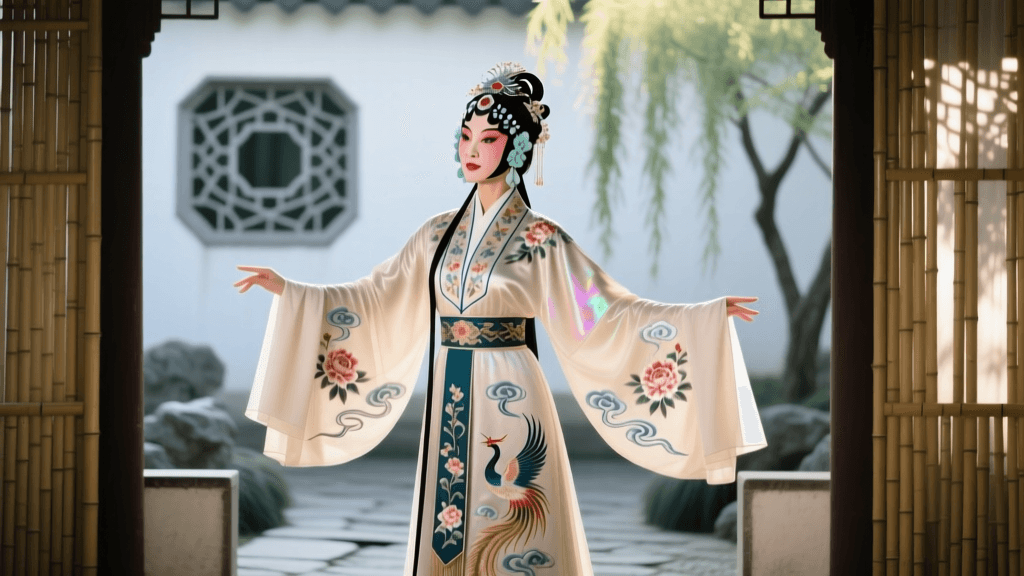
No Kunqu costume is complete without Shuixiu, or water sleeves. These are extensions of pure white silk attached to the cuffs of the base robe. In 2026, professional Kunqu performers demand water sleeves measuring exactly 60 to 90 centimeters beyond the fingertips, depending on the actor's height and the specific role type (e.g., Dan or female roles often use longer, more fluid sleeves than Sheng or male roles). The silk used must be high-grade mulberry silk, specifically woven to have a heavy drape but a fluid snap, allowing performers to execute the dozens of specialized sleeve movements that convey emotion and narrative.
2026 Sourcing Guide: Where and How to Buy
The market for authentic Kunqu opera costumes has evolved significantly. While mass-produced, synthetic costumes are available for amateur troupes, serious practitioners and institutional buyers in 2026 are turning directly to the artisan hubs of Jiangsu province. The epicenter of this craft remains Zhenhu Embroidery Town in Suzhou, where multi-generational ateliers specialize in theatrical Xifu.
Pricing Tiers and Custom Tailoring
Understanding the pricing landscape is crucial for budgeting a theatrical wardrobe in 2026. Costs are dictated by the density of the embroidery, the quality of the silk base, and the use of genuine metallic threads.
- Entry-Level / Student Tiers ($800 - $1,500 USD): These robes utilize a blend of silk and synthetic bases with machine-assisted embroidery. The water sleeves are standard white polyester-silk blends. Ideal for university theater programs and beginner practitioners.
- Professional Stage Tiers ($3,500 - $6,500 USD): Hand-embroidered motifs using the Pingjin (flat gold) technique. The base fabric is 100% heavy crepe silk or Song brocade. Custom-fitted to the performer's exact measurements, including specialized shoulder padding.
- Masterwork / Collector Tiers ($12,000 - $25,000+ USD): Fully hand-embroidered by recognized provincial-level intangible cultural heritage inheritors. These pieces use genuine gold and silver foil threads and can take 12 to 18 months to complete. They are often purchased by museums, elite collectors, or national theater companies.
The 2026 Tailoring Innovation: 3D Body Scanning
One of the most significant advancements for international buyers in 2026 is the integration of 3D body scanning by top-tier Suzhou ateliers. Historically, ordering a custom Mang robe from overseas required complex mail-in measurement forms, often resulting in fitting errors that compromised the garment's drape. Today, premier workshops accept standardized 3D scan files (often captured via smartphone LiDAR or local tailoring hubs). This data allows artisans to construct the internal scaffolding of the robe—specifically the stiffened collar and the weighted hem—to perfectly match the performer's biomechanics, ensuring the robe moves flawlessly during intricate Kunqu choreography.
Care, Maintenance, and Archival Storage
An authentic Kunqu Mang robe is a substantial financial and cultural investment. The heavy embroidery and delicate silk base require meticulous care to ensure longevity. The Britannica guide to Kunqu Opera notes that the preservation of these performing arts relies as much on material maintenance as it does on the transmission of vocal techniques.
Post-Performance Protocol
After a performance, the robe must never be folded immediately. The actor's perspiration can degrade the silk and tarnish the metallic threads. The garment must be hung on a wide, padded wooden hanger in a climate-controlled, well-ventilated room for at least 24 hours. The water sleeves must be detached (if designed with hidden clasps) or carefully draped over a secondary bar to prevent creasing.
Long-Term Archival Storage
For long-term storage, theatrical robes should never be kept on hangers, as the immense weight of the embroidery will eventually warp the shoulder seams and tear the silk. Instead, the robe must be stuffed with acid-free tissue paper to maintain its three-dimensional shape and rolled—never folded—around a large, acid-free archival tube. The rolled garment should then be wrapped in unbleached, washed cotton muslin and stored in a cedar-lined chest to deter pests. Maintain a strict storage environment of 65°F (18°C) and 45% relative humidity to prevent the silk from becoming brittle and the metallic threads from oxidizing.
Conclusion
Sourcing an authentic Kunqu opera Mang robe in 2026 is a journey that bridges the gap between historical reverence and theatrical necessity. By understanding the critical distinctions between everyday Hanfu and stage Xifu, recognizing the hallmarks of master-level Suzhou embroidery, and utilizing modern tailoring technologies, performers and collectors can acquire garments that truly honor the legacy of this magnificent art form. Whether you are outfitting a professional troupe or building a private collection of Asian traditional garments, investing in authentic, meticulously crafted Kunqu costumes ensures that the visual poetry of the stage continues to captivate audiences for generations to come.