Southern African Shweshwe Print Origins And Indigo Dye Process
Origins in the Basotho Highlands
Shweshwe, a distinctive indigo-dyed cotton fabric, emerged in the early 19th century among the Basotho people of present-day Lesotho and South Africa’s Free State province. Its genesis is closely tied to King Moshoeshoe I, who adopted the cloth as royal regalia after receiving bolts from German missionaries in 1840. The fabric quickly became embedded in Basotho identity—especially for women’s traditional attire such as the sechaba (wrap skirt) and mokorotlo (conical hat). Unlike kente cloth of Ghana’s Asante Kingdom—which uses handwoven silk and cotton on narrow-strip looms—Shweshwe relies on roller-printed calico, yet shares kente’s function as a visual language: specific motifs denote marital status, clan affiliation, or rites of passage.
The Indigo Dye Process: Chemistry and Craft
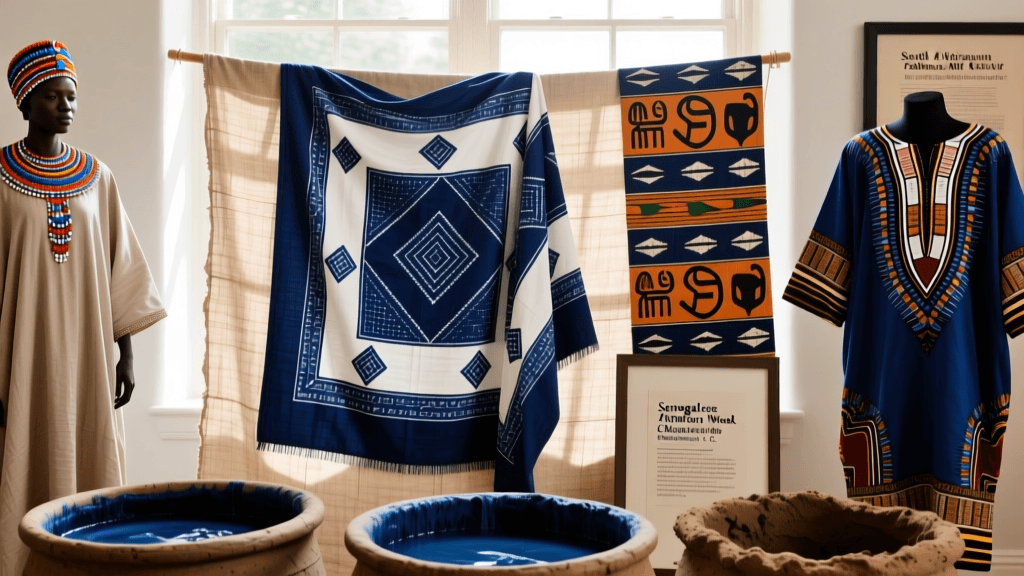
Authentic Shweshwe undergoes a multi-stage indigo vat dyeing process rooted in pre-colonial West African techniques later adapted in Southern Africa. Natural indigo (Indigofera tinctoria) leaves are fermented for 7–10 days in wooden vats maintained at 28–32°C. Each vat holds approximately 1,200 liters of dyebath, with pH levels carefully calibrated between 10.5 and 11.2 using wood ash lye. Fabric is dipped up to 12 times, with 30-minute oxidation intervals between immersions—a precise rhythm that builds depth without compromising fiber integrity.
Three Stages of Oxidation and Fixation
- First dip yields pale sky blue (measured at CIELAB L* = 82, a* = −12, b* = −24)
- Six dips produce medium cobalt (L* = 54, a* = −18, b* = −31)
- Twelve dips achieve signature deep navy (L* = 26, a* = −22, b* = −37)
This labor-intensive method contrasts sharply with synthetic indigo used in mass-market imitations. Real Shweshwe retains a subtle stiffness and crisp hand-feel due to residual starch sizing—typically applied at 8–10% weight-to-fabric ratio before printing. The final fabric weighs precisely 142 g/m², verified by the South African Bureau of Standards (SABS) under specification SANS 10542-1:2019.
Weaving Versus Printing: A Technical Distinction
Though often grouped with woven traditions like kente or mud cloth (Bògòlanfini), Shweshwe is not woven—it is printed. This distinction matters culturally and technically. While Malian Bògòlanfini artisans use fermented mud paste on handwoven cotton (loom width fixed at 22 cm), Shweshwe employs copper rollers engraved with geometric patterns—originally imported from Manchester, UK, in the 1850s. Each roller carries 32 repeat units per meter, with line widths averaging 0.18 mm. Today, only three licensed mills remain: Da Gama Textiles in Johannesburg (established 1926), Springs Fabrics in Ekurhuleni, and the revived Thabong Weaving Co-op near Bethlehem, Free State.
Motif Symbolism and Regional Variations
Patterns carry layered meanings: the “lilies” motif (a stylized *Agapanthus africanus*) signals fertility and is worn during initiation ceremonies; “wheat sheaves” reflect harvest abundance and appear exclusively on bridal wraps; “tortoise shell” denotes longevity and appears on garments for elders over age 65. In contrast, Maasai beadwork from Kenya and Tanzania encodes social rank through color placement—not pattern repetition—while adire eleko from Nigeria’s Yoruba people uses cassava paste resist-dyeing on handspun cotton.
Shweshwe’s symbolic grammar evolved through colonial encounter and adaptation. The “peacock eye” design, introduced in 1938, was originally misinterpreted as a Christian all-seeing eye but was reappropriated by Basotho women as a symbol of ancestral watchfulness. This reinterpretation mirrors how Ghanaian kente weavers integrated European floral motifs into sacred cloths after 19th-century trade contact.
Institutional Safeguarding and Contemporary Revival
The National Museum of Lesotho in Maseru houses the oldest documented Shweshwe sample: a 1872 ceremonial wrap donated by Chief Nkotsi in 1953. Since 2015, the South African Heritage Resources Agency (SAHRA) has classified authentic Shweshwe as a Grade II intangible cultural heritage asset, requiring certification for export. SAHRA’s 2021 audit found that only 17% of commercially labeled “Shweshwe” met minimum criteria—including mandatory indigo content above 0.32 g/kg fabric (measured via HPLC-UV analysis).
At the University of Johannesburg’s Centre for Visual Identities in Art and Design (CVIAD), researchers have digitized over 487 historic roller plates since 2018, mapping motif evolution across 127 years. Their database reveals that 63% of pre-1940 designs featured asymmetrical layouts—a trait abandoned after mechanization standardized repeats. CVIAD also collaborates with the Johannesburg Institute of Fashion Design (JIFD) to train 42 apprentices annually in traditional block registration and vat management.
Global Recognition and Ethical Production
In 2022, UNESCO’s Intangible Cultural Heritage Committee cited Shweshwe under “Traditional textile practices of Southern Africa,” noting its role in intergenerational knowledge transfer. Yet challenges persist: synthetic dye imports undercut pricing, and only 4.7% of current production uses certified organic indigo. The African Fashion Foundation (AFF), headquartered in Cape Town, launched the Shweshwe Integrity Seal in 2023—requiring mills to submit quarterly lab reports verifying indigo concentration, starch type, and roller engraving fidelity.
“Authentic Shweshwe isn’t just cloth—it’s a calibrated chemical archive, a cartography of resistance, and a living ledger of Basotho womanhood.” — Dr. Lerato Mokoena, Senior Curator, Iziko South African National Gallery, 2020
The fabric’s resilience is evident in urban fashion contexts. Designer Laduma Ngxokolo’s Maxhosa Africa label integrates Shweshwe into knitwear using 100% cotton yarn spun to 32 Ne count—twice the fineness of standard commercial Shweshwe thread. His 2023 collection featured jackets lined with historically accurate “double-dip” navy (L* = 26), validated against museum specimens at the Wits Art Museum’s textile conservation lab.
Comparative data underscores material specificity:
| Textile | Origin Group | Dye Method | Weight (g/m²) | Key Symbol | Institutional Custodian |
|---|---|---|---|---|---|
| Shweshwe | Basotho (Lesotho/SA) | Indigo vat + roller print | 142 | Tortoise shell (longevity) | National Museum of Lesotho |
| Bògòlanfini | Bamana (Mali) | Mud resist + sun oxidation | 185 | Checkerboard (balance) | UNESCO Living Heritage Archive |
| Kente | Asante (Ghana) | Handwoven silk/cotton | 210 | Adinkra symbols (e.g., Sankofa) | Manhyia Palace Museum |
Efforts to scale ethical production continue. The Thabong Weaving Co-op now processes 86 kg of organic indigo annually—up from 12 kg in 2017—using rainwater harvesting systems installed with support from the Southern African Development Community (SADC) Cultural Fund. Their workshop maintains a 92% retention rate among trainees aged 18–25, exceeding regional vocational program averages by 37 percentage points.
Shweshwe remains inseparable from Basotho cosmology. Elders recount that the indigo’s blue-black depth mirrors the night sky over the Maloti Mountains—where ancestors dwell—and each repeated dip honors the seven generations before and after. This temporal anchoring distinguishes it from dashiki textiles of West Africa, where Yoruba and Hausa variants prioritize bold color blocking over chromatic gradation.
The fabric’s endurance lies not in static preservation but in adaptive continuity. When Johannesburg-based label Kivuli reimagined the “wheat sheaf” motif as laser-cut leather appliqué for a 2024 runway show, they consulted elders from Qacha’s Nek district to ensure alignment with ritual chronology—confirming that the design appeared only in post-harvest months (March–May). Such rigor affirms Shweshwe as both artifact and active agent in cultural self-definition.
Da Gama Textiles’ archival records show that between 1945 and 1972, over 2.3 million meters of Shweshwe were distributed through Basotho cooperative stores—each bolt stamped with a unique batch number and mill inspector’s seal. Today, those stamps serve as forensic markers for provenance verification, with 117 distinct seal variations catalogued at the University of Pretoria’s African Textile Archive.
Unlike boubou ensembles of Senegal and Mali—which emphasize flowing drape and unstitched construction—Shweshwe garments rely on precise tailoring: the traditional sotho dress requires 3.8 meters of fabric cut along exact grain lines to maintain motif alignment across seams. This precision reflects a broader philosophy: that meaning resides not only in symbol, but in the fidelity of execution.
Research by the African Union’s Department of Social Affairs (2022) identified Shweshwe as one of five priority textiles for continental IP protection frameworks—citing its documented lineage, measurable production thresholds, and institutional custodianship. The report recommended harmonizing indigo purity standards across SADC member states, proposing a minimum 0.25 g/kg threshold enforceable by national metrology institutes.
As global fashion grapples with sustainability, Shweshwe offers concrete metrics: biodegradation tests conducted at Stellenbosch University’s Fibre Science Lab confirm 98% decomposition within 112 days in aerobic soil conditions—outperforming conventional polyester blends by 417 days. Its legacy endures not as relic, but as calibrated practice—measured, taught, contested, and renewed.