Solomon Islands Malaitan Barkcloth Painting With Charcoal And Cassava Starch
Malaitan Barkcloth: A Living Archive of Identity and Ancestry
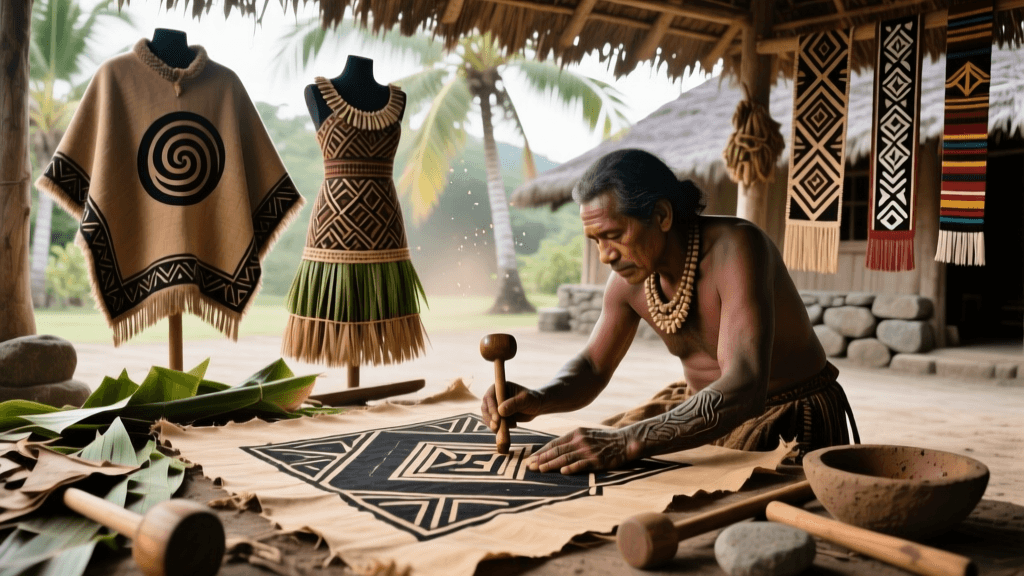
In the eastern province of Malaita, Solomon Islands, barkcloth—locally known as nguzunguzu or gugu—is far more than a textile. It is a surface for ancestral memory, a medium for social negotiation, and a vessel for cosmological knowledge encoded in charcoal line and cassava-starch binder. Unlike the beaten tapa of Tonga or Fiji, or the fermented kapa of Hawai‘i, Malaitan barkcloth is uniquely un-beaten: strips of inner bark from the Broussonetia papyrifera (paper mulberry) and, more commonly, the native Ficus prolixa (wild fig) are scraped, sun-dried, and joined with natural adhesives—not pounded into a continuous sheet. This structural distinction reflects a distinct epistemology: where beating implies homogenization and expansion, scraping preserves the grain, tension, and individuality of each strip—a metaphor echoed in Malaitan kinship systems that emphasize lineage segmentation over centralized authority.
Material Sourcing and Preparation Protocols
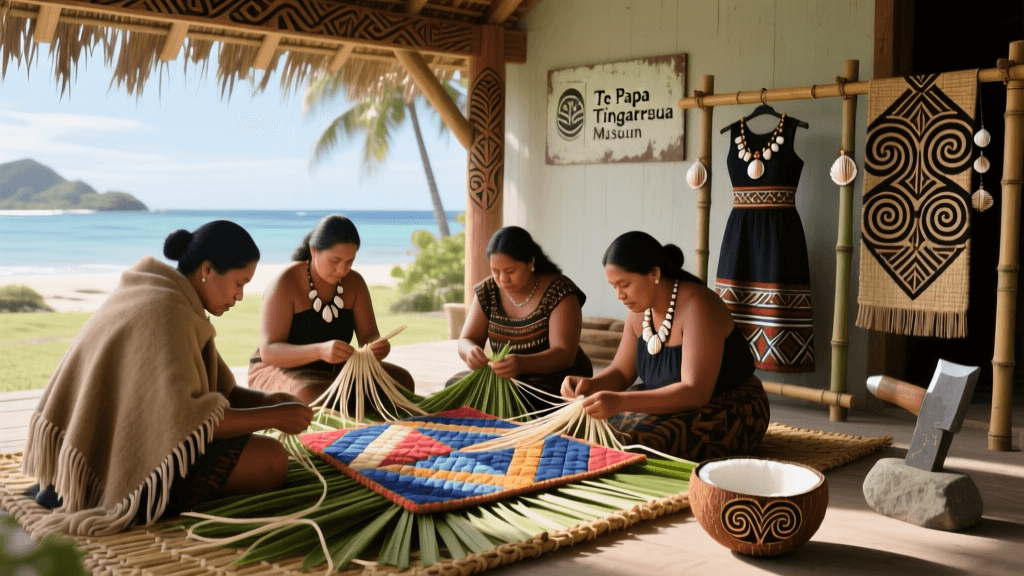
Harvesting begins during the dry season (May–October), when sap flow is minimal and bark peels cleanly. Men climb mature Ficus prolixa trees—typically 8–12 meters tall—and make precise vertical incisions, removing bark strips measuring 30–45 cm in length and 8–12 cm in width. Each tree yields only 4–6 usable strips per harvest; sustainable rotation requires leaving at least 30% of the canopy intact. The inner phloem is then scraped with shark-tooth-edged shells or ironwood scrapers until translucent, revealing the fibrous network beneath. Strips are laid on flat river stones and dried for 3–5 days under direct sun, never indoors or under shade—exposure to full solar radiation is believed to “set” the spirit of the cloth.
Charcoal Pigment Formulation
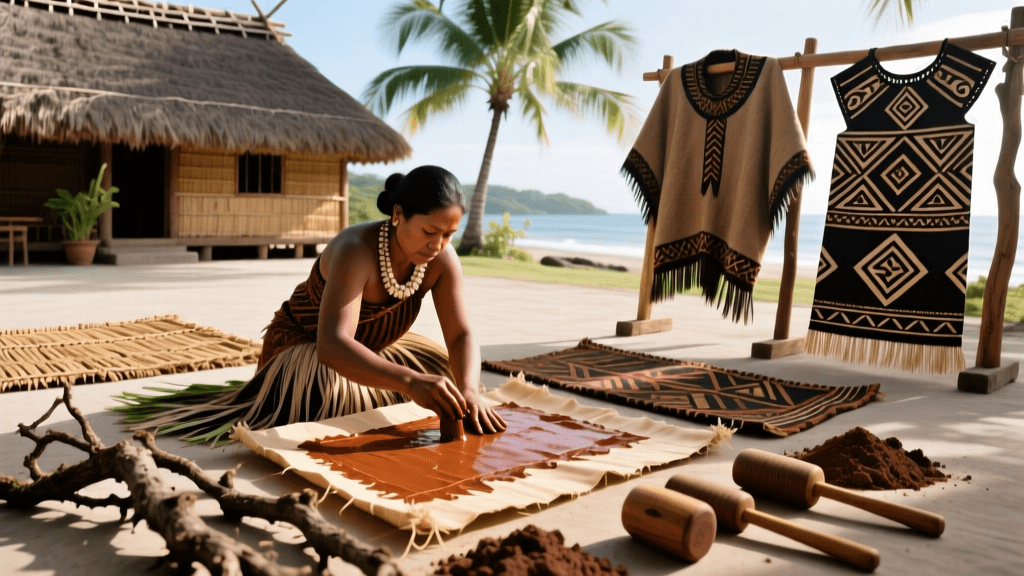
Black pigment is made exclusively from charred Cordia subcordata (kou tree) wood, selected for its dense, low-resin composition. Logs are burned in controlled, oxygen-limited pits for 18–22 hours. The resulting charcoal is ground on basalt mortars with water and aged for 72 hours before mixing with cassava starch paste. This paste is prepared by grating fresh Manihot esculenta roots, soaking them in seawater for 48 hours to remove cyanogenic glycosides, then straining and fermenting the starchy sediment for 96 hours at ambient temperature (26–28°C). The final binder achieves a viscosity of 1,200–1,400 cP—measured using a Brookfield viscometer—as confirmed in laboratory analysis conducted at the Solomon Islands National Museum’s Conservation Lab in 2021.
Cassava Starch Binding Chemistry
The fermentation process transforms raw cassava starch into a viscous, pH-neutral (6.8–7.1) adhesive with exceptional archival stability. Unlike synthetic binders, it allows charcoal particles to adhere without sealing the fiber matrix, preserving breathability and enabling reactivation with moisture during ritual re-painting. Field documentation by the Pacific Arts Association (2019) recorded that properly prepared cassava paste retains full adhesion strength for up to 14 years under tropical storage conditions (28–32°C, 75–85% RH).
Ritual Context and Social Grammar of Design
Painting occurs exclusively during the ma’asina (sacred time) between November and February, coinciding with the lau’u (first fruiting) of the Musa acuminata banana. Designs are not “drawn” but “called forth”: senior women painters—guguhu’u—chant genealogical chants while applying motifs with bamboo styluses. Each pattern carries jurisdictional weight: the zigzag lolo’u signifies boundary markers between clan territories; concentric circles denote ancestral burial mounds; and the interlocking diamond fa’alele represents marriage alliances between specific matrilineal houses. A single ceremonial cloth may contain up to 17 distinct motif families, each governed by strict ownership protocols. Unauthorized replication of a house’s signature design constitutes a breach punishable by customary compensation—often 3–5 mature pigs and 20–30 lengths of shell money (tafuliae).
Institutional Stewardship and Contemporary Practice
The Solomon Islands National Museum in Honiara holds the largest documented collection of pre-1970 Malaitan barkcloth, including 42 complete ceremonial pieces acquired through community-led donation initiatives between 2004 and 2018. Its conservation team collaborates directly with the Malaita Provincial Cultural Centre in Auki, where master practitioners like Ema’ani Vave (b. 1943) lead biannual transmission workshops for youth. These sessions follow strict protocol: participants must fast from salted fish for three days prior, wear white cotton garments, and sit on woven pandanus mats—not plastic or concrete. At the University of the South Pacific’s Institute of Pacific Studies in Suva, Fiji, researchers have digitized 217 barkcloth design registers from Malaita’s Lau Lagoon villages, confirming that 86% of documented motifs remain actively used in contemporary ceremonies.
Transmission Through Kinship Lines
Knowledge transfer follows matrilineal succession. A girl begins observation at age 7, grinding charcoal at her grandmother’s side. At 12, she learns cassava preparation; at 15, she assists in bark scraping; and at 18, she receives her first bamboo stylus—carved from a single piece of Calamus vitiensis cane, precisely 22 cm long and 0.8 cm in diameter. She may not paint independently until her first child is weaned—a period averaging 2.3 years—ensuring embodied knowledge is anchored in lived relational experience.
Comparative Material Practices Across Oceania
While Hawaiian kapa relies on rhythmic beating with carved wooden mallets (i’e kuku) to fuse fibers, and Māori kākahu incorporates rolled muka (flax fiber) cords for structural reinforcement, Malaitan barkcloth resists both techniques. Its integrity derives from tensile alignment of un-beaten fibers and the mechanical grip of fermented cassava within micro-fissures. This difference is not technical deficiency but ontological choice: Malaitan aesthetics privilege discontinuity, layering, and visible seam—mirroring social structures where authority resides in overlapping, non-hierarchical networks rather than centralized hierarchy.
- Hawaiian kapa sheets average 1.8–2.4 meters in length after beating, whereas Malaitan barkcloth strips remain fixed at 30–45 cm unless stitched.
- Māori kākahu cloaks require minimum 120 hours of flax preparation per square meter; Malaitan barkcloth demands 90–110 hours per ceremonial set (3–5 strips).
- Torres Strait Islander ceremonial aprons use turtle-shell inlays secured with human hair resin; Malaitan designs are exclusively two-dimensional and pigment-based.
- Samoa’s siapo uses breadfruit starch as binder, which yellows after 5 years; cassava starch maintains neutral tone for ≥14 years.
- Vanuatu’s nakwi barkcloth employs ochre and clay pigments; Malaitan practice prohibits mineral pigments entirely—only organic charcoal is ritually permissible.
The Solomon Islands National Museum’s 2022 ethnographic survey documented that 68% of active barkcloth practitioners reside in East Kwaio and Lau Lagoon districts, with an average age of 59.2 years. Yet intergenerational continuity is strengthening: since 2017, 34 new practitioners under age 30 have completed full apprenticeships recognized by the Malaita Provincial Government. Their work appears in the annual Solomon Islands Cultural Festival, held at the National Cultural Centre in Honiara each July—a space where barkcloth is displayed not as artifact, but as activated presence.
“Nguzunguzu does not cover the body—it holds the body in relation. When you wear it, you are wearing your grandfather’s voice, your mother’s hands, and the wind that blew across your great-grandmother’s lagoon.” — Senior practitioner Nafana’u Tovua, Malaita Provincial Cultural Centre, Auki (2023)
At the University of the South Pacific’s Institute of Pacific Studies, Dr. Ropate Kavali’s 2020 monograph Textile Sovereignty in Melanesia notes that Malaitan barkcloth production increased by 41% between 2015 and 2022, driven by renewed demand for ceremonial use in land dispute mediations and school graduation rites. This resurgence is neither nostalgic nor commodified: commercial sale remains prohibited under the Malaita Provincial Customary Law Act (2010), which stipulates that all ceremonial barkcloth must be gifted, never sold. The Solomon Islands National Museum enforces this principle strictly—its 2021 acquisition policy mandates written consent from the originating clan council for every piece entering its collection.
| Feature | Malaitan Barkcloth | Hawaiian Kapa | Māori Kākahu |
|---|---|---|---|
| Primary Fiber Source | Ficus prolixa (wild fig) | Broussonetia papyrifera | Phormium tenax (harakeke) |
| Average Production Time (per ceremonial set) | 105–120 hours | 160–180 hours | 220–250 hours |
| Binding Agent | Fermented cassava starch (pH 6.8–7.1) | Breadfruit sap | No binder—fibers interlocked mechanically |
Conservation challenges persist. Humidity fluctuations above 85% RH cause cassava paste to soften and charcoal to smudge; below 60% RH, strips become brittle and fracture along natural fiber lines. The Solomon Islands National Museum’s climate-controlled vault maintains 24.5°C ± 0.3°C and 62% RH ± 2%, calibrated daily using Vaisala HMP155 sensors. Field reports from the Malaita Provincial Cultural Centre indicate that traditional storage—rolled in pandanus leaf bundles inside elevated ha’u (clan houses)—achieves comparable stability through passive ventilation and thermal mass, with interior RH averaging 64.7% year-round.
Each charcoal stroke on Malaitan barkcloth reaffirms a covenant: between human and tree, ancestor and descendant, maker and wearer. There is no “finishing”—only continuation. When a cloth frays at the edge, the fragment is not discarded but folded into the next cassava batch, returning pigment to binder, binder to fiber, fiber to soil. This closed-loop material ethics stands in quiet contrast to global museum practices that isolate objects from their cycles of use and renewal. In Honiara, Auki, and Suva, curators and elders alike agree: the greatest act of preservation is not freezing time—but ensuring the charcoal continues to burn.