Decoding Sogdian Samite: 2026 Silk Road Archaeological Finds
The 2026 Tarim Basin Excavations: Unearthing Sogdian Samite
The Silk Road was never a single, paved highway; rather, it was a shifting, complex network of trade routes that facilitated the exchange of goods, ideas, and technologies across Eurasia. In 2026, the archaeological landscape of the Tarim Basin and the broader Xinjiang region has yielded some of the most breathtaking textile discoveries of the decade. Among these, the unearthing of Sogdian samite—a luxurious weft-faced compound twill silk—has provided unprecedented insights into the cross-cultural exchanges between the Sasanian Empire, Sogdian merchants, and Tang Dynasty China.
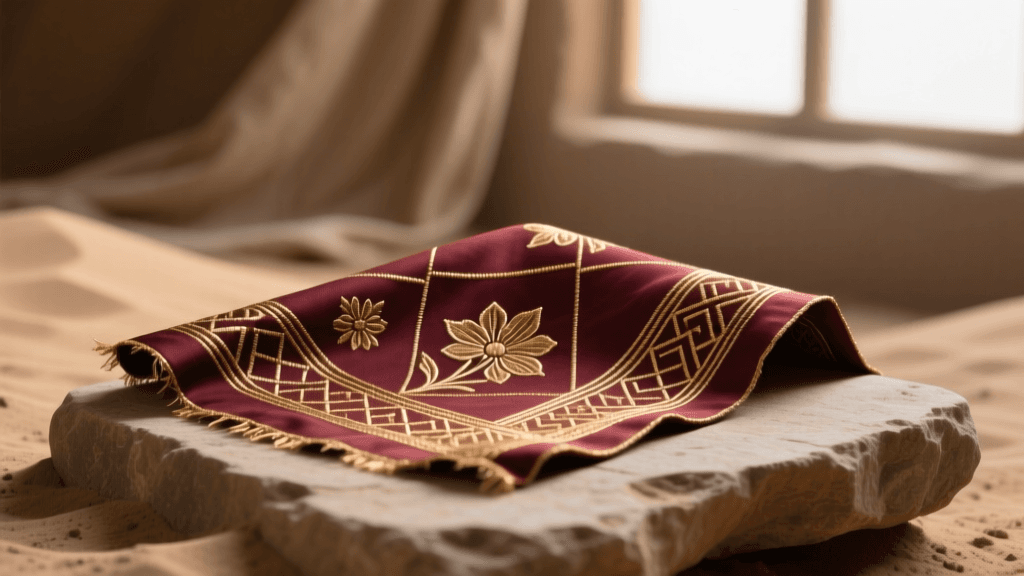
According to the UNESCO Silk Roads Programme, the Sogdians acted as the primary middlemen of the ancient silk trade, operating a vast commercial network that stretched from Samarkand to Chang'an. The 2026 excavation seasons near the ancient oasis cities of Loulan and Niya have revealed remarkably preserved silk fragments buried in the arid, alkaline sands. These fragments feature iconic Sogdian motifs, most notably the senmurv (a mythical bird-dog) and pearl roundels, which were highly prized by the Central Asian and Chinese elite. These finds are not merely decorative artifacts; they are physical records of ancient globalization, showcasing how Persian artistic motifs were woven into Chinese silk using Central Asian aesthetic sensibilities.
Decoding the Weave: Warp-Faced vs. Weft-Faced Compound Twill
To truly appreciate the 2026 archaeological finds, one must understand the mechanical and structural differences in ancient weaving techniques. Traditional Han Dynasty silks were predominantly warp-faced, meaning the warp threads dominated the surface of the fabric, creating a smooth, lustrous finish but limiting the complexity of large, polychrome patterns. In contrast, the Sogdian and Sasanian textiles that heavily influenced Silk Road exchanges utilized weft-faced compound twills, known in the West as samite.
Samite allowed weavers to hide the warp threads entirely, using multiple colored wefts to create dense, heavy, and highly patterned fabrics. This technique was perfectly suited for the bold, geometric, and large-scale figural designs favored by Sogdian artisans. Below is a structural comparison of the two dominant Silk Road weaving techniques analyzed in recent 2026 archaeometric studies.
| Feature | Han Warp-Faced Silk (Jin) | Sogdian/Sasanian Samite |
|---|---|---|
| Dominant Thread | Warp threads form the pattern and surface. | Weft threads form the pattern and surface. |
| Pattern Scale | Smaller, repeating geometric or cloud motifs. | Large, bold motifs (e.g., pearl roundels, boars). |
| Color Palette | Limited by warp threading (usually 2-3 colors). | Highly polychrome, utilizing multiple weft shuttles. |
| Drape and Weight | Lightweight, fluid, and highly lustrous. | Heavy, structured, and opaque. |
| Loom Requirement | Drawloom with complex warp harnesses. | Twill loom with multiple weft insertions. |
Archaeometric Dye Analysis: Tracing Colors Across Continents
One of the most exciting developments in 2026 is the application of non-invasive High-Performance Liquid Chromatography coupled with Mass Spectrometry (HPLC-MS) to analyze the dyes used in these excavated silks. Researchers collaborating with the International Dunhuang Project have successfully mapped the chemical signatures of the pigments without destroying the fragile fibers.
The 2026 analyses have confirmed the presence of madder root (Rubia tinctorum) for deep reds, weld for vibrant yellows, and true indigo for the striking blues found in the pearl roundels. Interestingly, trace amounts of Tyrian purple—a dye derived from the Murex sea snail and historically associated with Mediterranean royalty—have been identified in the borders of a high-status samite fragment found in a Turpan tomb. This discovery provides irrefutable chemical evidence of long-distance luxury trade networks, proving that Mediterranean dyes were being applied to Chinese-woven silk in Central Asian workshops before being sold to Tang Dynasty aristocrats.
2026 Preservation Protocols for Excavated Silks
The moment an ancient textile is excavated, it faces immediate threats from light, oxygen, and fluctuating humidity. The arid conditions of the Taklamakan Desert act as a natural preservative, but removing the textiles from their microclimates requires state-of-the-art conservation. In 2026, museum conservators and archaeological institutes employ rigorous, standardized protocols to stabilize these fragile protein-based fibers.
For curators, collectors, and conservators managing Silk Road textiles or highly fragile antique silk replicas, the following 2026 preservation parameters are considered the global standard:
- Anoxic Display Cases: To prevent oxidative degradation and deter biological pests, display and storage environments are flushed with inert argon gas, maintaining oxygen levels below 1%.
- Strict Climate Control: Temperature is locked at 18°C (± 1°C), with Relative Humidity (RH) maintained precisely at 50% (± 3%). Fluctuations in RH cause the silk fibroin to expand and contract, leading to micro-fractures.
- Light Exposure Limits: Illumination is strictly limited to cold LED sources emitting zero UV radiation. Lux levels are capped at 50 lux for a maximum of 150,000 lux-hours per year to prevent photochemical fading of the ancient dyes.
- Support Mounts: Textiles are never hung. They are supported flat or on custom-carved, acid-free Ethafoam mounts covered in washed, unbleached cotton muslin to distribute weight evenly and prevent stress on the weave.
From Antiquity to the Runway: The Xin Zhongshi Revival
The influence of these archaeological discoveries extends far beyond the museum vitrine; it is actively shaping the contemporary fashion landscape. The Xin Zhongshi (新中式), or 'New Chinese Style' movement, has seen a massive surge in 2026, with avant-garde designers looking directly to the Sogdian samite fragments for inspiration. Rather than merely copying traditional Hanfu silhouettes, modern designers are adopting the structural drape and bold, cross-cultural motifs of the Silk Road.
In the 2026 international design weeks, several prominent Asian fashion houses debuted collections featuring heavy, weft-faced jacquard weaves that mimic the tactile weight of ancient samite. The iconic pearl roundel and the senmurv have been reimagined through digital jacquard looms, blending ancient Sogdian geometry with modern, minimalist tailoring. This synthesis highlights a core truth of Asian traditions: they are not static relics of the past, but living, evolving dialogues between different cultures. As noted by the World History Encyclopedia, the Silk Road was fundamentally about the synthesis of disparate ideas, a principle that the 2026 Xin Zhongshi movement embodies perfectly.
Conclusion: The Enduring Legacy of the Silk Road
The 2026 archaeological finds in the Tarim Basin remind us that textiles are among the most intimate and informative artifacts of human history. The Sogdian samite fragments are not just beautiful fabrics; they are complex documents of ancient diplomacy, technological exchange, and artistic fusion. Through advanced archaeometric analysis and cutting-edge preservation techniques, we are able to read these woven documents with greater clarity than ever before. As modern designers continue to draw upon these ancient exchanges, the legacy of the Silk Road continues to drape itself across the modern world, proving that true style, much like history, is a tapestry woven from countless intersecting threads.