Silk Road Textile Finds 2026: Sogdian Samite & Archive Access Guide
The Enduring Legacy of Silk Road Textile Exchanges
The Silk Road was never merely a conduit for the exchange of raw goods; it was a vibrant artery of technological, aesthetic, and cultural transmission. As we examine the archaeological landscape in 2026, the study of ancient textiles has evolved from simple artifact cataloging to a highly sophisticated digital and material science discipline. For researchers, historians, and traditional garment enthusiasts, understanding the physical remnants of these exchanges offers unparalleled insights into the lives, trade networks, and artistic dialogues of ancient Asia and the broader Eurasian continent.
This comprehensive guide explores the latest 2026 developments in Silk Road textile archaeology, with a specific focus on the highly prized Sogdian samite. Furthermore, it provides actionable, step-by-step instructions for students and independent researchers to access, navigate, and utilize the world's premier digital textile archives and conservation databases.
Understanding Sogdian Samite: The Pinnacle of Cross-Cultural Weaving
When discussing Silk Road textile exchanges, few fabrics capture the imagination and historical significance quite like Sogdian samite. The Sogdians, an ancient Eastern Iranian people who inhabited the region of modern-day Uzbekistan and Tajikistan, were the premier merchants of the Silk Road. While they traded Chinese silk, they also developed their own luxurious textile traditions, most notably samite—a heavy, weft-faced compound twill silk.
Weave Structure and Motif Analysis
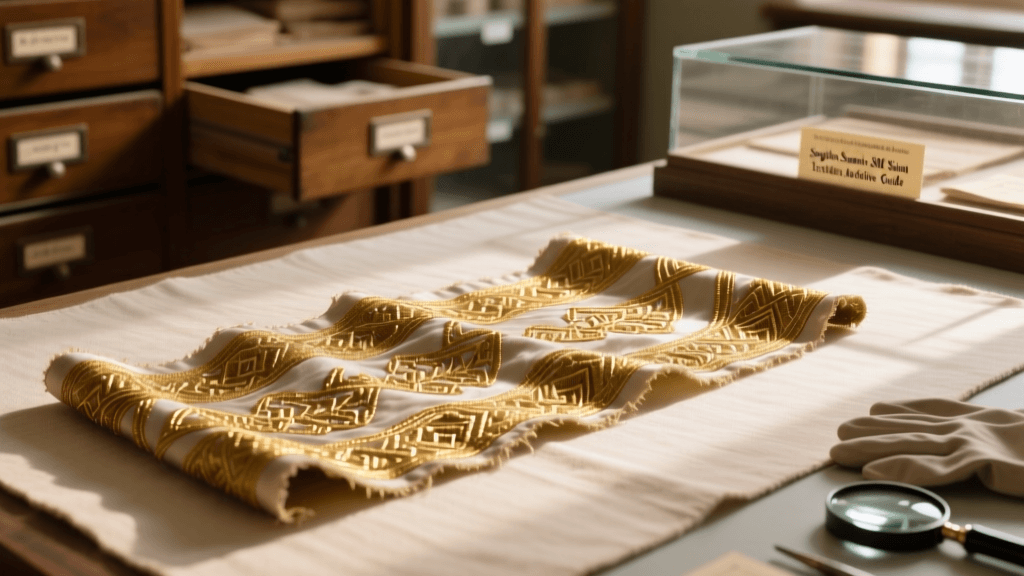
Samite is characterized by its complex weave structure, which allows for intricate, multi-colored patterns that are reversible or feature a distinct, smooth face. Unlike the lighter, warp-faced silks produced in early Han Dynasty China, samite required specialized drawlooms and a deep understanding of weft manipulation. The Sogdians masterfully blended Sassanian Persian motifs with Chinese silk technology. Common motifs found in archaeological fragments include the iconic pearl roundel, confronting boars, senmurvs (mythical bird-dogs), and stylized floral medallions.
The technical mastery required to produce these textiles cannot be overstated. A single centimeter of high-quality Sogdian samite could contain over 40 weft threads, requiring a drawloom operated by multiple weavers working in tandem. The integration of metallic threads, often made from gilded animal membranes or thin strips of silver, added a level of opulence that made these garments highly sought after by the elite of the Tang Dynasty and the Byzantine Empire alike. The cross-pollination of design is evident in how Chinese weavers eventually adopted the weft-faced compound technique, creating hybrid textiles that featured traditional Chinese dragons enclosed within Persian-style pearl roundels.
In 2026, multispectral imaging applied to newly excavated fragments from the Turfan oasis has revealed previously invisible dye compounds, proving that Sogdian weavers utilized a complex mix of indigenous Central Asian madder and imported Indian indigo to achieve their signature vibrant purples and deep blues.
Major 2026 Archaeological Updates and Digital Expansions
The current year has brought remarkable advancements in how we interact with excavated textiles. The integration of AI-driven pattern reconstruction has allowed conservators to digitally reconstruct heavily degraded garments found in the Astana cemetery. By feeding microscopic weave data into machine learning algorithms, researchers can now accurately predict the original drape, tailoring, and full-pattern repeat of fragmented Sogdian caftans and trousers.
Furthermore, the International Dunhuang Project has significantly expanded its high-resolution 3D textile database in 2026. This initiative allows users to manipulate virtual fragments, examining the twist direction of the silk threads and the exact tension of the weft inserts. For academic researchers and fashion historians, this level of digital access is unprecedented, bridging the gap between fragile physical artifacts and robust material analysis.
Practical Guide: Accessing and Navigating Silk Road Textile Archives
For those looking to conduct primary research on Silk Road garments, navigating international archives can be daunting. Below is an actionable guide to accessing the most valuable digital repositories available today.
Step-by-Step Archive Navigation
- Define Your Search Parameters: Before querying databases like the IDP or the British Library, establish precise terminology. Use terms like 'weft-faced compound twill', 'z-spun silk', or 'pearl roundel motif' rather than generic terms like 'old silk'.
- Utilize Boolean Operators: When searching the UNESCO Silk Roads Programme affiliated archives, use operators such as 'Sogdian AND samite AND Astana' to filter out unrelated medieval European textiles.
- Access High-Resolution Zoom: Always download the TIFF files where permitted. JPEGs often compress the weave structure, making it impossible to count the thread density (ends and picks per centimeter), which is crucial for identifying the specific loom type used.
- Cross-Reference Conservation Reports: Textile metadata often includes links to conservation reports. These PDFs contain vital information on the fabric's degradation state, previous chemical treatments, and exact colorimetry data (CIELAB values).
Comparative Analysis of Global Silk Road Archives
To streamline your research, refer to the table below, which compares the primary institutions holding Silk Road textile collections and their current digital access capabilities.
| Institution | Key Collection Focus | Digital Access Level (2026) | Best Search Strategy |
|---|---|---|---|
| International Dunhuang Project (IDP) | Mogao Caves, Turfan, and Dunhuang manuscripts and textiles | Full 3D manipulation and multispectral imaging | Search by excavation site code (e.g., MAS, Or.8211) |
| Victoria and Albert Museum | Central Asian silks, embroideries, and later trade textiles | High-res 2D zoom with detailed curatorial essays | Filter by 'Material: Silk' and 'Technique: Compound Weave' |
| British Museum | Sogdian metalwork and associated textile impressions | Standard 2D with linked bibliography | Cross-reference metalwork motifs with textile pattern databases |
| Asian Art Museum (San Francisco) | Later Silk Road trade and Central Asian tribal garments | Interactive drape simulations and provenance maps | Use the geographic map tool to trace trade route origins |
Modern Conservation Protocols for Excavated Silks
Understanding how these textiles are preserved in 2026 is vital for anyone handling or studying physical replicas. Ancient silks are highly susceptible to photo-oxidation, fluctuating humidity, and biological pests. Modern conservation labs utilize strict anoxic (oxygen-free) display cases filled with inert argon gas to halt the degradation of fragile protein fibers.
When storing or studying physical samples, conservators mandate a stable environment of 50% Relative Humidity (RH) and a temperature of 18°C (64°F). Lighting is strictly limited to 50 lux, with all UV radiation filtered out. For structural support, textiles are never folded; instead, they are supported by custom-carved Ethafoam mounts padded with washed, unbleached cotton muslin. This prevents the introduction of acidic compounds that could catalyze the hydrolysis of the ancient silk fibroin.
Furthermore, the handling of these artifacts requires specialized training. Conservators use bamboo spatulas and soft, natural-hair brushes to manipulate the fibers, avoiding the oils and salts present in human skin. In cases where the silk has become entirely desiccated and brittle, localized humidification chambers are employed to gently relax the fibers before they are mounted for study. This meticulous approach ensures that the physical evidence of the Silk Road's vibrant textile trade remains accessible for future generations of scholars and fashion historians.
Conclusion
The study of Silk Road textile exchanges in 2026 is a thrilling intersection of ancient craftsmanship and cutting-edge digital technology. By understanding the complex weave structures of Sogdian samite and leveraging the expansive digital archives now available to the public, researchers and enthusiasts can piece together the vibrant, interconnected history of Asian traditional garments. Whether you are analyzing thread counts in a digital database or studying the conservation methods that keep these treasures intact, the legacy of the Silk Road continues to weave its way into the fabric of modern historical research.