Silk Road Sogdian Silks: 2026 Finds & Digital Reconstruction
The Resurgence of Sogdian Silk Motifs in 2026 Excavations
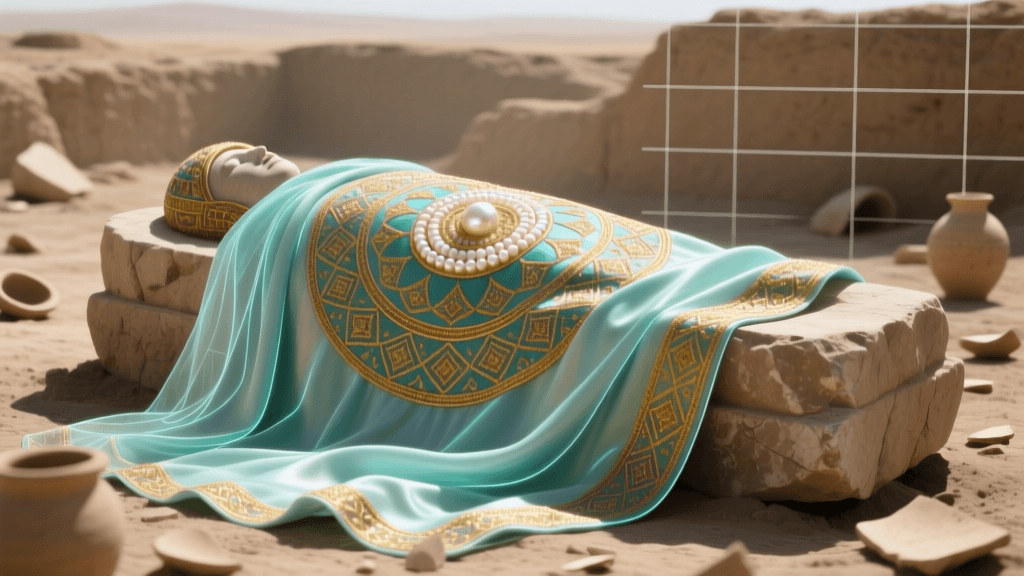
The Silk Road was never merely a conduit for goods; it was a vibrant artery of cultural, artistic, and technological exchange. In the spring of 2026, the archaeological community witnessed a monumental leap in our understanding of these ancient networks following the latest excavation reports from the Astana Cemetery in Turpan, Xinjiang. This sprawling necropolis, often referred to as the 'Underground Museum,' has yielded a new cache of impeccably preserved textiles that highlight the profound influence of Sogdian merchants on Chinese weaving traditions.
Among the most striking 2026 discoveries are fragments of compound twill silks featuring the iconic 'pearl-roundel' motif. Originating from Sasanian Persia and popularized across Central Asia by Sogdian traders, these circular borders enclosing mythical beasts, boars, or waterfowl were eagerly adopted by Tang Dynasty weavers. The 2026 Astana finds provide unprecedented physical evidence of how Chinese artisans adapted foreign iconography, merging it with indigenous sericulture techniques to create luxury fabrics that were subsequently traded back westward. For scholars and enthusiasts of Asian traditions, these artifacts represent a masterclass in early globalization.
Non-Invasive AI Dye Analysis: A 2026 Breakthrough
Historically, analyzing the vibrant colors of excavated Silk Road textiles required destructive sampling—a sacrilege when dealing with thousand-year-old artifacts. However, the 2026 conservation season has been revolutionized by the integration of AI-driven multispectral imaging and portable Raman spectroscopy. Conservators at the Xinjiang Institute of Cultural Relics and Archaeology are now utilizing these non-invasive tools to map the chemical signatures of organic dyes without touching the fragile fibers.
Recent scans of the newly unearthed pearl-roundel silks have confirmed the use of safflower (Carthamus tinctorius) for brilliant reds and Indian indigo for deep blues. The AI models, trained on a vast 2026 database of ancient botanical pigments, can now differentiate between regional variations of madder root, allowing historians to trace the precise geographic origins of the dyestuffs. According to the UNESCO Silk Roads Programme, this level of granular data is rewriting our understanding of secondary trade routes that supplied raw dye materials to the imperial workshops of Chang'an.
'The 2026 multispectral analyses prove that the Silk Road textile trade was not just about finished garments, but a complex, multi-tiered exchange of raw materials, chemical knowledge, and aesthetic philosophies.'
Reconstructing the Drape: Digital Simulation for Modern Scholars
For textile students, fashion historians, and digital archivists, the physical fragility of the Astana silks poses a challenge: how do we understand the way these heavy, structured garments moved and draped on the human body? The answer lies in advanced 3D fabric simulation. Using the latest 2026 releases of software like CLO 3D and Marvelous Designer, researchers are digitally reconstructing the drape of Sogdian-influenced compound twills.
Unlike the fluid, lightweight silk chiffons of later dynasties, Tang-era compound twills and samites were dense, heavy, and highly structured. Simulating this requires precise input of physical parameters. Below is a comparative chart used by digital conservationists in 2026 to translate historical textile measurements into 3D simulation environments.
| Parameter | Historical Astana Silk (Physical) | 2026 Digital Simulation (CLO 3D) |
|---|---|---|
| Warp Density | 45 ends/cm | 450 (scaled for rendering engine) |
| Weft Density | 20 picks/cm | 200 (scaled for rendering engine) |
| Weight (GSM) | ~185 g/m² | 185 g/m² |
| Bending Stiffness | High (Compound Twill) | 65 (U-Bend / V-Bend parameters) |
| Shear | Low (Tightly packed) | 15 (Shear parameter) |
Actionable Guide: Simulating Ancient Weaves
If you are a digital fashion student or historian looking to recreate these Silk Road garments, follow these steps in your 3D environment:
- Base Material Selection: Start with a heavy silk twill preset. Do not use charmeuse or satin presets, as they lack the structural integrity of historical samite.
- Adjust Physical Properties: Manually override the bending and shear values. As noted in the CLO Virtual Fashion material guidelines, compound twills require high bending resistance to simulate the 'stiff' drape characteristic of Tang Dynasty court robes.
- Texture Mapping: Import high-resolution photogrammetry scans of the pearl-roundel motifs. Ensure the texture scale matches the historical 45 ends/cm warp density to maintain accurate visual proportions.
- Avatar Pose & Gravity: Set your avatar to a dynamic walking pose and enable real-time gravity simulation to observe how the stiff fabric creates distinct, angular folds rather than fluid cascades.
Experiencing the 2026 Silk Road Textile Exhibitions
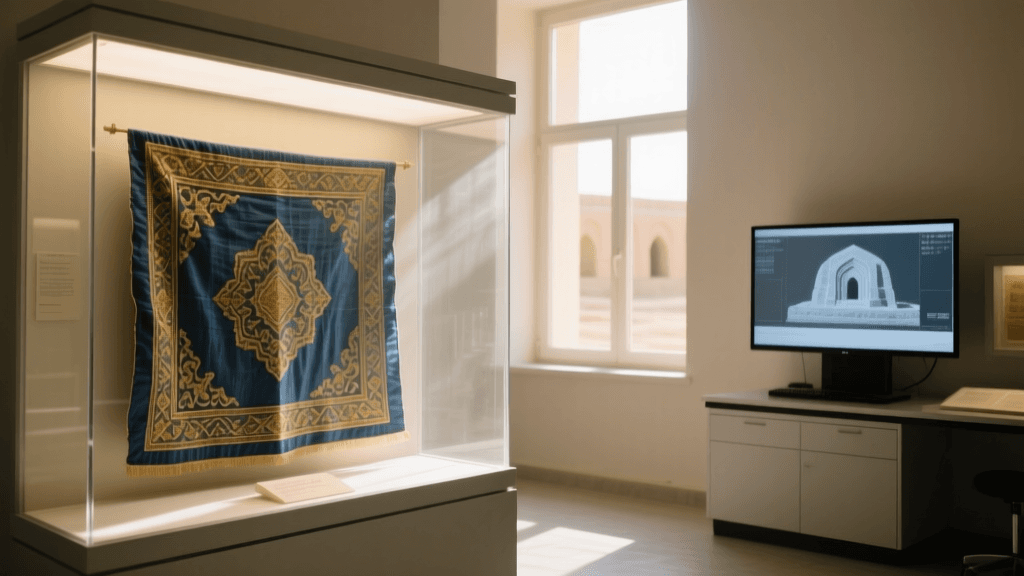
For those who prefer to witness the majesty of these textiles in person, the 2026 exhibition season offers unparalleled access to both physical artifacts and digital reconstructions. The Xinjiang Uygur Autonomous Region Museum in Urumqi has recently unveiled its newly expanded Silk Road Textile Wing. Here, climate-controlled, low-lux display cases house the latest Astana finds, illuminated by fiber-optic lighting that preserves the fragile organic dyes while allowing visitors to see the intricate gold-wrapped thread details.
Furthermore, the Metropolitan Museum of Art's extensive research on Silk Road exchanges highlights the importance of context when viewing these garments. To truly understand the scale of the Sogdian trade network, travelers in 2026 should pair a visit to the Xinjiang museum with a trip to the Dunhuang Academy. The Academy's latest 'Digital Caves' initiative allows visitors to wear augmented reality (AR) headsets that overlay the vibrant, original colors of the cave murals, showing exactly how these heavy pearl-roundel silks were worn by nobility and deities in the 8th century.
Travel & Preservation Tips for 2026 Visitors
- Booking: Due to strict daily caps on foot traffic to preserve the microclimates of the Astana and Dunhuang sites, you must book entry tickets via the official provincial heritage mini-programs at least 14 days in advance.
- Photography: Flash photography is strictly prohibited and heavily monitored by AI-enabled sensors in the 2026 exhibition halls. Use high-ISO capabilities on your camera or rely on the museum's official open-access digital archives for high-resolution study.
- Best Time to Visit: Early autumn (September to October) offers the most comfortable climate for traveling the Hexi Corridor and visiting the Turpan depression, avoiding the extreme summer heat that can make outdoor archaeological site visits exhausting.
The intersection of ancient craftsmanship and cutting-edge 2026 technology ensures that the legacy of the Silk Road is not just preserved in glass cases, but actively studied, simulated, and appreciated by a new generation of global textile enthusiasts. By understanding the physical realities of these Sogdian silks, we gain a deeper respect for the artisans who wove the world together, one pearl roundel at a time.