Slavic Rubakha Tunic Construction: Zero-Waste Patterns for 2026
The Resurgence of Ancestral Zero-Waste Sewing
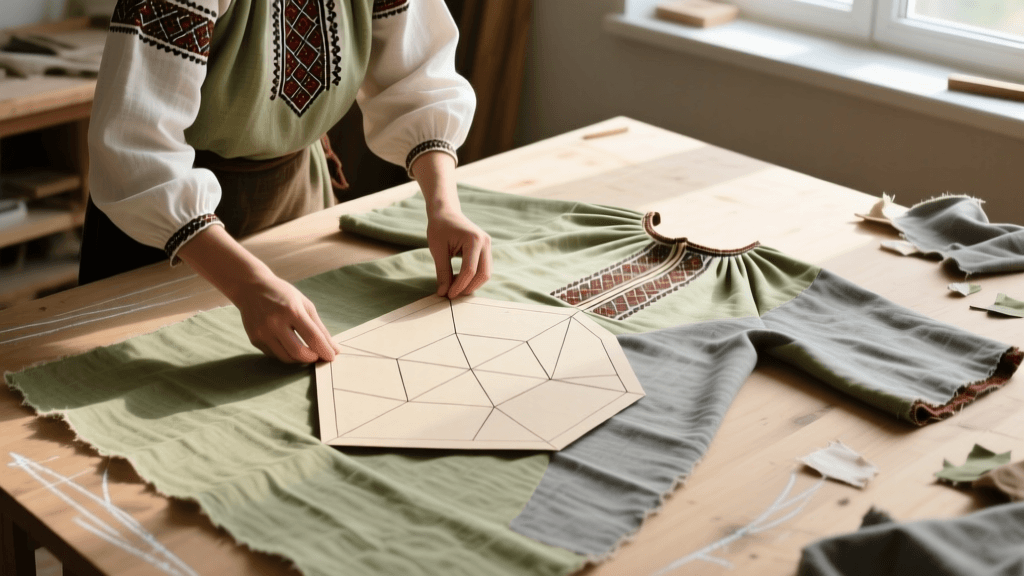
As we navigate the fashion landscape of 2026, the global slow-fashion movement has increasingly turned its gaze toward historical European folk dress for sustainable solutions. Long before the modern concept of 'zero-waste' pattern drafting was coined, rural artisans across Eastern Europe and the Balkans were mastering geometric, waste-free garment construction. The traditional Slavic rubakha (also known regionally as the sorochka, košulja, or vyshyvanka) stands as a masterclass in this discipline. By utilizing straight lines, rectangular panels, and strategic gussets, these historical garments maximized every inch of hand-woven cloth while providing exceptional mobility and durability.
For contemporary sewists and historical garment enthusiasts, reconstructing the rubakha offers more than just a connection to Slavic and Balkan heritage; it provides a highly practical framework for sustainable sewing. In this comprehensive guide, we will explore the geometric construction patterns of the traditional Slavic tunic, detail the precise techniques for inserting underarm gussets and hem godets, and discuss how to adapt these historical methods using the premium, sustainably farmed linens available in 2026.
The Loom-Width Legacy: Understanding Geometric Cutting
To truly understand European folk dress construction, one must first understand the limitations and advantages of the historical loom. Traditional village looms in the 18th and 19th centuries typically produced narrow cloth, usually ranging from 36 to 45 centimeters (14 to 18 inches) in width. Because cutting curved armholes or shaped side seams resulted in unusable, fraying offcuts, folk tailors developed a purely rectilinear cutting system.
The body of the tunic was often formed from a single long rectangle folded over the shoulders, or two identical rectangles joined at the shoulders. Sleeves were simple tubes, and mobility was achieved not through curved tailoring, but through the insertion of diamond-shaped gussets under the arm and triangular godets at the side seams. According to archival textile research preserved by The Metropolitan Museum of Art's Costume Institute, this geometric approach ensured that nearly 100% of the woven textile was incorporated into the final garment, a stark contrast to the 15-20% fabric waste typical in modern commercial apparel manufacturing.
2026 Material Sourcing: Sustainable Flax and Linen
While historical rubakhy were woven from homespun hemp or flax, modern makers in 2026 have access to exquisitely refined, sustainably farmed European linens. When selecting fabric for your tunic, look for certifications such as 'European Flax' or 'Masters of Linen,' which guarantee traceable, eco-friendly farming practices primarily based in Normandy, Belgium, and the Baltic states.
For a traditional mid-weight tunic suitable for year-round wear, opt for a 180 to 200 GSM (grams per square meter) pure linen. Modern broadloom linens typically come in 140 cm to 150 cm widths. To honor the zero-waste philosophy of the original narrow-loom garments, you must carefully plan your rectangular layout across this wider fabric, often utilizing the remaining horizontal strips to draft the collar, cuffs, and underarm gussets, ensuring no scrap is left behind.
Pattern Drafting: The Rubakha Measurement Guide
Drafting a rubakha requires abandoning standard modern slopers. Instead, you rely on a series of measured rectangles. Below is a standard drafting table for a medium-sized adult tunic, adapted for a modern 140 cm wide linen fabric.
| Pattern Piece | Traditional Shape | Dimensions (Approx.) | Function & Placement |
|---|---|---|---|
| Main Body Panel | Large Rectangle | Width: 60 cm Length: 120 cm |
Folds over the shoulder or forms front/back panels. Provides the core volume. |
| Sleeve Panel | Long Rectangle | Width: 45 cm Length: 65 cm |
Forms the straight, untapered sleeve tube. |
| Underarm Gusset | Square / Diamond | 12 cm x 12 cm | Inserted at the intersection of body and sleeve to allow arm mobility. |
| Side Godet | Right Triangle | Base: 30 cm Height: 50 cm |
Inserted into the side seams from the hem upward for walking ease. |
| Stand Collar | Long Strip | Width: 6 cm Length: Neck + 4 cm |
Finishes the neckline, often heavily embroidered. |
Mastering the Lastovitsa: The Underarm Gusset Technique
The most critical and technically demanding element of Slavic folk dress construction is the lastovitsa, or underarm gusset. Because the sleeve is a simple rectangle sewn to a rectangular body panel, the resulting 90-degree corner under the arm would restrict movement and tear under tension without a gusset. The lastovitsa acts as a three-dimensional pivot point.
Step-by-Step Gusset Insertion
- Preparation: Cut your 12x12 cm linen square. Finish the edges with a narrow zig-zag or serger to prevent fraying during the pivoting process.
- The Slash: On your main body panel, mark the shoulder fold line. Measure down from the shoulder the depth of your armhole (typically 25-28 cm). Make a precise slash perpendicular to the side seam, measuring exactly half the width of your gusset (6 cm).
- Pinning the Pivot: Pin one edge of the gusset to the slashed opening on the body panel, right sides together. Pin the adjacent edge of the gusset to the underarm seam of the sleeve panel.
- Sewing the Y-Seam: Using a 1 cm seam allowance, stitch the gusset to the body slash. Stop exactly at the corner pivot point with your needle down in the fabric. Lift the presser foot, pivot the fabric, and stitch the next side of the gusset to the sleeve edge. This requires precision; a single millimeter off the pivot point will result in a puckered underarm.
- Reinforcement: Historically, this stress point was reinforced with a dense blanket stitch or a secondary line of topstitching. In 2026, using a high-tensile, long-staple cotton or silk thread for this seam ensures historical accuracy while providing modern durability.
Godets and Gores: Engineering the Hem Flare
While the upper body of the rubakha remains relatively narrow and boxy, the hem requires significant flare for agricultural work, dancing, and general mobility. This is achieved through side godets (triangular inserts). As highlighted in the structural analyses found within the Victoria and Albert Museum's Textile Collection, the integration of gores and godets in European peasant dress represents an ingenious method of adding volume exactly where it is needed without adding bulk to the waist or hips.
To insert a side godet, sew the main body side seam from the hem upward, stopping 50 cm below the armhole gusset. Leave the seam open above this point. Pin the straight grain edge of your triangular godet to one side of the open slit, sew upward, pivot at the apex, and sew down the other side. Press the seams flat and finish with a traditional flat-felled seam to enclose all raw edges, a hallmark of high-quality historical linen garments.
Embroidery Placement and Modern Stabilizers
Construction of the rubakha is incomplete without its protective embroidery. Traditional Slavic folk belief dictated that the 'openings' of the garment—the neckline, the sleeve cuffs, and the hem—were vulnerable points where negative energy could enter. Consequently, these edges were heavily fortified with counted-thread embroidery, such as cross-stitch, satin stitch, or the intricate drawn-thread work known as merezhka.
When working with the beautiful but sometimes slippery mid-weight linens of 2026, maintaining perfect tension in counted-thread work can be challenging. Modern sewists should utilize water-soluble mesh stabilizers hooped directly with the linen. This provides the rigid foundation necessary for perfectly even cross-stitches and prevents the linen warp and weft from distorting under the tension of heavy cotton or wool embroidery floss. Once the embroidery is complete, a simple soak in lukewarm water dissolves the stabilizer, leaving behind pristine, historically accurate needlework that integrates seamlessly into the garment's structural seams.
Conclusion
The construction of the traditional Slavic rubakha is a testament to the brilliance of ancestral makers who viewed textile waste as an unacceptable luxury. By mastering rectilinear drafting, the precise insertion of the lastovitsa gusset, and the strategic placement of hem godets, modern makers can create deeply meaningful, highly functional garments. As we continue to seek sustainable alternatives in 2026, the geometric wisdom of European folk dress offers a timeless blueprint for the future of ethical sewing.