Expert Silk Kimono & Hanbok Preservation Guide 2026
The Science of Silk Degradation in Asian Heritage Garments
Silk, the cornerstone of traditional Asian garments like the Japanese kimono, Korean hanbok, and Chinese cheongsam, is a natural protein fiber composed primarily of fibroin and sericin. While incredibly strong when new, vintage silk is highly susceptible to environmental degradation. In 2026, textile conservators emphasize that the greatest threats to these heritage pieces are fluctuating relative humidity (RH), ultraviolet (UV) radiation, and improper mechanical stress from folding.
When silk is exposed to light, the amino acid chains break down, leading to photo-oxidation. This manifests as severe yellowing and eventual 'shattering,' where the fabric becomes brittle and tears under its own weight. Furthermore, traditional folding methods, while culturally significant, can cause permanent crease-line fractures over decades. Modern preservation protocols now prioritize flat storage or rolled storage for heavily embroidered pieces to mitigate these mechanical stresses.
Archival Storage Upgrades for 2026
The foundation of garment preservation is proper storage. For silk kimono and hanbok, the environment must be strictly controlled. According to the Canadian Conservation Institute, textiles should be stored in an environment with a stable relative humidity of 45% to 55% and a temperature between 65°F and 68°F (18°C to 20°C).
Choosing the Right Enclosures
Historically, kimono were stored in tansu (chests) made from Paulownia wood (kiri). Paulownia is naturally hygroscopic, meaning it absorbs and releases moisture to buffer humidity changes, and it is naturally resistant to insects. In 2026, custom-built, untreated Paulownia boxes remain the gold standard for private collectors. However, for those without access to custom woodworking, museum-grade polyethylene or polypropylene plastic bins are the recommended alternative. Avoid PVC or standard cardboard, which off-gas harmful plasticizers and acids that accelerate silk deterioration.
Padding and Folding Protocols
If folding is necessary, conservators mandate the use of unbuffered, acid-free tissue paper. Unlike buffered tissue (which contains calcium carbonate to neutralize acids), unbuffered tissue is required for protein fibers like silk and wool, as alkaline environments can degrade them. Every fold must be padded with rolled 'snakes' of unbuffered tissue to prevent sharp creases. In 2026, many collectors are transitioning to the 'roll and wrap' method, where the garment is rolled around an acid-free honeycomb cardboard tube and wrapped in washed, unbleached cotton muslin.
Integrated Pest Management (IPM) for Silk
Pest infestations, particularly from webbing clothes moths and carpet beetles, can devastate a silk collection in a matter of weeks. In the past, collectors relied on toxic chemical repellents like mothballs, which are now known to be hazardous to human health and can cause chemical burns or discoloration on silk fibers. In 2026, the standard is Integrated Pest Management (IPM). This involves rigorous housekeeping, the use of pheromone traps to monitor insect activity, and, if an infestation is detected, anoxic treatments. Anoxic treatment involves placing the garment in a sealed, oxygen-deprived chamber filled with nitrogen or argon gas for several weeks, effectively eliminating all life stages of the pest without leaving toxic residues or altering the silk's dye.
Non-Destructive Cleaning and Stain Removal
Cleaning heritage garments requires a delicate balance between removing damaging soils and preserving fragile fibers. Traditional Japanese arai-hari involves completely deconstructing the kimono into flat fabric panels, washing them gently, and stretching them on frames to dry before re-sewing. While highly effective, this is incredibly labor-intensive and stresses the seams.
In 2026, the conservation field has largely moved toward localized, non-aqueous cleaning for fragile vintage pieces. For localized stains, conservators use specialized, pH-neutral amino acid-based surfactants that mimic the structure of silk, allowing them to lift dirt without stripping the fiber's natural luster. Dry cleaning with perchloroethylene (perc) is strictly avoided, as the harsh mechanical agitation and chemical solvents can dissolve traditional metallic threads and weaken aged silk.
For general dusting, a low-suction HEPA-filtered vacuum with a specialized textile wand is used. The wand is covered with a fine fiberglass screen to ensure no loose threads or embellishments are pulled into the machine.
Structural Restoration: Stabilizing Shattered Silk
When a vintage hanbok or kimono suffers from shattered silk—often seen in the heavily weighted black silks of the late 19th and early 20th centuries—restoration shifts from cleaning to stabilization. The goal of modern conservation is not to make the garment look 'new,' but to halt further degradation.
Conservators utilize a technique called 'overlay mounting' using sheer silk crepeline or lightweight nylon tulle. A backing fabric is dyed to match the original garment using stable, lightfast conservation dyes. The shattered silk is then carefully laid over the backing and secured using microscopic conservation stitches, such as the laid-couching stitch. In 2026, synthetic conservation adhesives are rarely used on silk kimono or hanbok, as they can cross-link over time, becoming impossible to reverse without damaging the artifact.
Comparison Chart: Traditional vs. Modern 2026 Conservation Methods
| Aspect | Traditional / Historical Method | Modern 2026 Conservation Standard |
|---|---|---|
| Storage Material | Standard cedar chests, camphor wood | Untreated Paulownia, museum-grade polyethylene, unbuffered acid-free tissue |
| Pest Control | Mothballs, chemical camphor, lavender | Strict climate control, anoxic treatments (nitrogen/argon gas), pheromone traps |
| Cleaning | Full deconstruction and water washing (arai-hari) | Localized pH-neutral surfactants, HEPA micro-vacuuming, minimal intervention |
| Repairing Tears | Visible darning, heavy patching, iron-on fusibles | Silk crepeline overlays, laid-couching stitches, fully reversible techniques |
| Display Lighting | Standard gallery halogens or sunlight | LEDs restricted to 50 lux maximum, UV-filtered glazing, timed rotation |
Display and Exhibition Standards
When displaying a prized kimono or hanbok, the environmental parameters must be as strict as in storage. The Victoria and Albert Museum recommends that light exposure for sensitive silk textiles be limited to a maximum of 50 lux, with all ultraviolet radiation filtered out entirely. Furthermore, textiles should not be on continuous display; a common 2026 museum rotation schedule involves displaying a piece for three to six months, followed by resting it in dark archival storage for an equal or greater period.
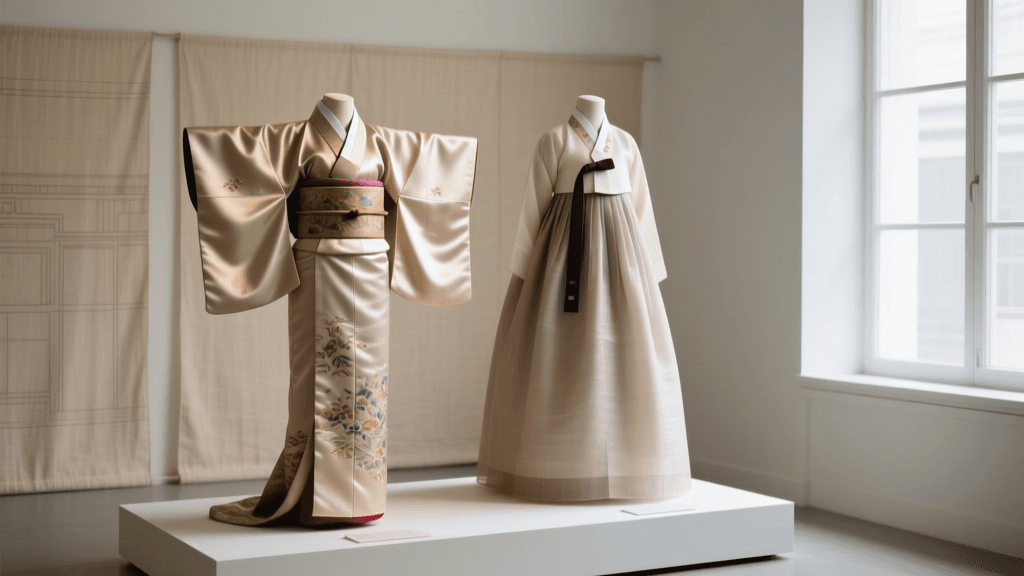
For three-dimensional display, standard retail mannequins are entirely inappropriate. They often have sharp shoulders and narrow waists that place immense stress on historic seams. Conservators use custom-carved, Ethafoam mannequins padded with polyester batting and covered in washed cotton jersey to provide a smooth, supportive silhouette that respects the garment's original cut and structural integrity.
Additionally, when mounting a hanbok, special attention must be paid to the chima (skirt) and jeogori (jacket). The high waistline and voluminous skirt require specialized internal support structures to prevent the heavy pleats from pulling on the delicate silk waistband. Conservators often use internal twill tape ties and custom-molded acrylic supports hidden beneath the skirt to distribute the weight evenly, ensuring the garment's structural integrity is maintained during long-term exhibition.
Conclusion: Stewardship for the Future
Preserving Asian heritage garments is an act of cultural stewardship. By adopting the 2026 standards for archival storage, non-destructive cleaning, and reversible restoration, collectors and institutions can ensure that the intricate artistry of silk kimono and hanbok survives for future generations. Whether you are maintaining a single family heirloom or curating a vast collection, prioritizing preventive conservation is the most effective way to honor and protect these textile masterpieces.