The 2026 Guide To Kabuki Noh Bunraku Stage Kimono
Introduction to Japan's Classical Theater Wardrobes
When discussing the pinnacle of Japanese textile arts, few domains rival the breathtaking complexity of traditional theater costumes. In 2026, the intersection of heritage preservation and live performance has brought renewed global attention to the stage kimono used in Kabuki, Noh, and Bunraku. These garments are not merely clothing; they are architectural structures, narrative devices, and masterclasses in textile engineering. Unlike everyday kimono, stage garments must withstand rigorous physical demands while projecting visual storytelling to the back rows of grand theaters.
The Japan Arts Council has recently expanded its digital archiving initiatives this year, utilizing hyperspectral imaging to document the fading natural dyes of Edo-period stage garments. This technological leap allows textile historians and contemporary weavers to study the exact chemical composition of historical threads, ensuring that the vibrant reds, deep indigos, and shimmering golds of classical theater are accurately reproduced for modern audiences. For collectors, cultural enthusiasts, and fashion historians, understanding the distinct differences between the three classical forms is essential.
Kabuki: The Extravagance of Kariginu and Hiki-nuki
Kabuki is a theater of spectacle, and its costumes reflect this dramatic ethos. Originating in the early 17th century, Kabuki stage kimono are characterized by their bold colors, exaggerated silhouettes, and heavy, opulent fabrics. The primary goal of a Kabuki costume is to instantly communicate a character's social status, moral alignment, and emotional state to the audience.
The Hiki-nuki Quick-Change Technique
One of the most thrilling aspects of Kabuki is the hiki-nuki (pulling out) quick-change technique. During a dramatic climax, stage assistants (kuroko) pull specific basting threads holding the outer kimono together. In a fraction of a second, the garment falls away or transforms, revealing a completely different kimono underneath. This requires ingenious structural engineering. The outer kimono is not tailored in the traditional sense; it is loosely basted with silk threads designed to snap under precise tension. In 2026, modern Kabuki productions at the Shochiku Kabuki-za in Tokyo continue to use this centuries-old method, though contemporary costumiers now reinforce the inner layers with lightweight, high-tensile synthetic cores to prevent damage to priceless antique silk brocades during the violent transformation.
Textile Weight and Actor Mobility
A standard Kabuki kariginu (hunting robe) or heavy brocade uchikake can weigh upwards of 15 kilograms (33 pounds). The textiles used, such as nishiki (gold and silver brocade), are woven with metallic threads that add immense weight. To compensate, actors wear specialized padded undergarments that distribute the weight across the shoulders and hips, preventing fatigue during the vigorous aragoto (rough style) fight scenes. The sweeping, elongated sleeves (ode) are often weighted at the tips to create a fluid, dramatic arc when the actor strikes a mie (pose).
Noh: The Ethereal Elegance of Karaori and Surihaku
If Kabuki is a spectacle of the physical world, Noh is a meditation on the spiritual. Noh theater, deeply rooted in Zen Buddhism and Shinto animism, demands costumes that evoke yugen—a profound, mysterious sense of the beauty of the universe. The stage kimono in Noh are less about exaggerated silhouettes and more about the subtle interplay of light, texture, and movement.
The Mastery of Karaori and Surihaku
The crowning textile achievement of Noh is the karaori (Chinese-style weaving). This technique creates a floating weave where the weft threads are passed over multiple warp threads, creating a raised, embroidered-like effect directly on the loom. A single karaori kimono can take over a year to weave by hand. The motifs—often autumn grasses, flowing water, or geometric clouds—are deeply symbolic, changing the perceived season and emotional tone of the play.
Another vital technique is surihaku, where gold or silver leaf is pressed onto the fabric using a stencil and rice paste adhesive. Unlike woven metallic threads, surihaku creates a flat, mirror-like surface that catches the dim, natural light of the Noh stage, giving the actor an otherworldly, ghostly luminescence. As of 2026, the Agency for Cultural Affairs has designated several master surihaku artisans as Living National Treasures, providing grants to ensure the toxic traditional mercury-based adhesives are safely replaced with modern, non-toxic botanical resins without sacrificing the historical luster.
The Concept of Wearing the Mask
In Noh, the costume and the mask (omen) are inextricably linked. The collar of the Noh kimono is worn exceptionally stiff and wide, framing the mask and creating an architectural transition between the human actor and the spiritual entity they portray. The layering is precise; the inner garments (kitsuke) are deliberately arranged to peek out at the sleeves and hem, providing subtle flashes of contrasting color that hint at the character's hidden emotions.
Bunraku: Engineering Kimono for Puppet Articulation
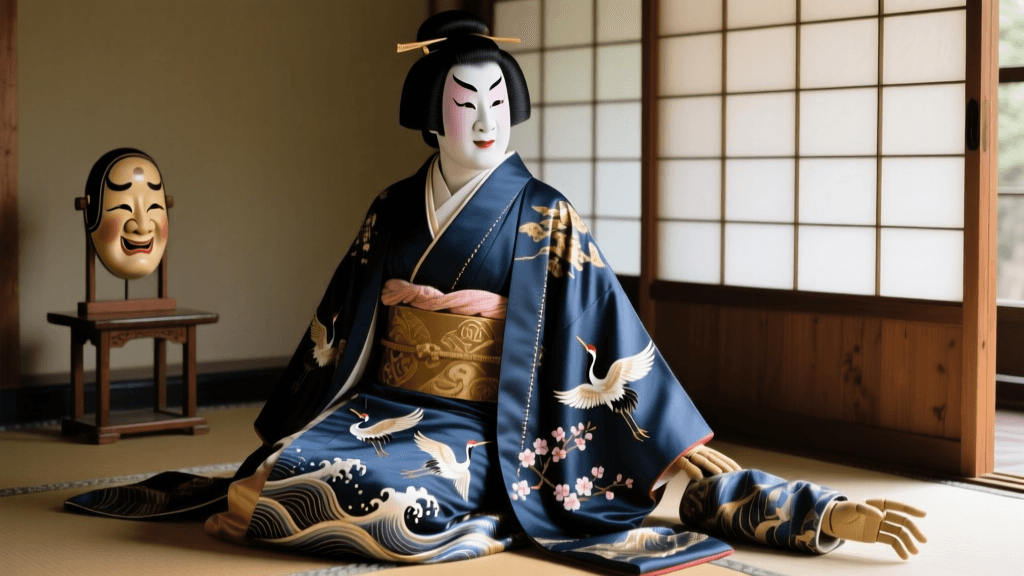
Bunraku (Ningyo Joruri) presents a unique set of challenges for costume designers: the garments must be tailored not for human bodies, but for wooden armatures manipulated by three puppeteers (ningyotsukai). The kimono in Bunraku must conceal the mechanics of the puppet while allowing for hyper-realistic, fluid movements that often surpass human capability.
Scale, Padding, and the Three-Puppeteer System
Bunraku puppets range from one-half to two-thirds the size of a human. Consequently, the kimono are scaled down, but the textiles used are often full-weight, high-quality silk to maintain the authentic drape and sound of rustling fabric. The internal structure of a Bunraku puppet consists of a central bamboo pole, a shoulder board, and a hip ring. The kimono must be expertly draped and pinned over this scaffolding.
Because the lead puppeteer operates the head and right arm from inside the costume, the right sleeve of the kimono is left open or specially gusseted to allow the puppeteer's arm to pass through and manipulate the puppet's wooden hand. The left arm and the legs are operated by assistants using control rods. The kimono's obi (sash) is tied in a specific, flattened knot that hides the hip ring while providing a grip for the puppeteers to stabilize the heavy wooden torso during emotional scenes.
Comparative Analysis: Stage Kimono Across the Three Arts
To fully appreciate the distinct engineering and aesthetic priorities of each theater form, consider the following comparative breakdown of their primary stage garments.
| Feature | Kabuki | Noh | Bunraku |
|---|---|---|---|
| Primary Silhouette | Exaggerated, heavily padded, wide stance | Architectural, stiff collars, tubular drape | Scaled-down (1/2 to 2/3), structured over wood |
| Signature Textile | Nishiki (heavy metallic brocade) | Karaori (floating weave), Surihaku (gold leaf) | Chirimen (silk crepe), Rinzu (silk damask) |
| Average Garment Weight | 10kg - 15kg (22 - 33 lbs) | 3kg - 5kg (6.5 - 11 lbs) | 1.5kg - 3kg (3.3 - 6.6 lbs) |
| Key Structural Feature | Hiki-nuki (snap-thread quick change) | Stiffened inner collars for mask framing | Gusseted sleeves for puppeteer arm access |
| Symbolic Focus | Social status, dramatic transformation | Spiritual essence, seasonal melancholy | Illusion of human life, emotional realism |
Sourcing and Viewing Authentic Stage Kimono in 2026
For textile collectors and cultural travelers visiting Japan in 2026, experiencing these garments in person is a profound endeavor. While purchasing authentic, performance-grade antique Kabuki or Noh kimono is largely restricted to theater families and museums, there are exceptional ways to engage with these textiles.
- The National Noh Theatre (Tokyo): The adjacent museum frequently rotates its collection of Edo-period karaori and surihaku garments. The 2026 spring exhibition specifically highlights the evolution of metallic thread spinning techniques.
- Kyoto Costume Museum: Offers intimate displays of Bunraku puppet costumes, allowing visitors to see the intricate internal pinning and padding techniques up close, which are usually hidden from the audience.
- Antique Textile Markets: While stage garments are rare, the monthly antique markets at Toji Temple in Kyoto often feature kosode (small-sleeved kimono) from the late Edo period that share the exact weaving techniques and motifs used in classical theater, offering a more accessible entry point for serious collectors.
Understanding the stage kimono of Kabuki, Noh, and Bunraku requires looking beyond the fabric. It demands an appreciation for the physics of performance, the spirituality of the stage, and the relentless dedication of the artisans who, even in 2026, continue to weave history into every thread.