Seoul Hanbok Construction Workshops 2026: Top Picks
The Renaissance of Hanbok Making in 2026
The global fascination with traditional Asian garments has reached a fever pitch in 2026, and nowhere is this more evident than in Seoul, South Korea. The Hanbok, characterized by its vibrant colors, graceful lines, and absence of pockets, has transcended its historical roots to become a focal point for international fashion students, textile artists, and bespoke tailors. According to the Cultural Heritage Administration, government-backed initiatives and private atelier programs have expanded significantly this year to accommodate the surge in foreign artisans seeking authentic, hands-on training in traditional Korean garment construction.
Unlike Western tailoring, which relies heavily on darts and complex curved seams to contour the body, traditional Hanbok construction is rooted in flat-pattern cutting and geometric precision. The fabric is revered in its entirety, with cuts designed to minimize waste and preserve the integrity of the woven threads. For international students and professional garment makers, attending a specialized seminar in Seoul offers an unparalleled opportunity to master these ancient techniques while understanding their modern applications.
Deconstructing the Jeogori: Core Techniques You Will Master
Any comprehensive Hanbok workshop begins with the Jeogori (the traditional upper garment). Mastering the Jeogori requires an understanding of several unique structural elements that define the Hanbok silhouette:
- Baerae (배래): The uniquely curved underarm seam of the sleeve. Unlike Western set-in sleeves, the Baerae is cut as an extension of the bodice, creating a gentle, sweeping curve that allows for graceful movement and hides the natural lines of the body.
- Git (깃): The collar band that frames the neck. Drafting the Git requires precise bias-cutting and interfacing techniques to ensure it stands perfectly upright without buckling.
- Dongjeong (동정): The removable, stiff white paper collar attached to the Git. Students learn the traditional methods of starching, folding, and attaching the Dongjeong to create a crisp, bright contrast against the colorful silk of the Jeogori.
- Goreum (고름): The long, flowing breast ties. While they appear simple, the Goreum must be cut on a specific grain and hand-stitched using invisible techniques to ensure they drape elegantly and hold the garment securely without the use of buttons or clasps.
Top 3 Hanbok Construction Seminars in Seoul for 2026
Selecting the right workshop depends on your current skill level, your focus (historical reproduction vs. modern adaptation), and your availability. Here are the top three highly-rated seminars operating in Seoul this year.
1. The Korean Traditional Craft Institute (KTCI) Intensive
Located in the historic Jongno District, the KTCI offers a rigorous, four-week intensive program designed for intermediate to advanced sewists. The 2026 curriculum places a heavy emphasis on Myeongjeol Hanbok (festive and ceremonial wear). Students spend the first week drafting flat patterns using traditional Korean measuring units (cheok and chon), followed by three weeks of hand-stitching a complete bridal Hwarot (ceremonial robe). The institute provides access to authentic silk brocades and gold-leaf (geumbak) stamping tools.
2. Bukchon Master Tailor Apprenticeship
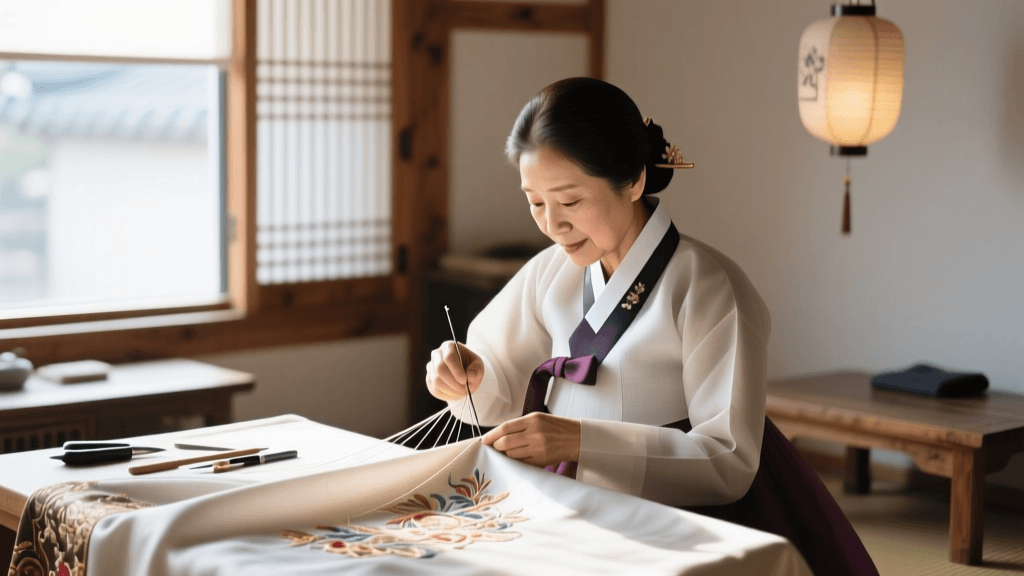
For those seeking an intimate, mentorship-style experience, the Bukchon Master Tailor program pairs international students with recognized Myeongjang (master artisans). This six-week seminar focuses heavily on Chimseon (the art of hand-stitching). You will learn the microscopic blind-stitching techniques used to hem sheer silk organza (sa) and ramie (mosi) so that the threads are virtually invisible. This seminar is highly competitive and requires a portfolio submission demonstrating advanced hand-sewing proficiency.
3. Dongdaemun Heritage Textile & Dyeing Workshop
Garment making begins with the fabric. This two-week seminar, situated near the bustling Dongdaemun design district, bridges the gap between textile creation and garment construction. The first week is dedicated to natural dyeing techniques, including Jjok (indigo) and Hwangto (yellow earth). The second week focuses on constructing the Chima (the high-waisted wrap skirt), teaching students the intricate godeunson (fine pleating) techniques that give the skirt its voluminous, bell-like drape.
2026 Workshop Comparison Chart
| Workshop Name | Duration | Primary Focus Area | 2026 Tuition (USD) | Language Support |
|---|---|---|---|---|
| KTCI Intensive | 4 Weeks | Ceremonial Hwarot & Flat Pattern Drafting | $2,800 | English / Korean |
| Bukchon Master Tailor | 6 Weeks | Advanced Chimseon (Hand-stitching) & Ramie | $4,500 | Korean (Translator avail.) |
| Dongdaemun Heritage | 2 Weeks | Natural Dyeing & Chima Pleating | $1,400 | English / Mandarin |
Essential Tools for the Modern Hanbok Artisan
While many workshops provide basic materials, serious students traveling to Seoul in 2026 should invest in specialized tools to maximize their learning experience. The National Folk Museum of Korea frequently highlights the importance of traditional implements in achieving authentic garment finishes.
- Dumitak (Ironing Mallet): Traditional Hanbok seams are rarely pressed with a modern steam iron, which can scorch delicate silks and flatten the natural texture of ramie. Instead, artisans use a wooden Dumitak to gently pound and flatten seams after they are lightly misted with water.
- Chimsun (Traditional Needles): Korean hand-sewing needles are exceptionally fine and short. You will need a graduated set, from longer needles used for basting (shimsol) to ultra-short needles for permanent, high-density stitching.
- Gawi (Silk Shears): Heavy-duty, carbon-steel shears specifically calibrated to cut through multiple layers of slippery silk satin without fraying the edges. Look for heritage brands operating in the Euljiro tool district.
Sourcing Materials: Navigating Gwangjang Market
No Hanbok education is complete without sourcing your own textiles. Gwangjang Market remains the beating heart of Seoul's fabric trade. In 2026, the market has implemented a new digital mapping system via their official app, making it easier for international students to locate specific silk vendors. Head to the "Myeongju" (silk) alleys on the second floor. Here, you can negotiate directly with weavers for Gap-sa (a lightweight, tightly woven silk perfect for summer Jeogori) and Gongdan (a thicker, lustrous satin used for winter garments and ceremonial skirts). Always bring a physical color swatch, as the lighting in the market can distort the perception of vibrant traditional dyes like hong (safflower red) and cheong (indigo blue).
Visa, Housing, and Logistics for International Students
Planning a trip to Seoul for a multi-week seminar requires careful logistical preparation. For programs lasting under 90 days, most international students from visa-waiver countries will utilize the K-ETA (Korea Electronic Travel Authorization) system, provided their primary entry purpose aligns with short-term cultural study. For the rigorous six-week Bukchon apprenticeship or longer degree-seeking programs, students must apply for a D-4 (General Trainee) or C-3 (Short-Term General) visa, which requires an official letter of acceptance from the hosting institute.
Housing near these workshops is highly sought after. Many students opt for Goshiwon (compact, affordable studio rooms) or short-term Hanok (traditional house) rentals in the Bukchon and Ikseon-dong neighborhoods. These areas not only place you within walking distance of your seminars but also immerse you in the architectural aesthetics that deeply influence Hanbok design and color theory.
Further Reading and Authoritative Resources
To deepen your understanding of Korean textile history before arriving at your seminar, we recommend exploring the digital archives and exhibition catalogs provided by the Korea Craft and Design Foundation. Their ongoing research into the preservation of intangible cultural assets provides invaluable context for the structural evolution of the Hanbok from the Goryeo Dynasty through the late Joseon period, ensuring your modern construction techniques remain historically grounded.