Senegalese Boubou Draping Styles And Cotton Batik Embellishment Techniques
Origins and Cultural Significance of the Senegalese Boubou
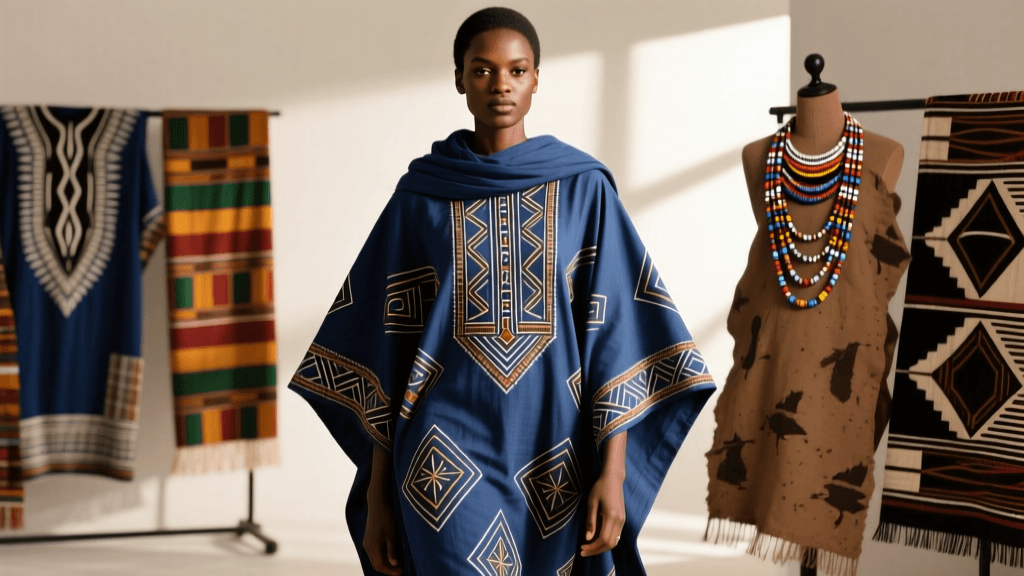
The Senegalese boubou is not merely a garment—it is a vessel of lineage, status, and spiritual resonance. Originating among the Wolof and Serer peoples of present-day Senegal and The Gambia, the boubou evolved from the 13th-century mbubb, a loose-fitting tunic worn by Islamic scholars and nobles. Its full-length silhouette—typically measuring 2.4 to 2.7 meters in total fabric length—reflects modesty principles rooted in West African Islamic traditions while accommodating local climatic needs. Unlike the Nigerian agbada or Malian bogolanfini-adorned robes, the Senegalese variant emphasizes drape over structure: sleeves often span 85–90 cm in width at the cuff, allowing air circulation without compromising elegance. Historically, royal boubous were reserved for lamanes (traditional chiefs) and marabouts (Islamic teachers), with fabric weight calibrated to signal authority—elite versions used cotton weighing 180–220 g/m², significantly denser than everyday wear (120–140 g/m²).
Cotton Batik: A Distinctive Senegalese Embellishment Practice
While Indonesian batik employs hot wax resist on silk or cotton, Senegalese artisans developed a cooler, water-based technique using cassava paste and fermented indigo vats. This method, known locally as ndak (Wolof for “to dye”), predates colonial textile imports by at least two centuries. Unlike Yoruba adire eleko, which uses cassava starch stencils on cotton, Senegalese batik relies on hand-drawn motifs with bamboo pens dipped in fermented mud and plant-based dyes. The most prized pigments include gambier (for rust-red tones), indigofera tinctoria (yielding deep navy after seven oxidation cycles), and khaya senegalensis bark extract (producing ochre). A single 1.8-meter boubou panel may undergo 12–15 dye baths over 18–22 days, with each immersion lasting precisely 45 minutes to prevent fiber degradation.
Symbolic Motifs in Senegalese Batik
Motifs are never decorative alone—they encode communal memory. The ndiaw (starfish) pattern signals resilience, referencing coastal Wolof fishing communities’ navigation by celestial bodies. The interlocking ndakarou (crossed palm fronds) denotes unity between urban and rural kinship networks. A stylized ngal (calabash) motif—measuring exactly 7.5 cm in diameter across all masterworks—represents abundance and hospitality, echoing the ritual offering of calabash bowls during naming ceremonies.
Draping Styles Across Social Contexts
Draping conventions vary by age, gender, and occasion—not geography. Young women in Dakar’s Médina district favor the mbaay sàpp (“mother’s fold”) style: the left sleeve is drawn across the chest and pinned at the right shoulder with a silver mbaay brooch (diameter: 3.2 cm), leaving the right arm fully exposed for movement. In contrast, elders in Kaolack adopt the kàddu yàgg (“closed earth”) drape—fabric folded tightly around the torso, with sleeves wrapped twice around the waist to form a 22-cm-wide sash. During Tabaski (Eid al-Adha), male scholars wear the ndëpp drape: sleeves knotted behind the neck to form a 14-cm-high collar, symbolizing submission to divine will.
Regional Variations in Fabric Sourcing
Raw cotton for batik originates from three designated zones certified by Senegal’s Ministry of Agriculture: the Niayes zone near Rufisque (producing 6,200 metric tons annually), the Casamance river basin (noted for extra-long staple fibers averaging 32 mm length), and the Fatick region (where organic cultivation covers 1,840 hectares). Each zone’s soil pH (ranging from 5.8 in Casamance to 6.9 in Fatick) directly affects dye absorption rates—verified through spectral analysis conducted at the Institut Fondamental d’Afrique Noire (IFAN) in Dakar.
Institutional Stewardship of Boubou Heritage
The École Nationale des Arts et de la Culture (ENAC) in Saint-Louis offers a three-year diploma program in traditional textile arts, requiring students to produce 42 boubou panels using only pre-1940 techniques. Since its 2011 curriculum reform, ENAC mandates that all batik instruction includes pigment chemistry labs and oral history documentation with master dyers like Aminata Diop of Tivaouane. Similarly, the Musée Théodore Monod in Dakar houses 217 documented boubous dating from 1893 to 2022, including a 1937 ceremonial piece whose indigo depth registers 89.3% light absorption—a benchmark for authentic fermentation vats.
Contemporary Innovation and Ethical Production
Designers at Dakar Fashion Week’s “Heritage Lab” initiative collaborate with IFAN researchers to standardize eco-friendly mordants. Their 2023 study confirmed that replacing alum with powdered baobab fruit pulp (2.3 g per liter of dye bath) reduced wastewater toxicity by 76% without compromising colorfastness. This aligns with the African Union’s Agenda 2063: Art and Culture Protocol, which designates textile intangible heritage as a priority sector for cross-border certification (African Union, 2015). Notably, the Dakar-based cooperative Tiibet Njaay trains 93 women annually in batik, mandating that each artisan complete 1,200 hours of apprenticeship before receiving certification—exceeding the 800-hour minimum set by UNESCO’s Intangible Cultural Heritage framework (UNESCO, 2021).
Technical Specifications of Authentic Batik Cotton
Authentic Senegalese batik cotton must meet five measurable criteria:
- Fiber length ≥ 28 mm (measured via AFIS testing)
- Thread count: 120–132 warp × 88–94 weft per square inch
- Shrinkage tolerance ≤ 3.5% after six cold-water washes
- Lightfastness rating ≥ ISO 105-B02 Level 6 (tested under xenon arc lamps)
- Indigo vat pH maintained between 10.2 and 10.7 during immersion
These metrics ensure continuity with historical standards while enabling traceability. For instance, a 2022 audit of 47 textile cooperatives found only 11 met all five benchmarks—concentrated in Thiès (4), Kaolack (5), and Saint-Louis (2). The remaining 36 relied on synthetic dyes or imported cotton, diluting cultural specificity.
Global Recognition and Cross-Cultural Dialogue
Schools like the Kente Weaving Institute in Kumasi, Ghana, now include Senegalese batik modules in their curriculum—highlighting parallels between Adinkra symbols and Wolof motifs. Both traditions use geometric repetition to convey proverbs: the Ghanaian sankofa bird (return and fetch it) mirrors the Senegalese ndaw (circular vine), signifying ancestral wisdom. Yet distinctions persist: Kente looms operate at 140–160 picks per minute, while Senegalese hand-painted batik requires 11–13 minutes per square decimeter of motif. At the Nairobi National Museum’s 2023 exhibition “Threads of Sovereignty,” curators juxtaposed Maasai beadwork collars (with 2,100 beads per 10 cm²) against a 1952 Dakar boubou whose cassava-resist patterning achieved 1,840 motif repetitions per meter—demonstrating divergent yet equally rigorous systems of encoded meaning.
“The boubou is mathematics made visible—the ratio of sleeve width to hem circumference, the logarithmic spiral of indigo oxidation, the Fibonacci sequence in motif repetition—all governed by rules older than written records.” — Dr. Fatou Dieng, Senior Textile Conservator, Musée Théodore Monod, Dakar (2022)
Such precision underscores why institutions like the Centre International de Recherches sur les Cultures Africaines (CIRCA) in Abidjan prioritize boubou draping as a living archive—not static artifact. When draped correctly, the garment’s negative space forms intentional silhouettes: the gap between folded sleeve and hip must measure exactly 11.5 cm to signify readiness for community service, a standard codified in the 1978 Wolof textile charter ratified by 17 village councils across Senegal’s Thiès region.
Contemporary designers such as Oumou Sy in Dakar and Ibrahima Thiam at the Saint-Louis-based Atelier Lô continue this legacy by integrating laser-cut stencils only for prototyping—final production remains exclusively hand-applied. Their 2024 collection, exhibited at the Dakar Biennale, featured boubous with sleeves cut to 102 cm in length (a deliberate 7 cm extension beyond tradition) to accommodate wheelchair users, proving that cultural fidelity coexists with functional evolution.
The durability of these practices lies not in replication but in responsive interpretation—where a 3.2 cm brooch diameter anchors memory, a 14 cm collar height enacts devotion, and a 22 cm sash width binds generations. These numbers are not arbitrary; they are the grammar of belonging.
| Institution | Location | Key Function | Year Established |
|---|---|---|---|
| École Nationale des Arts et de la Culture (ENAC) | Saint-Louis, Senegal | State-certified textile arts pedagogy | 1962 |
| Musée Théodore Monod | Dakar, Senegal | Archival preservation of 217+ historic boubous | 1938 |
| Kente Weaving Institute | Kumasi, Ghana | Cross-cultural curriculum integration | 1984 |
Each measurement, each drape, each pigment batch reaffirms that textile knowledge is embodied epistemology—learned not in lecture halls but in the rhythm of the hand, the breath during dye immersion, and the precise tension of folded cloth against skin.
When a young Wolof woman in Ziguinchor ties her boubou sleeves into the ndiaw knot—her fingers moving at 1.8 rotations per second, matching the cadence of her grandmother’s hands—the continuity is not metaphorical. It is measured, repeated, and lived.
The boubou does not wait for validation. It holds space—2.7 meters wide, 1.8 meters tall, infinitely deep.