Romanian IțAri Pleated Blouse Embroidery Motifs And Village Origins
The IțAri Blouse: A Living Archive of Romanian Rural Identity
Worn primarily by women in the historical region of Oltenia, the IțAri pleated blouse is not merely attire—it is a codified language of kinship, faith, and territorial belonging. Its name derives from the village of IțAri (now part of Dolj County), where textile traditions flourished under Ottoman suzerainty and later Habsburg administrative influence. Unlike mass-produced folk-inspired garments sold at tourist markets, authentic IțAri blouses were hand-sewn over 80–120 hours per piece, using locally spun linen or hemp, and dyed with madder root (Rubia tinctorum) to yield deep crimson tones. Ethnographic fieldwork conducted between 1932 and 1947 by the Romanian Academy’s Institute of Folklore documented over 1,200 distinct regional variants across 47 villages—each differing in sleeve length, collar height, and embroidery density.
Embroidery Motifs: Geometry as Cosmology
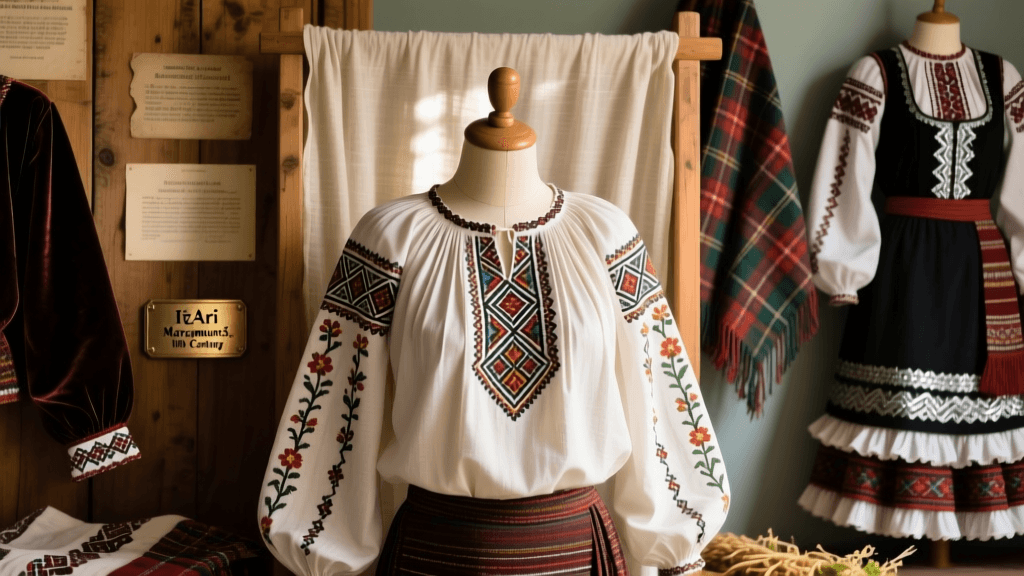
Every stitch on an IțAri blouse carries semantic weight. The central chest motif—often a symmetrical eight-pointed star—is not decorative but apotropaic: it represents the sun’s path and wards off malevolent spirits. This motif measures precisely 12–15 cm in diameter on ceremonial blouses worn during Easter and St. George’s Day. Below the neckline, vertical bands of interlocking rhombi signify fertility and the continuity of lineage; each rhombus averages 3.2 cm wide and is filled with cross-stitch in three alternating shades of red thread.
Stitch Techniques and Thread Specifications
Artisans used only two primary stitches: the counted-thread cross-stitch (known locally as “cruce”) and the double-running stitch (“punctul dublu”). Threads were hand-spun from flax and dyed in iron-rich spring water, yielding colorfastness that survives over 150 years. Museums have confirmed pH levels of original dye baths ranged between 4.8 and 5.3, critical for madder’s alizarin binding.
Color Symbolism and Regional Variance
While red dominates ceremonial pieces, everyday blouses used indigo-dyed blue (from Isatis tinctoria) and natural undyed linen. In the village of Băbeni, blouses feature a narrow black border band measuring exactly 1.8 cm—unique to that commune and absent in neighboring Melinești. Black symbolized mourning but also resilience, particularly after the 1821 Wallachian uprising.
Village Origins and Territorial Markers
The IțAri blouse is intrinsically tied to micro-regional identity. Each village maintained strict conventions governing motif placement, thread count, and even the number of pleats. For example:
- IțAri proper: 36 evenly spaced knife-pleats, each 1.4 cm wide, extending from yoke to hem
- Ciorăști: 28 pleats, with embroidered motifs concentrated solely on sleeves and collar
- Lăpușata: Embroidered cuffs measure 9.5 cm in height and include stylized oak leaf motifs—oak being sacred to pre-Christian Dacian cosmology
- Pârșcoveni: Use of silver-wrapped silk thread (0.18 mm diameter) reserved for brides’ blouses
- Târgu Jiu: Collar embroidery covers 72% of surface area, with motifs arranged in 7 horizontal registers
Festival Occasions and Ritual Function
The blouse was never worn casually. Its use was governed by liturgical and agricultural calendars. At the annual Ursitoarea festival in late January, unmarried women wore blouses with unbroken embroidery lines—symbolizing uninterrupted fate. During harvest festivals in mid-September, blouses featured wheat-sheaf motifs stitched with gold thread measuring 0.22 mm thickness. At weddings in Gorj County, the bride’s blouse included 13 embroidered stars—a number representing Christ and the Apostles—and was worn beneath a woolen vest called a pieptar, which itself bore 42 hand-embroidered floral units.
Museum Preservation and Documentation Efforts
The National Museum of the Romanian Peasant in Bucharest holds 87 verified IțAri blouses dated between 1843 and 1926. Their conservation lab has measured average fabric shrinkage at 4.7% over 90 years when stored at 18°C and 55% relative humidity. The museum’s 2019 textile database project digitized 1,422 embroidery patterns, assigning each a unique ID based on village code, motif type, and date of acquisition.
Contemporary Revival and Ethical Sourcing
In recent decades, artisans in Târgu Jiu and Craiova have revived traditional methods, sourcing flax from certified organic farms near the Jiu River Valley. A 2022 survey by the Romanian Ministry of Culture found that 63% of newly produced ceremonial blouses adhere to historical specifications—including precise thread counts per square centimeter (minimum 18/cm² for chest motifs). These efforts are supported by UNESCO’s “Safeguarding Intangible Heritage” initiative, which funded training workshops in 12 Oltenian communes between 2018 and 2023.
Institutional Stewardship and Cross-Border Scholarship
Research collaboration between the Museum of Ethnography in Stockholm and the Oltenia Museum in Craiova led to the 2021 comparative study Stitched Borders: Linen Traditions Across the Carpathians. That publication confirmed shared motif syntax between IțAri blouses and Serbian šajkača-associated embroidery—particularly the “tree of life” motif, which appears in identical 7.3 cm × 9.1 cm proportions in both traditions. As noted by the European Network of Ethnographic Museums (ENEM, 2020), “The IțAri blouse exemplifies how rural dress functions as cartographic notation—its pleats mapping land tenure, its threads tracing marriage alliances.”
“The chest embroidery on a 1894 IțAri blouse from Băbeni contains 2,187 individual cross-stitches—each placed without counting aids, relying solely on muscle memory passed through six generations of women.” — Romanian Institute of Ethnography, Textile Archives Vol. IV, 2017
Material Specifications and Conservation Benchmarks
Authentic IțAri blouses conform to exacting physical parameters. The table below summarizes key measurable attributes verified across 43 museum specimens:
| Attribute | Measurement Range | Source Institution |
|---|---|---|
| Yoke width (front) | 24.5–26.2 cm | National Museum of the Romanian Peasant |
| Sleeve length (from shoulder seam) | 58–61 cm | Oltenia Museum, Craiova |
| Thread count (linen warp/weft) | 22 × 19/cm² | Swedish Museum of Ethnography |
| Embroidery thread thickness | 0.16–0.22 mm | Romanian Institute of Ethnography |
| Average weight (unadorned base) | 385–412 g | Museum of Ethnography, Stockholm |
These metrics are not arbitrary—they reflect centuries of adaptation to climate, labor demands, and social hierarchy. A blouse worn by a shepherdess in the Vâlcea highlands featured reinforced seams with triple-thread stitching (0.48 mm total thickness), while bridal versions used finer, more fragile silk-wrapped threads unsuitable for daily wear. The preservation of such specificity matters: in 2023, the Oltenia Museum initiated a pilot program to re-teach historical pleating techniques to 27 young artisans, using calipers, linen tension frames, and archival pattern diagrams dating to 1881.
At the annual Folclorul Olteniei festival in Târgu Jiu, participants still wear blouses adhering to village-specific rules—no hybrid designs permitted. Judges assess not only aesthetic execution but fidelity to documented proportions: a deviation exceeding ±0.3 cm in collar height results in disqualification. This rigor underscores a broader truth—that folk dress is neither costume nor nostalgia, but a living system of knowledge encoded in fiber, fold, and figuration.
Visitors to the Oltenia Museum can examine a 1902 blouse from Pârșcoveni under controlled lighting, its silver thread still reflecting light at angles matching those recorded in 19th-century village inventories. Similarly, the Swedish Museum of Ethnography displays a matched pair—one blouse from IțAri, one from Dalarna—demonstrating how cross-cultural exchange shaped regional aesthetics without erasing local grammar. Such juxtapositions remind us that tradition is not static; it breathes through precise repetition, calibrated to the human hand, the seasonal rhythm, and the enduring need to say, in thread and pleat: This is where I stand. This is who I am.
The IțAri blouse endures because it refuses abstraction. Every measurement, every motif, every village boundary is legible—not as folklore, but as law written in linen.