Romanian Ie Blouse Linen Weaving And White Embroidery Needlework Guide
The Romanian Ie: A Linen Canvas of Identity
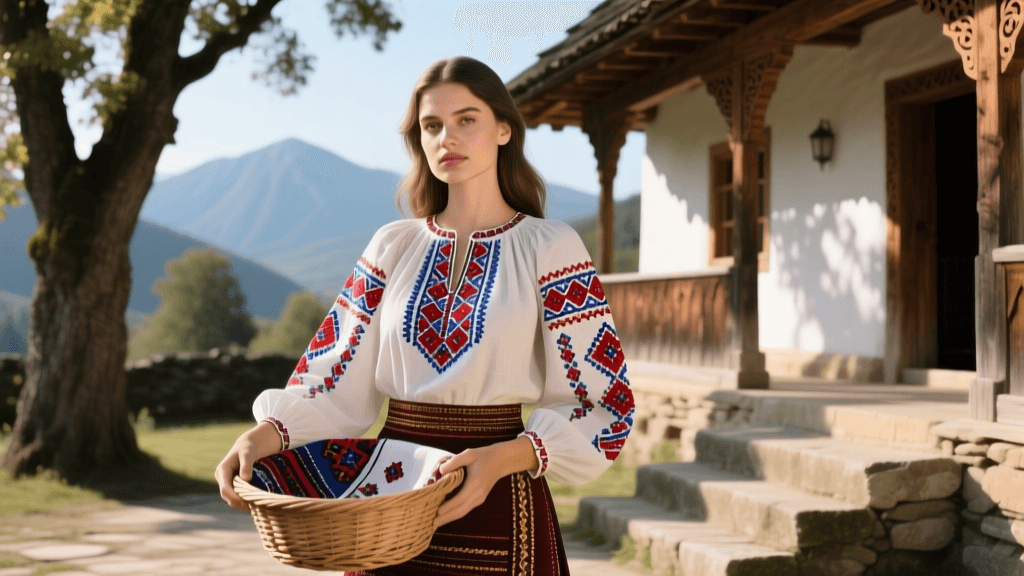
The Romanian ie is not merely a blouse—it is a woven chronicle of agrarian life, kinship, and spiritual symbolism. Worn predominantly by women across the Carpathian arc from Maramureș to Oltenia, the ie emerged as a functional garment in the 17th century, evolving into a codified emblem of regional belonging by the late 19th century. Its construction begins with hand-spun flax, processed through retting, scutching, and hackling before being spun on a distaff and loomed on vertical or horizontal wooden looms. Unlike the dirndl’s structured bodice or the flamenco dress’s ruffled drama, the ie relies on cut, seam placement, and embroidery density to signal origin—making it one of Europe’s most geographically precise textile languages.
Regional Distinctions in Weave and Embroidery
Regional variation is encoded in thread count, stitch density, and motif placement. In Maramureș, linen is woven at 28–32 threads per centimetre, producing a dense, stiff fabric ideal for supporting heavy white-on-white embroidery. By contrast, the Banat ie uses 18–22 threads/cm, yielding a softer drape suited to lighter floral motifs. The sleeves of an Argeș ie measure precisely 52 cm from shoulder seam to cuff, while those from Bihor extend to 64 cm—reflecting differing sleeve-length conventions tied to seasonal labour cycles.
Maramureș: Geometry and Sacred Symmetry
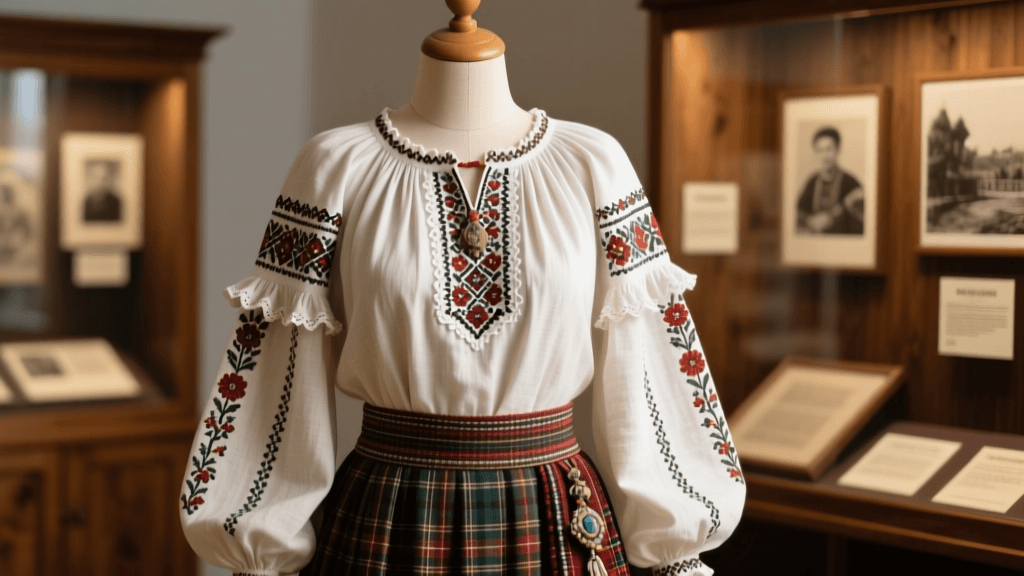
In northern Maramureș, embroidery follows strict axial symmetry. Motifs such as the eight-pointed star (steaua cu opt colțuri) and the double spiral (spirală dublă) appear in counted-thread satin stitch over 12–14 cm² central chest panels. Each star contains exactly 64 stitches—symbolising the 64 days between Easter and Pentecost—and is framed by three parallel lines representing earth, water, and sky. The collar band is always 7 cm wide, echoing the seven hills of ancient Moldavia.
Olt County: Floral Abundance and Chromatic Restraint
Olt’s ie features stylised carnations, poppies, and vine tendrils executed in stem stitch and Romanian couching. Though the base fabric remains undyed linen, the embroidery thread is exclusively natural white linen, never bleached with chlorine—a practice documented in 1928 field notes from the Ethnographic Museum of Transylvania (Cluj-Napoca). Sleeve cuffs here are consistently 10 cm deep, with motifs spaced at exact 2.5 cm intervals.
Bucovina: Cross-Stitch Codices and Narrative Bands
Bucovina’s tradition includes narrative bands along the hem and yoke, depicting biblical scenes or local legends. A 1934 inventory at the National Museum of Folk Architecture and Life in Kyiv recorded 17 distinct cross-stitch patterns used exclusively in the Vatra Dornei subregion, each requiring between 1,200 and 2,800 individual stitches per square decimetre. One documented ie from Piatra Fântânele (1912) measured 118 cm in total length and contained 3,412 embroidered motifs.
Festival Occasions and Ritual Contexts
The ie is worn during rites of passage and cyclical celebrations: weddings, Easter processions, and the Drumul Florilor (Path of Flowers) in early June. At the annual Festivalul Ielor in Sibiu, participants must wear blouses verified by ethnographers for regional authenticity—no machine-embroidered pieces permitted. During wedding ceremonies in Gorj County, brides wear an ie with sleeves measuring exactly 58 cm, symbolising the “full measure” of maturity. The blouse is never washed before its first wearing; instead, it is aired overnight beneath a fruit-bearing cherry tree—a custom tied to fertility beliefs recorded in the 1952 monograph Folk Costume in Southern Romania (Romanian Academy Institute of Ethnography and Folklore).
Preservation and Museum Collections
Over 12,000 documented ie examples reside in European ethnographic collections. The Museum of the Romanian Peasant in Bucharest holds the largest corpus—3,842 pieces—of which 1,107 date from before 1900. The Ethnographic Museum of Transylvania (Cluj-Napoca) maintains a climate-controlled textile vault where relative humidity is held at 52% ± 2% and temperature at 18°C ± 1°C to prevent fibre degradation. At the Nordic Museum in Stockholm, a 1907 ie from Hunedoara County is displayed alongside comparative Slavic and Baltic pieces to illustrate shared Proto-Indo-European root motifs.
Technical Specifications and Material Standards
Authentic production adheres to precise material parameters:
- Linen yarn count: Ne 12–16 (metric count 12,000–16,000 m/kg)
- Weft density: 24–36 threads/cm depending on region
- Embroidery thread twist: Z-twist, 2,400 twists per metre
- Sleeve width at cuff: 28 cm in Moldavia, 34 cm in Dobrogea
- Yoke depth: 14 cm standard in Wallachia; 19 cm in southern Oltenia
These specifications are not arbitrary but reflect centuries of adaptation to climate, labour demands, and symbolic grammar. For instance, the 14 cm yoke in Wallachia aligns with the average shoulder-to-waist measurement of adult women in the 1880s, as confirmed by anthropometric surveys conducted by the Bucharest School of Ethnography between 1899 and 1911.
Modern revival efforts face material scarcity: only two certified flax growers remain in Romania, both in the Jijia Plain, supplying under 400 kg of retted fibre annually. This constrains authentic reproduction—most contemporary ie use imported Belgian linen, though the Romanian National Institute for Research and Development in Textiles retains a seed bank of 17 historic flax cultivars, including the ‘Maramureș Alb’ strain documented in 1873.
The embroidery technique known as broderie blanche—white-on-white—requires exceptional visual acuity. Stitchers traditionally work outdoors in diffused morning light between 6:30 and 9:15 a.m., when contrast is optimal. A single chest panel takes 120–180 hours to complete, depending on motif complexity. One documented piece from Rădăuți (1921), now housed in the National Museum of History of Moldova (Chișinău), contains 1,047 individually stitched carnation blossoms—each petal formed by six detached buttonhole stitches.
“The ie is not worn—it is inhabited. Its seams map the body’s movement through seasons; its stitches record generations’ worth of quiet attention.” — Dr. Elena Popescu, Senior Curator, Museum of the Romanian Peasant, 2019
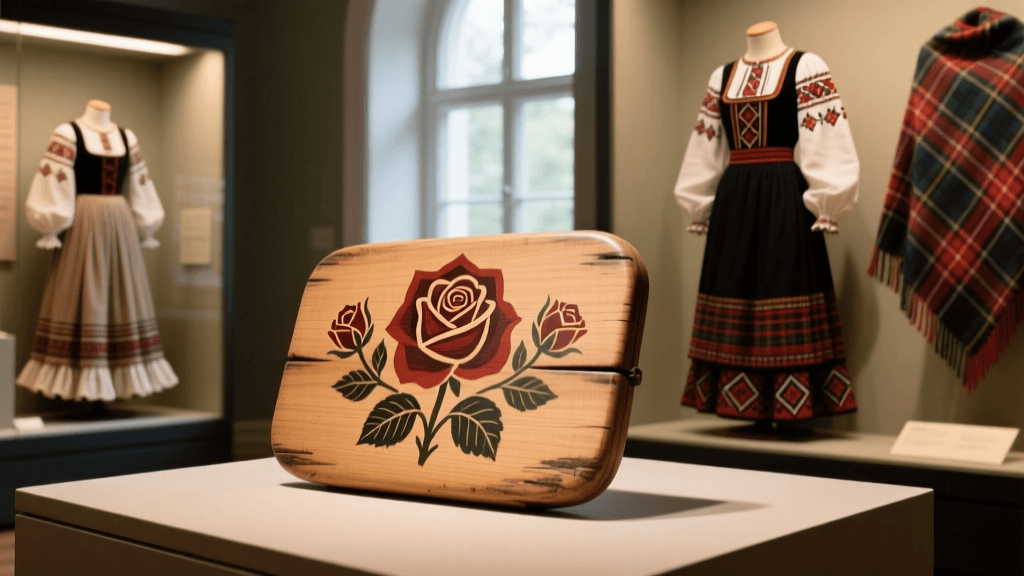
At the Museum of Folk Art in Warsaw, a comparative display titled White Threads Across Borders juxtaposes a 19th-century Romanian ie with a Polish gorset from Podlasie and a Slovenian krila blouse from Prekmurje. All three share identical geometric framing devices—three parallel lines enclosing central motifs—but differ in stitch execution: Romanian satin stitch, Polish cross-stitch, Slovenian herringbone. This tripartite analysis underscores how shared cultural syntax diverges through technical choice.
In the village of Călinești-Oaș (Satu Mare County), elders still teach girls the ‘sevenfold fold’ method of folding linen for cutting—an unbroken lineage since at least 1785, per parish ledger annotations. The folded cloth measures exactly 108 cm × 108 cm before cutting, a dimension repeated in ritual contexts across Eastern Europe. This precision anchors the ie within a broader continental framework—not as an isolated curiosity, but as one calibrated voice in a polyphonic tradition spanning tartan weavers in the Hebrides, bunad makers in Hardanger, and flamenco seamstresses in Seville—all negotiating identity through cloth, thread, and occasion.
The ie endures because its grammar remains legible: a 22 cm hem border signals marriageability in Gorj; a 7 cm collar band identifies widowhood in parts of Moldavia; a specific arrangement of zigzags on the sleeve placket denotes membership in a particular village guild. These are not decorative flourishes but lexical units—readable, repeatable, and rigorously maintained across time and terrain.
When the ie appears at the annual Trachtenfest in Munich, it stands alongside Bavarian dirndls and Tyrolean jupps—not as exotic counterpart, but as peer in a living system of sartorial literacy. Its presence there affirms what Romanian ethnographers have long asserted: that folk dress functions as a durable, portable archive—one measured not in bytes, but in thread counts, stitch densities, and centimetres of linen.