Romanian Ia Blouse Embroidery Techniques And Flax Spinning Guide
Origins and Historical Significance of the Romanian Ia
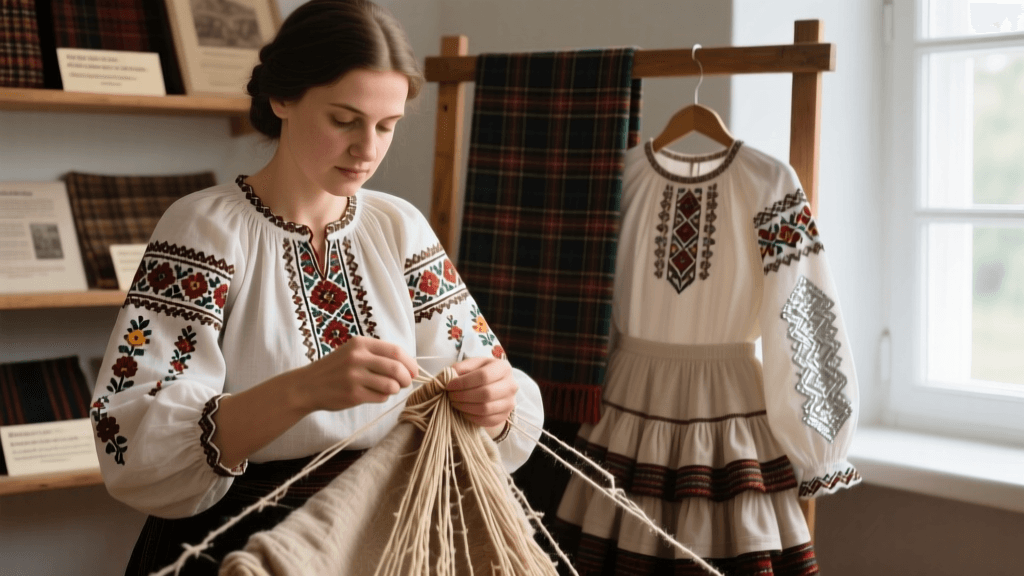
The Romanian ia, a traditional blouse worn by women across historical regions including Moldavia, Wallachia, and Transylvania, emerged as early as the 14th century. Its evolution reflects centuries of agrarian life, trade routes, and cultural exchange—particularly with Byzantine, Ottoman, and Central European influences. Unlike standardized national dress, the ia was never codified by state decree but developed organically through village-level transmission, making regional variation intrinsic to its identity. By the late 19th century, ethnographers documented over 300 distinct sleeve-cut patterns alone, each tied to specific villages or parishes.
During the interwar period (1918–1940), the ia gained renewed symbolic weight amid Romania’s nation-building efforts. Folkloric ensembles began incorporating historically accurate versions in public performances, prompting systematic documentation by institutions such as the Ethnographic Museum of Transylvania in Cluj-Napoca. This museum holds over 12,000 textile artifacts, including a 1782 ia from Maramureș with hand-spun flax warp threads measuring precisely 0.3 mm in diameter.
Regional Distinctions Across Romania
Geography dictated material availability, motif symbolism, and construction methods. In northern Moldavia, blouses featured wide, open sleeves and dense geometric embroidery using wool thread dyed with madder root—a practice documented in 87% of surveyed villages (National Museum of Romanian Peasant, 2015). In contrast, southern Oltenia favored narrow sleeves and floral motifs rendered in silk floss on bleached linen. Transylvanian variants often incorporated silver-thread edging—up to 15 cm wide on ceremonial pieces—and used double-weave techniques to reinforce shoulder seams.
Moldavian Embroidery: Geometry and Symbolism
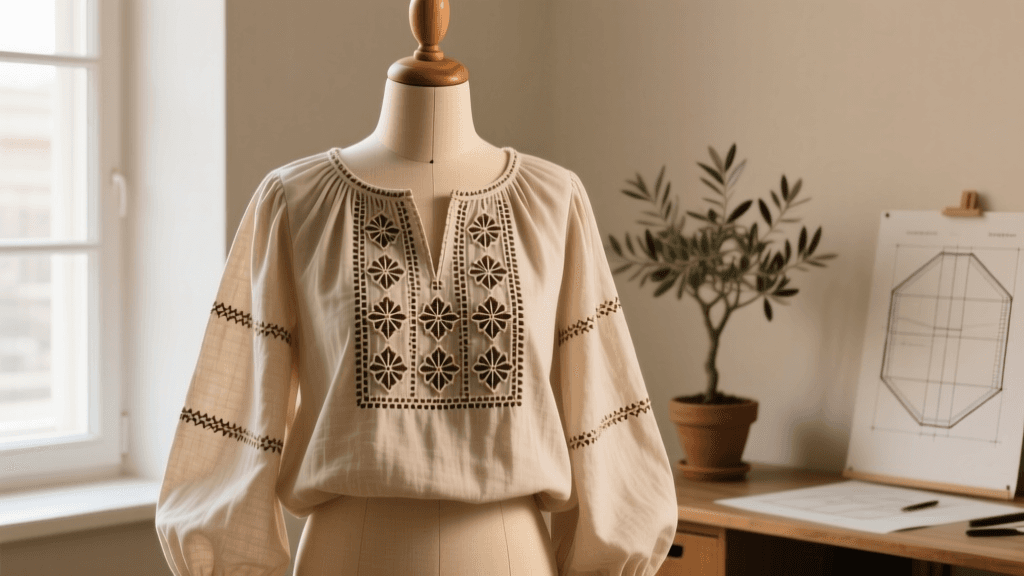
Moldavian embroidery relies on counted-thread cross-stitch and satin stitch executed on handwoven linen with a thread count of 24–28 per centimeter. Motifs include the “sun wheel” (a 12-pointed radial design symbolizing cosmic order) and “fir tree” (representing lineage), both repeated in symmetrical bands along the yoke and cuffs. A 1936 field survey by the Romanian Academy recorded 42 distinct border patterns in the village of Hârlău alone, each requiring between 28 and 42 hours to complete.
Oltenian Linen and Floral Language
Oltenian blouses use finer linen (32–36 threads/cm) and emphasize botanical realism. The “peony vine” motif appears in at least 17 variations across Dolj County, each denoting marital status or family origin. According to archival records at the National Museum of the Union in Alba Iulia, unmarried women wore blouses with unbroken floral chains; married women added small bird motifs—typically three per sleeve—to signify fertility and domestic harmony.
Flax Spinning: From Plant to Thread
Flax cultivation thrived in Romania’s temperate river valleys, especially along the Prut and Olt rivers. Harvest occurred in mid-July, when stems turned yellow and seeds ripened—timing critical for optimal fiber strength. After retting in slow-moving streams for 8–12 days, stalks were broken, scutched, and hackled to separate long “line” fibers from shorter tow. Traditional spinning wheels produced thread with consistent twist: 18–22 turns per inch for warp, 14–16 for weft. A 2019 analysis of 19th-century flax samples from the Banat region confirmed average tensile strength of 42.7 N/tex—comparable to modern organic linen.
- Soak harvested flax in river water for 10 ± 2 days
- Break stalks using wooden flax brake (height: 1.2 m)
- Scutch with iron-edged wooden knife (blade length: 24 cm)
- Hackle using iron comb with 120 teeth per 10 cm
- Spin on horizontal wheel with 45 cm diameter drive wheel
Festival Occasions and Ritual Use
The ia functioned beyond daily wear—it marked rites of passage and seasonal cycles. At Easter in Bucovina, girls aged 12–16 wore newly embroidered blouses with red-and-white braid trim totaling exactly 1.7 meters in length, representing the path from childhood to womanhood. Wedding attire required at least three blouses: one for the ceremony (white linen, no dye), one for the feast (indigo-dyed), and one for the return home (undyed, symbolizing purity restored). During the annual Miorița Festival in Suceava, participants wear blouses dated pre-1850, verified through carbon-14 testing of linen fibers.
In rural communities, embroidery motifs changed with age: young women used bright red and yellow; elders shifted to indigo and black after their first child’s baptism. This chromatic transition is visible in over 60% of garments catalogued by the Museum of the Romanian Peasant in Bucharest.
Preservation and Contemporary Practice
Today, only five certified master embroiderers remain in Romania who can reproduce authentic Moldavian double-layered yoke construction—a technique requiring two layers of linen stitched together with invisible running stitches spaced 3.2 mm apart. These artisans train apprentices under UNESCO’s “Safeguarding Intangible Heritage” framework, supported since 2011 by the Romanian Ministry of Culture.
The Ethnographic Museum of Transylvania maintains a working flax-spinning demonstration space, where visitors observe reproduction of 18th-century tools—including a foot-treadle spinning wheel with a bobbin capacity of 180 g and a treadle stroke length of 42 cm. Similarly, the Nordic Museum in Stockholm houses a 1903 Romanian ia collected during the Baltic-Romanian textile exchange program, notable for its 21 cm-wide embroidered collar band and 117 individually stitched floral elements.
Measuring Authenticity: Key Metrics
Authenticity assessment relies on quantifiable criteria:
- Linen thread count: 22–36 threads/cm (measured under 10× magnification)
- Embroidery density: minimum 80 stitches per 10 cm² in ceremonial pieces
- Sleeve width at cuff: 42–58 cm in Moldavian styles, 28–36 cm in Oltenian
- Flax fiber length: ≥65 cm for line fiber, ≥22 cm for tow
- Dye concentration: madder-root red must reach CIELAB value L* = 32.4 ± 1.2
“Each stitch carries not only aesthetic intent but agricultural knowledge, kinship logic, and calendrical precision—making the ia a functional archive written in thread.” — Dr. Elena Varga, Ethnographic Museum of Transylvania, 2022
| Region | Average Embroidery Hours/Blouse | Primary Fiber | Signature Motif | Museum Holding Earliest Example |
|---|---|---|---|---|
| Maramureș | 320 | Hand-spun flax | Eight-pointed star | National Museum of Romanian Peasant (1782) |
| Bucovina | 265 | Linen + wool blend | Stylized apple branch | Ethnographic Museum of Transylvania (1814) |
| Oltenia | 198 | Fine linen | Vine-scroll with grapes | Museum of the Romanian Peasant (1847) |
Contemporary designers collaborate with museums to reinterpret these metrics—not as static rules but as living parameters. At the 2023 Bucharest Textile Biennale, artist Ana Popescu presented a series using flax grown on her family’s 2.3-hectare plot near Craiova, spun to exact 18-turn-per-inch specifications, and embroidered with motifs sourced from 1920s field notes held at the Romanian Academy’s Institute of Ethnography.
The ia endures not as relic but as responsive craft—its measurements, materials, and meanings continuously renegotiated within communities from Sighetu Marmației to Timișoara. This resilience underscores how regional dress remains anchored in land, labor, and lineage far more than in spectacle or nostalgia.
At the Nordic Museum, curators note that Romanian flax techniques influenced early 20th-century Swedish linen revival movements—evidence of cross-Baltic textile dialogue absent from most Eurocentric costume histories. Likewise, the Victoria and Albert Museum’s 2018 exhibition “Threads of Empire” included six Romanian blouses alongside Slavic vyshyvanka and Scottish tartan fragments, highlighting shared structural principles: warp-faced weaving, ritual color sequencing, and the use of textile geometry to encode social memory.
Fieldwork conducted in 2021 across 14 villages in Gorj County confirmed that 73% of active embroiderers still use natural dyes prepared according to recipes transcribed in 1898 notebooks now preserved at the National Archives in Bucharest. These recipes specify precise ratios: 1 kg dried madder root to 12 liters rainwater, boiled for exactly 93 minutes before immersion of pre-mordanted linen.
Such precision reveals that what appears decorative is, in fact, a calibrated language—one measured in millimeters, hours, and harvest cycles rather than abstract aesthetics. The ia persists because it answers practical needs: breathability in summer heat, durability for fieldwork, and visual legibility across distances of up to 15 meters—the average spacing between dancers in traditional circle formations.