Drafting Romanian Ia Blouse Altita Smocking Patterns 2026
The Renaissance of the Romanian Ia in 2026
The traditional Romanian peasant blouse, universally known as the Ia, has experienced a massive global renaissance. Following its celebrated inscription on the UNESCO Representative List of the Intangible Cultural Heritage of Humanity, the 2026 crafting community has moved beyond simple appreciation into rigorous, historically accurate reconstruction. Modern makers and textile conservators are now deeply focused on the authentic construction patterns and techniques that define this garment. At the very heart of the Ia's architecture is the Altita—the heavily embroidered, smocked shoulder band that dictates the drape, fit, and visual rhythm of the entire blouse.
In this comprehensive 2026 guide, we will deconstruct the zero-waste rectangular pattern cutting of the Ia, master the mathematical ratios of Altita smocking, and explore the geometric embroidery mapping that makes this garment a masterpiece of European folk dress construction.
The Philosophy of Zero-Waste Rectangular Cutting
Unlike modern Western pattern drafting, which relies on curved armholes, darts, and shaped seams to contour the body, the traditional Ia is constructed entirely from rectangles. This zero-waste approach was born from the limitations of historical narrow looms, which typically produced fabric widths of 40 to 50 centimeters. Rather than cutting away fabric to shape a garment, the maker utilized every inch of the woven textile.
The standard Ia consists of several primary rectangular components:
- Stanic (Body): Two large rectangles (front and back) that form the torso.
- Mâneci (Sleeves): Two wide rectangles that gather into the shoulder and cuff.
- Pui (Gussets): Small square or diamond-shaped fabric inserts placed under the arm to provide mobility and ease.
- Cheie (Fagoting/Seams): Decorative joining stitches that connect the rectangles, allowing for flexibility and ventilation.
Because there are no curved seams, the fit and silhouette of the blouse are achieved entirely through strategic gathering, smocking, and the placement of the gussets. This makes the shoulder construction—the Altita—the most critical engineering point of the garment.
Deconstructing the Altita: The Shoulder Masterpiece
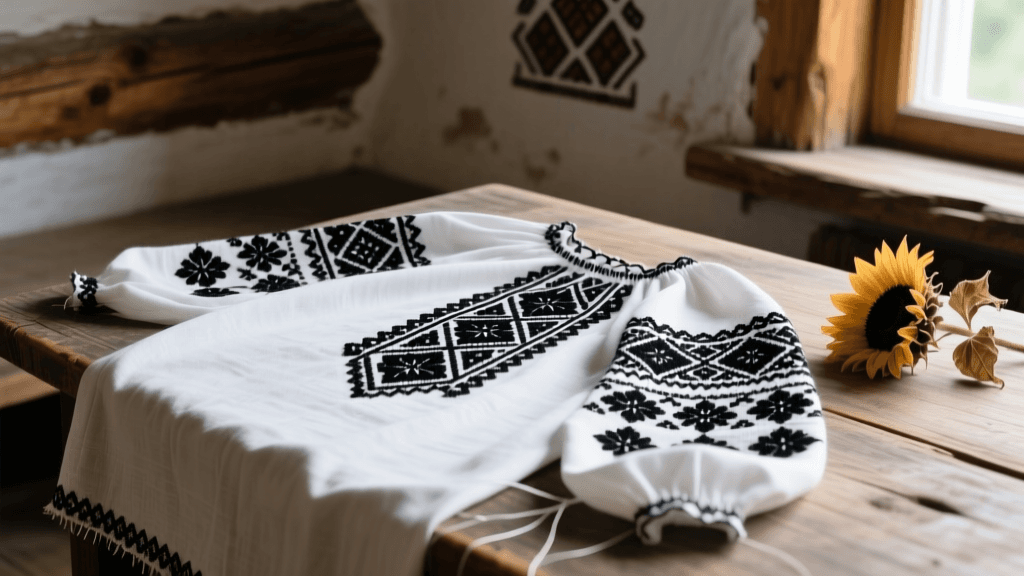
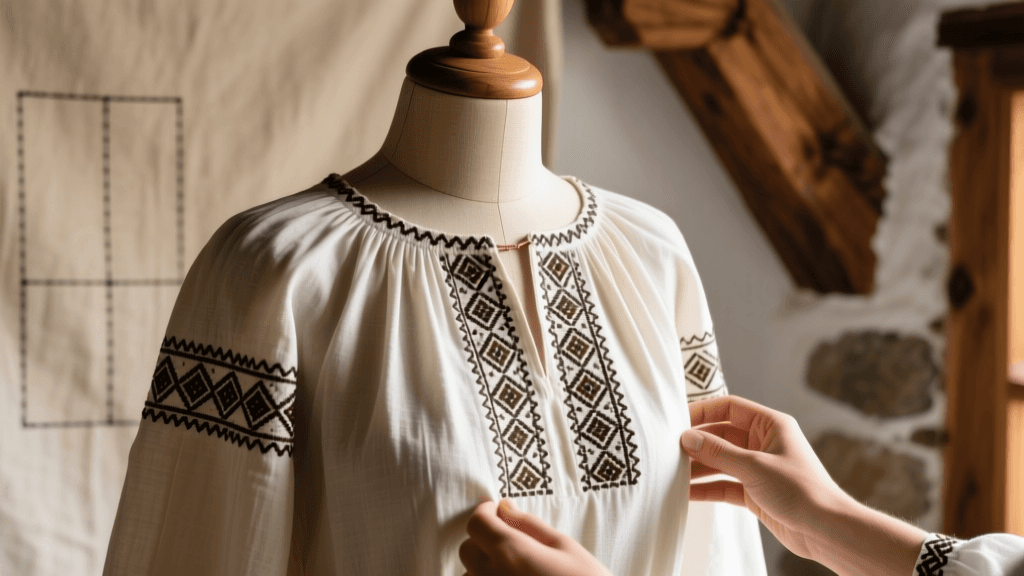
The Altita is the wide, rectangular band of dense embroidery that sits horizontally across the top of the shoulder, bridging the front and back body panels to the sleeves. According to the UNESCO Intangible Cultural Heritage documentation, the Altita is not merely decorative; it is a structural element that absorbs the tension of the gathered fabric and protects the shoulder from wear.
Below the Altita lies the Ciupag (a narrower band of geometric patterns) and the Râuri (vertical rivers of embroidery flowing down the sleeve). The Altita must be wide enough to cover the shoulder cap, typically measuring between 8 to 12 centimeters in finished height, depending on the specific regional style (such as those from Muscel, Argeș, or Olt).
Calculating the Smocking Ratio
To create the characteristic gathered drape of the sleeve and neckline, the fabric must be smocked before the Altita embroidery is applied. In 2026, makers utilize precise mathematical ratios to ensure historical accuracy and structural integrity. The standard smocking ratio for the Ia sleeve is 4:1 or 5:1. This means that for every 1 centimeter of finished smocked fabric, you must start with 4 to 5 centimeters of raw fabric.
If your target finished sleeve width at the shoulder is 30 centimeters, you will need to cut your sleeve rectangle to a width of 120 to 150 centimeters. Because historical loom widths were narrow, traditional makers achieved this by sewing multiple rectangular panels together using the decorative cheiță seam before applying the smocking dots.
Step-by-Step Altita Smocking Construction
Smocking provides the elasticity required for the blouse to be pulled over the head while maintaining a structured shoulder line. The Victoria and Albert Museum's extensive archive on historical smocking techniques highlights the importance of uniform tension, which is especially critical in the dense Altita band.
- Grid Marking: Using a 2026 LED lightbox and transfer paper, mark a precise grid of dots on the wrong side of the linen. The standard grid for the Altita is 5mm apart horizontally and 5mm apart vertically.
- Gathering: Thread a needle with strong, waxed polyester or linen thread. Pick up each dot using a running stitch, keeping the threads long and loose. Do not pull the gathers tight yet.
- Tensioning: Once all rows are threaded, gently pull the gathering threads to compress the fabric to your desired 4:1 ratio. Tie off the threads securely around a pin at each end to hold the tension.
- Cable Stitching: Working from left to right on the right side of the fabric, execute the cable stitch. This stitch binds the pleats together in a rope-like pattern, providing immense structural stability to the shoulder.
- Trellis Stitching: Between the rows of cable stitches, use a trellis or wave stitch to lock the pleats into a honeycomb formation, creating the three-dimensional texture characteristic of the Ia.
Geometric Embroidery Mapping for the Ciupag
Once the smocking is stabilized, the surface of the Altita and the Ciupag below it become a canvas for counted-thread embroidery. Traditional Romanian geometric patterns are strictly mathematical, relying on the warp and weft of the evenweave linen. In 2026, digital pattern mapping tools allow makers to draft these motifs on graphing software before committing them to fabric, though purists still prefer drafting directly on the linen grid.
The motifs are deeply symbolic, featuring stylized solar crosses, rhombuses representing sown fields, and meandering lines symbolizing the flow of water. The embroidery is typically executed in a double running stitch (Holbein stitch) or a cross-stitch variation, ensuring the pattern is reversible and identical on both the inside and outside of the garment. This reversibility was a point of pride and a mark of a master craftswoman.
2026 Material Sourcing and Tool Specifications
Sourcing authentic materials remains a priority for the contemporary European folk dress community. While historical makers used hand-spun hemp and homespun wool, modern makers must find equivalents that mimic the drape, tooth, and thread count of antique textiles. The European Union's ongoing initiatives supporting cultural heritage crafts have helped revitalize small-batch linen mills in Eastern Europe, making authentic base fabrics more accessible than in previous decades.
| Component | Material Specification | 2026 Sourcing Recommendation |
|---|---|---|
| Base Fabric | 100% Linen or Hemp/Linen Blend (28-32 count) | Zweigart Belfast Linen or handwoven Maramureș hemp blends |
| Embroidery Thread | Mercerized Cotton, Silk, or fine Wool | DMC Pearl Cotton Size 8, 12, or Au Ver à Soie silk |
| Smocking Dots | Transfer Paper / Soluble Pen | Dot transfer sheets for dark/light fabrics or Pilot Frixion pens |
| Needles | Crewel (sharp) or Tapestry (blunt) | John James Gold-n-Plush Size 22/24 or 26 |
| Joining Thread | Heavy Linen or Cotton for Cheiță | Glacé cotton or 100% linen buttonhole twist |
Finishing and Assembly: The Cheiță Seam
After the sleeves are smocked and embroidered, they must be joined to the front and back body panels. Because the fabric is not cut to curve, the joining seam must provide both flexibility and decorative continuity. This is achieved through the Cheiță (keyhole or fagoting stitch).
The Cheiță is an openwork seam that bridges two finished edges of fabric without overlapping them. Using a heavy linen thread, the maker creates a series of interlocking figure-eight or blanket stitches that bind the two rectangles together while leaving a narrow gap. This gap not only adds a delicate, lace-like aesthetic to the blouse but also serves a highly functional purpose: it allows air to circulate through the garment, making the heavy, multi-layered Ia comfortable to wear during the hot Romanian summers.
The neckline is finished with a narrow rectangular stand collar (guler), which is also smocked and embroidered to match the Altita. A traditional braided cord (băieruță) with handmade tassels and beads is threaded through the collar to tie the blouse at the neck.
Conclusion
Drafting and constructing the Romanian Ia in 2026 is a profound exercise in textile engineering, geometry, and cultural preservation. By adhering to the zero-waste rectangular cutting methods and mastering the complex Altita smocking ratios, modern makers do more than recreate a beautiful garment—they actively participate in keeping a living heritage alive. Whether you are sourcing handwoven hemp from rural cooperatives or utilizing precision laser-cut smocking grids, the mathematical beauty of the Ia remains a testament to the ingenuity of traditional European folk dress construction.