Romanian Ia Blouse Construction & Altitza Patterns 2026
Introduction to the Romanian Ia and the Altitza Tradition
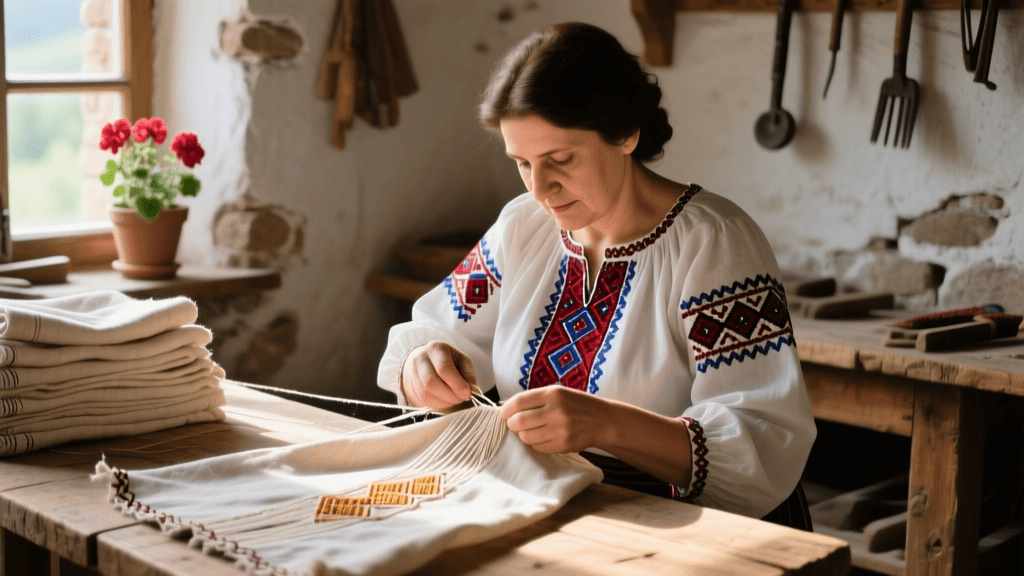
The Romanian Ia (traditional peasant blouse) is far more than a simple garment; it is a wearable manuscript of regional identity, cosmology, and ancestral craftsmanship. As the global slow-fashion and heritage textile movements continue to gain momentum in 2026, the construction of the Ia has seen a massive revival among contemporary sewists, embroiderers, and fashion historians. Unlike modern pattern drafting, which relies on complex curves and darts, the traditional Ia is rooted in zero-waste, geometric construction using rectangular panels of hand-woven linen. The true soul of the blouse, however, lies in the Altitza—the dense, highly symbolic shoulder embroidery that serves as both a structural reinforcement and a protective talisman. According to UNESCO's Intangible Cultural Heritage registry, the traditions of making the traditional blouse with shoulder embroidery represent a profound element of cultural identity in Romania and the Republic of Moldova, requiring immense technical precision and patience.
In this comprehensive 2026 guide, we will break down the exact construction patterns, the anatomy of the Altitza, and the intricate smocking techniques required to draft and assemble an authentic Romanian Ia from scratch.
Essential Materials for 2026 Ia Construction
Historically, the Ia was woven from hemp or flax linen, spun and woven by hand during the winter months. Today, while hand-woven village linen is still prized and available through specialized artisan cooperatives, most contemporary makers in 2026 rely on high-quality evenweave linens to ensure accurate thread-counting for cross-stitch and Romanian stitch embroidery. Below is a comparison of traditional materials versus modern 2026 equivalents.
| Material Component | Traditional Standard | 2026 Modern Equivalent & Sourcing | Estimated 2026 Cost |
|---|---|---|---|
| Base Fabric | Hand-woven hemp or linen (18-22 count) | Zweigart evenweave linen (25-count) or Permin | $35 - $50 per yard |
| Embroidery Thread | Hand-spun wool or silk, naturally dyed | DMC/Anchor cotton floss or hand-dyed silk | $1.50 - $4.00 per skein |
| Seam Joining | Hand-crocheted cotton lace | Size 10 or 20 crochet cotton (Aunt Lydia's) | $6 - $10 per ball |
| Smocking Thread | Heavy linen thread | Gutermann hand-quilting cotton or waxed linen | $8 - $12 per spool |
When sourcing fabric in 2026, it is critical to wash and block your linen before cutting. Linen shrinks significantly, and pre-washing ensures your geometric pattern blocks remain square after the final garment is laundered.
Drafting the Traditional Rectangular Pattern
The genius of Eastern European folk dress construction lies in its zero-waste geometry. The Ia is constructed entirely from rectangles, minimizing fabric waste and allowing the garment to drape naturally over the body without restrictive tailoring. The standard Ia requires four main structural components: the front panel, the back panel, two wide sleeves, and two side gussets (or pavane) for underarm mobility.
Standard Measurements and Cutting
- Front and Back Panels: Cut two identical rectangles. The width is typically determined by the fabric's loom width (historically 40-50 cm), and the length extends from the shoulder to the desired hemline (usually 60-70 cm).
- Sleeves: The sleeves are the canvas for the most elaborate embroidery. Cut two massive rectangles, typically 60-80 cm wide and 50-60 cm long. The extreme width allows for the deep, voluminous smocking at the cuff and shoulder.
- Underarm Gussets: Cut two squares, approximately 15x15 cm, to be inserted at the armpit junction, providing crucial ease of movement.
- Neline/Collar Band: A single rectangular strip of fabric, roughly 5 cm wide and 45-50 cm long, which will eventually be smocked to form the neckline.
Because there are no armholes or curved necklines to cut, the structural shaping of the Ia is achieved entirely through gathering and smocking, a technique we will explore later in this guide.
The Altitza: Anatomy of the Shoulder Embroidery
The Altitza is the defining feature of the Romanian Ia. Located on the upper shoulder and sleeve, it is a dense, rectangular block of embroidery that historically protected the wearer from evil spirits, as the shoulder was considered a vulnerable point where negative energy could enter the body. The Romanian Peasant Museum archives thousands of regional variations of the Altitza, but they all share a tripartite structural anatomy.
The Three Zones of the Altitza
- The Râuri (The Rivers): These are the vertical or diagonal bands of embroidery that flow down the sleeve from the shoulder block. They represent the flow of life, water, and time. They are usually stitched in a repeating geometric or floral motif.
- The Altitza (The Shoulder Block): This is the dense, horizontal rectangular band at the very top of the sleeve. It is the most complex part of the design, featuring a strict grid of motifs. The background is often completely filled with stitching, creating a thick, armor-like layer of thread.
- The Biscuits (Coada Vacii / The Cow's Tail): Located just below the main Altitza block, these are smaller, distinct geometric shapes (often resembling stars, hooks, or zig-zags) that serve as a transitional border between the dense shoulder block and the flowing Râuri.
Mastering the Point de Roumanie (Romanian Stitch)
To achieve the authentic texture of the Altitza, you must master the Point de Roumanie, also known as the Romanian stitch or split cross-stitch. Unlike a standard cross-stitch which forms an 'X', the Romanian stitch creates a diagonal line secured by a tiny, nearly invisible horizontal tie-down stitch in the center. This technique uses significantly less thread than traditional cross-stitch while providing a rich, raised, and textured surface that catches the light beautifully. For detailed historical references on Eastern European stitch variations, the Victoria and Albert Museum's textile collections offer excellent visual archives of regional embroidery techniques.
Smocking the Neckline and Cuffs (Smoc and Crețuri)
Because the Ia is cut from flat rectangles, the voluminous fabric must be gathered to fit the body. This is achieved through traditional honeycomb smocking, known locally as smoc or crețuri. Smocking not only provides elasticity but also creates a beautiful, textured geometric pattern at the neckline and cuffs.
Step-by-Step Honeycomb Smocking
- Marking the Grid: On the wrong side of your fabric, mark a precise grid of dots. For the neckline, dots should be spaced exactly 1 cm apart horizontally and vertically.
- The Gathering Threads: Using a strong, waxed linen thread, run parallel gathering stitches through the horizontal rows of dots. Do not tie off the ends; leave long tails.
- Pulling the Gathers: Gently pull the gathering threads to compress the fabric into tight, even pleats. Tie the threads securely around a pin to hold the tension.
- The Honeycomb Stitch: Using a contrasting embroidery thread, work from left to right. Bring your needle up through the first pleat, take a stitch through the adjacent pleat, and pull tight to draw them together. Move down to the next row, stitch the second and third pleats together, and repeat. This offset stitching creates the classic hexagonal 'honeycomb' structure.
- Finishing: Once the smocking is complete, carefully snip and remove the original gathering threads. The smocking itself will hold the pleats in place while allowing the neckline to stretch over the head.
Assembly and the Cheiță Lace Seams
The final hallmark of a masterfully constructed Ia is the Cheiță (the key). In traditional construction, the rectangular panels are not simply sewn together with a standard French seam. Instead, the edges of the linen panels are finished with a buttonhole stitch or hemmed, and then joined together using a decorative, hand-crocheted lace or needle-woven insertion stitch. This Cheiță serves a dual purpose: it prevents the raw linen edges from fraying, and it adds a delicate, semi-transparent lace detail that contrasts with the heavy, opaque embroidery of the Altitza.
Constructing the Cheiță
To create an authentic Cheiță in 2026, use a fine size 10 or 20 crochet cotton. The most common joining stitch is a variation of the figure-eight or infinity loop stitch, worked with a fine steel crochet hook (typically 0.75mm to 1.25mm). You will anchor your hook into the hemmed edge of the front panel, pull up a loop, reach across the gap to the hemmed edge of the sleeve panel, and pull up a second loop, twisting them together to form a secure, lace-like bridge. This process is incredibly time-consuming—a single blouse can require over 20 meters of Cheiță lace—but it is the definitive mark of a true heritage garment.
Conclusion
Constructing a traditional Romanian Ia is an exercise in patience, geometry, and deep cultural reverence. By honoring the zero-waste rectangular drafting methods, mastering the intricate Altitza embroidery, and finishing the seams with hand-crocheted Cheiță, modern makers in 2026 can keep this profound textile tradition alive. Whether you are building your first blouse or refining your smocking techniques, the Ia remains a testament to the enduring power of European folk dress construction.