Regional Japanese Kimono Textiles: A Prefecture Guide
Introduction to Japan's Regional Textile Heritage
When exploring the vast world of traditional Japanese clothing, it is easy to assume that the kimono is a monolithic garment with a single, unified aesthetic. However, Japan's diverse geography, ranging from the snowy northern islands of Hokkaido to the subtropical archipelagos of Okinawa, has given rise to a rich tapestry of regional textile traditions. Prefecture-specific microclimates, indigenous flora, and historical trade routes have deeply influenced local dyeing and weaving techniques. For collectors, enthusiasts, and cultural historians, understanding these regional variations is essential to appreciating the true depth of Japanese garment craftsmanship.
This guide delves into three of Japan's most prestigious and distinct regional textile traditions: Ishikawa's Kaga Yuzen, Kagoshima's Oshima Tsumugi, and Okinawa's Ryukyu Bingata. We will explore their historical contexts, unique production methods, and provide practical, actionable advice for those looking to acquire, wear, or preserve these masterpieces.
Ishikawa Prefecture: The Elegance of Kaga Yuzen
Originating in the Kanazawa region of Ishikawa Prefecture, Kaga Yuzen is renowned for its highly realistic, painterly designs. Unlike the stylized and heavily stylized patterns of Kyoto's Kyo Yuzen, Kaga Yuzen draws direct inspiration from the natural world, particularly the flora and fauna of the Hokuriku region. The technique is defined by the kaga-gosai, a strict palette of five traditional colors: indigo, yellow, purple, green, and reddish-brown.
The hallmark of Kaga Yuzen is the bokashi (gradation) technique, where colors fade from the outer edges of a motif toward the center, creating a three-dimensional, lifelike effect. Another signature element is mushikui, the deliberate depiction of insect-eaten leaves, which reflects a profound, wabi-sabi appreciation for the transient beauty of nature.
According to the Japan National Tourism Organization, the Kaga Yuzen Kimono Center in Kanazawa remains the premier destination for observing this meticulous process, which involves up to fifteen distinct steps, including hand-painting, steaming, and washing the fabric in the region's pristine rivers. A custom-ordered, hand-painted Kaga Yuzen kimono is a significant investment. Prices typically start around ¥800,000 (approx. $5,500 USD) and can easily exceed ¥3,000,000 ($20,000 USD) for pieces crafted by certified Living National Treasures. The lead time for a bespoke commission is generally 6 to 12 months.
Kagoshima Prefecture: The Resilience of Oshima Tsumugi
Traveling south to the Amami Oshima island in Kagoshima Prefecture, we encounter Oshima Tsumugi, a silk weaving tradition celebrated for its extraordinary durability, lightweight feel, and intricate kasuri (ikat) patterns. The defining characteristic of Oshima Tsumugi is its unique mud-dyeing process. Artisans use the tannin-rich bark of the sharinbai (techichi) tree, combined with the iron-heavy mud of Amami Oshima, to produce a deep, lustrous black that is remarkably colorfast.
The creation of the kasuri patterns requires staggering precision. Threads are bound and dyed before weaving, and when woven together, they form complex geometric or pictorial motifs. The Ministry of Economy, Trade and Industry (METI) designates Oshima Tsumugi as a Traditional Craft Product, recognizing the immense labor involved; a single bolt of fabric (tanmono) can take up to a year to complete from spinning to final weaving.
For buyers, Oshima Tsumugi is highly prized for its versatility and comfort. It is remarkably wrinkle-resistant and becomes softer with wear. Due to the intense labor and scarcity of skilled weavers, authentic Amami Oshima Tsumugi commands premium prices. A standard woven bolt costs between ¥600,000 and ¥1,500,000 ($4,000 to $10,000 USD). When purchasing, always look for the official Amami Oshima Tsumugi inspection certificate tag, which guarantees the fabric was woven on the island using traditional methods.
Okinawa Prefecture: The Vibrancy of Ryukyu Bingata
In the subtropical climate of Okinawa, the textile tradition shifts dramatically from the subdued elegance of the mainland to the explosive vibrancy of Ryukyu Bingata. Historically reserved for the royalty and nobility of the Ryukyu Kingdom, Bingata is a resist-dyeing technique that utilizes elaborate paper stencils (kata) and vibrant pigments. The designs heavily feature tropical and maritime motifs, such as hibiscus flowers, ocean waves, palm trees, and Chinese-influenced dragons and phoenixes.
As noted by the Victoria and Albert Museum, Ryukyuan textiles exhibit a distinct departure from mainland Japanese aesthetics, favoring bold, contrasting colors that reflect the island's intense sunlight and lush landscapes. The dyeing process involves applying a rice-paste resist through the stencils, followed by the meticulous hand-painting of pigments into the exposed areas.
Bingata is traditionally crafted on lightweight fabrics like linen, ramie, or sheer silk, making it ideal for summer wear. While historically a marker of high social status, today it is worn by locals and enthusiasts during festivals, weddings, and cultural celebrations. A high-quality, hand-dyed Bingata summer kimono or obi typically ranges from ¥300,000 to ¥1,200,000 ($2,000 to $8,000 USD), depending on the complexity of the stencil work and the reputation of the artisan.
Comparative Guide: Regional Textiles at a Glance
To help collectors and wearers navigate these distinct regional styles, the following table summarizes the core characteristics, ideal use cases, and market expectations for each textile tradition.
| Region / Prefecture | Textile Name | Primary Technique | Signature Motifs | Average Custom Cost (JPY) | Lead Time |
|---|---|---|---|---|---|
| Ishikawa (Kanazawa) | Kaga Yuzen | Hand-painting, Resist Dyeing | Realistic flora, birds, insect-eaten leaves | ¥800,000 - ¥3,000,000+ | 6 - 12 Months |
| Kagoshima (Amami Oshima) | Oshima Tsumugi | Mud Dyeing, Kasuri (Ikat) Weaving | Geometric patterns, tortoiseshell, crosses | ¥600,000 - ¥1,500,000 | 9 - 14 Months |
| Okinawa (Ryukyu) | Ryukyu Bingata | Stencil Resist Dyeing | Hibiscus, waves, dragons, tropical fish | ¥300,000 - ¥1,200,000 | 3 - 6 Months |
Practical Advice for Collectors and Wearers
Understanding the Tanmono (Fabric Bolt)
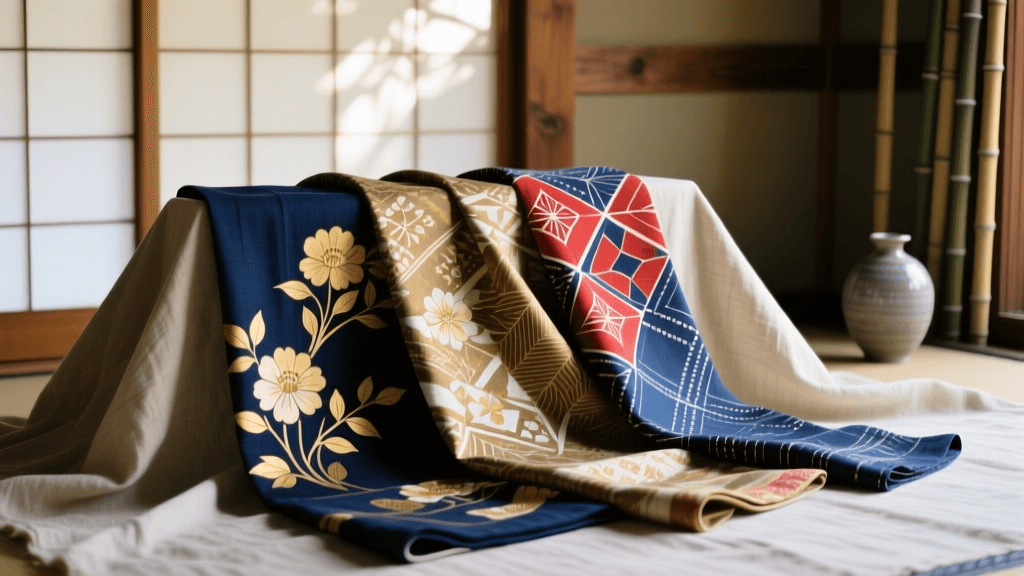
When commissioning or purchasing traditional Japanese textiles, you are often buying a tanmono—a narrow, uncut bolt of fabric. The standard dimensions for a silk kimono tanmono are approximately 36 centimeters (14 inches) in width and 12 meters (39 feet) in length. This specific width dictates the construction of the kimono, which is made from straight panels of fabric without cutting, allowing the garment to be entirely disassembled and re-tailored. When purchasing regional textiles like Oshima Tsumugi or Kaga Yuzen, ensure you are buying a full, uncut tanmono to maximize its resale value and tailoring flexibility.
Ordering Timelines and Seasonal Considerations
Traditional Japanese garments are deeply tied to the seasons. If you are commissioning a bespoke Kaga Yuzen kimono featuring autumn maple leaves, you must place your order at least eight months in advance to ensure the artisans have time to draft the design, paint, steam, and tailor the garment before the season begins. For Ryukyu Bingata, which is predominantly worn in the sweltering Okinawan summer, lightweight ro or sha (sheer woven silk) bases are preferred. Order these by early winter to ensure delivery in time for the June/July festival season.
Maintenance and Arai-Hari
Caring for regional textiles requires specialized knowledge. While Oshima Tsumugi is famously durable and can withstand light moisture, Kaga Yuzen and Ryukyu Bingata feature delicate surface pigments that can bleed if exposed to water. Never attempt to wash these garments at home. Instead, rely on the traditional Japanese service of arai-hari. This process involves carefully unpicking the kimono's seams, washing the flat fabric panels using specialized natural solvents, re-stretching them on wooden frames (shinshi) to restore the tension and luster, and finally re-sewing the garment. Expect to pay between ¥15,000 and ¥30,000 ($100 to $200 USD) for a full arai-hari service, and only entrust your garments to certified kimono care specialists.
Conclusion
The regional variations of Japanese kimono textiles offer a profound glimpse into the country's diverse cultural and environmental landscape. From the misty, river-washed elegance of Ishikawa's Kaga Yuzen to the sun-baked, mud-dyed resilience of Kagoshima's Oshima Tsumugi, and the vibrant, stencil-stamped joy of Okinawa's Ryukyu Bingata, each prefecture tells a unique story through thread and dye. By understanding the specific techniques, costs, and care requirements of these regional masterpieces, collectors and wearers can ensure that these vital Asian traditions continue to be preserved, celebrated, and worn with pride for generations to come.