How to Recreate Iconic Chinese TV Drama Hanfu Costumes
The global fascination with Chinese historical and fantasy dramas—often referred to as C-dramas—has done more than just captivate international audiences; it has ignited a massive resurgence in traditional Chinese clothing. According to BBC Culture, the Hanfu movement has evolved from a niche historical interest into a booming fashion industry heavily driven by social media and television. Shows like The Untamed (Chen Qing Ling), Nirvana in Fire, and Love Between Fairy and Devil (Cang Lan Jue) have turned costume designers into trendsetters. For fans and fashion enthusiasts, recreating these iconic screen looks offers a unique blend of cosplay, cultural appreciation, and high fashion.
Decoding Drama Genres: Xianxia vs. Wuxia vs. Historical Court
Before purchasing your first set of drama-inspired Hanfu, it is crucial to understand the three primary genres of Chinese television costuming. Each genre dictates specific silhouettes, fabric choices, and historical accuracies.
| Genre | Defining Characteristics | Key Garments | Typical Fabric & Cost |
|---|---|---|---|
| Xianxia (Immortal Fantasy) | Ethereal, flowing, gravity-defying. Often features excessive layering and trailing sleeves. | Da Xiu Shan (Large Sleeve Shirt), Qixiong Ruqun (Chest-high skirt) | Chiffon, organza, silk blends. ($80 - $250) |
| Wuxia (Martial Arts) | Grounded, practical for movement, rugged yet elegant. Features structured cuffs and armor elements. | Yuanlingpao (Round Collar Robe), Banbi (Half-sleeve), Hukou (Bracers) | Cotton-linen, jacquard, faux leather. ($60 - $180) |
| Historical Court | Opulent, rigid, highly regulated. Focuses on elaborate embroidery and structured collars. | Mamianqun (Horse-face skirt), Aoqun (Jacket and skirt), Piling (Cloud shoulders) | Heavy brocade, silk damask, velvet. ($120 - $400+) |
Practical Guide to Recreating the Ethereal Xianxia Look
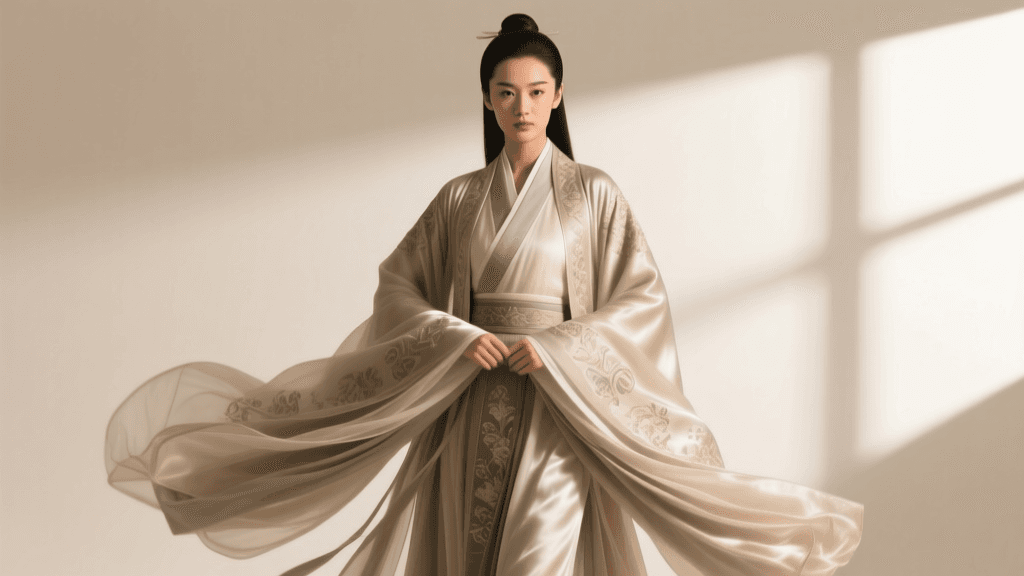
Xianxia dramas, such as Ten Miles of Peach Blossoms and Love Between Fairy and Devil, rely heavily on visual poetry. The costumes are designed to catch the wind, creating an illusion of flight and immortality. To recreate this look for photography or convention wear, focus on volume and translucency.
Essential Garments and Measurements
- Da Xiu Shan (Large Sleeve Shirt): The hallmark of Xianxia. Look for sleeve lengths that exceed 180cm from cuff to cuff. The cuffs themselves should flare out to at least 60cm in diameter to allow for dramatic hand gestures and fan choreography.
- Qixiong Ruqun (Chest-High Skirt): A skirt tied above the bust. For the dramatic 'fairy' sweep, purchase a skirt with a minimum hem circumference of 3 meters (approx. 9.8 feet). Standard daily Hanfu skirts are usually 1.5 to 2 meters, but drama costumes require double the fabric for spinning shots.
- Pibo (Silk Scarf/Stole): A 2.5-meter long chiffon ribbon draped over the arms. Choose gradient-dyed (jianbian) chiffon to mimic the magical auras seen on screen.
Fabric Selection and Styling Tips
Avoid heavy cottons or matte linens for Xianxia. Instead, source garments made from pearl chiffon, starry organza, or crushed velvet accents. When styling, use a hidden corset or structural bandeau under the chest-high skirt to prevent slipping, a common issue with heavy, multi-layered drama costumes.
Mastering the Grounded Wuxia Hero Aesthetic
Wuxia dramas like The Untamed and Word of Honor popularized a rugged, martial aesthetic. The costuming here bridges the gap between historical Tang and Song dynasty menswear and modern fantasy practicality. As noted by industry analysts at Sixth Tone, the commercialization of drama 'Tongkuan' (同款 - meaning 'same style' or replica costumes) has made these intricate Wuxia sets highly accessible to global consumers.
Building the Wuxia Wardrobe
- Yuanlingpao (Round Collar Robe): Opt for a robe with side slits (kaiqi) for mobility. The length should hit right at the ankle bone (approx. 135cm for a person 175cm tall) to prevent tripping during martial arts choreography.
- Hukou (Wrist Bracers): Essential for the Wuxia silhouette. Bracers should measure 15cm to 20cm in length and fit snugly around the forearm. Look for sets with embossed PU leather or metal rivets to mimic armor.
- Waist Accessories: A Wuxia hero is defined by their waist. You will need a leather or thick woven belt, a jade pendant (pei), and a tassel. Ensure the belt sits at the natural waist, not the hips, to elongate the legs and hold the weight of the robe.
Sourcing Drama-Inspired Hanfu: Where and How to Buy
Finding authentic 'Tongkuan' requires knowing where to look and what keywords to use. While Western retailers offer curated selections, direct-from-manufacturer platforms provide the most accurate drama replicas.
Pro-Tip for Search: When browsing Taobao or AliExpress, append the Chinese drama name in Pinyin or Hanzi with the word '同款' (Tongkuan). For example, searching '陈情令 同款' (The Untamed same style) will yield exact factory replicas and officially licensed merchandise.
Cost and Retailer Comparison
| Platform | Pros | Cons | Estimated Price Range (Full Set) |
|---|---|---|---|
| Taobao (via Agent) | Highest accuracy, official studio collaborations, massive variety. | Requires a shopping agent (e.g., Superbuy, Wegobuy), longer shipping times. | $70 - $200 |
| AliExpress | Direct shipping, buyer protection, easy English interface. | Hit-or-miss fabric quality, often uses cheap polyester instead of drama-grade chiffon. | $40 - $120 |
| Specialty Western Boutiques | Curated quality, fast domestic shipping, accurate sizing charts. | Limited 'Tongkuan' stock, heavy retail markups. | $150 - $350 |
Hair, Makeup, and Accessories for the Screen-Ready Look
A Hanfu set is incomplete without the accompanying grooming and accessories. Drama costume departments spend hours on hair and headpieces to establish character rank and personality.
Headpieces: Guan and Zan
For male or gender-neutral Wuxia looks, a Guan (crown or topknot holder) is mandatory. A simple wooden or jade Guan secured with a hairpin (Zan) elevates the look from 'costume' to 'cinematic.' For female Xianxia looks, invest in a Bugyao (step hairpin) with dangling pearls or metal leaves that sway with movement, mimicking the camera-ready styling of lead actresses.
Screen-Accurate Makeup
- Huadian (Forehead Mark): Use red or gold cosmetic pigment to paint a floral or geometric Huadian on the forehead, a staple for Xianxia goddesses and high-ranking courtiers.
- Elongated Eyeliner: Draw eyeliner extending 1-2cm past the outer corner of the eye, flicking slightly upward to create the 'Phoenix eye' effect prevalent in C-drama character design.
- Brow Shape: Opt for soft, willow-leaf brows rather than sharp, Western-contoured brows to maintain historical authenticity.
Conclusion: Bringing the Screen to Life
Recreating Chinese TV drama costumes is an exercise in cultural storytelling and sartorial engineering. Whether you are spinning in a 3-meter Xianxia skirt or strapping on Wuxia bracers for a convention, understanding the mechanics of these garments ensures you look as though you just stepped off a high-budget studio set. As the Hanfu industry continues to globalize, the line between screen costume and wearable street fashion will only continue to blur, inviting enthusiasts worldwide to participate in this living, breathing tradition.