Reading Hanfu and Textiles in Classic Chinese Scroll Art
Introduction: The Canvas as a Historical Wardrobe
When we study the evolution of traditional Asian clothing, written records and archaeological textiles only tell half the story. To truly understand how garments moved, draped, and interacted with the human form, we must turn to traditional Chinese scroll paintings. For centuries, master painters served as inadvertent fashion historians, capturing the intricate details of hanfu, the socio-economic markers of textiles, and the shifting silhouettes of Chinese dynasties. According to comprehensive art historical analyses from institutions like Encyclopedia Britannica, Chinese painting is deeply intertwined with social philosophy, making the depiction of dress a vital tool for conveying moral, political, and cultural narratives.
For modern enthusiasts, historians, and designers, learning to 'read' these scrolls is an essential skill. It transforms a simple viewing experience into a masterclass in historical tailoring, fabric behavior, and sartorial etiquette. In this guide, we will decode the visual language of Tang and Song dynasty scroll art, analyze the brushwork used to depict different fabrics, and provide actionable advice on where and how to study these masterpieces today.
The Tang Dynasty: Opulence, Pibo, and the High-Waisted Ruqun
The Tang Dynasty (618–907 CE) is widely considered the golden age of Chinese cosmopolitanism, and its fashion was characterized by volume, vibrant colors, and daring silhouettes. The most iconic visual record of this era is Zhou Fang’s masterpiece, Court Ladies Adorning Their Hair with Flowers. This handscroll provides a flawless blueprint of the elite Tang wardrobe.
Deconstructing the Tang Silhouette
In Zhou Fang’s work, the women are depicted wearing the ruqun (a blouse and skirt ensemble), but with a distinct Tang variation: the skirt is tied exceptionally high, often just below the bust, creating an elongated, flowing lower half. Over their shoulders, the figures drape a pibo (a long, lightweight silk stole). The artist’s brushwork here is critical; the pibo is painted with gossamer-thin, translucent layers of pigment, indicating the use of ultra-fine silk gauze (luo or sha) that was highly prized and heavily taxed.
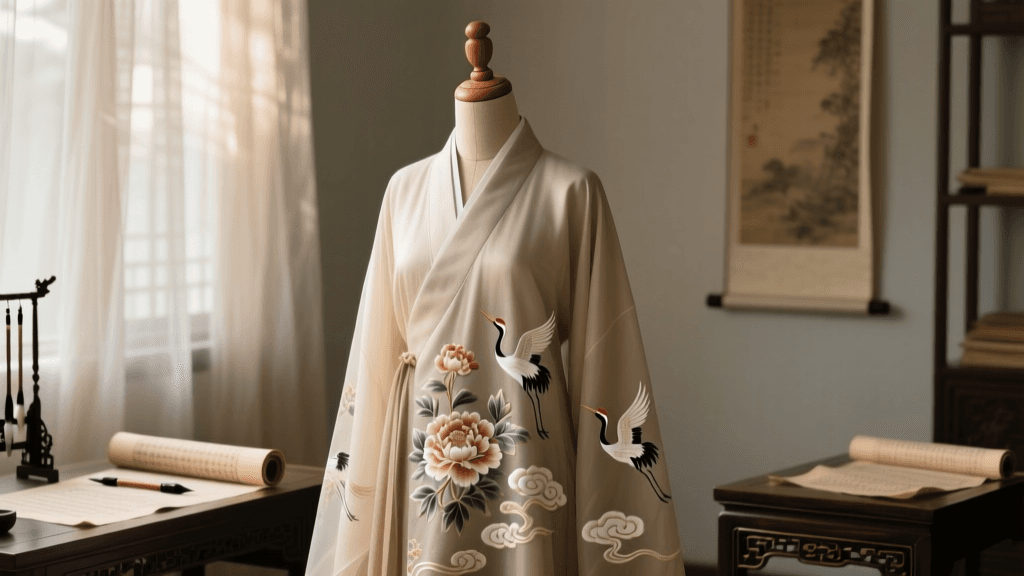
The motifs on these garments are equally telling. Large, bold peonies and cranes are painted directly onto the fabric, reflecting the Tang love for naturalism and prosperity. The heavy, rounded folds of the skirts suggest the use of heavier silk brocades (zhi), which held their shape and provided the structural volume necessary for the sweeping, ground-grazing hems favored by court women.
The Song Dynasty: Minimalism, Beizi, and the Qingming Scroll
If the Tang Dynasty was about opulent volume, the Song Dynasty (960–1279 CE) pivoted toward intellectual restraint, structural elegance, and slender silhouettes. This shift is profoundly visible in the art of the period, most notably in Zhang Zeduan’s monumental handscroll, Along the River During the Qingming Festival (Qingming Shanghe Tu). This painting is a panoramic encyclopedia of 12th-century society, capturing over 800 figures across all social classes.
Class Distinctions Through Textiles
Unlike the homogenous elite focus of Tang court paintings, the Qingming scroll allows us to compare elite hanfu with commoner workwear side-by-side. Elite men and women are shown in the beizi (a long, side-slit overcoat) and the shenyi (a deep, one-piece robe). The lines used to paint these garments are sharp, straight, and disciplined, reflecting the Neo-Confucian ideals of order and modesty. The colors, though faded by time, were originally muted earth tones, pale yellows, and soft blues.
Conversely, laborers, boatmen, and merchants in the scroll are depicted in short duanda (trousers and short tunics) made of hemp and ramie. The painter uses rougher, more erratic brush strokes—often referred to in traditional Chinese art as 'firewood bundle' lines—to convey the stiff, coarse texture of plant-based fibers. This contrast provides modern textile historians with invaluable data on how different materials behaved under stress, movement, and wind.
The Brush as a Loom: Depicting Fabric Textures
One of the most actionable skills for a garment historian is learning to identify fabric types based on the artist's brush technique. Traditional Chinese painters developed specific 'line drawing' (baimiao) techniques to replicate textile physics.
- 'Iron Wire' Lines (Tie Xian Miao): Used to depict stiff, heavily starched linens, hemp, or thick winter brocades. The lines are uniform, unyielding, and maintain a consistent thickness, showing that the fabric does not easily drape or cling.
- 'Floating Silk' Lines (You Si Miao): Characterized by incredibly fine, continuous, and wavering lines. This technique was reserved for depicting raw silk, gauze, and lightweight summer garments that clung to the body and caught the breeze.
- 'Willow Leaf' Lines (Liu Ye Miao): Lines that swell and taper, mimicking the organic, heavy folds of quilted winter garments or thick woolen blends used in northern climates.
Decoding Motifs: A Guide to Textile Patterns in Art
Patterns in Chinese scroll paintings were rarely decorative afterthoughts; they were strict indicators of rank, season, and philosophical alignment. Below is a structured guide to the most common motifs found in traditional scroll art and their sartorial implications.
| Motif | Dynastic Prominence | Social Meaning & Usage | Typical Garment Placement |
|---|---|---|---|
| Five-Clawed Dragon | Ming / Qing | Exclusive to the Emperor. Unauthorized use was punishable by death. | Center chest, shoulders, and hem of the longpao (dragon robe). |
| Peony | Tang / Song | Wealth, honor, and feminine beauty. Worn by elite women and wealthy merchants. | Woven into the pibo (stole) or embroidered on skirt panels. |
| White Crane | Song / Ming | Longevity and high scholarly rank. Often designated for civil officials of the first rank. | Rank badges (buzi) on the chest and back of official overcoats. |
| Plum Blossom | Song | Resilience, winter, and moral purity. Favored by scholars and literati. | Subtle embroidery on the collars and cuffs of the beizi. |
| Cloud Bands | Yuan / Ming | Divine connection and cosmic harmony. Used across various social strata. | Shoulder yokes and hem borders of formal robes. |
Practical Guide: Studying and Viewing Scroll Art Today
For those looking to study hanfu and historical textiles firsthand, engaging with original scroll paintings requires specific planning. Handscrolls are notoriously fragile and are rarely displayed in their entirety. Here is how to approach your research and viewing experience.
Top Institutions for Viewing Garment History
- The Metropolitan Museum of Art (New York, USA): The Met’s Asian Art Department houses some of the most significant Tang and Song figure paintings outside of China. When visiting, check the Met's Asian Art Collection online beforehand, as light-sensitive scrolls are only rotated into the galleries for a few months at a time. Admission is pay-what-you-wish for NY residents, and $30 for non-residents.
- The Smithsonian National Museum of Asian Art (Washington D.C., USA): The Freer and Sackler galleries offer incredible resources for textile history. Their digital exploration tools allow you to zoom in on high-resolution scans of scrolls, revealing the weave patterns painted onto the garments. Admission is free, making it an excellent resource for students and independent researchers.
- The Palace Museum (Beijing, China) & National Palace Museum (Taipei): These institutions hold the lion's share of imperial court paintings, including detailed records of Ming and Qing dynasty court dress. Exhibitions here are heavily timed; plan your visit at least two months in advance and book specific 'Calligraphy and Painting' gallery slots.
How to 'Read' a Handscroll in Person
If you are fortunate enough to view a handscroll in a study room or special exhibition, remember the traditional etiquette and mechanics of viewing. Handscrolls are meant to be read from right to left, unrolled one shoulder-width at a time. This intimate, sequential viewing mimics the passage of time and allows the viewer to focus on individual figures and their garments in isolated vignettes. Do not attempt to view the entire scroll at once; instead, pause at each cluster of figures to analyze the drape, layering, and textile motifs of their hanfu.
Conclusion: The Enduring Legacy of Painted Threads
Chinese scroll paintings are far more than aesthetic triumphs; they are meticulous archives of Asian sartorial history. By understanding the silhouettes of the Tang ruqun, the structural restraint of the Song beizi, and the nuanced brushwork used to depict silk and hemp, we can reconstruct the lived experience of historical garments. Whether you are a fashion designer seeking authentic inspiration, a historian tracing trade routes through textile depictions, or a hanfu enthusiast aiming for historical accuracy, the scrolls offer an unparalleled window into the wardrobes of the past. The threads may have faded, but the painted records remain vivid, waiting to be unraveled by those who know how to look.