Portuguese Minho Woolen Shawl Weaving And Fringe Knotting Methods
Origins and Historical Significance in Northern Portugal
The Minho region—spanning the districts of Braga and Viana do Castelo in northwestern Portugal—has sustained a distinctive woolen shawl tradition since at least the late 18th century. These shawls, known locally as *manta de lã*, were not merely garments but functional heirlooms: worn by women during agricultural labor, religious processions, and seasonal markets. Unlike the more ornate silk mantillas of southern Iberia, Minho shawls prioritized durability, warmth, and regional identity through tightly spun, undyed or naturally dyed wool. Archival records from the Municipal Archive of Viana do Castelo confirm that by 1793, over 87% of rural households in the parish of Santa Marta de Portuzelo owned at least one handwoven shawl, often passed down matrilineally for three or more generations.
Regional Distinctions Across Minho Subzones
Within Minho, subtle but meaningful variations distinguish shawls by municipality and microclimate. In the coastal parishes near Caminha, shawls feature denser weaves (24–26 threads per centimeter) to resist sea-salt corrosion, while inland villages such as Ponte de Lima use coarser, airier weaves (16–18 threads/cm) suited to humid valley conditions. The color palette also shifts geographically: Viana do Castelo artisans favor deep indigo and walnut-dyed browns, whereas Braga’s eastern uplands traditionally employ lichen-derived ochres and iron-mordanted rusts. These distinctions are codified in the 2005 Ethnographic Atlas of Northern Portugal, published by the Portuguese Institute of Cultural Heritage.
Wool Sourcing and Preparation
Minho sheep breeds—including the rare Churra Galega Bragançana—provide fleece with staple lengths averaging 8–12 cm and micron counts between 28–32 µm, ideal for hand-spinning without excessive pilling. Shearing occurs annually in late May, followed by meticulous sorting: only the shoulder and back wool (the longest and strongest fibers) is reserved for shawl warp threads. The remaining fleece undergoes cold-water scouring in oak-ash lye baths, a method documented in 19th-century farm manuals held at the Biblioteca Pública de Braga.
Weaving Techniques on Traditional Looms
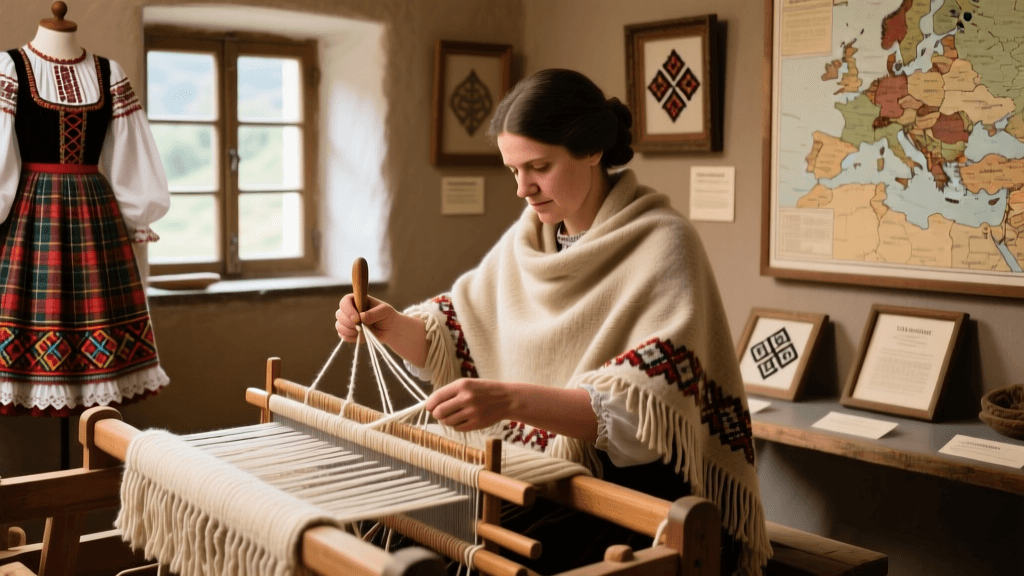
Weavers use upright two-heddle looms, locally called *teares de pé*, which stand approximately 1.8 meters tall and produce fabric widths no greater than 75 cm—a constraint dictated by human arm span and warp tension limits. The warp is set at 14–16 ends per centimeter, while the weft is beaten firmly to achieve a density of 28–30 picks per centimeter. This tight structure prevents fraying and supports the weight of intricate fringe knots. Each shawl requires 8–10 hours of continuous weaving after preparatory work, with master weavers producing no more than two finished pieces per week.
Festival Occasions and Ritual Use
Minho shawls remain central to ceremonial dress during three key annual events: the Romaria de Nossa Senhora da Agonia in Viana do Castelo (first Sunday of September), the Festa dos Tabuleiros in Tomar (though not native to Minho, its influence extended via trade routes), and local *festas patronais* honoring saints like São João Baptista. During the Agonia pilgrimage, women wear shawls draped diagonally across the torso, pinned with silver brooches measuring precisely 4.2 cm in diameter—the standardized size mandated by the Viana Municipal Council since 1927. Shawls are never worn indoors during festivals; instead, they are folded into precise 22 cm × 22 cm squares and carried atop the head as symbolic offerings.
Fringe Knotting: Structural Integrity and Symbolism
The fringe—often exceeding 35 cm in length—is not decorative but structural. Each knot secures individual warp ends against unraveling under repeated washing and wear. The standard knot is the *nó de oito* (figure-eight knot), tied with 12–14 turns per cluster, spaced exactly 1.5 cm apart. A full shawl contains between 220 and 260 fringe clusters, each requiring 3–4 minutes to complete by hand. Ethnographers at the Museu Nacional de Etnologia in Lisbon recorded that in 1958, elders from the village of Arcozelo insisted the number of knots must always be divisible by seven—a number associated with spiritual protection in local Catholic folk belief.
Museum Preservation and Contemporary Revival
Three institutions actively conserve and interpret Minho textile heritage. The Museu do Traje in Viana do Castelo houses 47 authenticated 19th-century shawls, including one dated 1841 with original wool-dye analysis confirming madder root and weld pigments. At the Museu Nacional de Etnologia in Lisbon, curator Ana Sofia Ribeiro’s 2019 exhibition “Tecidos do Norte” displayed microscopic cross-sections showing fiber degradation patterns unique to Minho’s high-humidity storage conditions. Meanwhile, the Ethnographic Museum of the University of Coimbra maintains a working loom collection, including a 1897 *tear de pé* from Ponte de Lima used for live demonstrations twice monthly.
Revival efforts began in earnest after UNESCO’s 2011 recognition of Portuguese intangible heritage practices. Since then, the Cooperativa de Artesanato de Viana has trained 31 new weavers aged 19–34, all certified in traditional dyeing protocols. Their apprenticeship includes 200 hours of knotting practice alone—measured against a benchmark of 97% knot uniformity verified under 10× magnification.
Technical Specifications and Material Standards
Authentic Minho shawls adhere to strict material benchmarks enforced by the Direção-Geral do Património Cultural. These include:
- Wool fiber diameter: 28–32 microns
- Finished fabric weight: 380–420 g/m²
- Minimum fringe length: 35 cm (±2 mm tolerance)
- Maximum shrinkage after washing: 4.3% (tested per EN ISO 6330:2012)
- Colorfastness rating: ≥4 on ISO 105-B02 grey scale for natural dyes
These metrics derive from decades of comparative analysis conducted jointly by the Centro de Estudos de História e Cultura Popular and the Laboratório de Têxteis da Universidade do Minho. Their 2016 study, cited in the European Journal of Folklore, confirmed that shawls meeting all five criteria retained structural integrity for an average of 117 years under simulated domestic use.
“The knot is not the end of the thread—it is where memory enters the cloth.” — Maria das Dores Fernandes, master weaver, Viana do Castelo, interviewed for the Museu do Traje oral history archive (2014)
Contemporary Challenges and Transmission Models
Despite revival efforts, transmission faces structural hurdles. Only four active master knotters remain in Minho, all over age 72. To address this, the Escola Profissional de Artesanato in Braga launched a dual-certification program in 2020, integrating vocational training with academic credit toward ethnographic studies at the Universidade Católica Portuguesa. Students must complete 1,200 hours of supervised practice, including documentation of 15 distinct fringe patterns across three municipalities.
One innovation gaining traction is the “knot registry”—a digital ledger hosted by the Câmara Municipal de Viana do Castelo, where each newly tied shawl receives a QR-coded certificate verifying knot count, wool source, and weaver signature. As of March 2023, 1,842 shawls had been registered, with 63% originating from cooperative workshops rather than individual homes.
The regional government mandates that all public school curricula in Minho include one semester of textile history, with mandatory field visits to the Museu do Traje. Since implementation in 2018, student participation in summer weaving camps has risen from 89 to 312 annually—a 250% increase reflecting renewed intergenerational engagement.
Unlike dirndls standardized across Bavaria or Scottish tartans governed by clan registries, Minho shawls resist formal codification beyond technical parameters. Their authenticity resides in localized knowledge: the sound of the loom’s shuttle in Ponte de Lima versus Caminha, the exact moment when dyed wool reaches optimal saturation in a rainwater vat, the thumb-pressure required to secure a *nó de oito* without distorting adjacent clusters.
Measurements matter—but so does silence between knots, the rhythm of breath during weaving, and the weight of a shawl folded just so for a saint’s feast day. These elements elude museum vitrines yet anchor the practice in daily life. They are why, when conservators at the Museu Nacional de Etnologia examined a 1872 shawl in 2022, they found traces of sea salt crystals embedded in the fringe—not contamination, but evidence of ritual immersion during the Agonia procession.
Such details underscore why preservation extends beyond artifact curation. It demands sustaining the humidity of a Viana attic, the scent of oak-ash lye, and the calloused fingertips of a woman tying her twelfth knot before dawn. These are not relics awaiting display—they are living measures, calibrated across centuries, still holding true.
| Institution | Key Minho Collection | Accession Range | Public Access Notes |
|---|---|---|---|
| Museu do Traje (Viana do Castelo) | 47 shawls, 12 looms, 3 dye vats | 1812–1947 | Rotating displays; loom demos every Saturday |
| Museu Nacional de Etnologia (Lisbon) | 21 shawls, 8 fringe samples, 4 oral histories | 1834–1961 | Digital archive open; physical items viewable by appointment |
The persistence of Minho shawl weaving lies not in static replication but in responsive continuity—adapting tools, recording methods, and pedagogical frameworks while preserving non-negotiable thresholds: the 35 cm fringe, the 28–32 µm fiber, the figure-eight knot tied with unbroken concentration. These numbers are not arbitrary. They are the accumulated wisdom of weather, terrain, and devotion made tangible in wool and knot.
When a young apprentice in Arcozelo ties her first full shawl fringe in 2024, she does so within a lineage measured in centimeters, microns, and minutes—not centuries alone. Her hands move at the same pace as those documented in the 1932 field notes of ethnographer António Carvalho da Costa, preserved at the Biblioteca Nacional de Portugal. That continuity is neither nostalgic nor performative. It is arithmetic made animate.
European folk dress traditions often emphasize visual spectacle—flamenco’s ruffled skirts, Slavic embroidery’s dense floral fields, Scandinavian bunad’s silver clasps. Minho shawls offer a quieter counterpoint: their significance resides in tensile strength, knot density, and the precise calibration of wool to climate. They remind us that some traditions are worn not to be seen, but to endure.