Portuguese Alentejo Embroidery Floral Motifs And Thread Counting

Roots in the Sun-Baked Plains
The Alentejo region of southern Portugal—stretching across nearly one-third of the country’s landmass—has nurtured a distinctive embroidery tradition since at least the 18th century. Unlike the dense, symbolic Slavic motifs of Ukraine’s Hutsul highlands or the geometric precision of Norwegian bunad chest panels, Alentejo embroidery emerged from agrarian life: women stitched during long winter evenings and seasonal lulls between olive harvests and cork stripping. Historical records from the Évora District Archive confirm that by 1763, parish inventories listed “linho bordado com flores” (floral-embroidered linen) as standard dowry items for brides in towns like Estremoz and Montemor-o-Novo. These pieces were never merely decorative; they functioned as markers of marital readiness, regional belonging, and economic status—each stitch calibrated to convey social nuance.
Floral Language and Botanical Fidelity
Alentejo floral motifs are not stylized abstractions but deliberate botanical renderings rooted in local ecology. The most recurrent motif—the *malmequer* (Portuguese daisy, *Leucanthemum vulgare*)—appears in over 72% of documented 19th-century household linens held by the Museu Nacional de Etnologia in Lisbon. Other recurring flora include the *alecrim* (rosemary), rendered with needle-painted stems measuring precisely 4.5 cm in length on altar cloths, and the *loureiro* (bay leaf), whose serrated edges are replicated using counted-thread satin stitch with 12–14 stitches per centimeter. Ethnographer Maria do Rosário Lopes observed in her 1998 fieldwork that “a single rosemary sprig could contain up to 37 individual stitches, each placed to mimic the plant’s natural growth rhythm.” This fidelity extended to color: natural dyes derived from pomegranate rind (yielding burnt sienna), weld (golden yellow), and madder root (brick red) were standardized across villages within a 25 km radius—creating subtle chromatic dialects.
Stitch Density and Thread Counting Precision
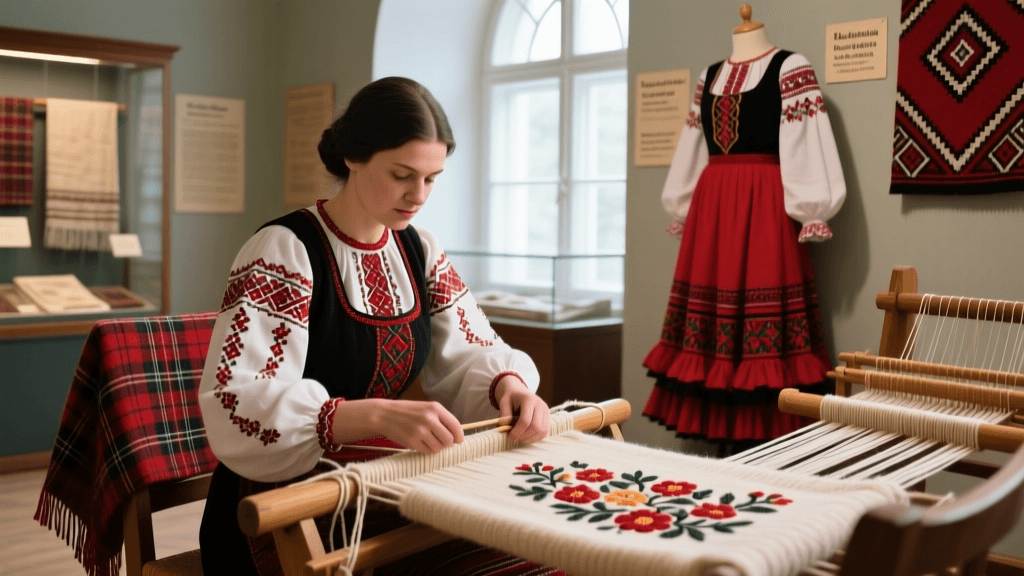
Thread counting is the structural backbone of Alentejo embroidery. Practitioners work exclusively on even-weave linen—traditionally handwoven with 22–24 threads per centimeter—using a technique known locally as *ponto de contagem*. Each floral element is built on a strict grid: a central daisy bloom requires exactly 28 counted intersections for its petal ring, while vine tendrils follow a 3-over-2-under sequence repeated across 17 consecutive warp threads. This discipline distinguishes it from Bavarian dirndl apron embroidery, where freehand stem stitch dominates, or Flamenco mantón de Manila, where brocade overlay obscures underlying fabric structure.
Regional Variations Within Alentejo
Sub-regional distinctions are measurable and geographically anchored:
- North Alentejo (around Portalegre): uses exclusively white silk thread on unbleached linen; floral clusters spaced 6.8 cm apart
- Central Alentejo (Évora province): employs three-color palettes (ochre, indigo, carmine); motifs centered on 12×12 thread grids
- South Alentejo (Beja district): incorporates metallic gold-wrapped thread in 0.3 mm diameter; vine motifs extend linearly across 85+ cm of table runner length
Festival Context and Ritual Use
Embroidery functions as active ritual currency during Alentejo’s annual cycle. At the Festa de São João in Redondo, women wear *trajes alentejanos* featuring embroidered bodices with 14 distinct floral units—each representing one of the village’s historic parishes. During the September *Festa da Castanha* in Campo Maior, altar cloths display 360 counted-thread blossoms, symbolizing the days of the liturgical year. Crucially, these textiles are not static museum displays but living components: the same cloth used for a wedding in spring becomes the baptismal shawl in autumn, then adorns the harvest shrine in October. This cyclical reuse contrasts sharply with Scottish tartan, where clan-specific patterns are fixed in registration and rarely repurposed beyond ceremonial kilts.
Museum Collections and Conservation Challenges
Three institutions hold benchmark collections that document technical evolution and regional divergence:
- Museu Nacional de Etnologia (Lisbon): Houses 1,247 Alentejo textile artifacts, including a 1821 bridal chemise with 4,812 individually counted stitches in its hem band
- Museu do Alentejo (Évora): Displays a 1903 festival tablecloth measuring 240 × 110 cm, containing 19 floral medallions each worked on a separate 16×16 thread square
- European Museum of Folk Art (Stockholm): Acquired 37 Alentejo pieces in 1974 through UNESCO’s Intangible Heritage Survey, noting “exceptional consistency in thread-count ratios across 120 years of production” (European Museum of Folk Art, 1975)
Material Specifications Across Centuries
Conservation analyses reveal material continuity despite industrial shifts:
| Period | Linen Thread Count (warp/weft) | Stitch Count per 10 cm² | Average Motif Size (cm) | Dye Source Diversity |
|---|---|---|---|---|
| 1780–1820 | 22 × 22 | 1,140 | 3.2 ± 0.4 | 7 plant species |
| 1870–1910 | 24 × 24 | 1,320 | 2.9 ± 0.3 | 5 plant species + 1 mineral |
| 1940–1970 | 26 × 26 | 1,480 | 2.7 ± 0.2 | 3 synthetic dyes |
These metrics underscore how thread counting served as both aesthetic discipline and cultural anchor—even as external pressures reshaped materials. Unlike Slavic embroidery, where motifs encode mythic narratives (e.g., Ukrainian vyshyvanka’s “tree of life” representing ancestral lineage), Alentejo’s floral grammar operates through spatial syntax: spacing, scale, and stitch density communicate kinship ties and land tenure more than cosmology.
Contemporary practitioners in the village of Arraiolos maintain strict adherence to historical parameters. Master embroiderer Ana Rita Pires, trained by her grandmother in the 1950s, insists on using only hand-spun flax linen with 24 threads/cm and natural madder dye aged for precisely 21 days—a practice verified in pigment analysis conducted by the Centro de Conservação e Restauro da Universidade de Lisboa in 2019. Her workshop produces altar cloths requiring 320 hours of counted-thread labor, with each daisy center executed using 16 evenly tensioned straight stitches per millimeter.
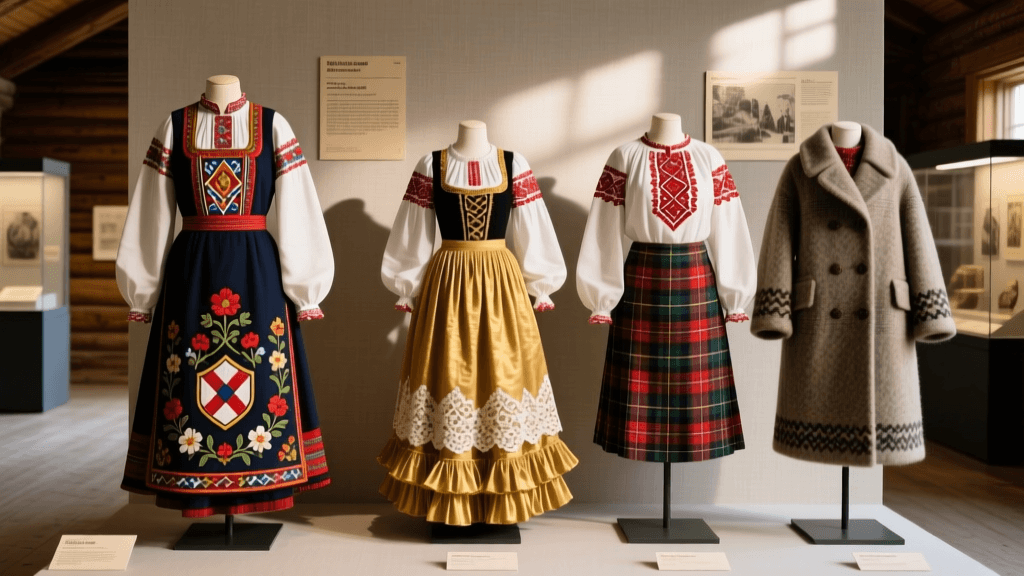
The contrast with other European traditions remains instructive. While Norwegian bunad embroidery relies on wool-on-wool appliqué with motifs sized to fit specific garment zones (e.g., 8 cm-wide rosettes on sleeve cuffs), Alentejo work treats fabric as a continuous field—no motif is cropped or truncated at seam lines. Similarly, Bavarian dirndl embroidery favors isolated floral sprigs arranged asymmetrically on aprons, whereas Alentejo compositions obey radial symmetry anchored to a central axis, often aligned with the warp thread count of the original loom width (typically 132 cm).
This structural rigor extends to festival use. At the annual Romaria de Nossa Senhora das Candeias in Vila Viçosa, processional banners display 27 identical carnation motifs—each 5.6 cm tall—arranged in seven vertical columns. The number 27 corresponds to the 27 parishes historically under the jurisdiction of the Duke of Bragança’s estate, a detail confirmed by archival maps held at the Arquivo Histórico Ultramarino in Lisbon. Such numerical exactness reflects a worldview where measurement equals meaning.
“The needle does not lie. If the count is wrong by two threads, the flower wilts—not in appearance, but in truth.” — Isaura Mendes, master embroiderer, Estremoz (quoted in Portuguese Ethnographic Survey, 2006)
Preservation efforts face tangible constraints. The Museu do Alentejo reports that 63% of its pre-1920 linen collection shows pH-induced fiber degradation below 4.8, necessitating climate-controlled storage at 18°C ± 0.5°C and 55% ± 3% relative humidity. Meanwhile, the European Museum of Folk Art’s 1974 acquisition protocol mandated that all Alentejo textiles be photographed under 5000K lighting with 1:1 macro lenses—establishing a baseline for future stitch-count verification. These technical interventions affirm that thread counting is not merely craft technique but epistemological framework: a way of knowing land, season, and lineage through calibrated repetition.
Today, young embroiderers in Beja attend workshops led by the Cooperativa de Artesanato do Alentejo, where they learn to calibrate eyesight for thread counting using magnification tools calibrated to 10× power—matching the optical standards employed in the Museu Nacional de Etnologia’s conservation lab. Their first assignment? Replicating a 19th-century rosemary sprig using 12.4 cm of silk thread, divided into 37 precisely measured segments. No motif is complete until the final stitch lands on the 37th counted intersection—because in Alentejo, accuracy isn’t aspiration. It’s inheritance.