Pacific Northwest Coast Button Blankets & Regalia 2026
The Living Legacy of Northwest Coast Ceremonial Dress
The Indigenous peoples of the Pacific Northwest Coast—encompassing the Tlingit, Haida, Tsimshian, Kwakwaka'wakw, and Nuu-chah-nulth nations—possess one of the most visually striking and culturally profound textile and garment traditions in the Americas. For these communities, traditional dress is not merely decorative clothing; it is a complex legal document, a form of spiritual armor, and a tangible connection to ancestral lineages. As we move through the 2026 potlatch season, the creation, gifting, and wearing of ceremonial regalia remain central to the social, political, and spiritual life of the Northwest Coast.
In recent years, a powerful cultural revitalization movement has ensured that ancient weaving techniques and appliqué methods are not just preserved in museum archives, but are actively evolving. Contemporary Indigenous artists are blending centuries-old formline design with sustainable, modern material sourcing. According to the Sealaska Heritage Institute, the transmission of these garment-making skills from master artists to the 2026 generation of apprentices is vital for maintaining tribal sovereignty and cultural continuity.
The Anatomy of the Button Blanket (Dance Robe)
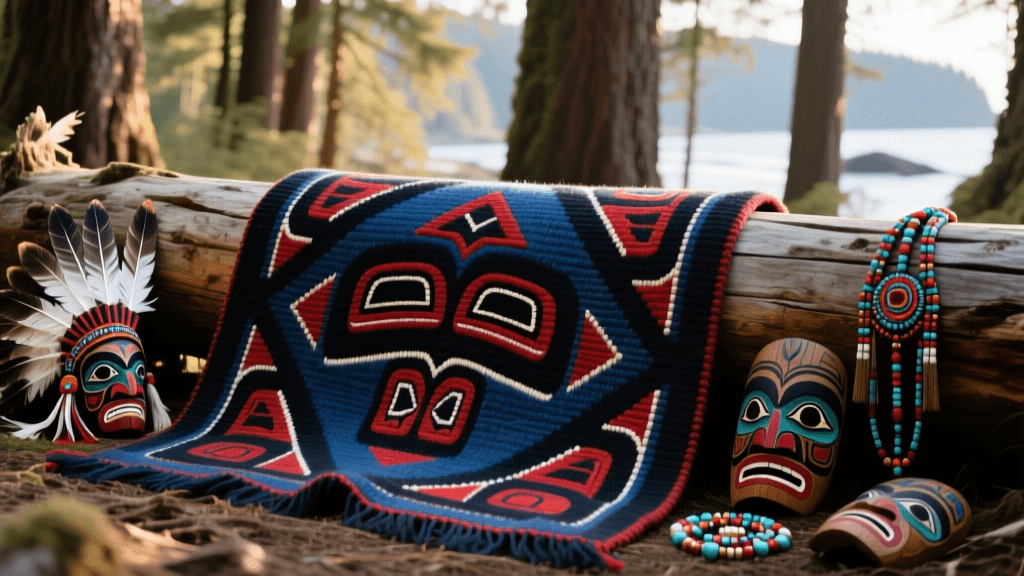
The button blanket, often referred to as a dance robe, is the most iconic garment of the Northern Northwest Coast. Emerging in the late 19th century following the introduction of trade goods, the button blanket was rapidly adapted by Indigenous seamstresses into a uniquely Native art form. A standard adult robe measures approximately 60 inches wide by 55 inches long, though dimensions vary based on the wearer's stature.
The foundation of the garment is a heavy, dark-colored Melton wool base, traditionally navy blue, black, or deep green. Onto this base, artisans hand-stitch intricate appliqué designs cut from bright red flannel or wool-blend fabrics. These red shapes outline the clan crests—such as the Raven, Eagle, Wolf, Bear, or Killer Whale—using the strict visual grammar of the Northwest Coast formline system.
The defining feature of the robe is the extensive use of abalone shell buttons. A single, fully realized dance robe can feature anywhere from 500 to over 2,000 buttons. These buttons are not merely decorative; they serve an auditory and kinetic purpose. During ceremonial dances, the dancer's movements cause the heavy shell buttons to strike one another, producing a rhythmic, percussive clacking sound that mimics the rain, the ocean, or the movement of ancestral spirits. The sheer weight of the wool and the shells means a finished robe can weigh between 12 and 20 pounds, requiring significant physical endurance from the dancer.
Formline Design and Crest Rights
To understand Northwest Coast garments, one must understand formline design. This highly structured visual language uses continuous, flowing lines to define shapes and spaces. The primary elements include ovoids, U-forms, split U-forms, and trigons. In traditional color theory, black is used for the primary formlines, red for secondary spaces, and blue or green for tertiary details.
The crests depicted on these blankets are the intellectual and spiritual property of specific clans and houses. The Smithsonian National Museum of the American Indian emphasizes that wearing a crest without the hereditary right or explicit permission from clan leaders is considered a severe cultural and legal breach. In 2026, the protocols surrounding crest rights are strictly enforced at potlatches, where the public display of a new button blanket serves as a legal validation of the wearer's status, lineage, and territorial rights.
Chilkat and Ravenstail Weaving: A Living Tradition
While button blankets rely on appliqué, the Tlingit and neighboring tribes also maintain the ancient and extraordinarily labor-intensive traditions of Chilkat and Ravenstail weaving. These garments are woven from a combination of mountain goat wool and the inner bark of the yellow cedar tree.
Ravenstail weaving is the older of the two techniques, characterized by stark, geometric black-and-white patterns that resemble the tail feathers of a raven. Chilkat weaving, which evolved later, features complex, curvilinear formline designs woven directly into the textile. Unlike European loom weaving, Northwest Coast weavers use a vertical frame where the warp threads hang freely, weighted by the weaver's hands and the natural tension of the twining process.
Creating a single Chilkat robe requires between 1,500 and 2,000 hours of meticulous labor. The mountain goat wool must be harvested, cleaned, and spun by hand, while the cedar bark must be gathered in the spring, boiled, and pounded into soft fibers. In 2026, master Chilkat weavers are highly revered, and their finished robes are considered priceless heirlooms, often valued well over $50,000 on the contemporary Indigenous art market.
Regional Variations: Tlingit, Haida, and Tsimshian
While the foundational elements of the button blanket are shared, distinct regional and tribal variations exist:
- Tlingit: Tlingit robes often feature highly complex, multi-crest compositions and are frequently paired with elaborate woven hats and carved wooden frontlets topped with sea lion whiskers and ermine pelts.
- Haida: Haida artists are renowned for their bold, expansive formline proportions. Haida dance robes often incorporate extensive use of ermine pelts along the bottom hem and sleeves, signifying high rank and wealth.
- Tsimshian: Tsimshian regalia is noted for its intricate crest storytelling and the frequent inclusion of beadwork integrated into the wool base, reflecting historical trade networks and contemporary stylistic innovations.
Sourcing Authentic Materials in 2026
The global supply chain shifts of the mid-2020s have impacted how Indigenous artisans source materials for regalia today. High-quality Melton wool, which must be dense enough to support the weight of hundreds of buttons without tearing, is increasingly imported from specialized textile mills in Italy and the United Kingdom, as domestic North American wool mills have largely pivoted to lighter apparel fabrics.
Sourcing abalone shell has also evolved. Due to strict marine conservation limits on Pacific abalone harvesting in Alaska and British Columbia, many artists in 2026 utilize sustainably farmed New Zealand Paua shell for the outer borders of the blanket, reserving carefully permitted, locally harvested Pacific abalone for the central crest pieces to maintain spiritual authenticity. The Burke Museum of Natural History and Culture notes that contemporary Indigenous artists are highly adaptive, blending traditional ecological knowledge with modern sustainable sourcing to ensure their art forms survive without depleting local ecosystems.
| Material Component | 19th Century Historical Source | 2026 Contemporary Sourcing |
|---|---|---|
| Wool Base | Hudson's Bay trade blankets | Heavyweight Italian/UK Melton Wool |
| Appliqué Fabric | Stranded cotton and trade flannel | High-grade red wool-blend flannel |
| Buttons | Locally harvested Pacific Abalone | Sustainable NZ Paua & local reserve |
| Weaving Warp | Wild yellow cedar bark | Ethically cultivated cedar & wild harvest |
| Weaving Weft | Wild mountain goat wool | Domestic goat blends & wild harvest |
Commissioning Regalia: Costs and Timelines
For tribal members and institutions looking to commission authentic Northwest Coast regalia in 2026, it is essential to understand the investment of time and capital required. A standard, fully beaded and buttoned dance robe commissioned from an established master artist typically costs between $15,000 and $35,000. Highly complex Chilkat or Ravenstail woven robes can exceed $60,000 due to the sheer volume of hand-spun fiber and weaving hours.
Lead times are substantial. Because artists often balance their studio practice with cultural obligations, teaching, and seasonal harvesting, the waitlist for a commissioned button blanket is generally 18 to 36 months. It is standard practice to provide a 50% deposit upfront to cover the cost of premium materials, with the remainder due upon completion.
Preservation and Archival Care
Because these garments are considered living entities and vital clan property, proper preservation is critical. Button blankets should never be dry-cleaned, as the harsh chemicals can degrade the Melton wool and strip the iridescent luster from the abalone shells. Instead, they are gently surface-cleaned and aired out in shaded, dry environments after ceremonial use.
For long-term storage, garments should be folded loosely with acid-free, unbuffered tissue paper to prevent sharp creases in the wool. They are best stored in custom-built, untreated yellow cedar chests, which naturally repel moths and insects while imparting a protective, culturally significant aroma. Climate-controlled environments maintaining a relative humidity of 45% to 55% are recommended to prevent the flannel appliqué from drying out and the wool from becoming brittle.
As the 2026 potlatch seasons unfold, the sight and sound of the button blanket remain a testament to the resilience of Pacific Northwest Coast peoples. Through the meticulous stitching of red wool and the rhythmic clatter of abalone shell, these garments continue to assert Indigenous presence, pride, and unbroken connection to the land and sea.